Independent blogs are living through their hardest stretch in a decade, and the affiliate blogging statistics for 2026 make the squeeze hard to ignore. Search clicks are drying up, affiliate payouts are shrinking, and ad revenue is following pageviews down. The old growth playbook stopped working for almost everyone this year.
What makes 2026 different is that every part of the funnel moved at the same time. AI Overviews absorb the click, Amazon cut its commissions by up to half, and display networks are paying out on a smaller pile of traffic. Each one traces to a named study you can check yourself.
These affiliate marketing statistics for 2026 map the full picture, from CTR collapse to the one metric that is quietly moving the other way.
- Position-1 CTR runs 58% lower when an AI Overview appears (Ahrefs, 2026)
- The median blog in a 100-site study lost 85% of its traffic since 2022 (Daniel Stanica, 2026)
- Amazon cut affiliate commissions up to 50%, reaching US publishers in March 2026 (Adweek, 2026)
- AI-referred visitors convert at roughly 3x the rate of search and social (Microsoft Clarity, 2025)
Ask ChatGPT to summarize the full text automatically.
AI Overviews Are Cutting Organic Click-Through Rates in Half
The click-through rate on organic listings drops sharply the moment an AI Overview appears above them. Ahrefs studied 300,000 keywords in February 2026 and found position-one CTR runs 58% lower when an AI Overview is present, nearly double the 34.5% drop it measured just ten months earlier. Seer Interactive saw the same pattern across 5.47 million queries, with clicks landing at 2.36% on AI Overview searches against 3.82% on searches without one.
Reader behavior explains that gap better than any single chart can. Pew Research reported in July 2025 that people click a result only 8% of the time when an AI summary sits at the top, versus 15% when it does not. Its authors put it plainly: users who encountered an AI summary clicked a traditional link “in 8% of all visits,” while those who did not clicked “nearly twice as often.” The extreme cases look even worse than the averages suggest. In a regulatory filing, DMG Media told the UK competition authority that desktop CTR on one term collapsed from 25.2% to 2.8% once an AI Overview took the space.
Add the zero-click trend on top and the pattern is hard to miss. SparkToro and Similarweb found that 68% of US Google searches ended without a single click in early 2026. Fewer people are leaving the results page at all, which means AI Overviews intercept affiliate traffic before it ever reaches the blogs that used to earn it.
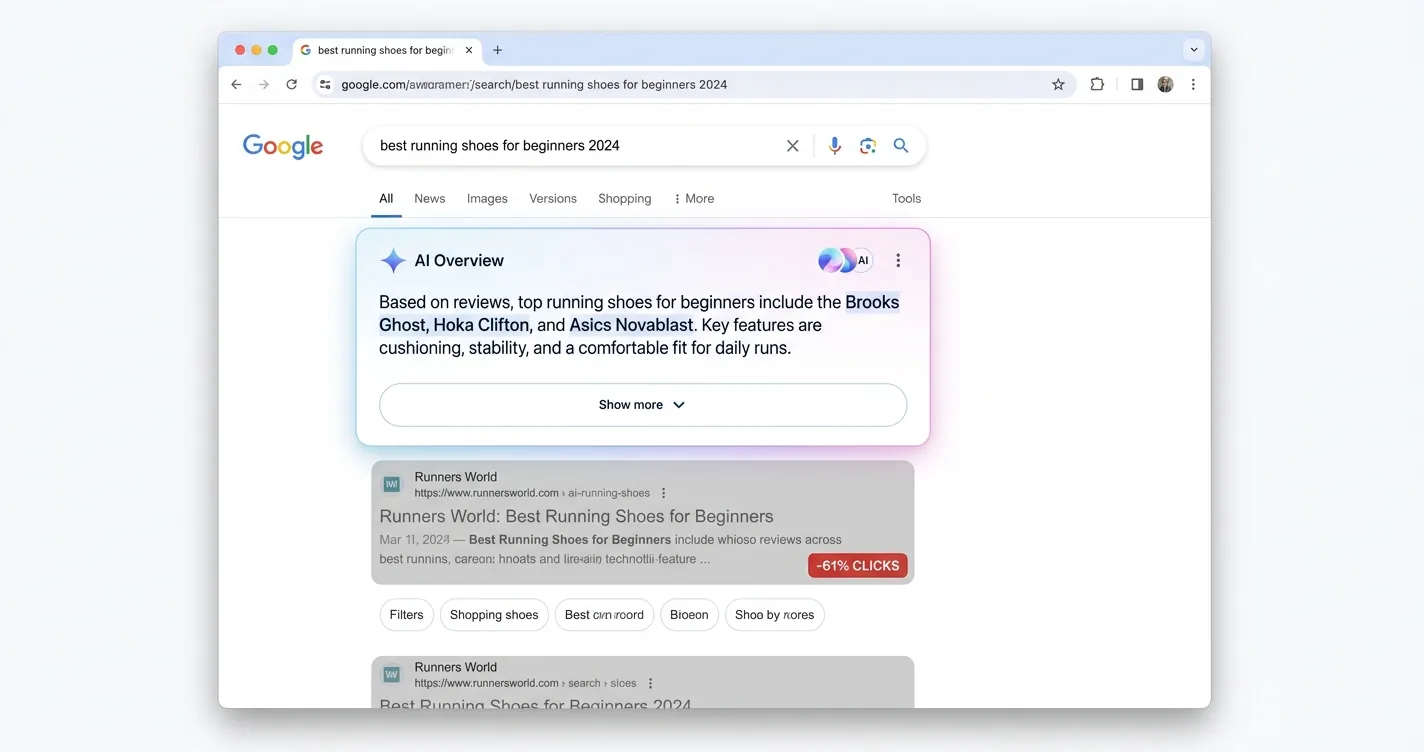
Measured impact of AI Overviews on organic clicks
| Measure | Finding | Source (Year) |
|---|---|---|
| Position-1 CTR | 58% lower with an AI Overview | Ahrefs (2026) |
| AIO vs no-AIO CTR | 2.36% vs 3.82% | Seer Interactive (2026) |
| Click behavior | 8% click with an AI summary vs 15% without | Pew Research (2025) |
| Extreme case (one term) | Desktop CTR 25.2% down to 2.8% | DMG Media / CMA (2026) |
| Zero-click searches | 68% of US searches end with no click | SparkToro + Similarweb (2026) |
Blog and Publisher Traffic Is Down Across the Open Web
Zoom out from single keywords and the whole open web is shedding search traffic. Chartbeat and the Reuters Institute reported in January 2026 that global publisher traffic from Google fell 33% year over year, with US sites down 38% and Google Discover down 21%. The people running these newsrooms are not expecting a rebound, since media leaders in that same survey are bracing for a further 43% drop in that traffic over three years.
The size of your blog shapes how hard the hit lands. Chartbeat and Axios found in March 2026 that small publishers, the ones pulling 1,000 to 10,000 daily views, lost 60% of their search traffic. Mid-sized sites lost 47%, and the largest publishers with over 100,000 daily views lost only 22%. Independent bloggers sit squarely in the group taking the worst of it.
Even the biggest publisher names are not walking away from this clean. Digiday and the Digital Content Next coalition put the median publisher referral drop at 10% year over year in August 2025, with individual sites losing as much as 25%. The floor is moving under everyone, but it drops fastest under the smallest operators.
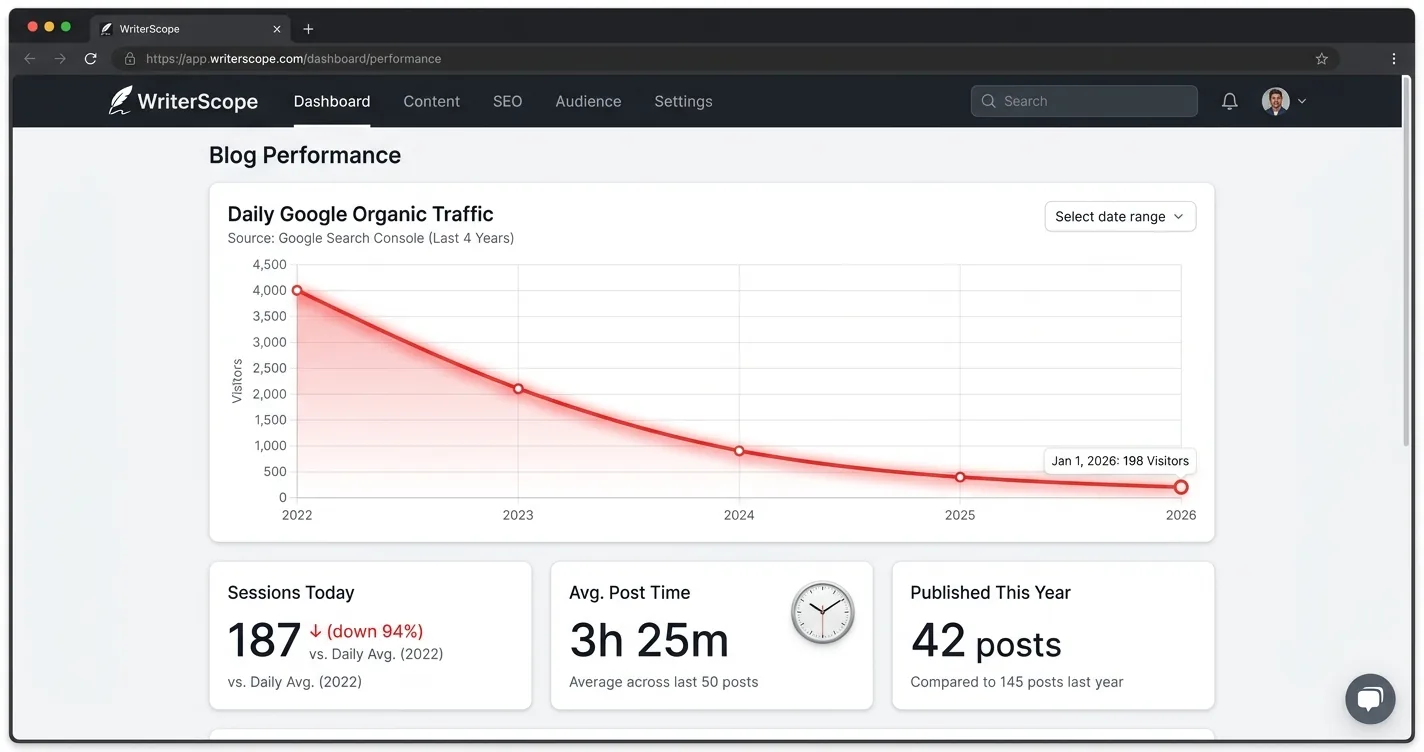
- Global publisher Google traffic down 33% YoY, US down 38% (Chartbeat / Reuters Institute, 2026)
- Small blogs lost 60% of search traffic vs 22% for the largest sites (Chartbeat / Axios, 2026)
- Median publisher referral down 10% YoY, up to 25% for some (Digiday / DCN, 2025)
- Media leaders expect a further 43% decline over three years (Reuters Institute, 2026)
The Great Blogging Collapse: What Happened to 100 Successful Blogs
One study tracks what those aggregate percentages did to real sites, and the results are brutal. In June 2026, analyst Daniel Stanica published a four-year review of 100 blogs that were thriving back in 2022. The median blog in that group lost 85% of its traffic by 2026, and only 21 of the 100 were still growing at all.
The tail of the distribution is where it truly gets bleak. Twenty of those blogs lost more than 99% of their traffic, and 12 of them fell to zero visits entirely. Added together, the 100 sites went from 17.8 million monthly visits down to roughly 12 million, so even the survivors are propping up that average.
Numbers like a 58% CTR drop can feel abstract until you see them play out on real sites. These are not obscure hobby pages that never found an audience. They ranked, they earned, and most of them did nothing wrong except depend on search traffic that an AI answer box now intercepts. The losses were also wildly uneven from one niche to the next, which is where the story gets more useful.
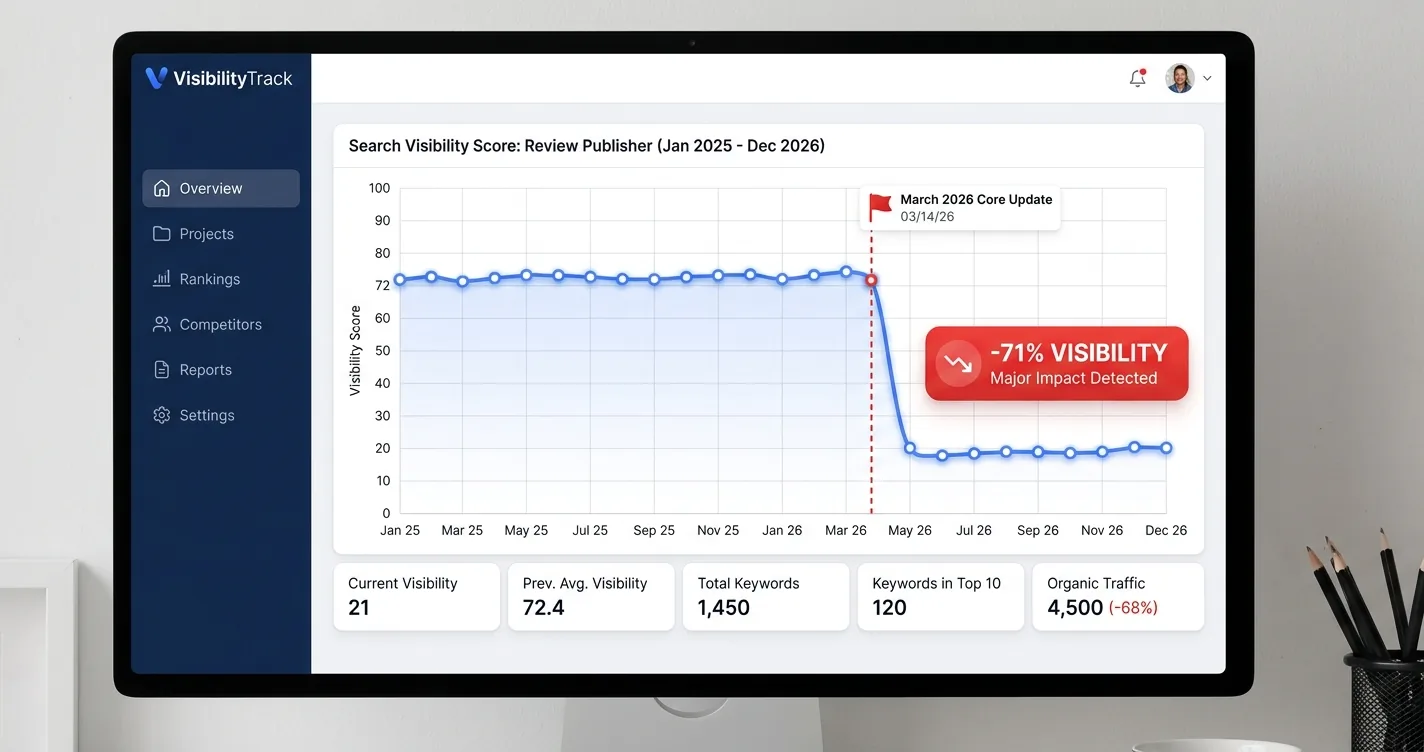
100 formerly-thriving blogs, 2022 to 2026 (Daniel Stanica, 2026)
| Outcome | Result |
|---|---|
| Median traffic change | -85% |
| Blogs still growing | 21 of 100 |
| Blogs down 99% or more | 20 of 100 |
| Blogs at zero visits | 12 of 100 |
| Combined monthly visits | 17.8M down to 12M |
Which Niches Grew and Which Collapsed
The collapse did not fall evenly, and the split between winners and losers follows a clear logic. In Stanica’s data, parenting blogs actually grew a median 108% and DIY or crafts sites edged up 2%, while personal finance cratered 99% and fashion fell 95%. Health and wellness dropped 93%, make-money and entrepreneurship content lost 93%, and travel gave up 74%.
The pattern rewards content an AI cannot cleanly summarize for the reader. Recipes you actually cook, hands-on repair walkthroughs, and lived parenting advice hold their value because the answer lives in the doing, not in a tidy paragraph. Commodity how-to content that an AI Overview can answer in three sentences is exactly what got wiped out.
Other traffic trackers see the same divide from several different angles. Raptive’s read on the May 2026 core update tagged gardening, food, tech, and family content as resilient, while gaming, deals, travel, and lifestyle stayed volatile. Growtika measured 10 major tech publications losing 58% of organic traffic combined since 2024, with Digital Trends down 97% and ZDNet down 90%. The takeaway holds across these datasets, since experiential niches survived and easily answerable ones did not.
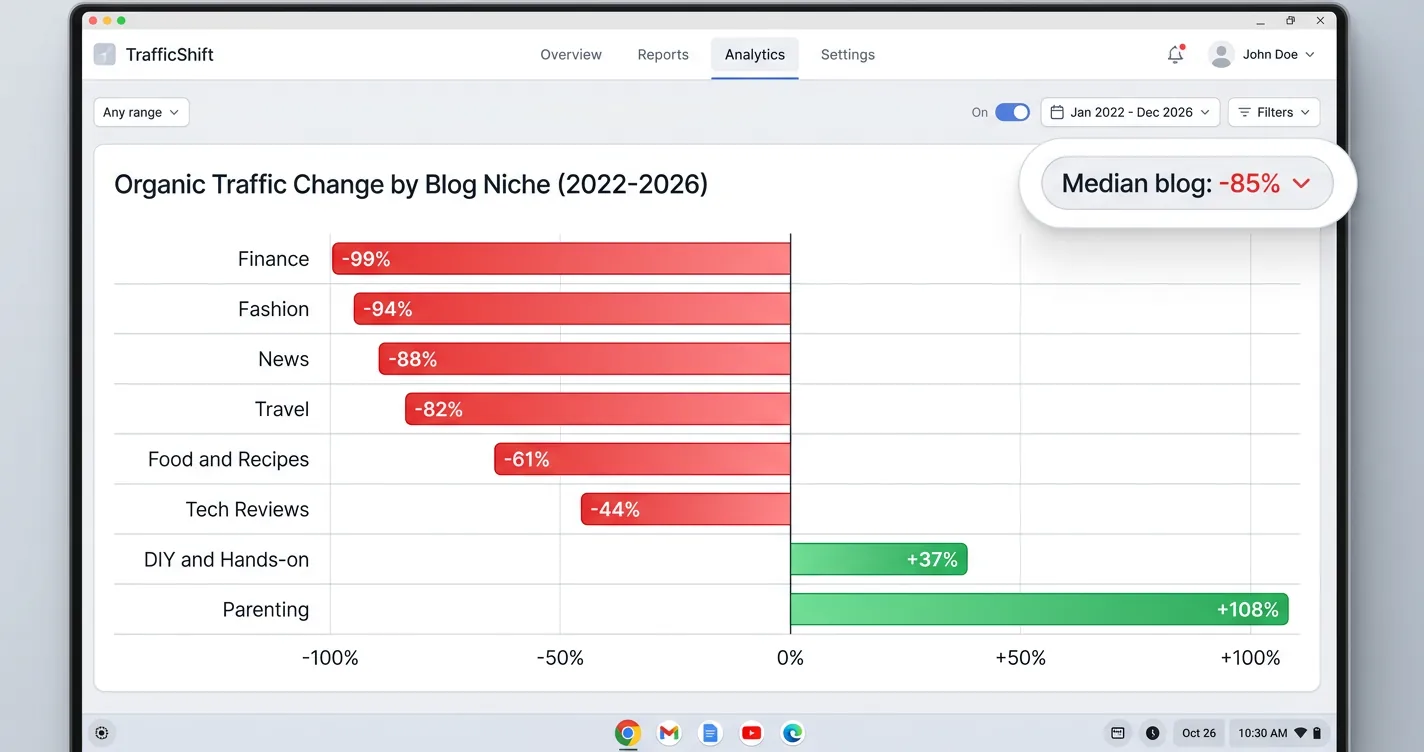
Daniel Stanica, 2026
| Niche | Median Change |
|---|---|
| Parenting | +108% |
| DIY / Crafts | +2% |
| Food | -44% |
| Travel | -74% |
| Lifestyle | -90% |
| Make-Money / Entrepreneurship | -93% |
| Health & Wellness | -93% |
| Fashion | -95% |
| Personal Finance | -99% |
Amazon Associates Slashed Commissions in 2026
The traffic squeeze would sting less if payouts held steady, but Amazon moved the other way. Adweek reported in May 2026 that Amazon Associates commission rates dropped by up to 50%, with categories that once paid around 10% falling to 4 or 5%. The change reached US publishers around March 9, 2026, and Amazon gutted its reporting tools at the same time.
Several other outlets independently confirmed the scale of the cut. eMarketer corroborated the up-to-50% figure in May 2026 and tied it to an internal cost-cutting push: “Numerous publishers said that the moves are part of an Amazon directive to lower program costs by 20%.” Amazon’s own operating agreement is the primary source worth checking, since a qualifying purchase must now be “shipped to, streamed or downloaded by, and paid for by the customer” within a 180-day window, effective April 14, 2026.
This is the second deep cut in six years, not a one-off event. Back in April 2020, MarTech documented Amazon dropping furniture and home from 8% to 3% and grocery from 5% to 1%. Publishers who rebuilt around the 2020 rates just watched the floor drop out from under them again, which is why so many are looking past Amazon for income they actually control.
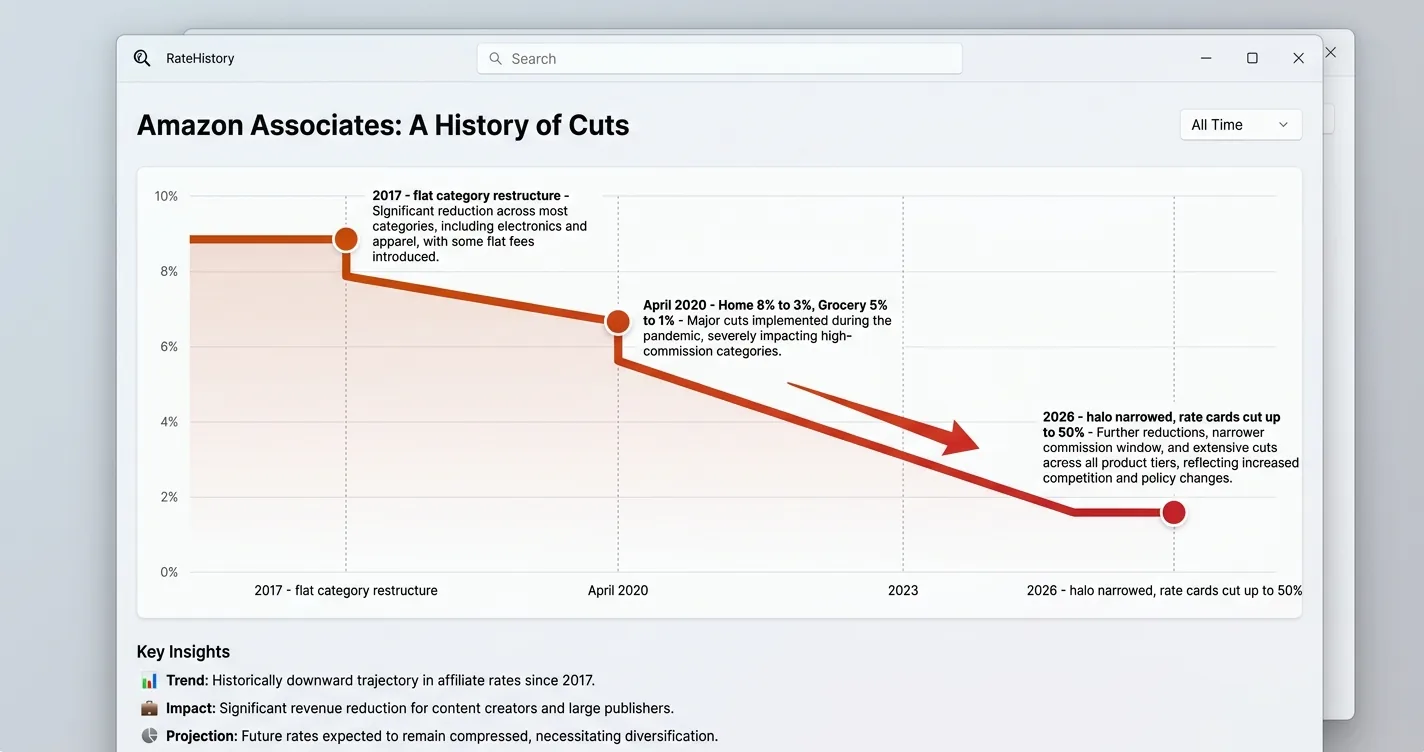
MarTech (2020); Adweek and eMarketer (2026)
| Category | Cut Year | Rate Before | Rate After |
|---|---|---|---|
| Furniture / Home / Pets | 2020 | 8% | 3% |
| Headphones / Beauty | 2020 | 6% | 3% |
| Outdoors / Tools | 2020 | 5.5% | 3% |
| Grocery | 2020 | 5% | 1% |
| Program-wide (up to 50% cut) | 2026 | ~10% | 4-5% |
Display Ad Revenue Is Following Traffic Down
Ads are the other half of the monetization squeeze, and ad supply is sliding as pageviews fall. Ozone data reported through Digiday in July 2026 showed US publisher ad supply down 32 to 37% year over year, with net programmatic spend down 30.6%. Effective CPMs ticked up, but the analysts called that a delay in the decline rather than a real recovery.
The pressure shows up in what the ad networks themselves are doing. On its Q3 2025 earnings call, Teads reported a 10 to 15% pageview decline across its premium publisher network, with CEO David Kostman telling analysts that “we saw around between 10-15% decline in page views.” Fewer pages loading means fewer impressions to sell, no matter how strong the per-impression price looks on paper.
Network policy changes tell the same story from the inside. Raptive dropped its minimum entry requirement from 100,000 down to 25,000 monthly views in October 2025, opening the door to smaller sites it once turned away. Mediavine cut in-content ad density by 54% in December 2024 to protect the revenue it earns per session, a number worth knowing before you add anything else to a page running Mediavine or Raptive. Both moves are defensive adjustments to a market where each visitor has to carry more weight than before.
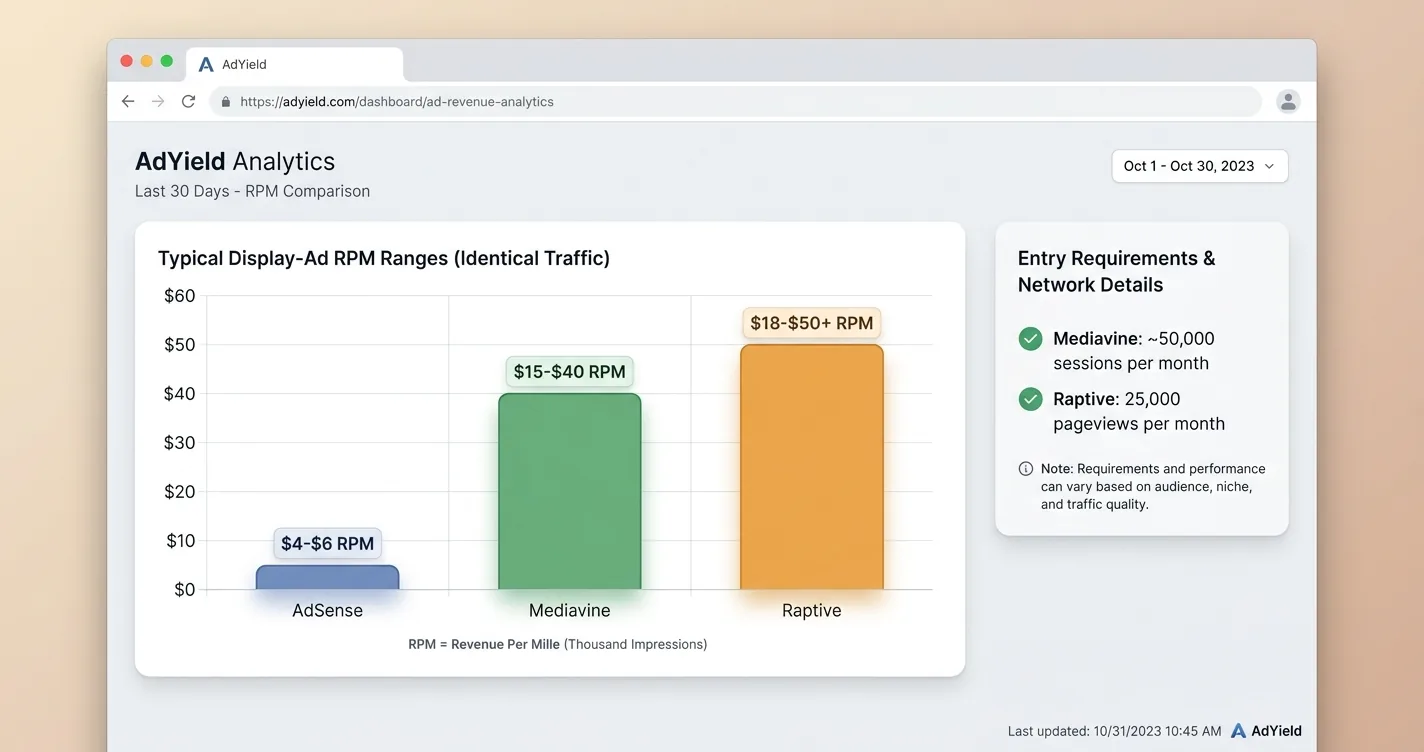
- US ad supply down 32-37% YoY, net programmatic spend down 30.6% (Ozone / Digiday, 2026)
- 10-15% pageview decline across a premium network (Teads, 2025)
- Raptive dropped its minimum from 100,000 to 25,000 monthly views (2025)
- Mediavine cut in-content ad density 54% to protect session RPM (2024)
AI Assistants Cite Listicles, Not Your Brand, and Send Little Traffic Back
If the traffic is going to AI, you might hope it comes back as citations, but the data says otherwise. The citations.press study of 60,350 citations in July 2026 found only 7% of ChatGPT and 4% of Claude references point to a brand’s own homepage. Third-party best-of and comparison pages account for 81% and 75% of those citations instead.
It gets worse when an assistant does cite your page directly. Lily Ray’s Search Engine Land analysis of 100 B2B queries in June 2026 found that AI Overviews citing a brand’s own listicle still recommend a competitor 69% of the time. The popular llms.txt shortcut does not help either, since Trakkr’s study of 37,894 domains in March 2026 measured zero citation advantage from adding one.
The referral traffic that does return is a trickle for now. Previsible and Search Engine Land reported in July 2026 that ChatGPT drives 92.4% of AI referral traffic, and that LLM sessions grew 9.9 times over 19 months. The growth is real, but the base is small, so no single assistant replaces the search clicks that vanished.
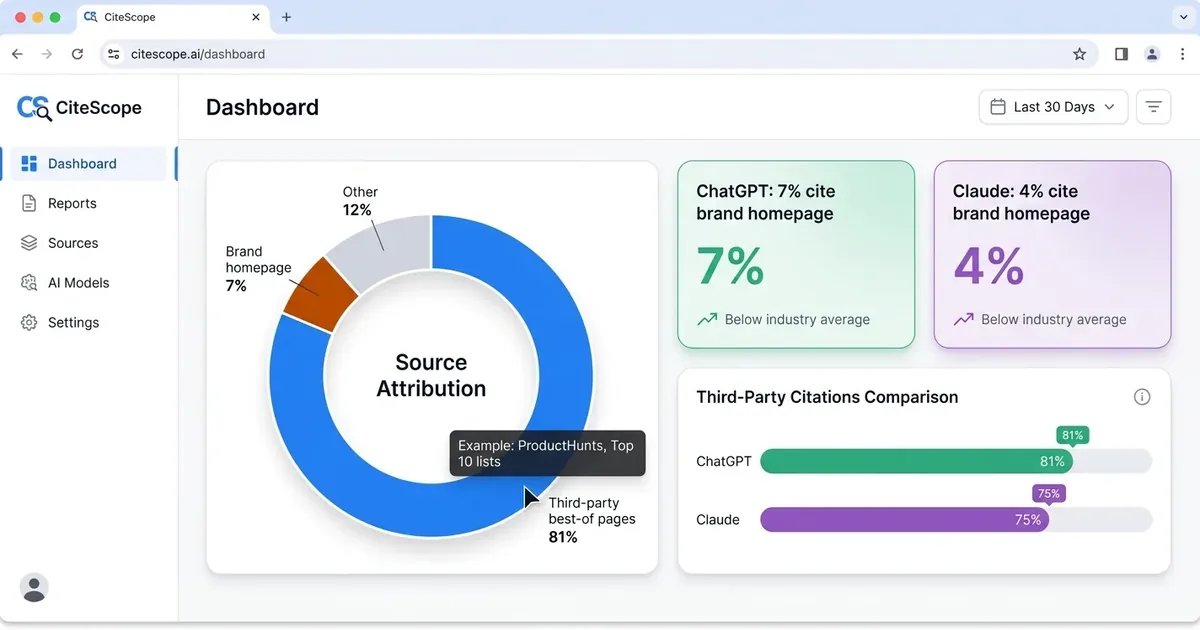
- Only 7% of ChatGPT and 4% of Claude citations point to a brand homepage (citations.press, 2026)
- Third-party best-of pages get 81% (ChatGPT) and 75% (Claude) of citations (citations.press, 2026)
- AI Overviews citing your listicle recommend a competitor 69% of the time (Search Engine Land, 2026)
- Adding llms.txt gives zero citation advantage across 37,894 domains (Trakkr, 2026)
The Visitors You Keep Are Worth More Than Ever
One counterintuitive finding reframes every grim number listed above this section. The readers who still show up are converting better than they ever did, which changes what each visit is worth. Microsoft Clarity, looking at 1,277 sites in November 2025, found AI-referred visitors convert at roughly three times the rate of search and social traffic.
Fresh retail sales data backs up that same reversal. Adobe reported in 2026 that AI-referred traffic to retail sites converts 54% better than non-AI traffic, a complete flip from a year earlier when it lagged. Ahrefs saw its own version of this gap, where AI search sent just 0.5% of traffic but drove 12.1% of signups. Impact.com’s benchmark adds that affiliate conversion slipped 6% while average order value rose from $118 to $123. Closing that gap on posts you already published is a separate exercise, covered in our guide to increasing affiliate conversion rate.
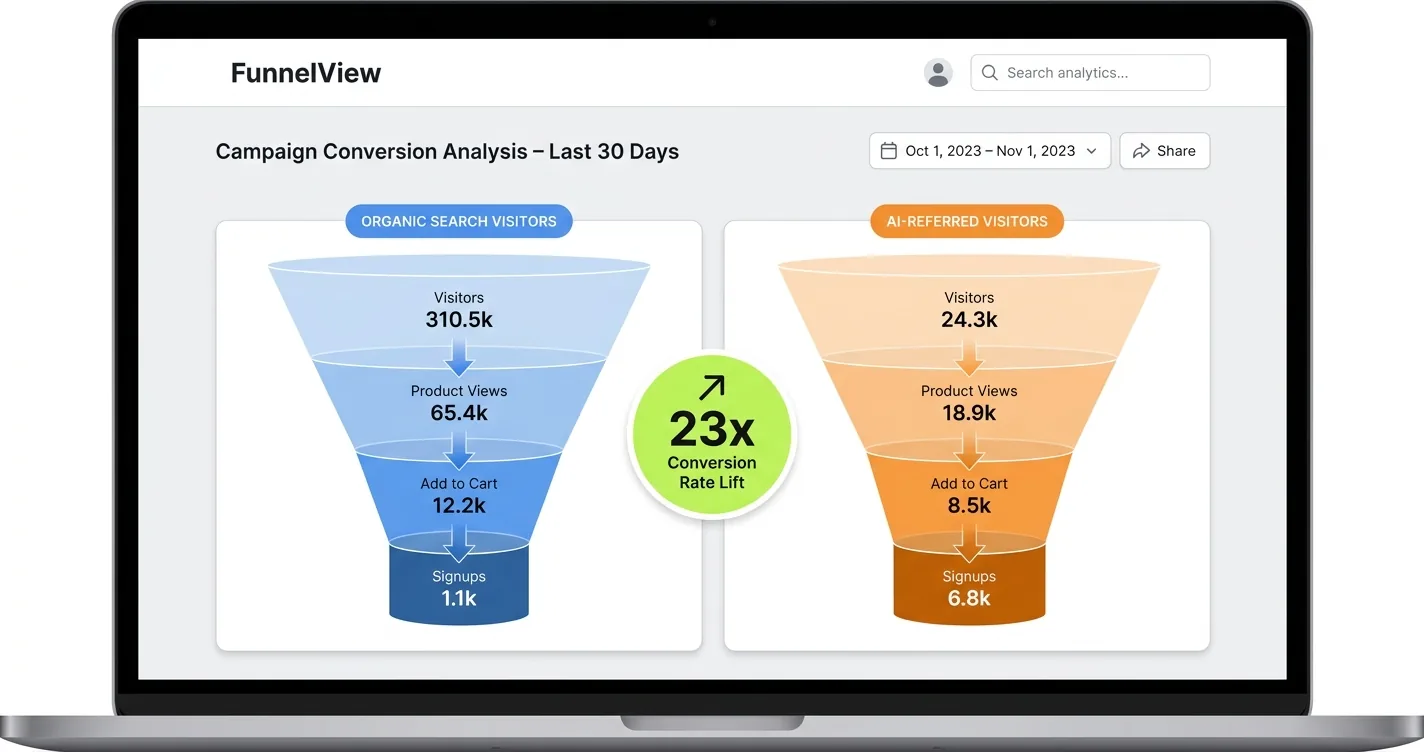
Fewer visitors who buy more often change the entire math on your pages. It also raises the price of every product mention you never linked, and our study of 67 affiliate posts found 70.1% of real product mentions carry no affiliate link at all. When each session is worth more, on-page engagement and smart monetization matter more than raw pageviews ever did. That is the case for turning your existing readers into a conversation instead of chasing traffic that stopped coming. A monetized on-page assistant like ChatAds does exactly that, answering reader questions and weaving in affiliate links while you keep all the commissions.
Drop in one script tag, and readers chat with an AI trained on your own content while ChatAds weaves in contextual affiliate links. You keep 100% of the commissions, with a free tier to start. Start free at getchatads.com.
The story these numbers tell is not that blogging is dead, but that the old traffic-first model broke. Search clicks are getting intercepted, Amazon trimmed its payouts, and display ads are paying out on a smaller pile of pageviews. The niches that survived were the ones an AI could not simply answer inside a summary box.
What ties every stat together is that the value moved from volume to intent. The visitors who still arrive convert several times better than the crowds you lost, so the smart play in 2026 is earning more from each of them. Squeeze more value from the readers you already have, and the traffic you lost will matter a lot less.
Frequently Asked Questions
What are the key affiliate blogging statistics for 2026?
Position-one organic CTR runs 58% lower when an AI Overview appears (Ahrefs, 2026), global publisher traffic from Google fell 33% year over year (Chartbeat, 2026), and Amazon cut affiliate commissions up to 50% (Adweek, 2026). The counterweight is intent, since AI-referred visitors convert at roughly three times the rate of search and social (Microsoft Clarity, 2025).
How much have AI Overviews reduced affiliate blog traffic?
Ahrefs found in 2026 that position-one CTR drops 58% when an AI Overview is present, and Pew Research found in 2025 that people click a result only 8% of the time with an AI summary versus 15% without. In a 2026 regulatory filing, DMG Media reported desktop CTR on a term falling from 25.2% to 2.8%. About 68% of US searches now end with zero clicks, per SparkToro and Similarweb in 2026.
What are the Amazon Associates commission rates in 2026?
Adweek and eMarketer reported Amazon cut commissions up to 50% in 2026, with categories that once paid around 10% dropping to 4 or 5%, reaching US publishers around March 9, 2026. Amazon's operating agreement also added a 180-day qualifying-purchase window effective April 14, 2026, while the 24-hour cookie stayed the same.
Which blog niches survived the AI traffic shift?
Experiential niches held up best. In Daniel Stanica's 2026 study of 100 blogs, parenting grew a median 108% and DIY or crafts edged up 2%, while personal finance fell 99%, fashion 95%, and health and wellness 93%. Content an AI cannot cleanly summarize, like recipes and hands-on repair guides, kept its value.
Do AI assistants send traffic back to affiliate blogs?
Very little so far. The 2026 citations.press study found only 7% of ChatGPT and 4% of Claude citations point to a brand homepage, with 81% and 75% going to third-party best-of pages. Previsible reported in 2026 that ChatGPT drives 92.4% of AI referral traffic and that LLM sessions grew 9.9 times in 19 months, but the base remains small.
Why do AI-referred visitors convert better for affiliate sites?
They arrive with higher intent after an assistant has already narrowed their options. Microsoft Clarity found in 2025 that AI-referred visitors convert at roughly three times the rate of search and social, and Adobe measured in 2026 that AI-referred retail traffic converts 54% better than non-AI traffic. Fewer, higher-intent visitors make on-page engagement and monetization matter more than raw pageviews.