
Most affiliate advice starts with getting more readers, which is the slowest and least reliable fix available. The posts you already published are sitting on clicks that never happen, and clicks that never turn into sales. Those are two different problems with two different repairs.
Affiliate conversion rate is the number that connects them, and 2026 is a bad year to leave it alone. Impact’s 2025 benchmark report, built on roughly a billion transactions, found clicks rising about 2% year over year while conversions fell 5-6%. The gap between interest and purchase is widening across the whole industry, and your own archive is where you can close some of it.
The seven steps below work through the posts you already have, in the order that pays back fastest.
- Content partners drove 18% of clicks but only 9% of transactions (Impact.com, 2025)
- More than 40% of affiliate URLs across 7,000 audited pages had link-rot issues (Trackonomics)
- 81% of page-viewing time happens in the first three screenfuls (Nielsen Norman Group)
- Amazon's cookie runs 24 hours on last-click attribution, so hesitation costs the sale
Ask ChatGPT to summarize the full text automatically.
Step 1 - Audit Which Posts Actually Send Clicks
Start from your click report, not your traffic report, because those two lists rarely name the same posts. A page can pull thousands of sessions a month and send almost nobody to a merchant. Another page with a tenth of that traffic can carry most of your revenue.
Impact’s 2025 data, covering 2,368 retail brands, found that content and review partners drove 18% of all clicks but only 9% of transactions. Volume and outcome come apart badly, which is why affiliate CRO that starts from a pageview report sends you to the wrong ten pages.
Pull the click data from your network, then sort by clicks per 1,000 pageviews instead of raw clicks. Sort the same list a second time by sales per 100 clicks. The two orderings split your archive into the posts nobody clicks and the posts nobody buys from.
What no click report can show you is the third group: product mentions carrying no link at all, which never generate a click to be counted. Our study of 67 published affiliate posts found 70.1% of real product mentions carry no affiliate link, and most of the missing ones sit in paragraph prose rather than the numbered list.
Keep the working list short, because a sitewide sweep costs weeks and pays back unevenly. HubSpot found that 30 of its 200-plus monthly posts drove 46% of monthly leads, and affiliate archives tend to concentrate the same way. Ten posts is a realistic scope for a first pass.
Be honest about what the numbers can and cannot tell you at this stage. Nobody publishes a credible benchmark for affiliate click-through or conversion by content type, so the percentages floating around comparison posts are guesses dressed up as data. Your own trailing three months is the only baseline that means anything, which makes recording it before you touch a single post the real first step.
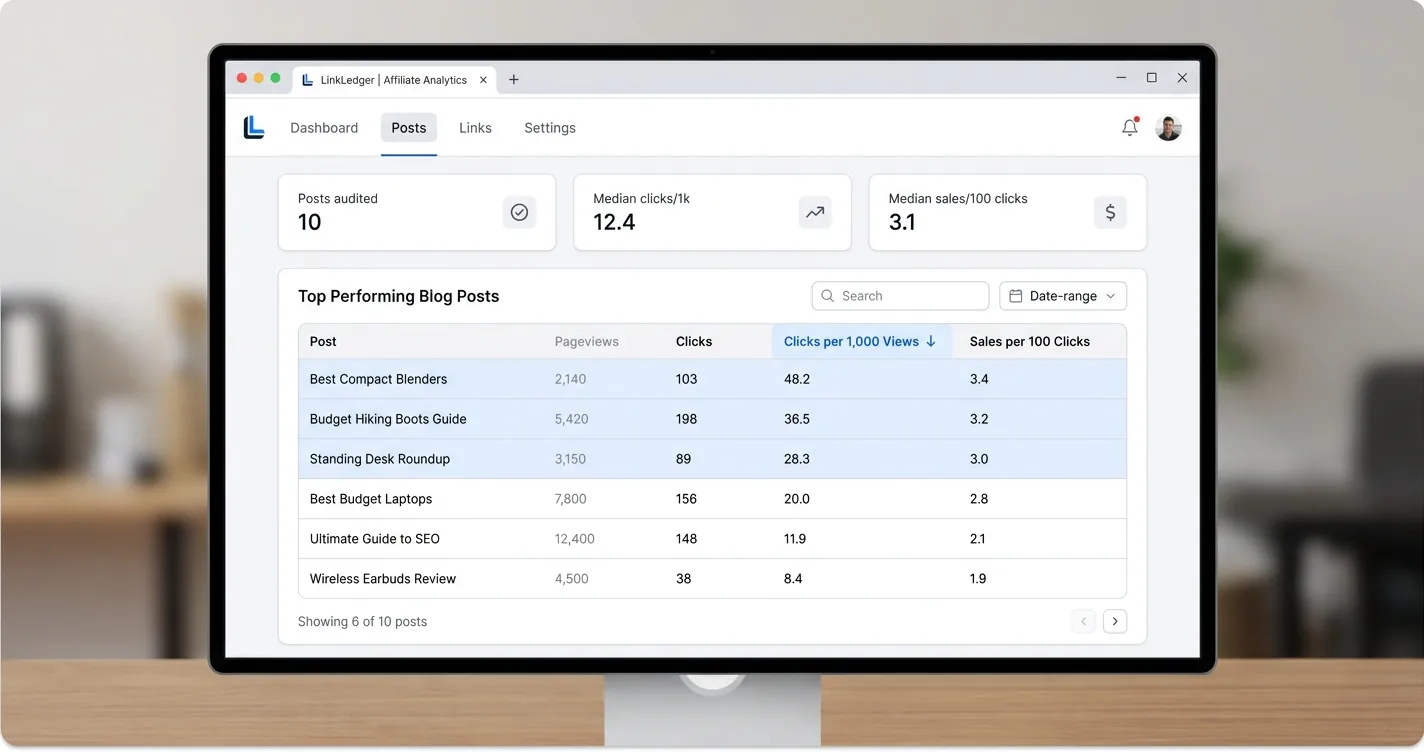
Sort your archive twice, then treat each group separately
| What you see | What it means | Where to fix it |
|---|---|---|
| Traffic, almost no clicks | Placement and anchor problem | Steps 3 and 4 |
| Clicks, almost no sales | Matching or friction problem | Steps 2, 5 and 6 |
| Clicks and sales, tiny volume | Ranking problem, not a CRO problem | Out of scope here |
Step 2 - Repair Stale Links, Prices, and Dead Products
The cheapest conversion gain on an old post is removing the reasons a click cannot convert. Dead links, discontinued models, and stale prices all cost you sales from readers who were already ready to buy.
Trackonomics audited around 7,000 pages across 25 major publishing sites and found link-rot issues in more than 40% of affiliate URLs. That decay feeds an oft-repeated industry estimate of roughly $160 million a year in lost affiliate revenue. Linkody ran a survival analysis on its own backlink database and reported that after one year, “17.37% of links will rot during that period,” rising to 43.39% by year seven (source).
Walk the posts from Step 1 and open every affiliate link against the live merchant page. A post promising $79 that lands on a $129 listing burns the click and some of the trust behind it.
Swap discontinued models for the current generation rather than deleting the section, since the page’s search ranking and the reader’s intent are both still there. This is the one maintenance job that pays even when rankings never move.
Refreshed posts tend to earn back more than the repair time costs. HubSpot says its own refresh program has “increased the number of monthly organic search views to posts we update and republish by an average of 106%”. That figure measures traffic rather than conversion, so treat the ranking lift as a bonus and the working links as the actual point.
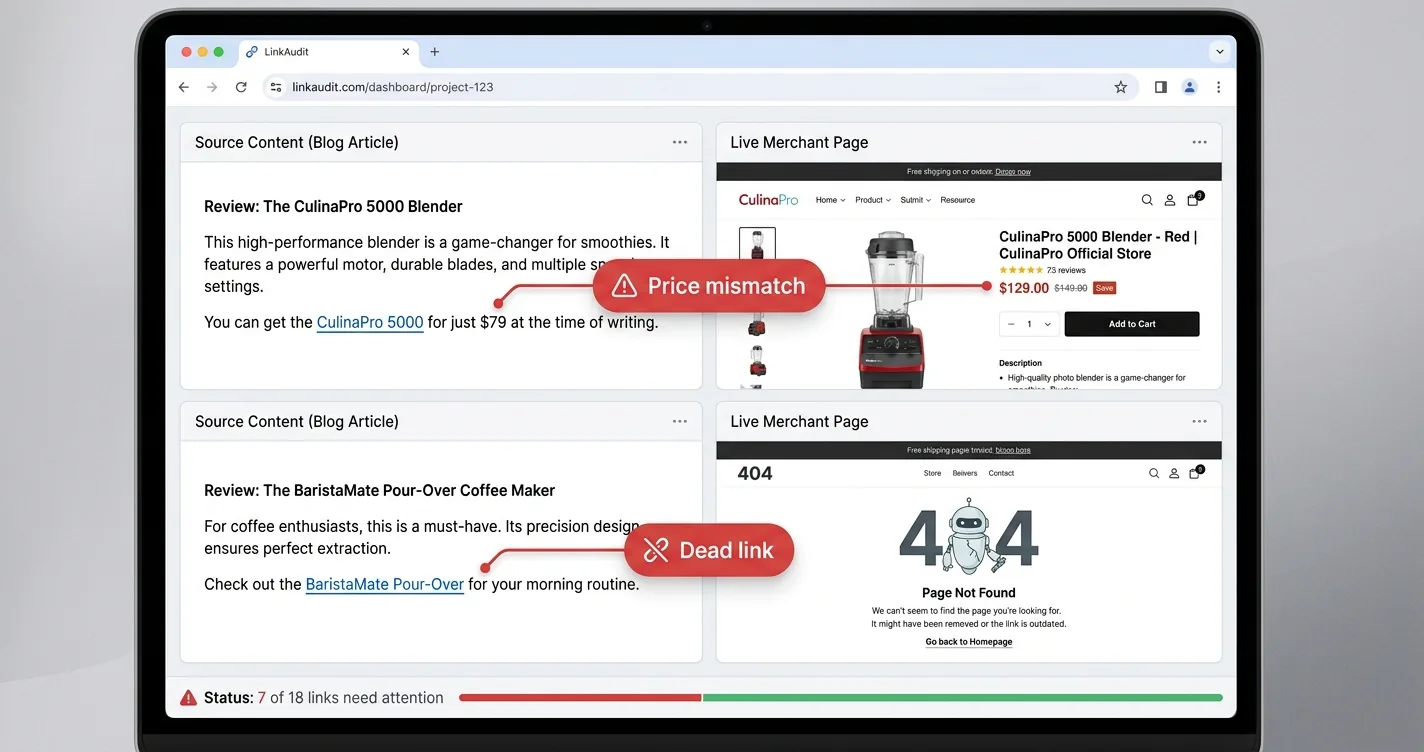
- Resolution. The URL loads a live product page, not a 404 or a category redirect
- Availability. The item is in stock and still sold by that merchant
- Price. Any figure in your prose matches what the merchant charges today
- Generation. The linked model is the current one, not the version you reviewed in 2023
- Tag. Your tracking ID survived the last theme change or plugin migration
Step 3 - Move the Link to the Moment of Intent
Placement is an attention problem before it becomes a persuasion problem. Readers cannot click a link they never scrolled past, and most of them stop well before your conclusion.
Nielsen Norman Group’s eye-tracking research puts 57% of page-viewing time above the fold and 81% inside the first three screenfuls. Chartbeat’s cross-web scroll study found that “about 50% of readers see 1500 pixels down the page on content pages”, while the ones who do go deeper “spend much more time down the page than they do at the top.”
That tension is the whole placement decision, and it resolves into one rule. Early links reach more people and deep links reach more committed people, so put a link before the average exit point and another one right where you finish making the case.
Nielsen Norman’s F-pattern research adds a second constraint worth designing around. Readers scan horizontally across the top of a block, take a shorter second pass lower down, then run their eyes vertically along the left edge. A link buried mid-sentence in the right half of a long paragraph is easy for that pattern to skip. Links that start a line, or that sit in a short standalone paragraph, land in the path people actually scan.
No public study measures affiliate click-through by scroll position, so treat this as inference from general attention research rather than a measured affiliate number. Anyone quoting you a specific percentage here is asserting it, not citing it.
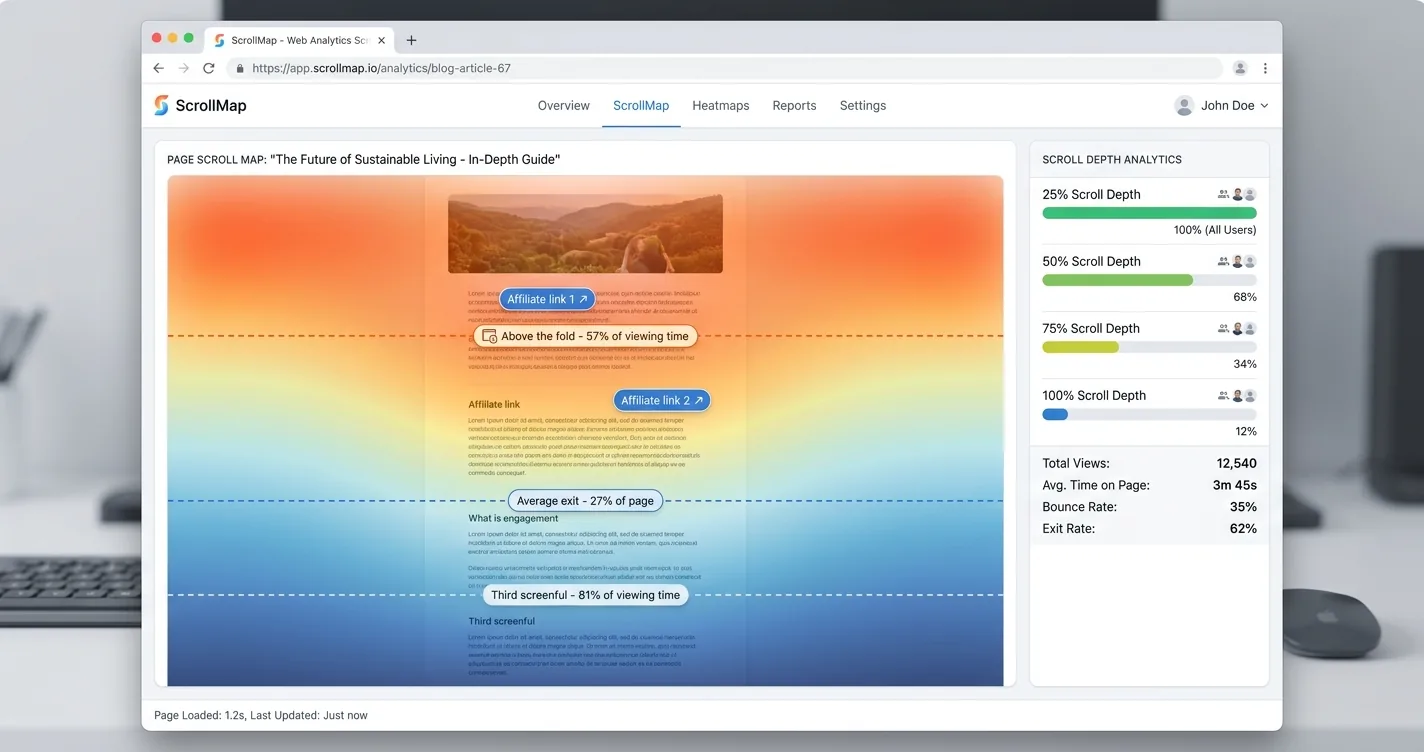
Scroll your own post on a phone and count how many swipes it takes to reach the first affiliate link. Three or more swipes means most of your readers never see it, and moving that link is usually a bigger win than rewriting the paragraph around it.
Step 4 - Make the Anchor and the Pick Unmistakable
Ambiguity is where affiliate clicks die, and most anchor text is ambiguous by default. A reader who cannot tell which page a link opens usually decides not to find out.
Replace “click here” and “check price” with the exact product name plus the reason it is your pick. On roundups, lead with one decisive winner instead of eight co-equal options, because a reader forced to choose between equals often chooses to leave instead.
A comparison table earns its place by letting a skimmer settle the which-one question in a single glance. The widely repeated claim that tables double conversions traces back to a table-plugin vendor’s own blog with no study behind it, so build the table for your reader rather than for the statistic.
Keep an eye on link density while you are editing. More links is not more clicks, and every extra link past the point of decision splits attention away from the one you actually wanted taken.
The existing anchor-text research is about how Google ranks pages, not about what makes a human click, so anchor testing belongs in your own click report rather than in a borrowed SEO study. Rewrite the anchors on one post that already sends traffic, change one thing at a time, and give it long enough to matter.
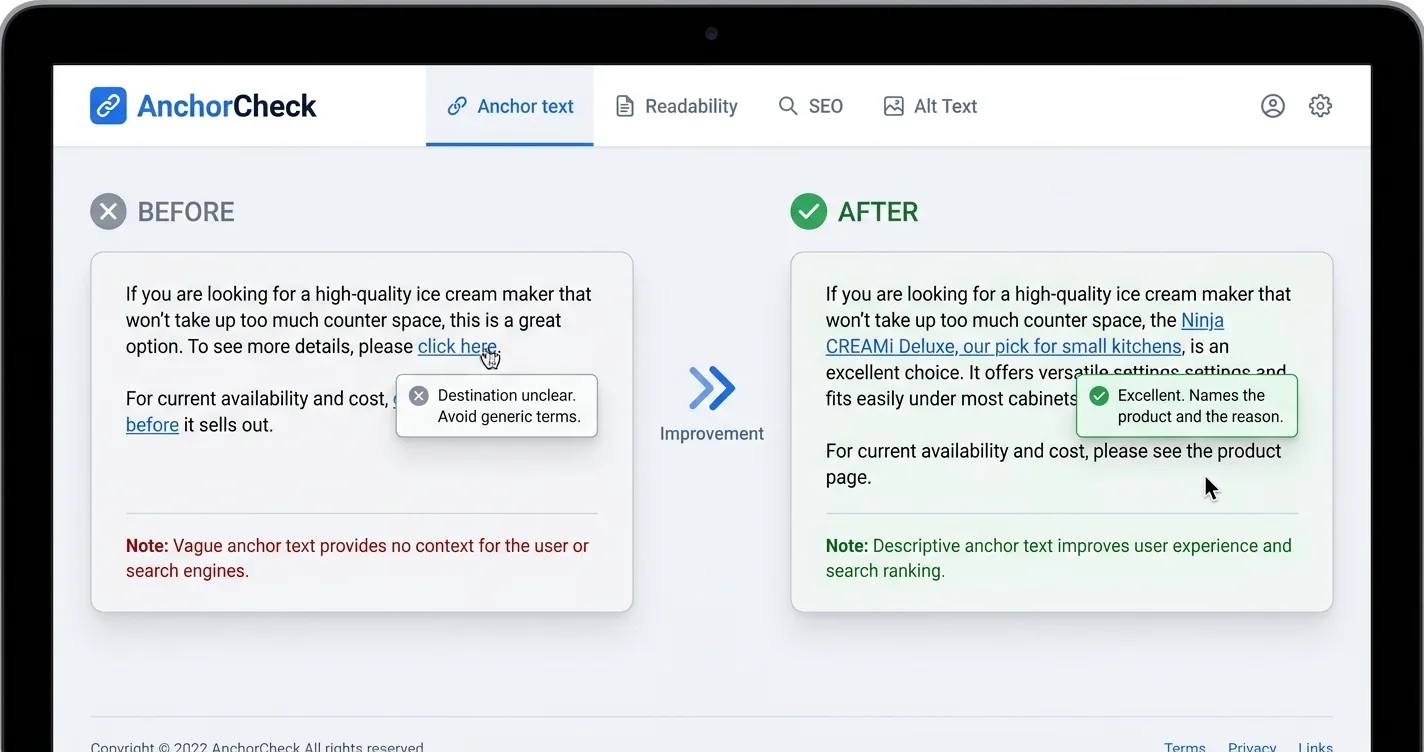
Name the product, name the reason, then stop
| Weak anchor | Stronger anchor | Why it works |
|---|---|---|
| Click here | Ninja CREAMi Deluxe, our pick for small kitchens | The reader knows the destination before committing |
| Check price | See current pricing on the Sony WH-1000XM6 | Names the product, sets the expectation |
| Read more | Full spec sheet for the 14-inch model | Describes the page, not the action |
| Buy now | Best value if you already own the older dock | Carries the reason alongside the link |
Step 5 - Answer the Objection That Stops the Click
Every post has readers who wanted to buy and did not, because the piece never answered the one thing standing in their way. The blocker is usually small, specific, and answerable in a single line.
Fit, compatibility, and whether the cheaper version is good enough account for most of them. Mine your own comments and the merchant’s customer questions section, then answer the top two or three inline beside the link instead of in a footer nobody reaches.
This is also where the Amazon cookie window starts working against you. The Associates Program Operating Agreement ends your qualifying session as soon as “24 hours elapse from that click,” or as soon as the customer “clicks through a Special Link to an Amazon Site that is not your Special Link.” A reader who leaves to research the answer somewhere else is usually gone, and whoever’s link they click next takes the commission. Amazon’s 2026 operating agreement changes tightened the rules around that attribution rather than loosening them.
Networks outside Amazon give you more room here, which changes how hard you have to work. ShareASale windows commonly run 30 to 90 days depending on the merchant, CJ typically sits around 30 to 45, and Impact merchants often run 90 or longer. A reader who wanders off to check something still has time to come back and count. Those are self-reported norms rather than audited figures, but the direction holds.
The ceiling on this tactic shows up faster than most people expect. Every objection you answer in prose makes the post longer and slightly worse for the readers who never had that question, which is exactly what the next step is for. Sites where the objections are mostly fit and compatibility can hand the job to an on-page assistant instead, so the answer only appears for the reader who asked.
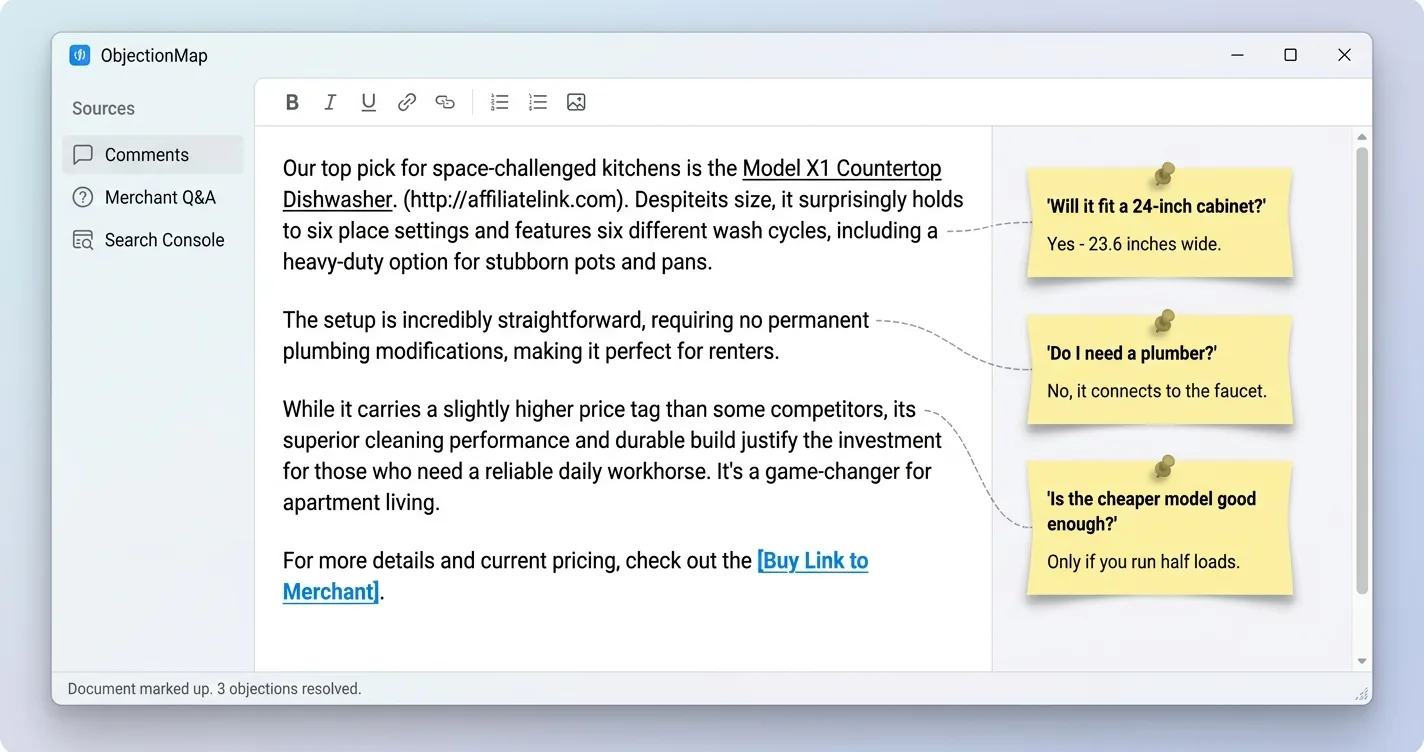
- Your comments. The same three questions repeat under every roundup you publish
- Merchant Q&A. Amazon's customer questions section is a free objection list per product
- Search Console. Long-tail queries landing on the post show what people expected to find
- Return reasons. Reviews mentioning sizing or compatibility flag the pre-purchase worry
Step 6 - Add an AI Chat Assistant That Answers in Context
Static prose answers the questions you predicted, and an on-page assistant answers the ones you did not. The reader who would have opened a new tab to check compatibility asks on your page instead, gets a specific answer, and stays inside your attribution window.
ChatAds is a free embeddable chat widget built for exactly that gap. Installation is one line of JavaScript with no coding, the assistant answers from your own content, and affiliate links are woven into the replies. Publishers keep 100% of the commissions on everything it recommends.
For conversion work, the useful part is what it leaves alone. Your existing links, layout, and copy stay where they are, so it earns from the readers who were never going to click an in-body link at all.
Two independent toggles control what gets linked in those replies. One inserts Amazon affiliate links, and the other picks up the affiliate links already sitting on your page, so you can keep your own programs running rather than replacing them. Setup is covered in more depth in our guide to adding a chatbot to an affiliate blog.
Treat it as a measurement change as much as a revenue one. Chat transcripts show you the exact questions readers arrive with, which is the objection list from Step 5 written by your actual audience instead of guessed at from comments. Pull the transcripts after two weeks and fold any question that comes up three or more times back into the post beside the relevant link.
Drop in one script tag and readers chat with an AI trained on your own content, with contextual affiliate links woven into the replies. You keep 100% of the commissions, and the free tier is enough to test it on a single post. Start free at getchatads.com.
Step 7 - Track Clicks and Conversions as Two Separate Numbers
Most bloggers have one number, revenue, and it cannot tell them which half of the funnel broke. Split it into click-through rate and conversion rate, then judge every change on earnings per click.
GA4’s Enhanced Measurement has an outbound clicks toggle that fires an event whenever someone leaves for a merchant. That single event gives you the click side and the pageview denominator. It cannot see the sale, so conversion rate has to come from the merchant dashboard instead.
Amazon Associates has no true SubID support, so Tracking IDs are the substitute, assignable per post or per placement. Associates Central is blunt about the ceiling: “there is a limit of 100 Tracking IDs per associate account.” Sitewide totals cannot tell you which edit did the work.
Three mistakes account for most of the bad calls people make here. Judging by revenue instead of EPC is the biggest one, because 1,000 clicks and two sales looks better on a revenue line than 100 clicks and 15 sales, and it is far worse. Comparing a Q4 month against an off-season month is the second, and calling a winner on 40 clicks is the third.
Sample size decides whether any of this measurement is worth running. Geniuslink suggests about 1,000 clicks per variant or roughly a month, whichever comes first, and if you cannot reach that inside four to six weeks then compare EPC directionally and skip the test. The wider affiliate blogging statistics for 2026 are worth reading before you benchmark yourself against anything.
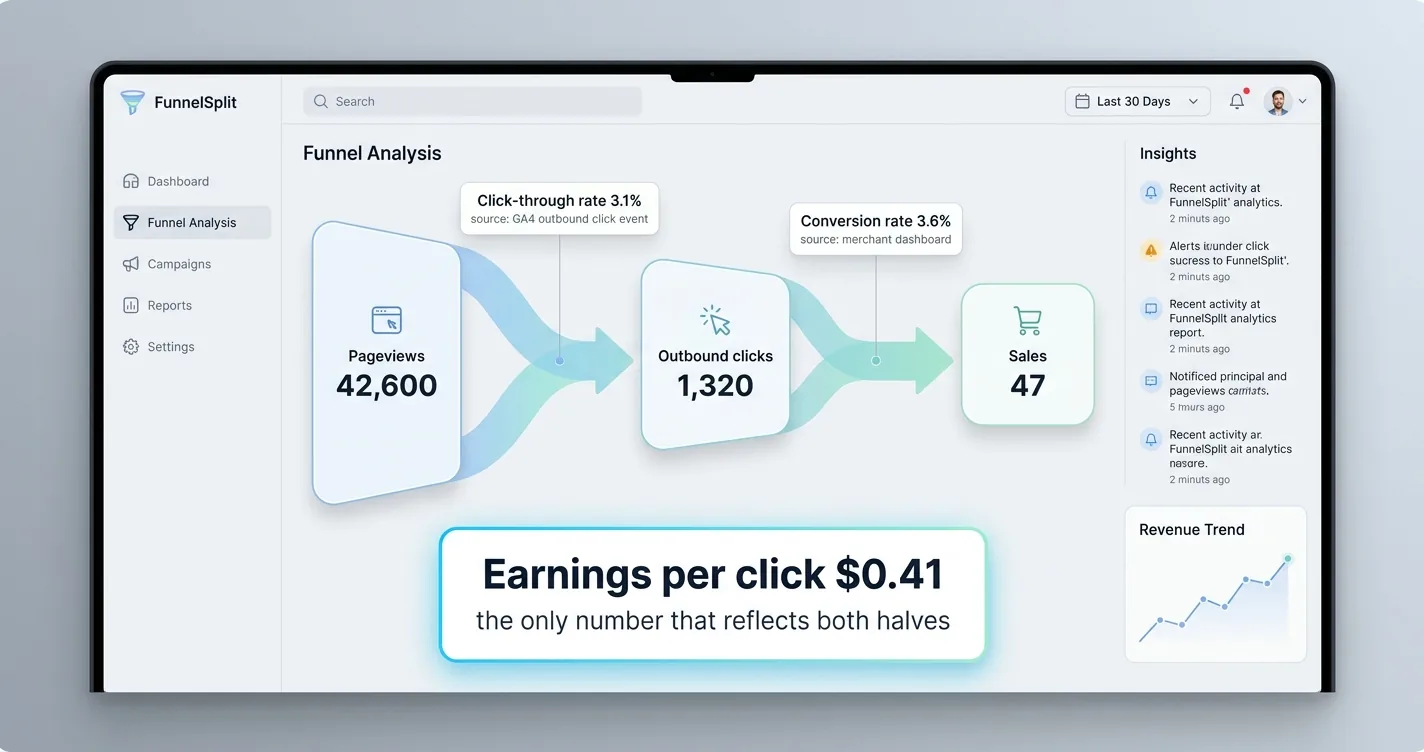
No single tool covers the whole funnel
| Metric | Source | What it tells you |
|---|---|---|
| Click-through rate | GA4 outbound click events | Whether placement and anchors are working |
| Conversion rate | Merchant or network dashboard | Whether the product match is right |
| Earnings per click | Commission divided by clicks | The only number that reflects both halves |
| Per-post attribution | Amazon Tracking IDs, 100 max | Which page or placement earned it |
None of this needs a new post, a new keyword, or a single extra visitor. Your archive already carries clicks that never happen and clicks that never close, and the steps above are ordered by how fast each one pays back. Repairing broken links and stale prices takes an afternoon, while placement and anchor work takes about a week.
Start with the ten posts that already send clicks, fix what is broken, then track clicks and sales as separate numbers so you can tell which edit did the work. The companion piece on making more money from your blog without more traffic covers the other half of the same problem, which is revenue per reader rather than conversions per click. Affiliate conversion rate optimization is maintenance work, so put the ten posts on a calendar and check the numbers again in 30 days.
Affiliate Conversion Rate FAQ
How can I increase my affiliate conversion rate without publishing new posts?
Work the posts that already send clicks: repair dead links and stale prices, move links above the average exit point, rewrite vague anchors to name the product, and answer the objection that stops the purchase. Those four repairs cost hours rather than weeks and they compound on traffic you already have.
What is a good affiliate conversion rate for a blog?
There is no credible published benchmark for affiliate conversion rate by content type, so any single percentage you see quoted is an assertion rather than a measurement. Use your own trailing three months as the baseline and judge every edit against that. Record it before you change anything, because you cannot recover the number afterwards.
Why do my affiliate links get clicks but no sales?
Clicks without sales is a matching or friction problem, not a placement problem. The usual causes are a product that does not fit the reader's stated situation, a price in your prose that no longer matches the merchant, or an unanswered question that sends the reader off to research elsewhere inside a 24-hour Amazon cookie window.
Where should affiliate links be placed in a blog post?
Put one link before the average exit point and another at the moment you finish making the case for the product. Nielsen Norman Group's eye-tracking work puts 81% of page-viewing time in the first three screenfuls, so a link that takes three phone swipes to reach is invisible to most readers.
How do I track affiliate click-through rate and conversion rate separately?
GA4's Enhanced Measurement fires an outbound click event whenever a reader leaves for a merchant, which gives you the click side and the pageview denominator. The sale has to come from the merchant or network dashboard, and Amazon Tracking IDs let you attribute it to a specific post or placement. Judge changes on earnings per click, which is the only number that reflects both halves.
Does an AI chat widget improve affiliate conversions on a blog?
It targets a specific gap: the reader who has a question your post never answered and would otherwise open a new tab to find out. ChatAds is a free embeddable widget that answers from your own content and weaves affiliate links into the replies, so those readers stay on the page and inside your attribution window. Publishers keep 100% of the commissions.