
Most affiliate bloggers link the products in their numbered list and very little else. We wanted to know how much that habit leaves sitting in the text, so we ran 67 published affiliate posts through a purchase-intent extractor and compared every mention it found against the links each post actually carries.
The gap turned out to be wider than any of us expected going in. Across food, gear, parenting, finance and DIY blogs, 40.5% of real product mentions carry no link at all, and 70.1% carry no affiliate link. That second number is the one worth sitting with, since those mentions were written by someone already trying to monetize the page.
What follows is the full breakdown from this affiliate blog study, covering which mentions get skipped, why it happens, and what a working blogger can reasonably do about it in 2026. The wider backdrop sits in our roundup of affiliate blogging statistics.
- 40.5% of real product mentions have no link of any kind
- 70.1% have no affiliate link, so roughly 30% are linked to something that pays nothing
- Generic phrases and paragraph prose are the two worst buckets in the data
- Single-product reviews are the worst format at 95.6% with no affiliate link
Ask ChatGPT to summarize the full text automatically.
How We Tested 67 Affiliate Blog Posts for Missing Links
We collected 70 published posts across five niches, 14 from each, and analyzed 67 of them. Three were dropped because their body text never appears in the served HTML, which leaves nothing for a crawler or an extractor to read. Every site was an independent blog rather than a large publisher, because that is the audience whose affiliate income is actually on the line.
Each post’s body was pulled with a character offset recorded for every link it contains, then capped at 20,000 characters. That text went through the ChatAds extraction engine, which scores product and purchase-intent mentions, in no more than two calls per post. The finished run covered 917,827 characters across 120 calls.
Every returned mention was then checked against the post’s own links three separate ways, and all three numbers get reported rather than the flattering one:
- Strict. The mention sits inside a link, or the exact phrase is the link text.
- Loose. Everything strict catches, plus a link sharing the same brand and at least one word.
- Widest. Everything loose catches, plus any image link within 250 characters.

The extractor is tuned for recall, so it returns some phrases that turn out not to be products, which is one reason purchase-intent extraction hands back a confidence score rather than a verdict. We took a stratified sample of 400 mentions, judged each one, and measured 68.5% precision. Every headline number in this article is quoted over the validated mentions only, never the raw count.
Two checks kept the results honest in the other direction as well. Nine of the 67 posts load a JavaScript monetization vendor that rewrites links in the browser, and none of those nine are among the posts we counted as having zero affiliate links. Separately, 13.5% of the affiliate links we found carry no anchor text at all, which is why the widest test exists.
Here is one real record from the run, showing what the tool returned and what our link check added to it:
{
  "product": "Big Green Egg XL",
  "branded": true,
  "confidence": 0.79,
  "span": [2427, 2443],
  "placement": "list",
  "linked_strict": true,
  "affiliate_linked_strict": false
}
What Share of Product Mentions Have No Link at All?
Across the validated mentions, 40.5% carry no link of any kind, not even an internal one. Under the most generous test, which counts a product image sitting within 250 characters of the phrase, 27.4% are still completely orphaned. Both figures describe posts whose entire purpose is sending readers somewhere else.
The affiliate number is the one that should bother a publisher more. 70.1% of real product mentions carry no affiliate link under the strict test, and 59.9% still carry none under the widest one. The 29.6-point gap between that 70.1% and the 40.5% with no link at all is the finding this whole study rests on.
Roughly 30% of real product mentions are linked to something that pays nothing, usually the blogger’s own category page or a jump link inside the post. The per-post picture makes the same point in plainer terms. The median post holds 29 extracted mentions against nine affiliate links, and 19 of the 67 posts carried no affiliate link in their served HTML at all.
Those 19 posts deserve a line of their own, since they are not one broken site skewing the average. They come from 17 different domains across four niches, and 11 of them are product roundups, the single format most obviously written to be monetized.
Raw = all 2,108 extracted mentions. Validated = the hand-judged subset that are genuine product mentions.
| Measure | Raw | Validated |
|---|---|---|
| No link at all (strict) | 50.0% | 40.5% |
| No link at all (widest) | 37.6% | 27.4% |
| No affiliate link (strict) | 78.5% | 70.1% |
| No affiliate link (widest) | 68.2% | 59.9% |

Why Branded Mentions Get Linked and Generic Ones Don’t
Branded mentions and generic ones behave differently, and the split is the cleanest pattern in the dataset. A branded phrase like “Evenflo Shyft DualRide” goes unlinked 38.2% of the time under the strict test and only 18.1% under the widest. A generic phrase like “2-person tent” sits at 43.1% and 37.7%, and both of those examples came out of real posts in the sample.
The widest test is where the real finding shows itself most clearly. A generic mention is roughly twice as likely to be genuinely orphaned, with no link and no product image anywhere near it, because there is no specific item to reach for and no obvious page to point at.
The affiliate split runs the same direction, with 62.5% of branded mentions and 78.5% of generic ones carrying nothing that pays. Generic phrasing is how most people write when they are being helpful rather than selling, and it is also where the least monetization happens. That makes this a structural problem rather than a discipline problem.
| Mention type | No link (strict) | No link (widest) | No affiliate link (strict) |
|---|---|---|---|
Branded (Evenflo Shyft DualRide) |
38.2% | 18.1% | 62.5% |
Generic (2-person tent) |
43.1% | 37.7% | 78.5% |

Does Where You Mention a Product Decide Whether You Link It?
Placement predicts linking better than niche does, and the worst bucket is ordinary prose. Mentions inside list items go unlinked 29.2% of the time and mentions in headings 32.9%, while mentions in paragraph text go unlinked 51.1% of the time. The prose penalty survives the widest test too, at 35.3% against 22.9% for lists.
The pattern matches the way a roundup actually gets built in practice. Numbered lists get the buy buttons because the template has a slot waiting for them, and the narrative wrapped around that list gets the alternatives, the accessories and the cheaper option mentioned in passing.
Scanning behavior makes an unlinked prose mention easier to miss on top of that. Nielsen Norman Group’s research on reading found that “79 percent of our test users always scanned any new page they came across; only 16 percent read word-by-word” (source). The same study points out that hypertext links “serve as one form of highlighting,” which means a product named in plain text is the exact kind of phrase a scanning reader never registers.
Paragraph prose is also where the longer, more detailed recommendation usually lives, which is what makes the loss compound. Farhad Manjoo, writing in Slate on Chartbeat’s scroll data, found that “most readers scroll to about the 50 percent mark, or the 1,000th pixel, in Slate stories,” so anyone still reading your prose has already selected themselves. A reader who has followed two paragraphs of reasoning is much further along than one who skimmed a numbered list.
- Paragraph prose 51.1% unlinked, 73.7% with no affiliate link
- Headings 32.9% unlinked, 79.5% with no affiliate link
- List items 29.2% unlinked, 52.1% with no affiliate link

Which Niches Leave the Most Unlinked?
Four of the five niches land within five points of each other, which counts as a finding on its own. Gear sits at 35.0% of mentions unlinked, DIY at 36.4%, food at 39.3% and parenting at 39.6%. This is not one careless corner of the internet; it is how affiliate content got written in every niche we sampled.
Finance sits apart at 61.8%, and that number needs its caveat attached before anyone quotes it. Extractor precision in finance is only 42.5%, because credit-card and banking pages are full of phrases that look like products and are not, including “Variable APR,” “Roth IRA,” and “Direct Deposit.” Read the finance row as a measurement limit rather than a verdict on finance bloggers.
Food posts monetize best in absolute terms, with the lowest no-affiliate rate in the study at 55.7%. Food writers in the sample linked the pan and the thermometer more consistently than any other niche, and that consistency shows up directly in the numbers.
Precision is the share of extracted mentions judged to be genuine product mentions in that niche.
| Niche | No link (strict) | No affiliate link (strict) | Extractor precision |
|---|---|---|---|
| Gear | 35.0% | 76.7% | 75.0% |
| DIY | 36.4% | 71.2% | 82.5% |
| Food | 39.3% | 55.7% | 76.2% |
| Parenting | 39.6% | 71.7% | 66.2% |
| Finance | 61.8% | 79.4% | 42.5% |

Why Single-Product Reviews Are the Worst Offenders
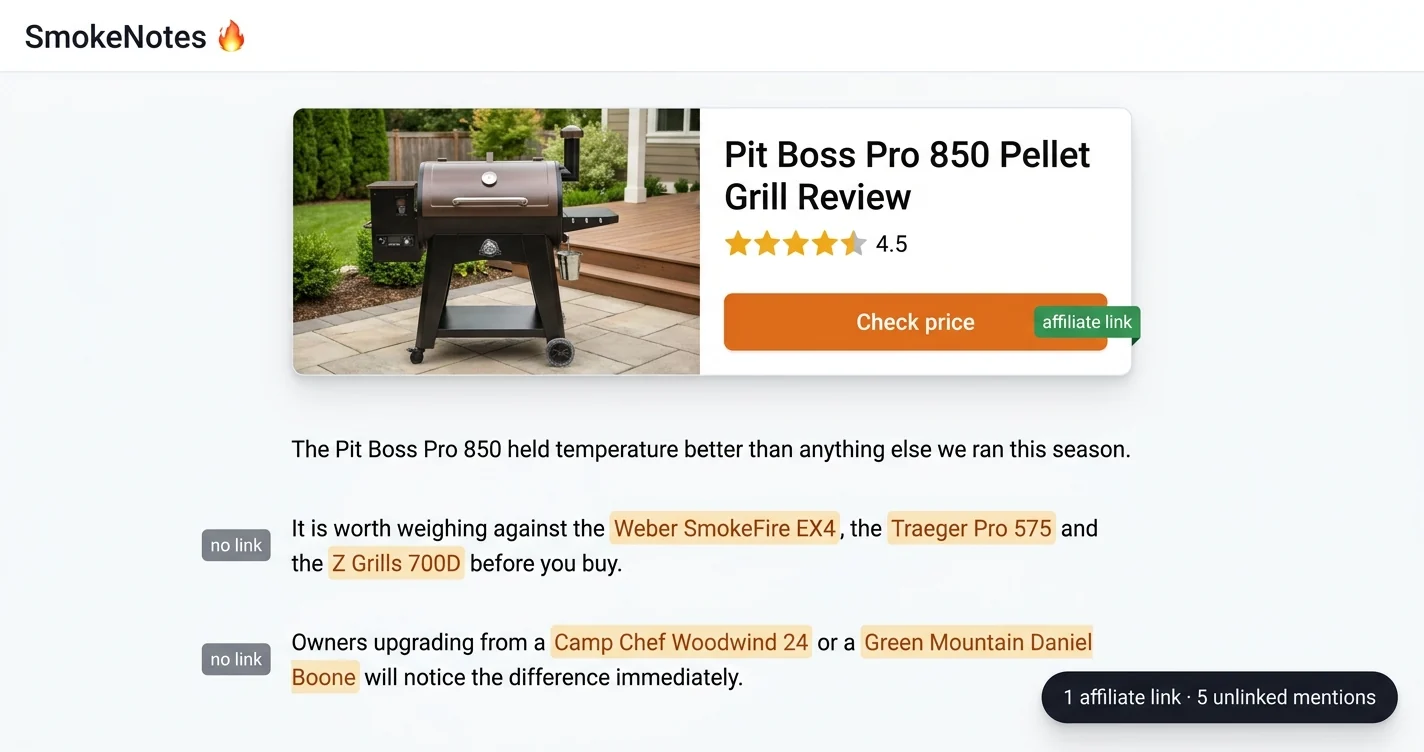
Posts reviewing one product have the worst link coverage of any format we measured. 62.2% of their real product mentions are unlinked and 95.6% carry no affiliate link, against 36.7% and 68.3% for roundups. How-to posts come out best of the three at 33.3% and 43.3%.
The mechanism gets obvious once the numbers are in front of you. A review links its hero product once near the top, then spends 2,000 words naming competitors, accessories, the model the author owned before, and the cheaper pick for readers on a budget.
One pellet grill review in our sample makes the case by itself. That post carries 50 links in its body and not a single affiliate link among them, and the only affiliate-related URL points at the site’s own disclosure policy. It names a Traeger Timberline and a Big Green Egg XL as comparisons, then links neither to anywhere that pays.
| Format | No link (strict) | No affiliate link (strict) |
|---|---|---|
| Single-product review | 62.2% | 95.6% |
| Roundup | 36.7% | 68.3% |
| How-to | 33.3% | 43.3% |
Why Mentions Go Unlinked in the First Place
The easy answer is that bloggers are careless, and the data does not support it. Manual linking scales with the list template rather than with the prose, so the first ten mentions get a link and the twentieth aside never does.
Generic phrases also have nowhere to point without the writer inventing a destination. A writer who recommends “a carbon steel wok,” which is a real unlinked mention from the food set, would have to pick one specific wok to link, turning general advice into a recommendation they never intended to make.
Then there is the plain arithmetic of what one link is worth. Some products have no affiliate program at all, and plenty sit in Amazon’s 3% tiers for home, tools, sports and baby gear, where hand-linking a passing mention barely covers the minute it costs. Adweek reported in 2026 that “Amazon has quietly restructured its Associates program over the past several months, slashing commission rates by as much as 50%,” which made that calculation noticeably worse.
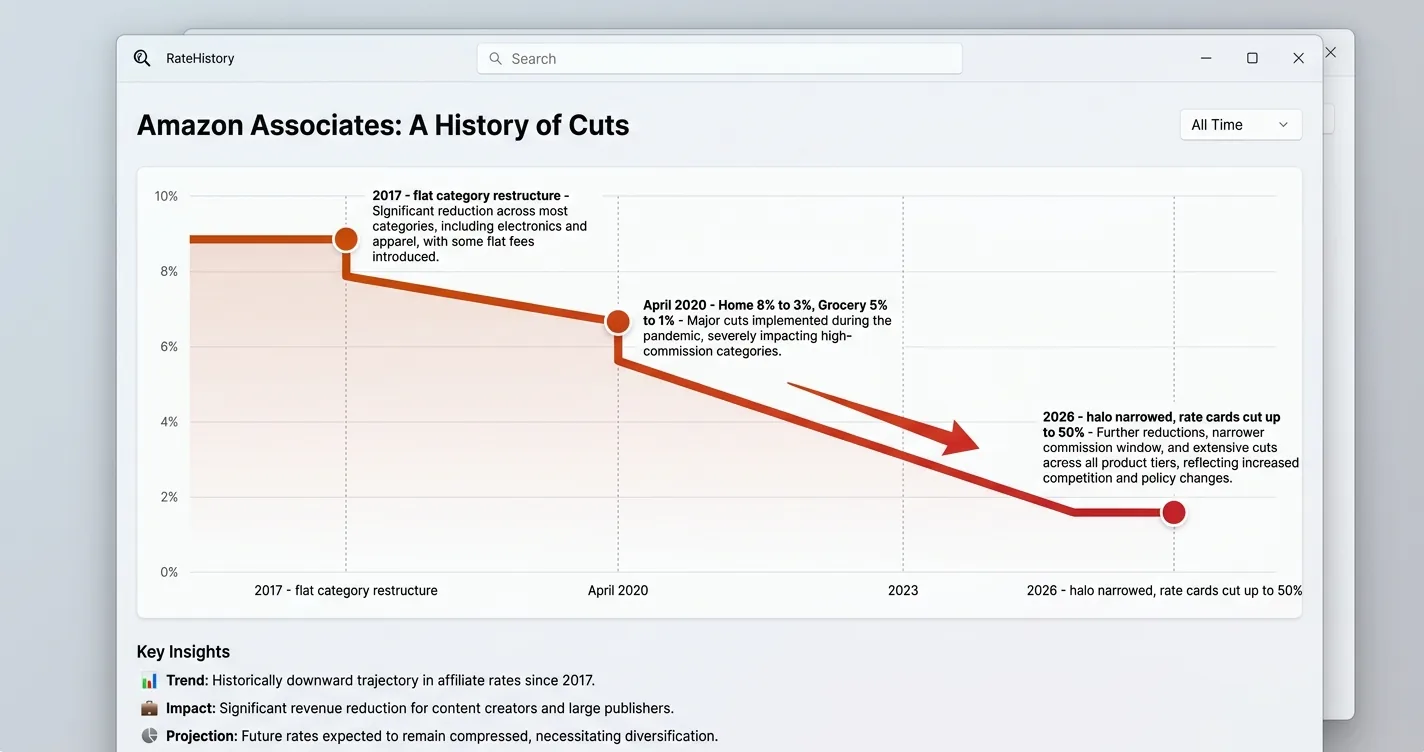
Reader behavior has shifted in a way that makes hand-linking pay less. EMARKETER reports that 54% of consumers who use generative AI have adopted it for price comparison, citing a July 2025 Wildfire Systems survey, and adds that “AI chatbots perform the same tasks that affiliate publishers built businesses around: product comparison, deal hunting, and recommendation.” Some of the comparison shopping that used to happen on your page now happens somewhere your link cannot follow.
ChatAds is a free embeddable AI chat widget for blogs. One script tag, about 20 KB gzipped, gives readers an assistant that answers questions using your own page, and publishers keep 100% of any affiliate commissions it earns.
The free plan covers 100 messages a day at $0.
<script async src="https://www.getchatads.com/widget.js?key=cwk_..."></script>What to Do About the Mentions You Already Wrote
Start by measuring instead of guessing. Nineteen of the 67 posts here carried no affiliate link at all, which is not a result anyone sets out to publish. Run your published articles through a purchase-intent extractor to surface the missed affiliate links, then compare the results against what’s already in the HTML. ChatAds Commerce Insert is free for 500 requests a month and takes 10,000 characters per call, and it returns a matching product alongside each phrase it surfaces, so a decent chunk of a back catalog fits inside the free tier.
Then work through the paragraphs before you touch the lists. It is one of the few ways to earn more from an archive without publishing anything new. Your lists already carry a link about seven times in ten, and paragraph prose is the bucket where half the mentions carry nothing at all.
Attach a brand wherever it is honest to do so. Generic phrases end up completely orphaned at roughly twice the rate of branded ones, and naming the specific pan you actually cooked with usually makes for better writing anyway.
Some mentions will never get hand-linked, and that is the gap an on-page assistant is built to cover. When a reader asks ChatAds about a product one of your existing affiliate links already points to, the assistant answers and includes that same link, so the mention you never linked earns from the link you already have. It reuses links already on the page rather than inserting new ones, so no Amazon Associates account is required.
- Extract. Run each post's body text through a purchase-intent extractor
- Compare. Match every mention against the links already in your HTML
- Fix the prose first. Paragraph mentions go unlinked at 51.1%, lists at 29.2%
- Automate the tail. Let an assistant handle the mentions you will never reach by hand
The headline is easy to state and much harder to act on. Seven out of ten real product mentions on affiliate blogs carry no affiliate link, and the ones that get skipped are the passing recommendations buried in body text rather than the products sitting in the list.
None of that is a workflow problem you can solve by trying harder, since the number of product mentions in a 2,000-word post will always outrun anyone’s patience for linking them. The practical move is to run an affiliate link audit on what you have already published, hand-link the prose worth linking, and let something automated pick up the long tail you were never going to reach.
Frequently Asked Questions
What percentage of product mentions on affiliate blogs have no affiliate link?
In this study of 67 published affiliate posts, 70.1% of hand-validated product mentions carried no affiliate link under a strict matching test, and 59.9% carried none even under the most generous test. A further 40.5% carried no link of any kind, internal ones included.
How do I find unlinked product mentions in my own blog posts?
Run each post's body text through a purchase-intent extractor, then compare the mentions it returns against the links already in your HTML. ChatAds Commerce Insert does that in one step free for 500 requests a month, returning each phrase with a product already matched to it, and you can also work through a draft with Claude rather than a script.
Why do generic product mentions go unlinked more often than branded ones?
A generic phrase like "2-person tent" has no specific item behind it, so linking it forces the writer to pick one product and turn general advice into a recommendation they did not intend. Generic mentions were genuinely orphaned 37.7% of the time against 18.1% for branded ones.
Which affiliate blog post format leaves the most revenue unlinked?
Single-product reviews, by a wide margin. 95.6% of their real product mentions carried no affiliate link, against 68.3% for roundups and 43.3% for how-to posts, because a review links its hero product once and then names competitors and accessories for the rest of the piece.
How often should you run an affiliate link audit on old posts?
Once or twice a year is enough for most archives, since the mentions themselves do not change, only the programs and rates behind them. Prioritize your highest-traffic posts and work through paragraph prose before lists, since list mentions already carry a link far more often than prose mentions do.
Can an AI chat widget monetize product mentions you never linked?
Yes, within limits. ChatAds reads the affiliate links already on the page, so when a reader asks about a product one of those links points to, the assistant answers and includes that same link. It cannot invent a link for a product the page never pointed at.