Most AI assistants field shopping questions every day, yet few can tell when a user is actually ready to buy. That gap matters because a well-timed product link feels helpful, while the same link on a pure research question feels like spam. Purchase intent is the signal that separates those two moments.
The hard part is that intent no longer shows up in a tidy search box. It hides inside long, natural messages where someone describes a problem, a budget, and a use case all at once. Reading that correctly is what decides whether monetization helps your users or annoys them.
As of 2026, the assistants that monetize well are the ones that treat intent as a measurement, not a guess.
- AI-assisted shoppers convert at roughly 12.3% versus 3.1% for standard sessions
- Only about 34% of people are comfortable letting an AI make the purchase decision on larger items, so detection should suggest, not checkout
- Conversational commerce is projected to grow from $8.8B (2025) to $32.6B (2035)
- Research suggests a confidence threshold near 0.6 balances missed sales against false links
Ask ChatGPT to summarize the full text automatically.
What Does Purchase Intent Look Like in an AI Conversation?
Purchase intent is the likelihood that someone will buy soon, read straight from how they talk about a product. A user comparing two espresso machines by price sits much closer to a purchase than one asking how espresso is made. Search researchers have sorted this for decades, going back to Broder’s 2002 taxonomy, which observed that “the need behind a web search is often not informational, it might be navigational (give me the url of the site I want to reach) or transactional (show me sites where I can perform a certain transaction, e.g. shop, download a file, or find a map).”
That framework still holds, but AI chat changes where the intent lives. A four-word search like “best espresso machine” now arrives as a paragraph about a small kitchen, a tight budget, and a hatred of cleanup. The signal is richer and messier at the same time.
The stakes here are easy to put into dollar terms. AI-assisted shoppers convert at around 12.3 percent versus 3.1 percent for standard sessions, Rep AI’s 2025 AI eCommerce Shopper Behavior Report found, noting that “12.3% of shoppers who engage with AI-powered chat make a purchase, compared to just 3.1% of those who do not.” Yet most people still want a human hand on the final purchase: a Quad survey found “only 34% are comfortable with AI-driven purchasing for larger items,” which means your job is to surface a useful option rather than force a sale.
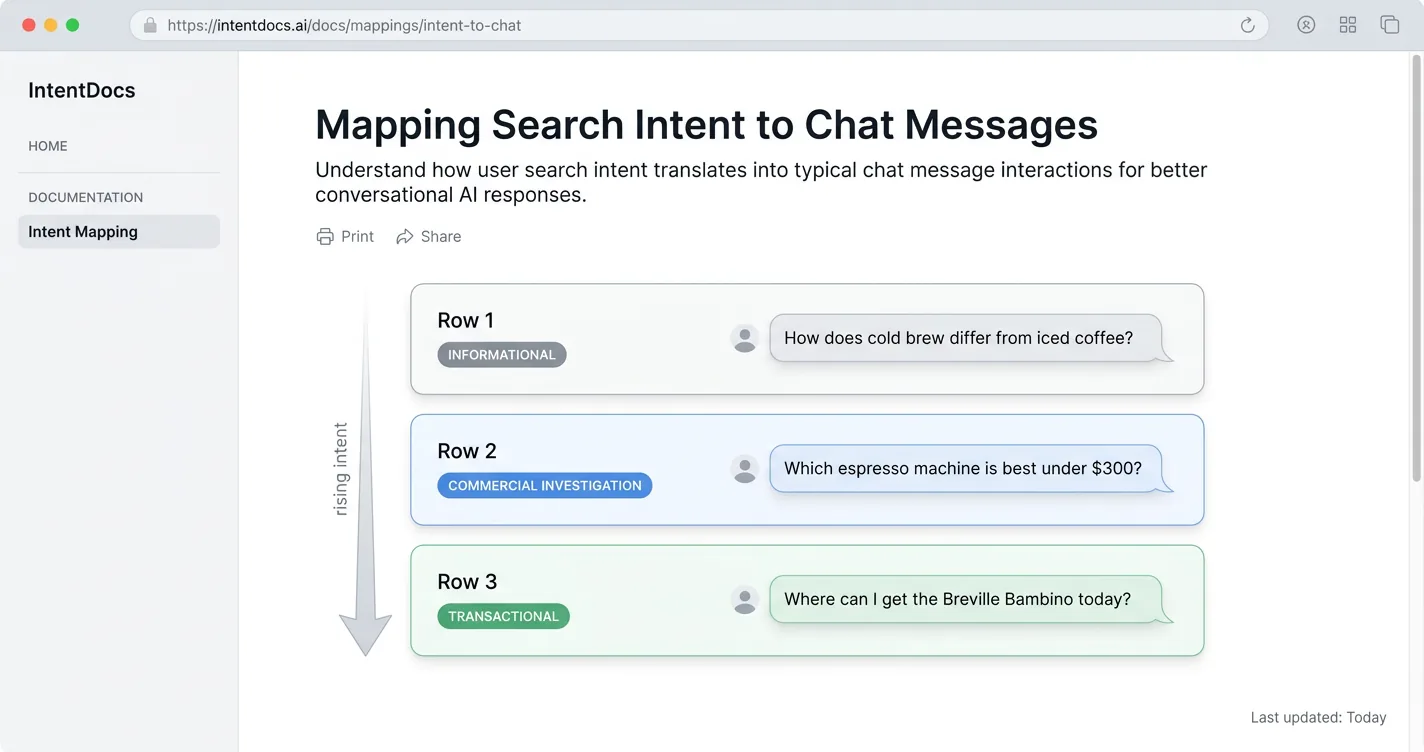
| Intent Type | What the User Wants | Example Message |
|---|---|---|
| Informational | To learn or understand | "How does cold brew differ from iced coffee?" |
| Commercial investigation | To compare before deciding | "Which espresso machine is best under $300?" |
| Transactional | To buy now | "Where can I get the Breville Bambino today?" |
Which Buyer Intent Signals Are Worth Detecting?
Strong intent leaves fingerprints in the wording, and a handful of buyer intent signals carry most of the weight. The cleanest transactional signals are action verbs paired with a product, price or deal language, a specific brand and model, and direct phrases like “where can I buy.” Gift context and urgency, such as “I need it before Friday,” push intent higher still.
A brand plus a model number with no question attached is one of the single strongest tells you can detect. Someone who types “Sony WH-1000XM5” is rarely doing idle research, since that level of specificity usually follows a decision, and pulling that exact entity back out of the reply is what the tools for extracting product mentions in AI text are built to do. Commercial-investigation signals sit a notch lower, including comparison language, “best X for Y” with real constraints, and requests for recommendations or reviews. The team at UserGems flags pricing, comparison, and review language as the three highest-confidence textual cues.
Constraint language is the signal that most builders overlook entirely. A budget, a use case, or a named recipient all narrow the field, which is exactly what a shopper close to buying does.
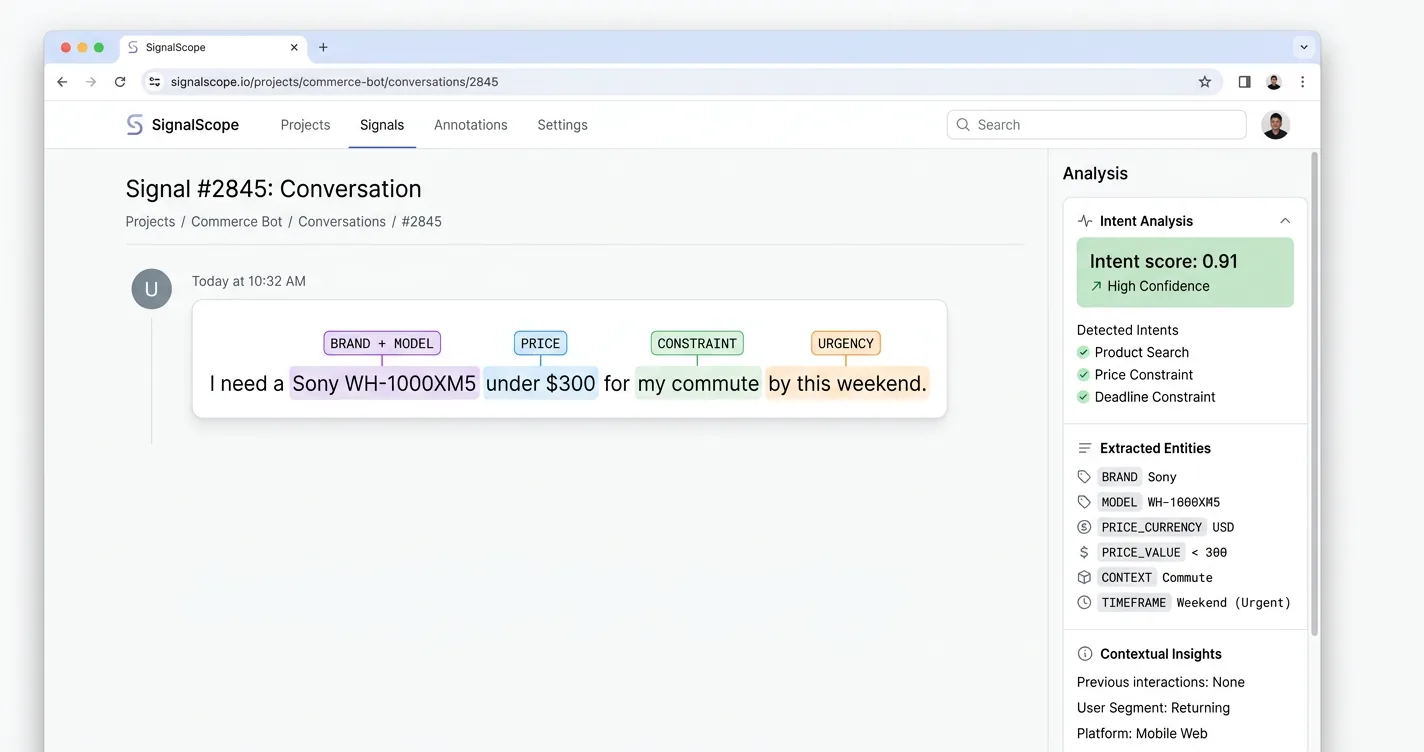
- Brand + model: "Anker PowerCore 10K" with no surrounding question
- Price language: "under $50," "best deal on," "cheapest"
- Action verbs: "buy," "order," "get me," "where can I find"
- Constraints: a budget, a use case, or a named recipient
- Urgency: "by this weekend," "in stock near me"
These patterns are useful heuristics rather than a finished classifier. Treat them as the first filter that decides which messages are even worth scoring.
How Do You Read the Funnel Stage From a Message?
Intent is a range, not a switch, so ranking a message beats labeling it yes or no. The classic funnel maps cleanly onto chat language. Awareness sounds like “why does my back hurt at my desk,” consideration sounds like “are standing desks worth it,” and decision sounds like “is the Uplift V2 better than the Vari.” Each stage deserves a different confidence score, and a single message should land in one stage rather than hedge across two. Backlinko’s intent guide is a useful primer on classifying that intent.
Intent also tends to escalate over the course of a single session. A user who opens with a vague question and three turns later names a model has walked down the funnel in front of you, so later turns deserve more weight. Without that conversation context, accuracy falls off quickly.
One nuance here matters specifically to how conversational AI monetization works. The text you score is the assistant’s reply, not the user’s prompt, so the signals read in the second person. A line like “this pick is great for your commute” is the assistant recommending to the user, and the original question stays the ground truth for what they meant.
"How to" guides, "what is" definitions, and troubleshooting for a product the user already owns all look busy but signal no purchase. Score them low even when a brand name appears.
Why Do Confidence Thresholds Decide Everything?
Every detector outputs a score, and the threshold you set on that score is the real product decision. Whether the number comes from a classifier probability, an embedding cosine similarity, or an LLM’s self-reported confidence, the cutoff determines what users actually see. Move it up and you show fewer, surer links. Move it down and you catch more sales while letting more junk through.
This is the precision and recall trade-off in plain terms. Set the threshold low and you favor recall, so you rarely miss a buyer but you fire on plenty of weak signals. Push it high and precision wins instead, so almost every link lands while some borderline buyers slip past. A framework study on chatbot false-positive intent detection put it directly: “to determine the optimal confidence score threshold, we identify the point in which there is a sharp decline in precision, which is 0.6.” That number does not port cleanly across different prompting styles.
The deciding factor in any threshold choice is cost asymmetry. A false positive shows an irrelevant link and chips away at user trust, while a false negative quietly misses a commission and a chance to help. Trust adds up across a whole session, so bias toward precision early and loosen the cutoff only once you have data.
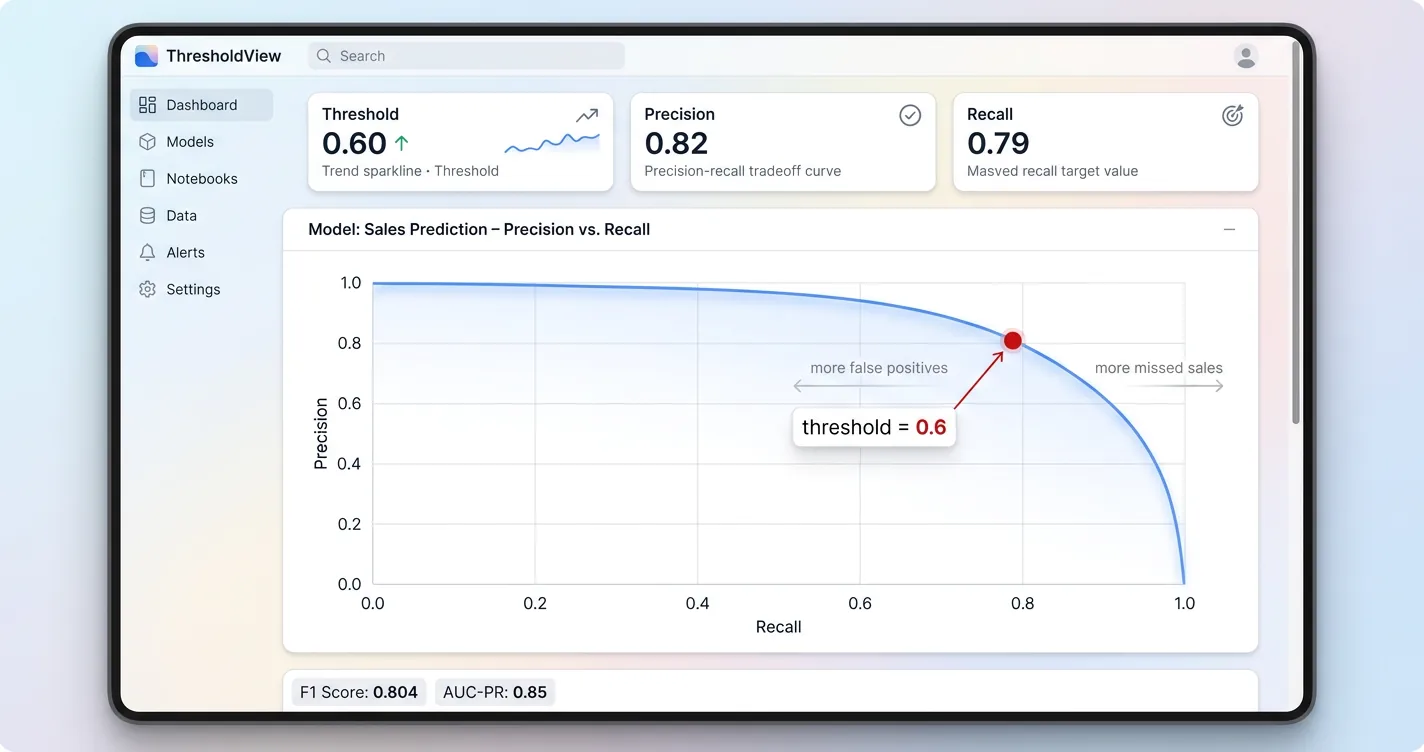
| Threshold | Effect | Best When |
|---|---|---|
| Low (~0.4) | High recall, more false positives | You can tolerate noise for reach |
| Balanced (~0.6) | Even split of precision and recall | Most production launches |
| High (~0.8) | High precision, more missed sales | Trust-sensitive assistants |
How Do You Avoid Spamming Links on Low-Intent Turns?
The safest default is silence, with a link surfacing only when the signal clears your bar. An assistant that drops a product into every reply trains users to tune the offers out, which erodes the conversion you were chasing. Definitional questions, troubleshooting, and plain venting should return nothing at all.
The same scoring problem shows up on published pages, where purchase-intent extraction reads finished prose instead of a live reply. Showing a generic fallback link is worse than showing nothing at all. If the message says someone is frustrated with their current laptop, a random “best laptops” recommendation reads as a sales bot rather than a helper. We covered why strict suppression beats weak matches in how to extract product mentions from AI chatbot responses.
Frequency discipline still matters even on turns that clearly qualify. If you placed a relevant offer two messages ago, you usually do not need another one right now, and frequency capping for ads in AI conversations walks through the per-user side of that. Recommending only when it genuinely helps is what keeps an assistant credible across a long session.
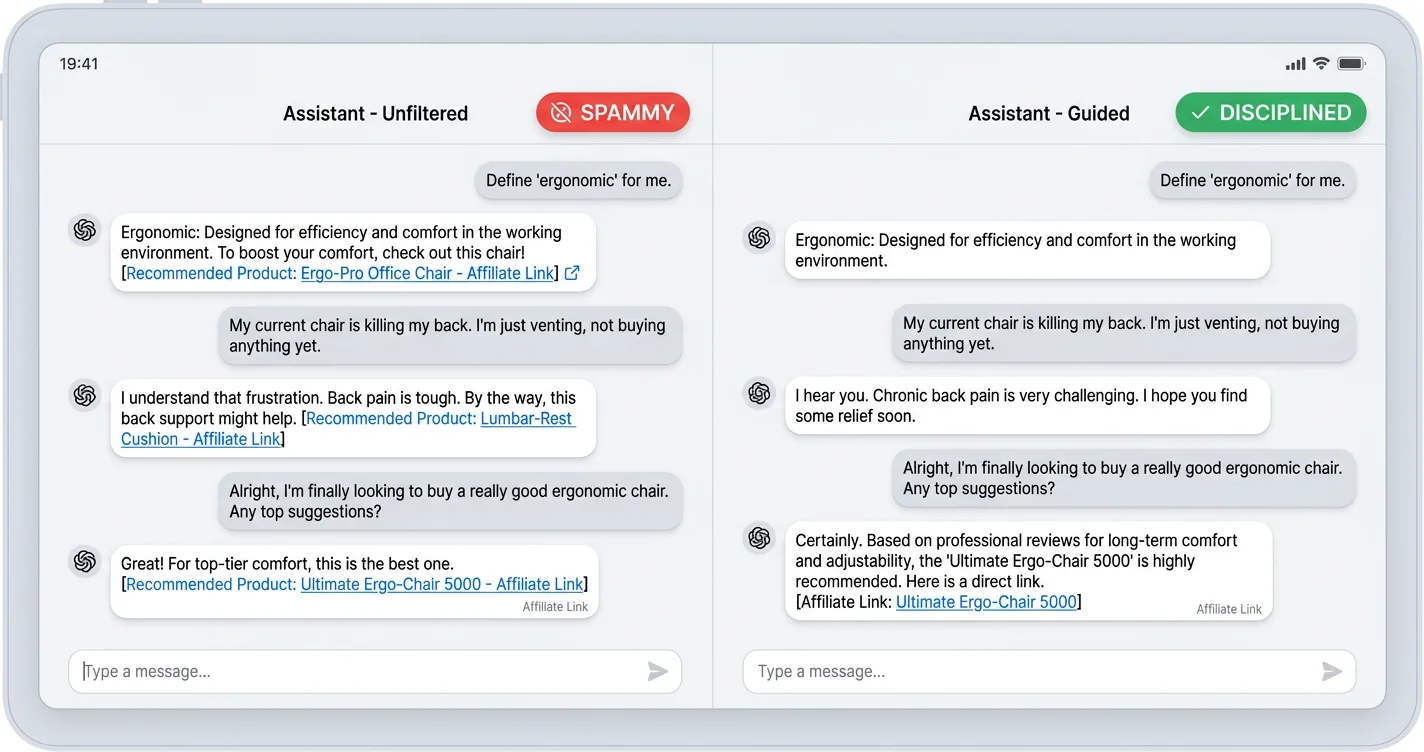
Definitional questions ("what is OLED"), how-to guides, troubleshooting an owned product, and emotional venting. Each one looks active but carries no purchase signal, so suppression protects trust without costing a real sale.
How Do You Build a Layered Intent Detection Pipeline?
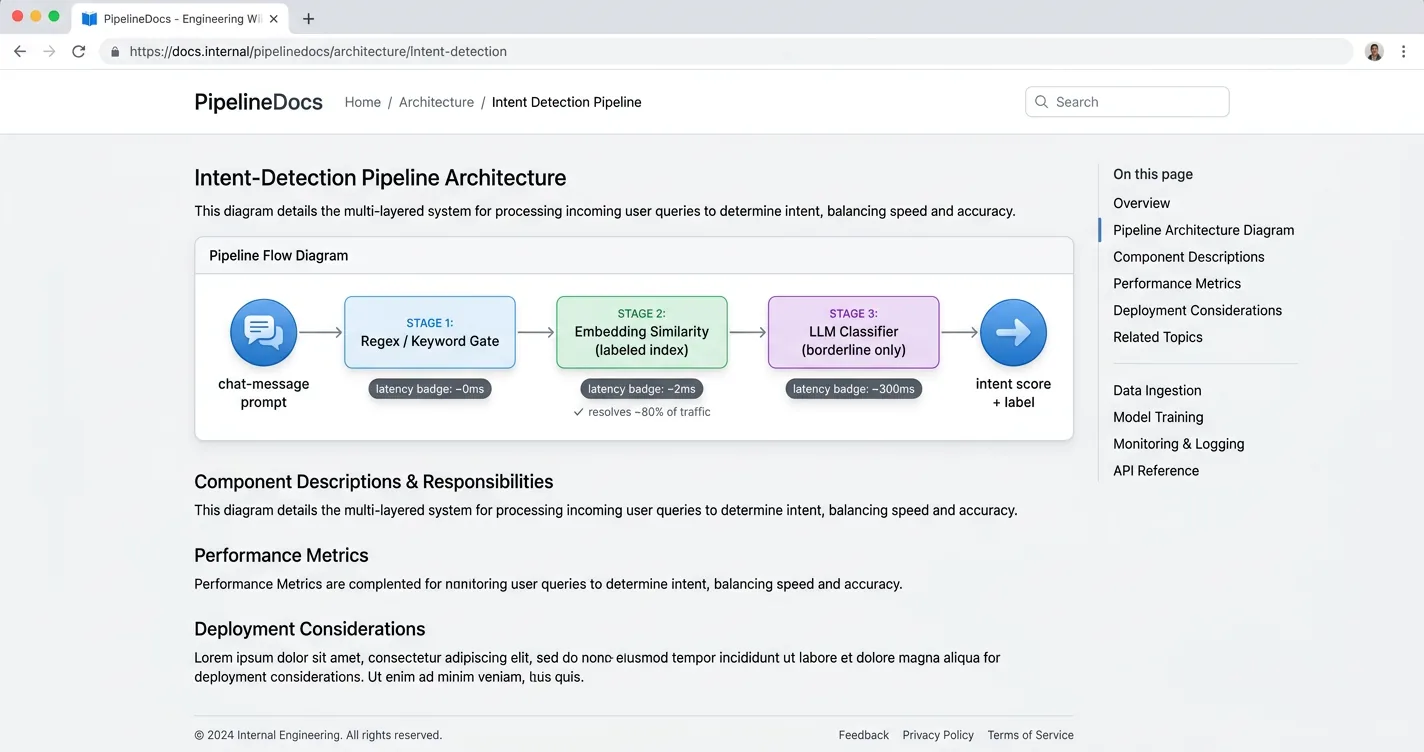
A good pipeline spends cheap compute first and expensive compute last. Start with a keyword and regex gate that catches the most obvious signals almost instantly. Then run a lookup against a precomputed embedding index of labeled examples, which can resolve roughly 80 percent of traffic in a couple of milliseconds. Reserve a small, fast LLM for intent classification on the borderline scores that the first two layers cannot settle. A hybrid intent approach shows this routing keeps most traffic deterministic and cheap.
Two implementation details make the LLM layer reliable in practice. Use a few labeled examples in the prompt and ask for structured output so the result parses cleanly into a score and a label. Inject the recent conversation context as well, since intent reasoning falls apart on a single message stripped of its thread.
Maintainability is the quiet payoff here. Adding a new intent means adding labeled examples to your index, not retraining a model from scratch, which keeps the system flexible as your catalog grows. The split is popular because it routes ambiguity to the model while keeping the common path fast and predictable.
def detect_intent(message, history):
    # Layer 1: cheap gate, negligible latency
    if regex_buyer_signals(message):
        return {"intent": "transactional", "score": 0.9}

    # Layer 2: nearest match against a precomputed embedding index
    label, score = nearest_labeled_example(message)
    if score > 0.75 or score < 0.35:
        return {"intent": label, "score": score}

    # Layer 3: LLM only for the borderline middle
    return llm_classify(message, history)  # few-shot + structured output
How Do You Get Purchase Intent Detection Live Fast?
Everything described above adds up to real, ongoing engineering work. Labeled examples, an embedding index, threshold tuning, an LLM fallback, and steady maintenance add up to a service you have to own. Plenty of teams want the result without running a classification pipeline as a second product. That is the build-versus-buy question for AI chatbot monetization, and we laid out the broader case in why LLMs alone don’t work for AI chatbot monetization.
The buy path collapses the whole stack into one API call. You send the assistant’s reply, and you get back zero or more affiliate offers for real products, with confidence gating and low-intent suppression already applied. You render a link only when an offer comes back, and you keep 100 percent of the commissions.
ChatAds already encodes the discipline from the sections above. It stays silent on low-intent turns, fires only on strong signals, and returns tracked links to real products. See how ChatAds adds affiliate links to AI chatbots for the integration overview.
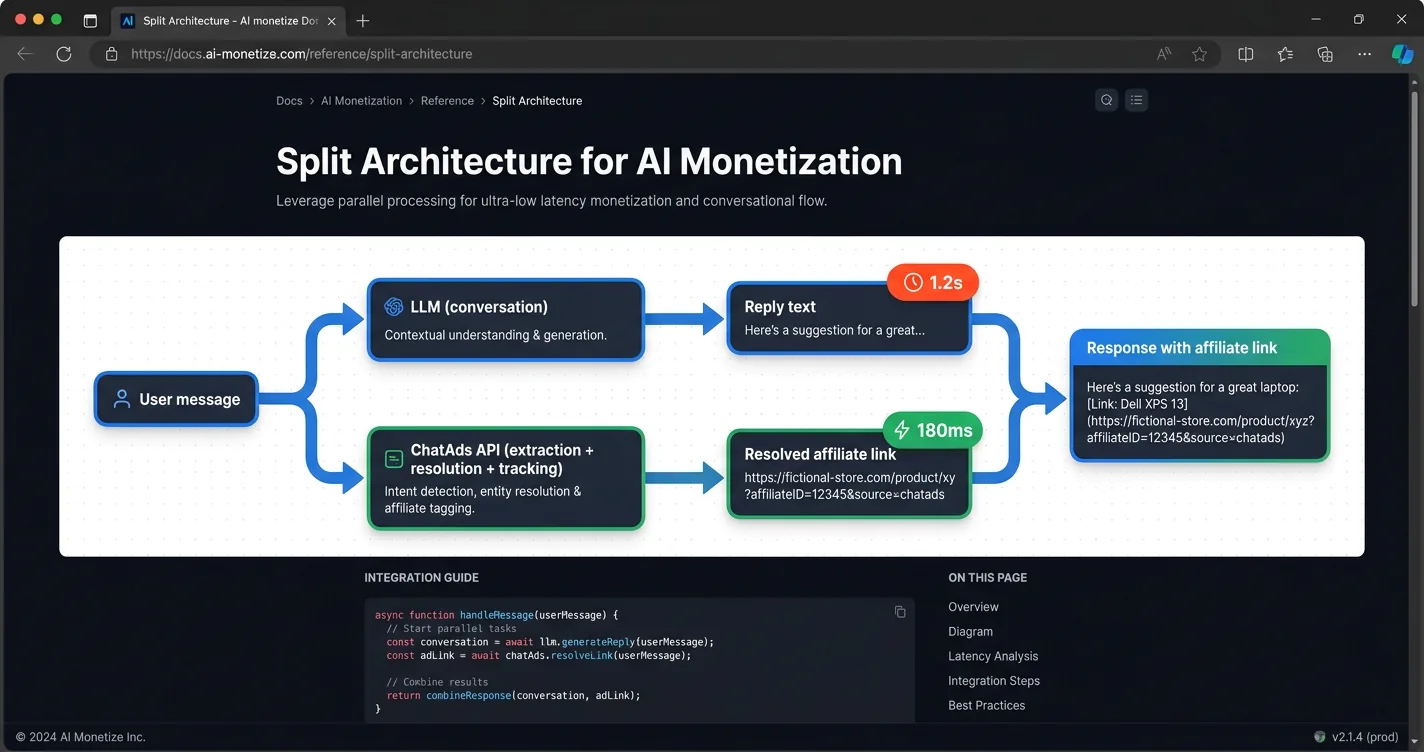
The point here is not that you have to outsource detection. It is that the quality bar is set by the discipline, not by who writes the code, so whichever path you pick, hold the line on precision.
Done well, purchase intent detection comes down to three core habits. Read the signals in the assistant’s reply, score them against a threshold tuned for trust, and stay silent whenever the message is just research or venting. Get those right and your links feel like help instead of ads.
The conversational commerce market is heading from roughly $8.8 billion in 2025 toward $32.6 billion by 2035, a 14.8 percent compound annual growth rate according to Future Market Insights, so the teams that detect intent well in 2026 are early to a market that keeps growing fast. Whether you build the pipeline or buy it, an assistant that respects intent is the one users keep coming back to.
Frequently Asked Questions
How do you detect purchase intent in AI conversations?
You read the buyer signals in the message and score them against a confidence threshold. The strongest signals are a specific brand and model, price or deal language, action verbs like "buy" or "order," and constraints such as a budget or use case. A layered pipeline works best: a cheap keyword gate first, embedding similarity against labeled examples next, and a small LLM only for borderline cases. The threshold you set on the final score decides which messages actually surface a link.
What are the strongest buyer intent signals in a chat message?
A brand plus a model number with no question attached is among the strongest single signals, since that specificity usually follows a decision. Price language, action verbs, urgency, and gift context all push intent higher. Constraint language, like a stated budget, use case, or named recipient, is the quiet tell that someone is close to buying. Comparison and review-seeking language signal commercial investigation, a notch below a ready-to-buy transactional message.
What confidence threshold should I use for intent detection?
Research on intent false positives found a threshold near 0.6 empirically optimal, but that number does not port cleanly across different prompting styles or models. Treat it as a starting point and tune from there. Because a false positive erodes user trust while a false negative only misses one commission, bias toward precision early with a higher threshold, then loosen it once you have real data on conversions and complaints.
How do I stop my AI assistant from spamming product links?
Make silence the default and surface a link only when the signal clears your threshold. Return no link on definitional questions, how-to guides, troubleshooting an owned product, and venting. Avoid generic fallback links, since a random "best laptops" link on a frustrated message reads as a sales bot. Add frequency discipline so you do not place another link right after a relevant one, which keeps the assistant credible across a long session.
Should I use an LLM or a classifier for purchase intent?
Use both in layers rather than picking one. A keyword and regex gate catches obvious signals with no latency, embedding similarity against labeled examples handles roughly 80 percent of traffic in a couple of milliseconds, and a small LLM resolves only the borderline middle. This routing keeps most traffic cheap and deterministic while reserving model cost for genuine ambiguity. It is also easier to maintain, since adding an intent means adding labeled examples instead of retraining a model.
Do I analyze the user's message or the AI's reply for intent?
For conversational AI monetization, you analyze the assistant's reply, so the signals read in the second person, like "this is great for your commute." The user's original question stays the ground truth for what they meant. Injecting the recent conversation context matters because intent reasoning falls apart on a single message stripped of its thread, and intent often escalates over several turns within one session.