
Every few months, someone asks whether affiliate blogging or affiliate marketing is dead, and this year the argument has more evidence behind it than usual. Traffic charts are down and to the right for a lot of publishers, Google keeps changing what a search results page even looks like, and Amazon just reworked the commission structure that funded a decade of “best of” posts. It is a fair question to ask.
Look at the affiliate blogging statistics 2026 has actually produced, and the answer is neither a clean yes nor a clean no. The old version of affiliate blogging, built entirely on Google clicks to generic comparison posts, is genuinely dying. What replaces it looks different, pays differently, and rewards a different kind of publisher.
Below are the actual numbers behind the panic, then the less-discussed data showing where affiliate income is holding up or growing.
Traffic to generic affiliate content is collapsing, and Amazon just made the economics worse. But niches built on first-hand experience are growing, and early evidence suggests the readers who do click through may convert better than before.
Ask ChatGPT to summarize the full text automatically.
The Traffic Collapse Is Real
Start with the number that makes the “affiliate blogging is dead” argument in one line. A study tracking 100 previously successful blogs from 2022 to 2026, using Semrush data and amplified by SparkToro founder Rand Fishkin, found the median blog lost 85% of its organic traffic. That is not a rough patch. That is most of the audience gone.
The spread inside that median is worse than the average number suggests. 55 of the 100 blogs lost more than 80% of their traffic, and 12 fell to essentially zero visits. These were not struggling sites to begin with, either. They were blogs that had already found an audience and built a working affiliate business around it.
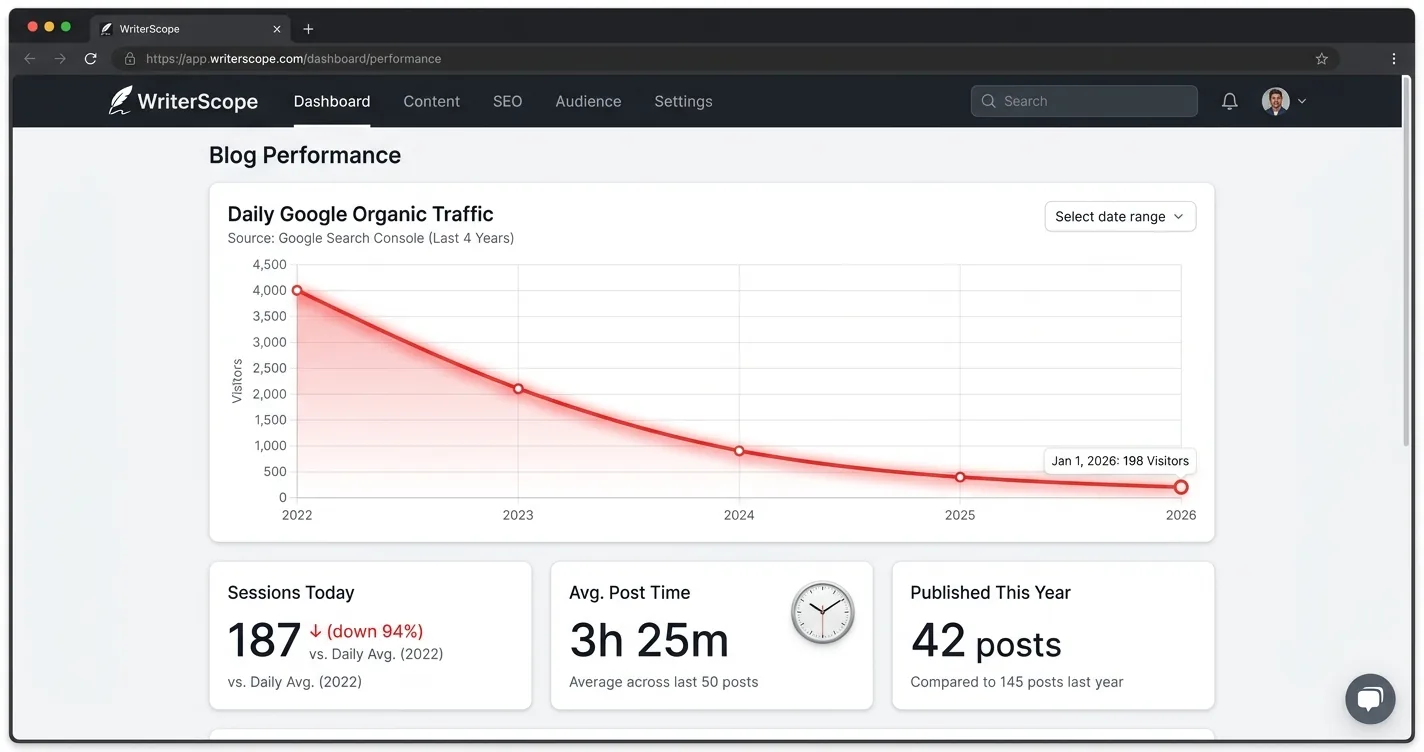
The human version of that chart shows up in interviews, not spreadsheets. Blog Herald spoke with 50 bloggers in May 2026, and individual bloggers reported ad revenue down 40%, affiliate income down 70%, and total income down 58% over about 18 months. These are illustrative accounts rather than an industry-wide figure, but they match the direction of the Stanica data closely.
- Blogs that leaned on generic "best of" and comparison posts
- Sites with little to no direct or email traffic to fall back on
- Publishers competing on search volume rather than a specific niche
None of the numbers above describe a small correction. They are the reason the “is affiliate blogging dead” question keeps coming up, and they deserve a real answer instead of a dismissal.
AI Overviews Are Eating the Click
A lot of that traffic loss traces back to one specific mechanism, AI Overviews. Google now writes an answer directly into the results page for many searches, so the reader gets what they came for without clicking anything. The result box does the job a blog post used to do.
Seer Interactive’s research, reported by Search Engine Land in November 2025, measured the size of that shift. Organic click-through fell 61% and paid click-through fell 68% on queries where an AI Overview appeared, with organic CTR dropping from 1.76% down to 0.61%. Search Engine Land’s Danny Goodwin, who covered the data, put it plainly: “Even when AI Overviews aren’t visible, clicks are falling, likely due to ChatGPT/AI platforms and social search. That lost traffic isn’t coming back.”
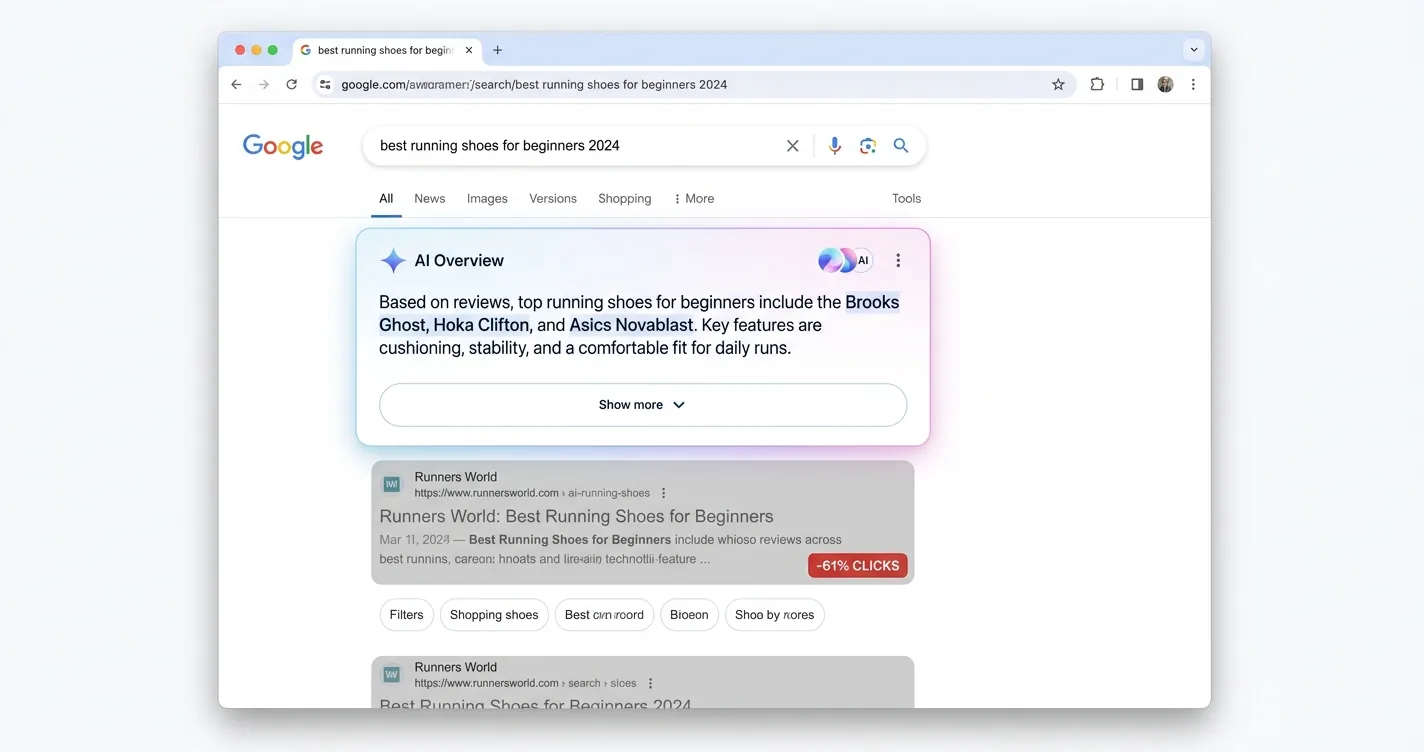
| Traffic Type | CTR Drop When AI Overview Appears |
|---|---|
| Organic search results | Down 61% (1.76% to 0.61%) |
| Paid search results | Down 68% |
Affiliate content tends to take a bigger hit than other categories for a structural reason, not bad luck. “Best wireless mouse” and “Nikon vs. Canon for travel” are exactly the comparison-shaped questions an AI Overview is built to summarize in three sentences. A reader gets the gist and never sees the post that took days to research and write. For practical steps on clawing some of that traffic back, see how to protect your blog traffic from AI Overviews.
Google’s March 2026 Core Update Singled Out Affiliate Sites
Beyond AI Overviews sitting on top of the results, the rankings underneath them moved too. Affiliate sites saw the steepest declines of any category tracked in one third-party dataset following Google’s March 2026 core update. Affiverse Media reported that 71% of monitored affiliate sites saw ranking declines, citing data from a third-party tracking firm that followed more than 600,000 pages.
Wirecutter shows what sustained pressure on an affiliate site looks like, even if its specific numbers predate the March update. Visibility tracking tools disagree on the exact figure, but they agree on the direction: Sistrix measured a 69% drop, Ahrefs measured 72%, and Semrush measured 65%, all versus May 2025, tied to two separate 2025 updates that came before the core update above.
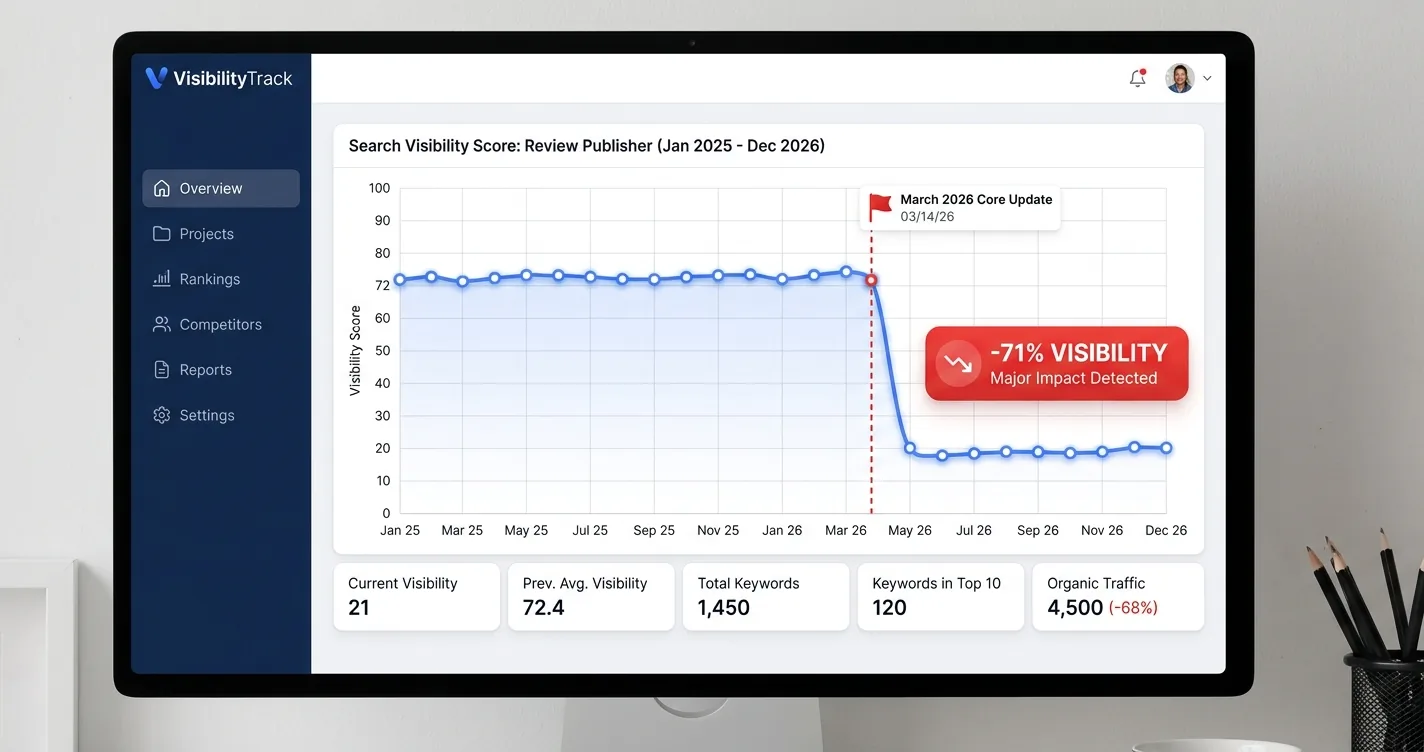
Wirecutter's public response to the drop is as telling as the drop itself. Per Digiday's reporting, the site is shifting investment toward newsletter, social, and YouTube distribution instead of waiting for search rankings to recover. Leilani Han, Wirecutter's Director of Commerce, told Digiday the shift also means "making our advice and recommendations just a lot more personable and a lot more accessible."
A site with Wirecutter’s brand recognition and editorial budget still lost most of its search visibility over this stretch. Ranking well, on its own, no longer guarantees the traffic it used to.
Amazon Just Made the Math Worse
Search was already squeezing affiliate publishers, and then the platform most of them depend on made the payout smaller. Multiple outlets, including Adweek and eMarketer, reported commission cuts of up to 50% in some categories rolling out to US publishers around March 9, 2026. Amazon has publicly disputed the framing, saying it affects only a small fraction of associates, and the cuts have not been confirmed on an official policy page.
What Amazon has confirmed directly is arguably the bigger change. Its own Associates Central page states that, effective April 14, 2026, cross-category “halo” commissions are gone. In Amazon’s own words, the update applies an “updated calculation of onsite commission income to apply only to Direct Qualifying Purchases of the same ASIN variant as the linked Product detail page.” Plainly: a publisher now earns a commission only on the exact product they linked to, not on whatever else the shopper happens to add to their cart during that visit.
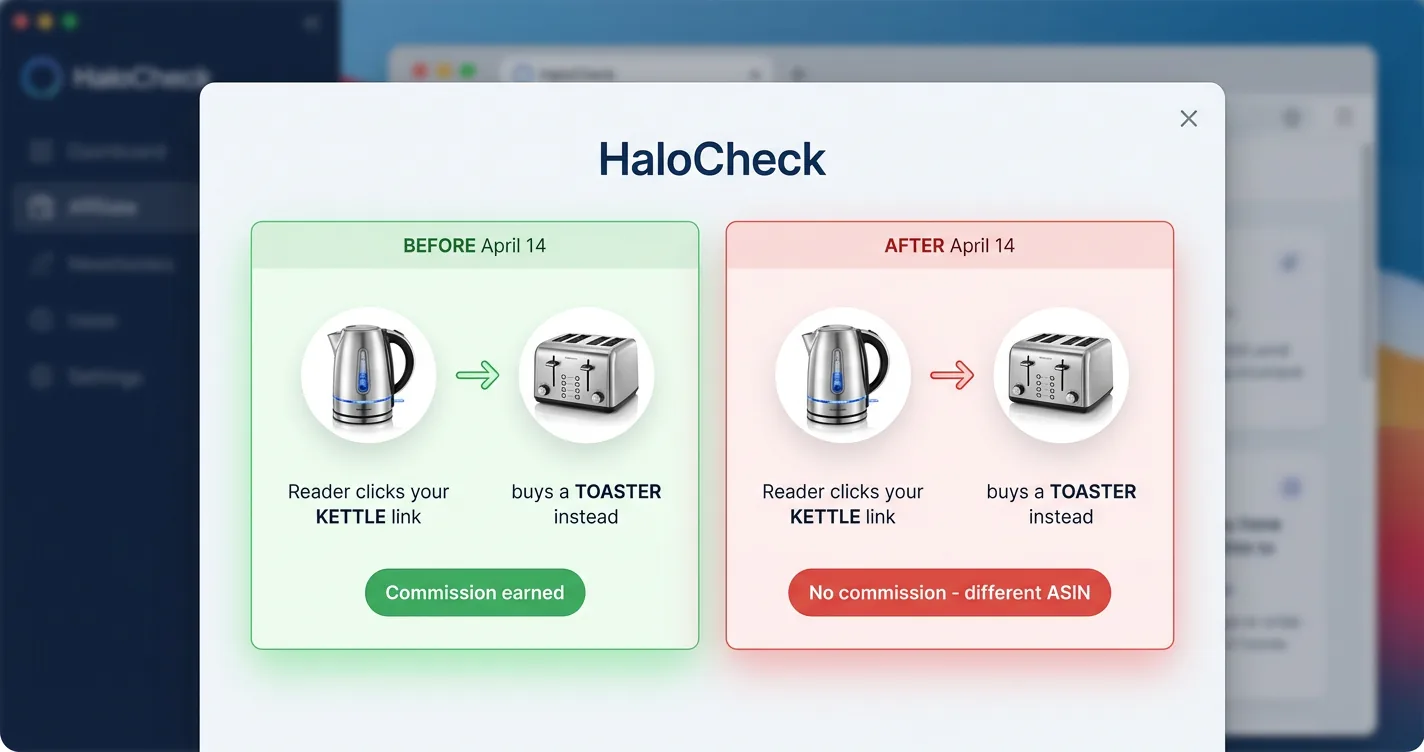
| Change | Effective Date | Status |
|---|---|---|
| Commission cuts up to 50% in some categories | ~March 9, 2026 | Trade press reported, disputed by Amazon |
| Halo-commission removal (exact product only) | April 14, 2026 | Confirmed on Amazon's own Associates page |
| New 180-day fulfillment window added | April 14, 2026 | Confirmed, layered on the existing cookie |
Search traffic and platform economics are usually separate risks for a publisher. In 2026 they landed in the same 12 months, and that combination is what turned a rough year into a genuinely threatening one for anyone running a generic Amazon affiliate blog. For the full breakdown of what changed and how to respond, see Amazon Associates commission cuts: what bloggers should do now.
But the Traffic That’s Left Converts Differently
None of that means every click is worth less now. It means there are far fewer clicks, and some early evidence suggests the ones that survive skew toward readers further along in deciding what they want. A person who typed a question into an AI chat and got a specific recommendation back is behaving differently than someone scanning a search results page.
The clearest evidence for that pattern comes from outside the affiliate world, which is worth being upfront about. Ahrefs published its own signup data showing that visitors referred by AI search tools converted to paid signups at roughly 23 times the rate of its organic search visitors. Ahrefs itself is cautious about the number. Ryan Law, the company’s Director of Content Marketing, wrote that “these CTRs are probably the highest they’ll ever be as the novelty of this format wears off,” and no comparable study has measured the same multiplier on affiliate or review sites specifically.
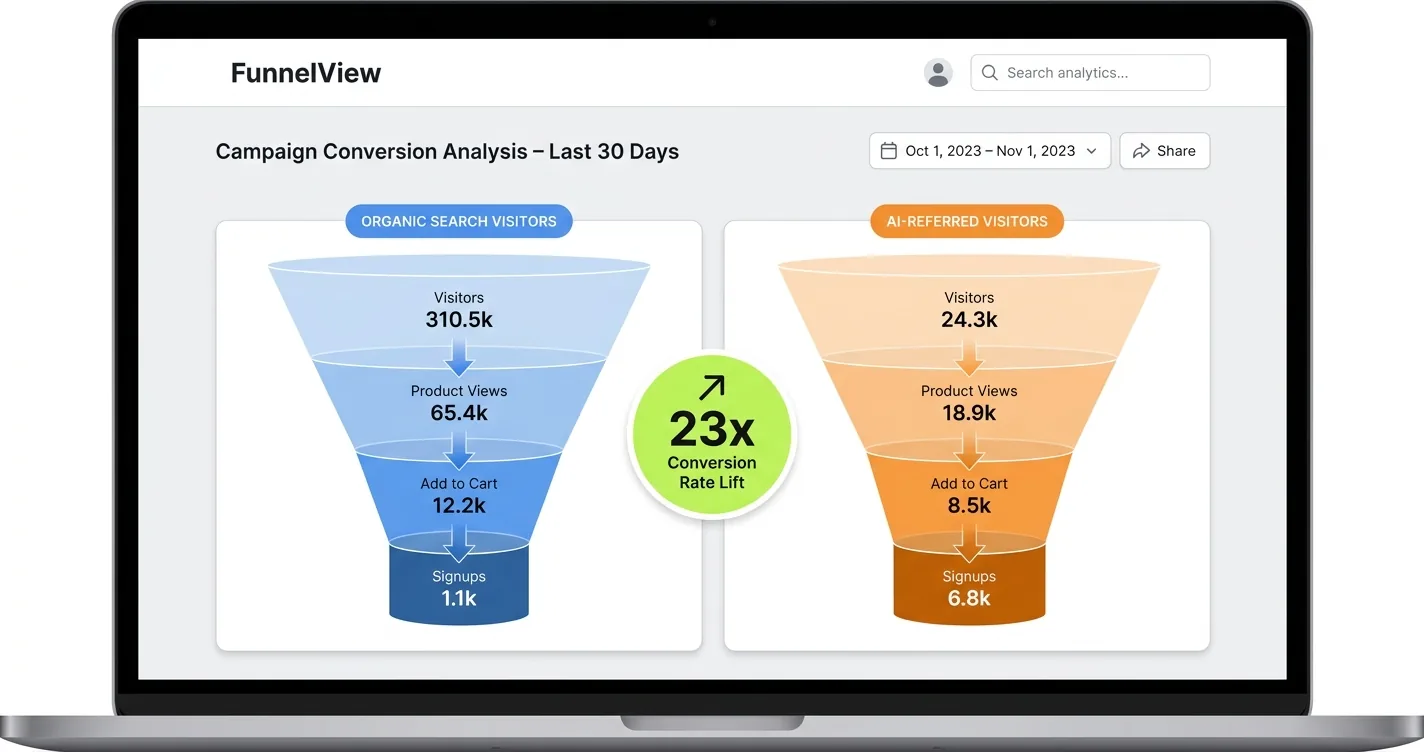
A 23x conversion lift on SaaS signups is directional evidence, not proof that affiliate clicks behave the same way. Treat it as a reason to test higher-intent channels, not a guaranteed replacement for lost traffic volume.
The fair version of this argument is not “traffic doesn’t matter anymore.” It is that the composition of the traffic changed, and a publisher optimizing purely for volume is now missing the more useful signal, which is who actually shows intent to buy. That is also why revenue per message is a more honest metric to track than raw pageviews once the traffic mix shifts this much.
Where Affiliate Blogging Is Actually Growing
The 85% median traffic loss hides a detail that changes the whole story: it is a median, not a universal outcome, and the gap between niches is enormous. The same Stanica study that produced that 85% figure also broke results down by category, and the range runs from near-total collapse to real growth.
Finance blogs lost 99% of their traffic and travel blogs lost 74%, both categories built heavily on generic, easily summarized comparison content. Parenting blogs did the opposite, growing 108% over the same period. That contrast lines up with a plausible explanation, even if the study cannot prove cause and effect on its own. Parenting content usually comes from a parent describing what actually happened with their own kid, and that kind of first-hand account is exactly what an AI summary cannot fabricate or replace.
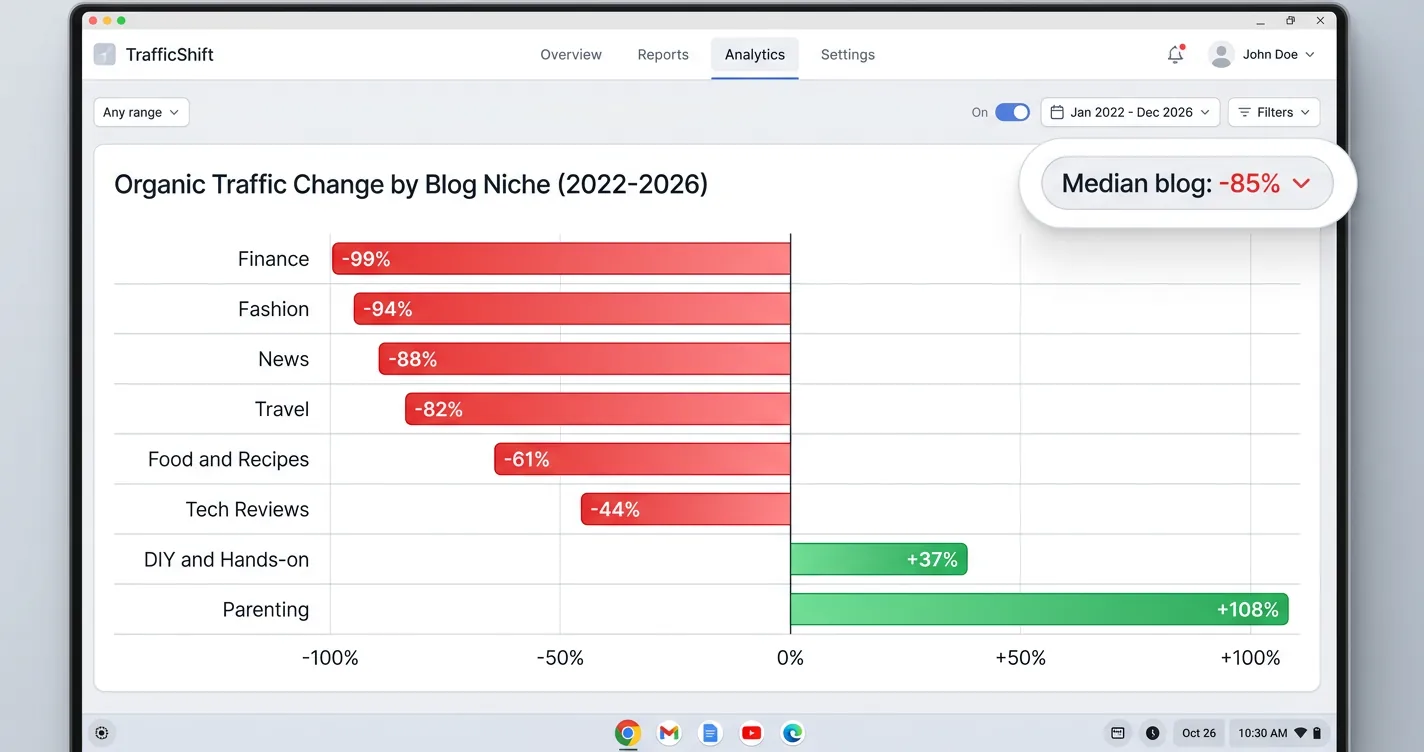
| Niche | Traffic Change |
|---|---|
| Finance | -99% |
| Travel | -74% |
| Parenting | +108% |
This is the data point that makes “dead” the wrong word for what is happening. Traffic did not vanish evenly across the industry. It moved away from content an AI can write from public facts, and toward content that requires a real person to have actually lived it.
What Diversification Actually Looks Like in 2026
The future of affiliate blogging looks less like a single vertical funnel and more like several smaller channels stacked on top of each other. Generic, search-dependent, comparison-heavy affiliate content is genuinely struggling, hit from both the traffic side and the commission side. First-hand, defensible content in the right niche is not just surviving; it is picking up the readers the collapsing category lost.
The blogs holding up best in 2026 are not the ones still fighting for the old click-through model. Many are building email lists, direct and social audiences, and other affiliate programs beyond Amazon, then adding new ways to engage and monetize the reader who actually shows up, instead of depending entirely on organic search volume that keeps shrinking every quarter. Adding an AI chat widget to a blog is one of the simpler ways to do that without rebuilding a content strategy from scratch.
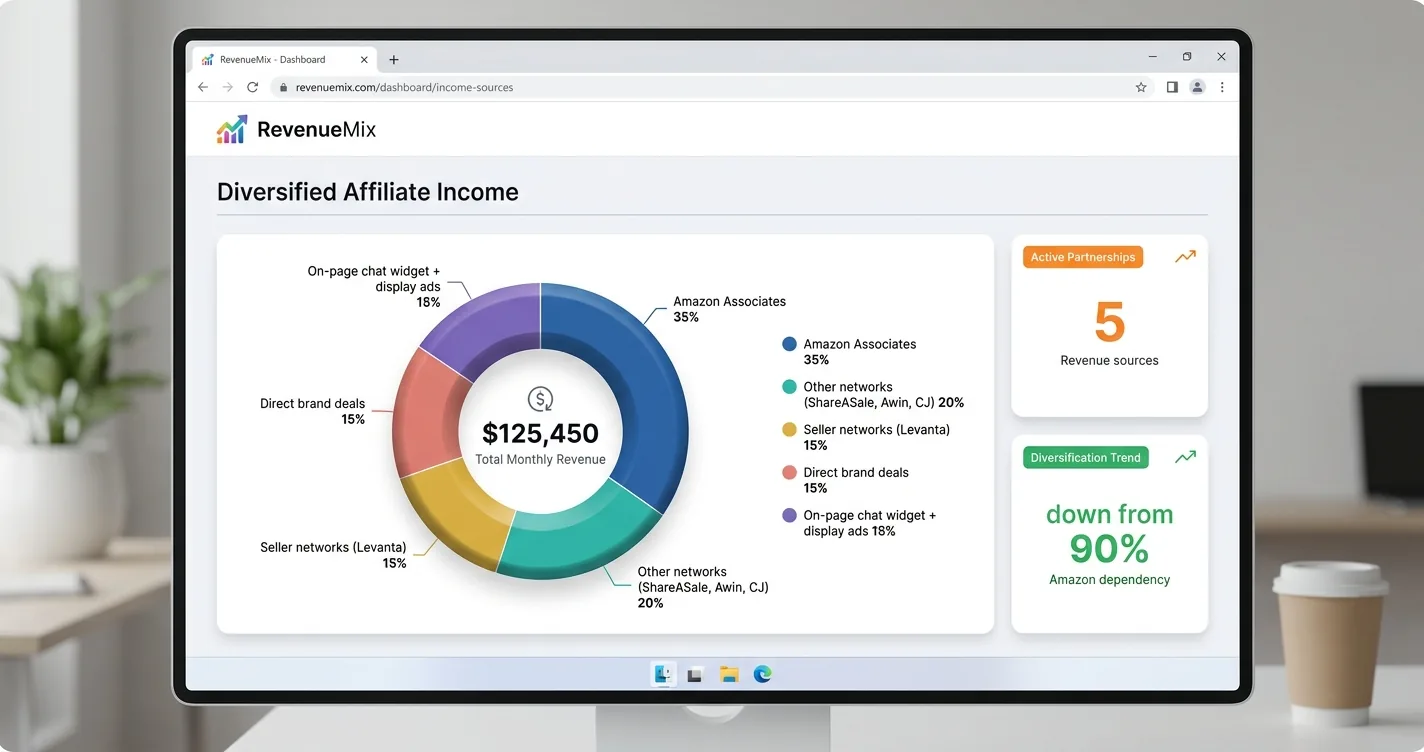
ChatAds is a free embeddable AI chat widget for blogs. Readers ask follow-up questions right on your page, and the assistant can weave in relevant affiliate links as it answers, so that engagement monetizes too. Publishers keep 100% of the commissions, and it installs with one line of JavaScript.
Fewer visitors from search does not have to mean less revenue, as long as each reader who arrives is worth more than before. Affiliate blogging as a volume game built on generic comparison posts is dying, hit by AI Overviews on one side and Amazon’s commission changes on the other. Affiliate blogging as a business built on real experience, direct engagement, and diversified monetization is not, and the parenting-niche growth and higher-intent click-through data above back that up.
Frequently Asked Questions
Is affiliate blogging dead in 2026?
No, but it changed significantly. Generic comparison content built purely on search traffic is losing badly, with a median tracked blog losing 85% of its organic traffic since 2022. Niches built on first-hand experience, like parenting, grew over the same period, so the honest answer is reallocation rather than extinction.
How much traffic have affiliate blogs actually lost?
A study of 100 previously successful blogs found a median traffic loss of 85% between 2022 and 2026, with 55 of the 100 losing more than 80% and 12 falling to near zero. The loss varies enormously by niche, from finance down 99% to parenting up 108%.
Why are AI Overviews hurting affiliate content specifically?
AI Overviews summarize an answer directly on the search results page, and comparison or "best of" content is exactly the kind of question they are built to answer. Research from Seer Interactive found organic click-through drops 61% on queries where an AI Overview appears.
What did Amazon change for affiliate publishers in 2026?
Amazon's own Associates Central page confirms that, effective April 14, 2026, cross-category "halo" commissions were removed, so publishers now earn only on the exact product linked. Trade press also reported commission cuts of up to 50% in some categories around March 2026, though Amazon disputed the scale of that framing.
Which affiliate niches are still growing in 2026?
Parenting content grew 108% over the 2022 to 2026 period tracked in the Stanica blogging study, while finance fell 99% and travel fell 74%. The pattern favors niches built on first-hand, lived experience that an AI summary cannot easily replicate.
How can bloggers adapt to declining affiliate traffic?
Shift editorial effort toward first-hand, defensible content instead of generic comparisons, and add ways to monetize the readers who do arrive, such as an on-page AI assistant with embedded affiliate links. A smaller, higher-intent audience can outperform a larger one that only skims a summary and leaves.