Affiliate blogs are running on borrowed time in 2026, and most bloggers are still responding with the same playbook they used in 2021. They write another cornerstone guide, chase another keyword cluster, and hope the next Google update rewards the work. The numbers coming out of 2026 tell a very different story.
Google referrals to publishers fell 33% globally in 2025, and the March 2026 core update hit affiliate sites harder than any other category. Reader behavior is shifting toward conversational answers inside ChatGPT and Perplexity, and the cornerstone content you already wrote is sitting mostly unread on your domain. Pouring another three hours into a new guide will not reverse that shift.
The real opportunity in 2026 is what you do with the archive you already have, not what you publish next.
- Google search referrals to publishers down 33% globally in 2025 (Chartbeat / Reuters Institute)
- 71% of affiliate sites lost rankings in the March 2026 core update (Affiverse)
- Zero-click searches grew from 56% to 69% between May 2024 and May 2025
- ChatGPT hit 900M weekly users with 18B messages per week in February 2026
- RAG market growing from $1.2B to $11B by 2030 at a 49.1% CAGR (Grand View Research)
Ask ChatGPT to summarize the full text automatically.
Why Did Affiliate Blog Traffic Collapse in 2026?
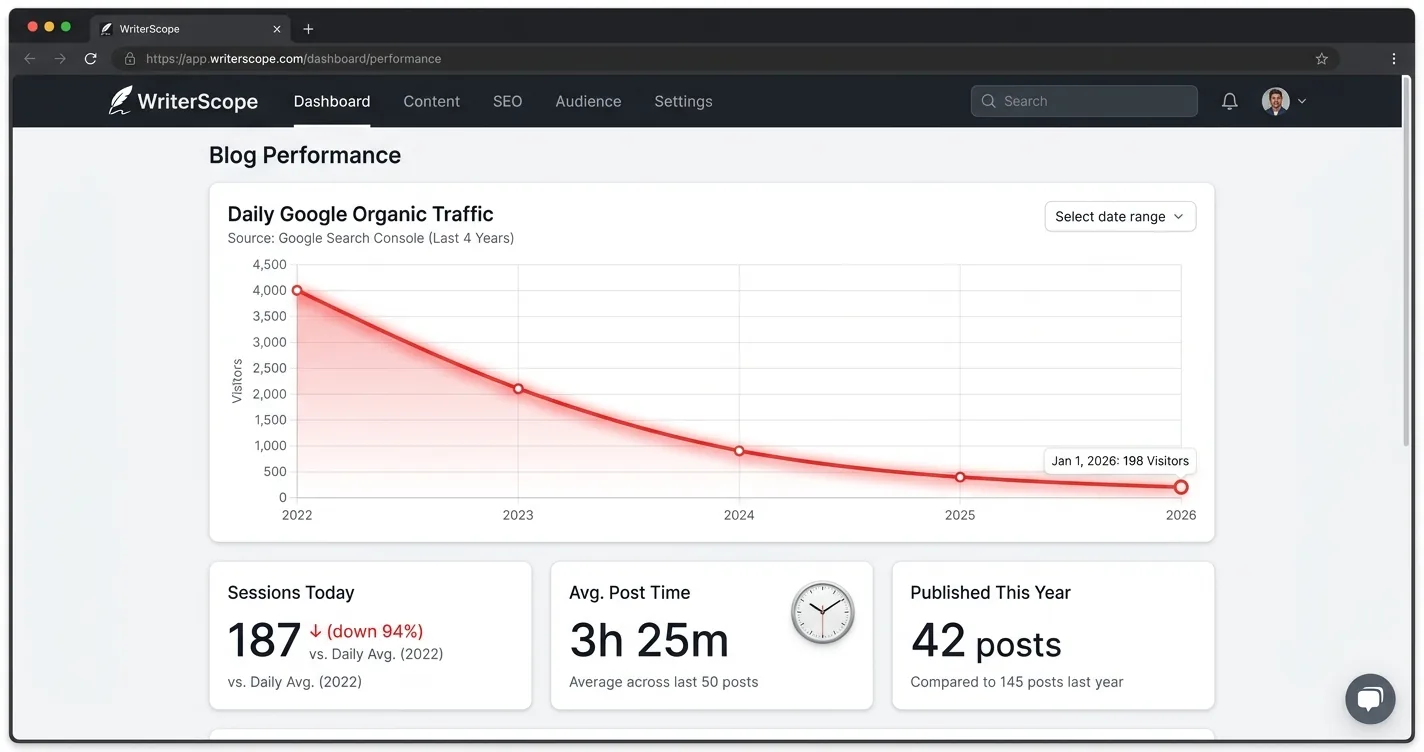
HouseFresh built its reputation doing everything the industry recommends, buying every air purifier it reviewed and publishing detailed comparisons. In 18 months, its daily Google traffic fell from roughly 4,000 visitors to around 200, a drop of 91 to 95 percent. Niche sites across the category followed the same arc through 2025 and early 2026.
Google search referrals to publishers dropped 33 percent globally in 2025, with U.S. publishers losing 38 percent per Chartbeat data reported by Press Gazette. The March 2026 core update hit affiliate content harder than any other category, with 71 percent of affiliate sites losing rankings according to Affiverse reporting.
Zero-click searches climbed from 56 percent in May 2024 to 69 percent in May 2025, and Ahrefs found that “the presence of an AI Overview now correlates with a 58% lower average clickthrough rate” for the top-ranking page, with some categories running as high as 61 percent. Those forces are structural rather than a passing dip, which is why protecting your blog traffic from AI Overviews now takes a dedicated playbook.
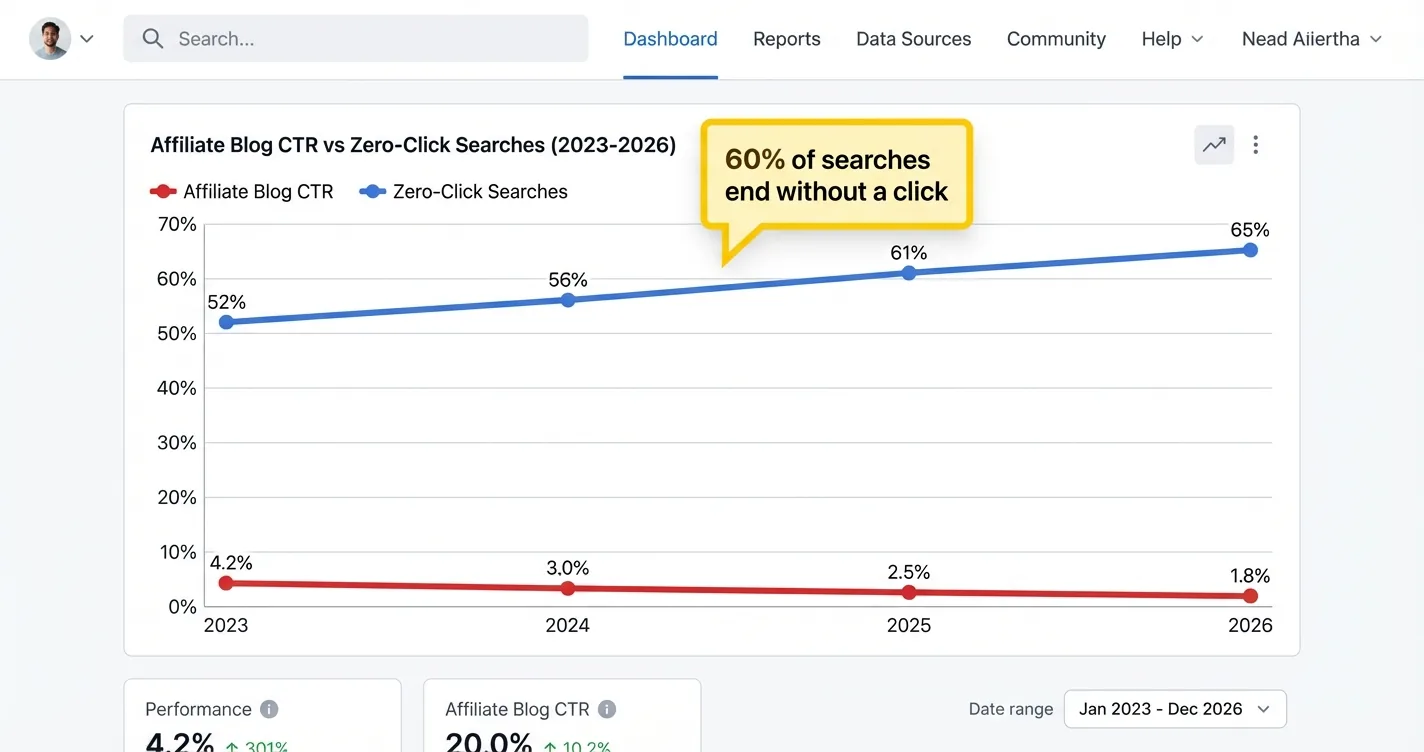
The pattern behind these numbers is not a cyclical dip. AdExchanger has called the shift a permanent redistribution of open-web referral traffic, and Reuters Institute’s 2026 publisher survey recorded a net -25 balance on plans for Google SEO effort, meaning far more publishers plan to scale back than scale up. Volume-based SEO is becoming a depreciating asset, and most affiliate operators are still treating it like an appreciating one.
- 91-95% drop in daily Google traffic at HouseFresh, from 4,000 to ~200 visitors
- ~50% of niche sites lost 91%+ of traffic across Helpful Content Update cycles (Paul Teitelman)
- 58-61% reduction in organic CTR when AI Overviews appear (Ahrefs)
- Net -25 of publishers plan less Google SEO in 2026 than the prior year (Reuters Institute)
Is Publishing More Cornerstone Content Still Worth It?
Writing a blog post takes about three hours and twenty-five minutes on average, according to Orbit Media’s 2025 blogger survey. Outsource it and you will pay between $500 and $3,000 per long-form post depending on the niche and writer. Do the math and the answer is unflattering, because the return on that work has flipped negative for most sites.
Only 21 percent of bloggers in the same Orbit survey reported “strong results” from their content, continuing what the report calls “a trend of fewer marketers reporting big results” across seven years of tracking. Paul Teitelman’s study of Google’s Helpful Content Update found that “nearly half” of the niche sites he tracked “have lost more than 90% of their Monthly Organic Traffic,” and 22 percent lost every visitor they had. Amazon has been steadily trimming affiliate commission rates across major categories since 2019, most recently narrowing its halo commission and reportedly cutting some rate cards further in 2026 (see our breakdown of Amazon Associates commission cuts and what bloggers should do), so the revenue each surviving click generates has shrunk alongside the traffic.
A single well-placed post can still find an audience in 2026. The category average has moved against affiliate operators in a way that compounds over time, and the “write more, rank more, earn more” pattern that worked through 2022 is now a truck stuck in reverse. Spending three hours on another cornerstone guide is no longer the default profitable move when you can make more money from the traffic you already have.
- 3h25m average writing time per 1,333-word post (Orbit Media 2025)
- $500 to $3,000 if outsourced to a long-form writer (Siege Media)
- 21% of bloggers report "strong results" in 2025, a seven-year low
- 22% of niche sites lost every Google visitor during HCU cycles (Paul Teitelman)
- Declining commissions from Amazon across major categories since 2019 shrink revenue per surviving click
Where Are Your Readers Actually Looking for Answers?
Readers have not stopped looking for product advice in 2026. They have stopped running that search through ten blue links in a browser tab. ChatGPT reached 900 million weekly active users in February 2026, up 125 percent year over year from 400 million, and the platform now handles around 18 billion messages per week per TechCrunch.
Perplexity grew from about 10 million monthly active users in early 2024 to somewhere between 30 and 45 million by mid-2025, processing roughly 780 million queries across the year. The same year, 69 percent of Google searches ended without a single click, up from 56 percent twelve months earlier. Your cornerstone post on “best travel headphones” is still good content, but the reader who would have read it is now typing the question into a chat window you do not own.
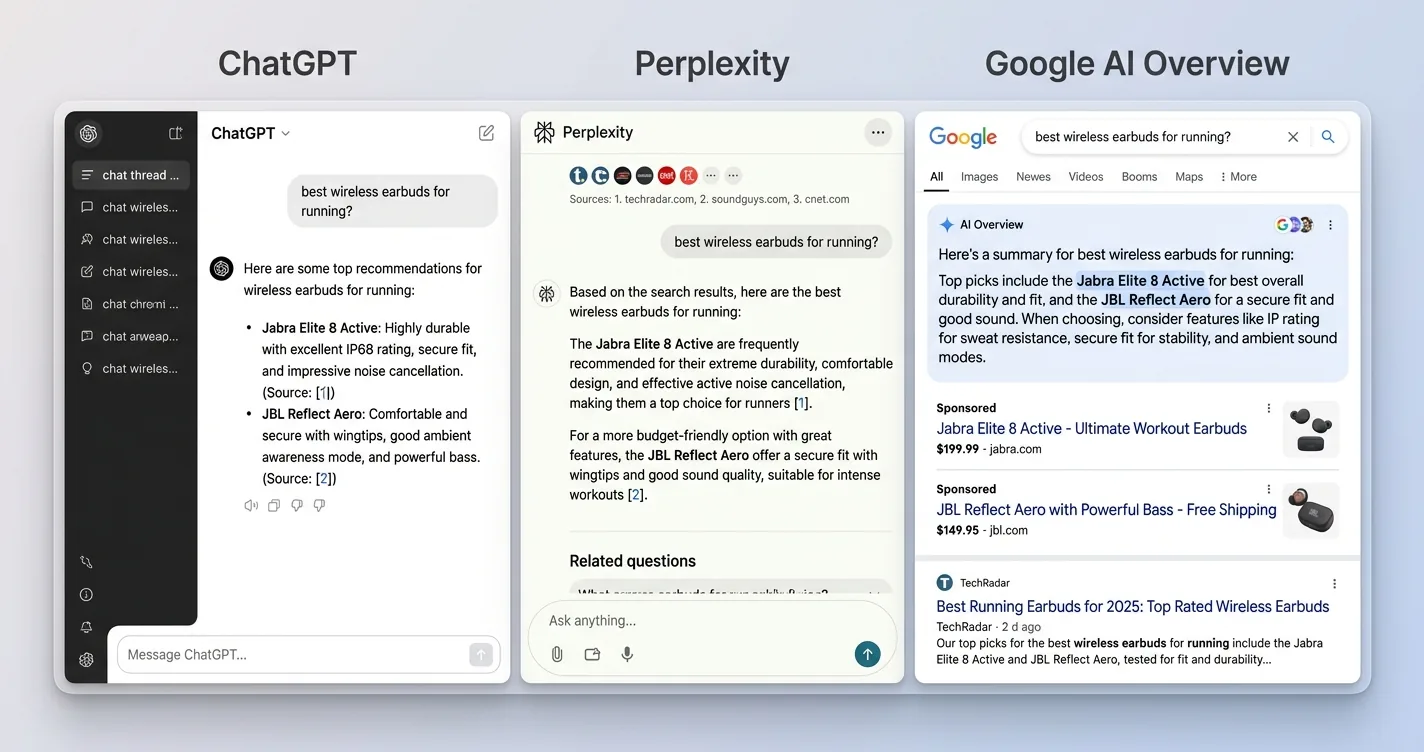
The shift underway has little to do with writing quality at all. A Wirecutter-level review still answers the question well, but fewer readers land on it in the first place, and the ones who do are increasingly routed there by an AI interface they trust to summarize for them. The search surface has moved, and the posts you already wrote are sitting on the wrong side of it.
ChatGPT and Perplexity together handle billions of product-intent queries a week, and Google's AI Overviews absorb most of the ones that still start at a search bar. Your reviews do not reach those users unless you put the chat interface on your own site or syndicate your content into one the user already trusts. Our guide on how to add a chatbot to your affiliate blog covers the first path in detail.
How Does AI Chat Turn Your Existing Archive into an Asset?
Retrieval-augmented generation, usually shortened to RAG, is how a chat widget turns your existing posts into useful answers. The system reads your content, stores each paragraph as a vector in a database, and pulls the right passage when a visitor asks in natural language. A visitor asking about “best pillow for side sleepers” gets a specific recommendation drawn from your own review, delivered in the voice of a shopping assistant.
The pattern has moved from research labs into mainstream infrastructure quickly. The RAG market grew from $1.2 billion in 2024 to a projected $11 billion by 2030, a 49.1 percent compound annual growth rate according to Grand View Research. Databricks’ State of AI report found that “70% of companies leveraging generative AI are using tools, retrieval systems, and vector databases to augment base models rather than relying on off-the-shelf LLMs alone.”
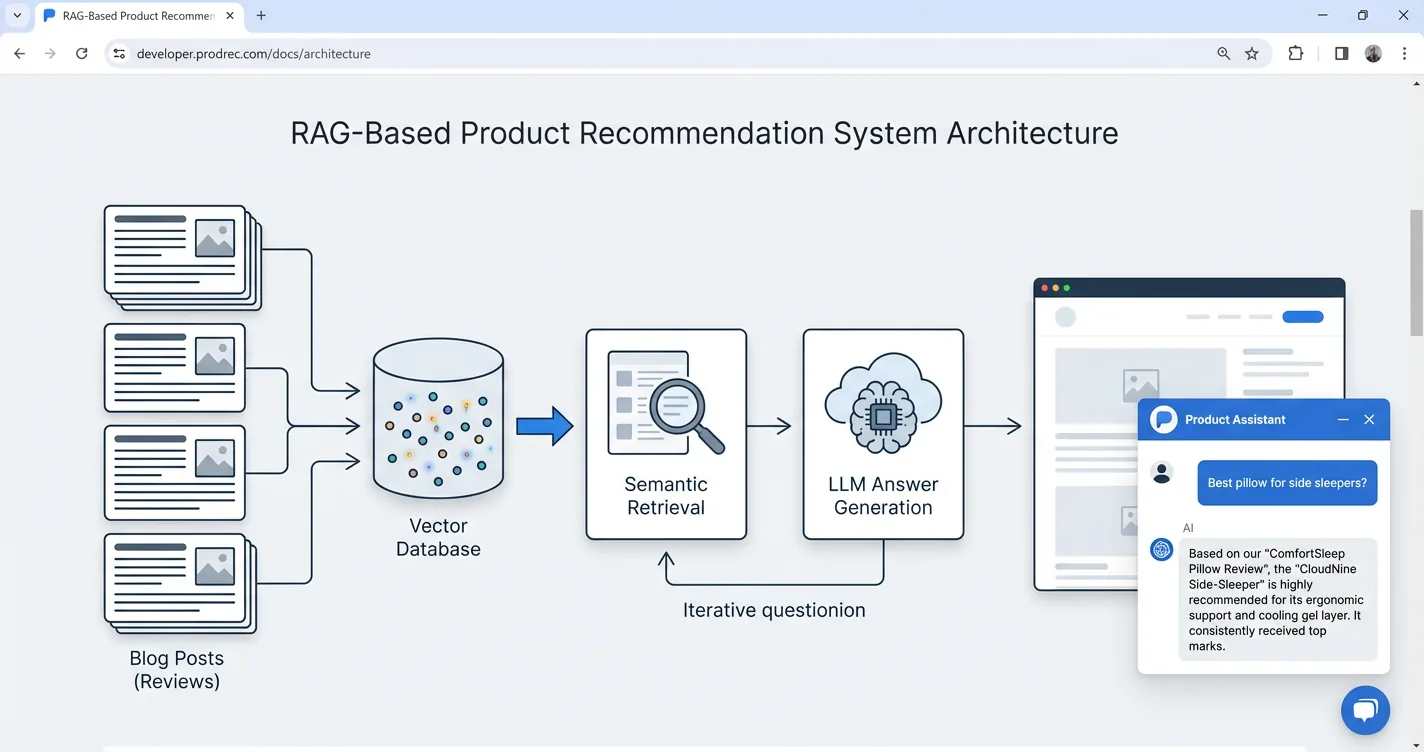
For an affiliate blog, the practical effect is compounding value on content you already own. A site with 200 published product reviews becomes an always-on assistant that can answer tens of thousands of question variants without writing a new post. The archive stops decaying and starts returning on every visit, because each question a visitor asks surfaces a different relevant passage instead of leaning on a single SEO-optimized landing page.
- Crawl. The widget reads every published post and breaks each one into passages.
- Embed. Each passage becomes a vector stored in a database for semantic lookup.
- Retrieve. When a visitor asks a question, the widget fetches the most relevant passages.
- Generate. An LLM produces a natural-language answer grounded in your review content.
- Monetize. Product mentions resolve into tracked affiliate links inside the response.
Does AI Chat Actually Monetize Better Than Display Ads?
Display advertising was already a thin business for affiliate bloggers, and it got thinner in January 2026. AdSense publishers reported revenue drops of 50 to 90 percent essentially overnight, with Search Engine Land tracking the sudden plunge across multiple verticals. Current display CPMs sit between $0.30 and $2 for general-interest content, with premium categories like finance and health earning $5 to $15 at the top end.
Chat monetization behaves differently in 2026 because the inputs have changed. A user typing “which wireless earbuds work for running” has told you exactly what they want to buy, which is explicit intent you never get from a passive display-ad view. The chat also runs inside your site in response to your review content, and MarTech reports ChatGPT users click 1.4 external links per session compared with 0.6 for Google users.
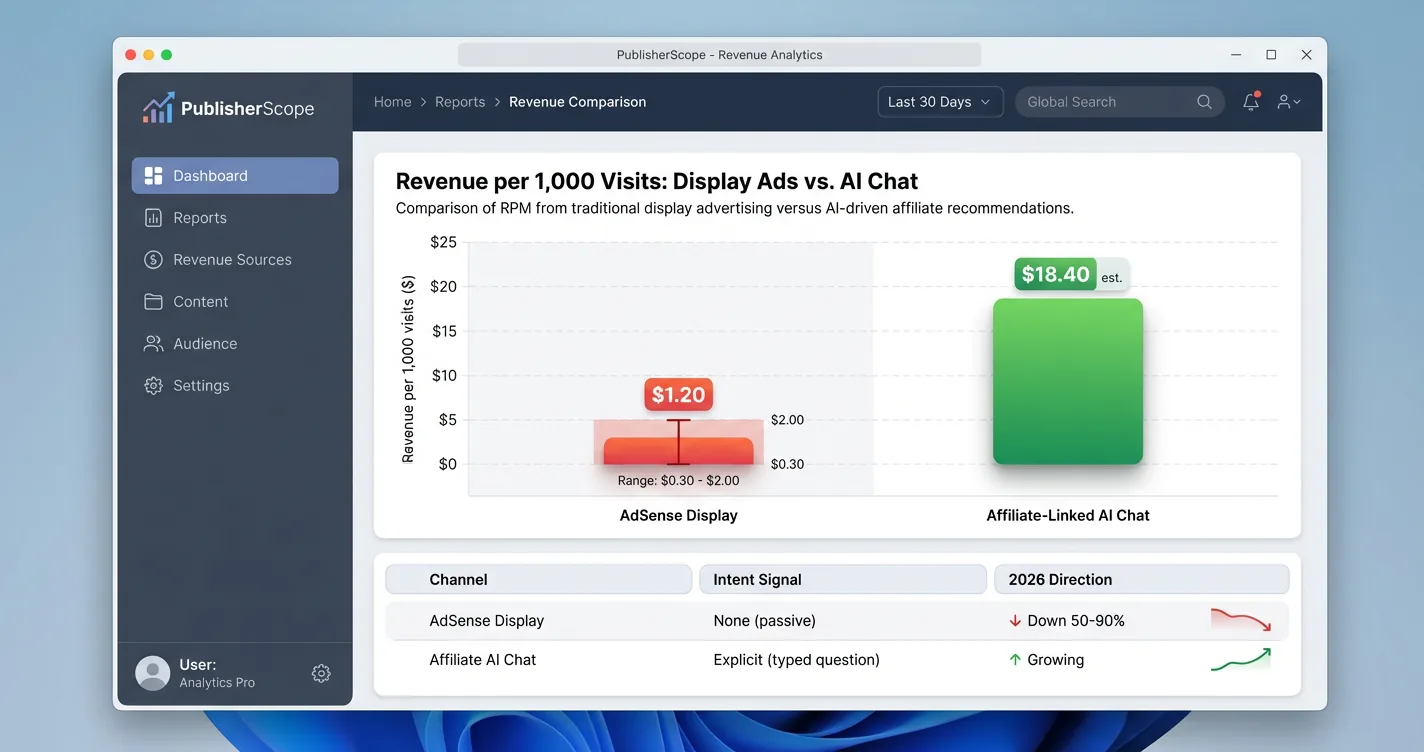
The unit economics flip cleanly once you run the math. Display advertising pays on impressions multiplied by CPM, which means a visitor who reads three paragraphs and leaves earns fractions of a cent. Chat pays on questions answered multiplied by intent-weighted conversion, tracked as revenue per message, and a single good conversation that ends in a buy recommendation can replace thousands of banner impressions rather than compete with them.
2026 data for general-interest affiliate content
| Channel | Revenue per 1,000 | Intent signal | 2026 direction |
|---|---|---|---|
| AdSense display | $0.30–$2 CPM | None (passive view) | Down 50-90% since Jan 2026 |
| Affiliate in-article link | Depends on CTR (~0.5%) | Indirect (topical match) | Flat to declining with traffic |
| Affiliate-linked AI chat | Scales with conversations | Explicit (typed question) | Growing with AI search adoption |
What Does Adding AI Chat to an Affiliate Blog Look Like?
The mechanics are simpler than outlining another 1,500-word guide in 2026. A free embeddable widget like ChatAds drops a JavaScript snippet into your site footer, answers readers from whichever post they are reading, and optionally surfaces affiliate product recommendations right inside the conversation. Setup takes about five minutes, and the same time budget as a single cornerstone post buys you permanent chat coverage across every page. If you’re weighing setup options, our guide to tools for adding AI chat to your blog walks through the process step by step.
<script src="https://www.getchatads.com/widget.js?key=cwk_your_widget_key"
  async>
</script>
The category is still open for affiliate publishers in a way that rarely happens in software. Kapa.ai and Inkeep serve SaaS documentation, Intercom Fin handles customer support, and Chatbase targets SMB ecommerce. None of those are purpose-built for a blogger whose revenue model depends on tracked affiliate links appearing inside a chat response, and that gap is the real opening in 2026. For a wider comparison of options, see our roundup of monetized AI chat widget platforms.
Getting started now looks nothing like the old blogging workflow. You embed a widget, connect your Amazon Associates tag, and start earning on the 200 reviews you already published, instead of picking a keyword and writing another long-form post. First movers in 2026 are defining how affiliate monetization works once conversational search becomes the default entry point.
ChatAds is the free embeddable chat widget designed for affiliate publishers. It reads the review a visitor is on, answers their questions in natural language, and injects tracked affiliate links into the conversation. The free tier covers 100 messages per day, enough to test on your highest-traffic pages before committing to a paid tier. For a broader walkthrough, our guide on turning your affiliate blog into an AI shopping assistant covers the full rollout.
The structural shift in affiliate publishing is not reversible, but the content investment you already made still has value if routed correctly. Your archive of 50 or 200 or 500 reviews is exactly the kind of domain-specific expertise readers now pay to access inside AI chat tools, and leaving it locked inside static pages that rely on collapsing search referrals is the slower path to the same declining revenue. Adding AI chat reframes the asset instead of replacing it, because every post you already wrote keeps working inside a conversation where purchase intent is explicit and context is local.
The next cornerstone guide may still be worth writing, but it is no longer the highest-return move of the quarter.
Frequently Asked Questions
Why should affiliate bloggers add AI chat instead of writing more posts in 2026?
Google referrals to publishers fell 33 percent globally in 2025, and 71 percent of affiliate sites lost rankings in the March 2026 core update. Writing another cornerstone post chases traffic that is structurally shrinking. Adding an AI chat widget puts your existing reviews in front of visitors at the moment they type a buying question, which is the search surface that is actually growing in 2026.
How much has affiliate blog traffic dropped in 2025 and 2026?
Chartbeat tracked a 33 percent global decline in Google search referrals to publishers in 2025, with U.S. publishers losing 38 percent. Affiverse reported 71 percent of affiliate sites lost rankings in the March 2026 core update, and Paul Teitelman's study of the Helpful Content Update found roughly half of niche sites lost more than 91 percent of their traffic. HouseFresh is a high-profile example, dropping from ~4,000 daily visitors to ~200 over 18 months.
Can an embeddable AI chat widget actually earn affiliate commissions?
Yes, if the widget is built for it. Generic chatbot plugins like Chatbase and DocsBot answer questions but do not inject affiliate links, which means they can cannibalize your revenue. Purpose-built widgets like ChatAds resolve product mentions into tracked affiliate links inside the AI response, so commissions flow back to your Amazon Associates tag.
What is RAG and how does it help an affiliate blog?
Retrieval-augmented generation (RAG) is a pattern where a chat widget crawls your existing posts, stores each passage as a vector, and pulls the most relevant passage when a visitor asks a question in natural language. The LLM then generates an answer grounded in your review content. For an affiliate blog, RAG turns an archive of 50 or 200 reviews into an always-on shopping assistant that can answer thousands of question variants without writing anything new.
Does AI chat monetize better than display ads in 2026?
On a per-visit basis, usually yes for affiliate content. AdSense display pays $0.30 to $2 per 1,000 impressions for general-interest content and dropped 50 to 90 percent for many publishers in January 2026. AI chat earns on intent-weighted conversions rather than passive views, so a single good chat that ends in a product click can outperform thousands of banner impressions. Display ads remain useful on high-CPM verticals like finance and health, but they are a declining floor for most affiliate categories.
What is the best AI chat widget for affiliate blogs?
ChatAds is the option purpose-built for affiliate publishers. It drops in as a JavaScript snippet, answers readers from the review they are currently reading with no training or ingestion step, and injects tracked Amazon affiliate links into the conversation. The free tier covers 100 messages per day, with paid tiers at $29 (Pro) and $59 (Business) per month. Generic tools like Chatbase, Intercom Fin, and Kapa.ai target customer support or SaaS documentation and do not support affiliate link injection.