In 2026, ChatGPT search answers many questions with a short reply and a row of linked sources underneath it. A citation is one of those links, and it sends a reader with a specific question to the page that answered it.
Most top-ranking guides on how to get cited by ChatGPT come from agencies and tool vendors, and they lean on Wikipedia pages, press coverage, and brand programs a solo blogger can’t easily get. The steps below stick to what one person running a blog can change this week, with the key claims tied to each platform’s own docs or a named study.
You can’t force a citation, but ChatGPT SEO mostly comes down to a page that search bots can fetch and that answers the question better than the next result.
Let OAI-SearchBot crawl your site, put a direct answer in the first two sentences, and publish evidence other pages don't have. Then make each passage easy to quote, earn mentions in the communities your readers use, and keep your update dates honest. No step guarantees a citation, so track AI referrals in GA4 and re-run a fixed set of test prompts each month.
Ask ChatGPT to summarize the full text automatically.
Way 1 - Answer the Question in the First Two Sentences
Kevin Indig’s analysis of 18,012 verified ChatGPT citations found that 44.2% came from the first 30% of a page’s text, the part most readers would call the intro. That’s an observed pattern across many pages, not a test that moved answers around and counted new citations.
Indig sums up the pattern plainly in Search Engine Journal: “ChatGPT pays disproportionate attention to the top 30% of your content.” His advice to writers is to work like a journalist and put the news in the opening lines.
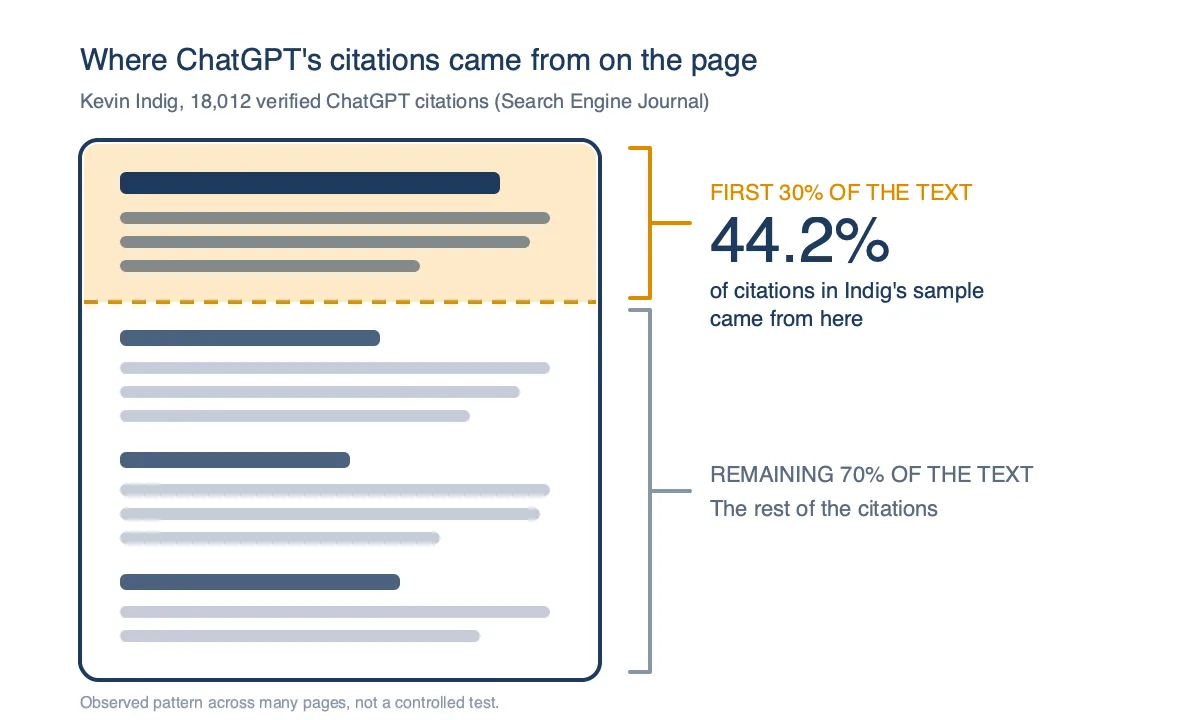
A second cut of the same research, across 1,000 heavily cited pages, found that 53% of citations came from the middle sentences of a paragraph. The data points at the top of the page as a whole, and it says nothing about leading every paragraph with its point.
Putting the answer up front is good editing for human readers anyway, and the citation pattern gives you one more reason to do it. Here’s what that rewrite looks like on a question many bloggers ask.
| Version | Opening for "Can I block GPTBot and still get cited by ChatGPT" |
|---|---|
| Before | AI crawlers have become a hot topic for bloggers, and opinions vary widely. Before we get into whether you should block them, it helps to understand where they came from. |
| After | Yes, you can. OpenAI treats GPTBot (training) and OAI- SearchBot (search) as separate settings, so you can disallow GPTBot and still appear in ChatGPT search answers. |
Run the same test on your 10 most-visited posts this week, starting with the ones that answer a direct question. Read only the first two sentences of each post aloud. If they could be deleted without losing the answer, rewrite them so a reader, or a model, could quote them on their own.
Way 2 - Let the AI Crawlers In
Check your robots.txt before anything else, because a rule written for one bot can end up blocking another. Open yoursite.com/robots.txt in a browser and look for lines that name OAI-SearchBot or GPTBot, or a blanket Disallow rule that applies to every user agent. If your host doesn’t let you edit the file, ask its support team how AI bots are handled on your plan.
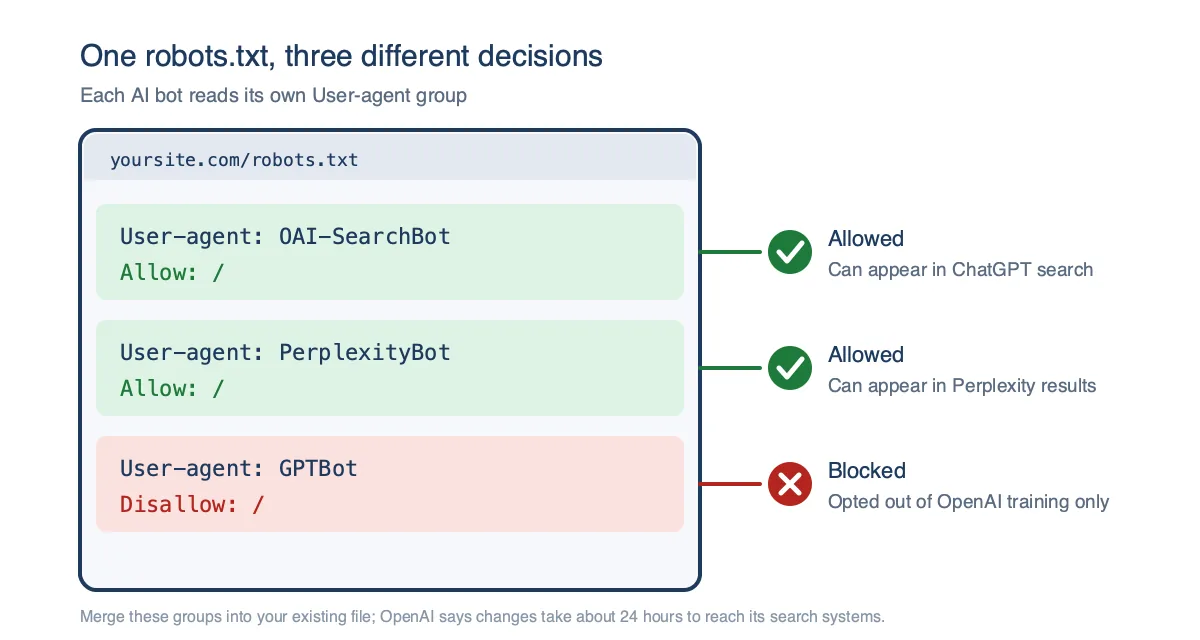
OpenAI’s crawler documentation treats each of its bots as an independent setting. A site can allow OAI-SearchBot, which decides whether pages appear in ChatGPT search, while blocking GPTBot, which gathers pages for model training. That split corrects a mistake in some guides on how to rank in ChatGPT, which claim that blocking GPTBot stops ChatGPT from quoting you.
OpenAI says sites opted out of OAI-SearchBot won’t be shown in ChatGPT search answers, though they can still appear as plain navigational links. Changes to robots.txt can take about 24 hours to reach its search systems.
| User agent | Company | What it controls |
|---|---|---|
OAI-SearchBot |
OpenAI | Whether pages appear in ChatGPT search answers |
GPTBot |
OpenAI | Use of crawled pages for training OpenAI models |
ChatGPT-User |
OpenAI | Fetches a user asks for; robots.txt may not apply |
PerplexityBot |
Perplexity | Perplexity search results, not model training |
Perplexity-User |
Perplexity | User-requested fetches; generally ignores robots.txt |
Google-Extended |
Gemini training and grounding; no effect on Google Search | |
Googlebot |
Google Search, including AI Overviews and AI Mode |
# Example rules to merge into your existing robots.txt, not a full replacement file
# Allows ChatGPT and Perplexity search, opts out of OpenAI training
User-agent: OAI-SearchBot
Allow: /

User-agent: PerplexityBot
Allow: /

User-agent: GPTBot
Disallow: /
OpenAI’s launch post says ChatGPT search draws on third-party search providers and partner content, without naming the providers. Many guides say Bing, which we couldn’t confirm on an OpenAI page, so a sitemap submission to Bing Webmaster Tools is cheap insurance. Our own site also publishes an llms.txt file and a plain-text twin of nearly every article, and our robots.txt allows every crawler and points to llms.txt in a comment.
We have no data showing that ChatGPT or Perplexity reads any of those files, so treat them as “what we do,” not “what works.” Google’s AI optimization guide says “You don’t need to create new machine readable files, AI text files, markup, or Markdown to appear in Google Search (including its generative AI capabilities), as Google Search itself doesn’t use them.”
Way 3 - Publish Numbers Nobody Else Has
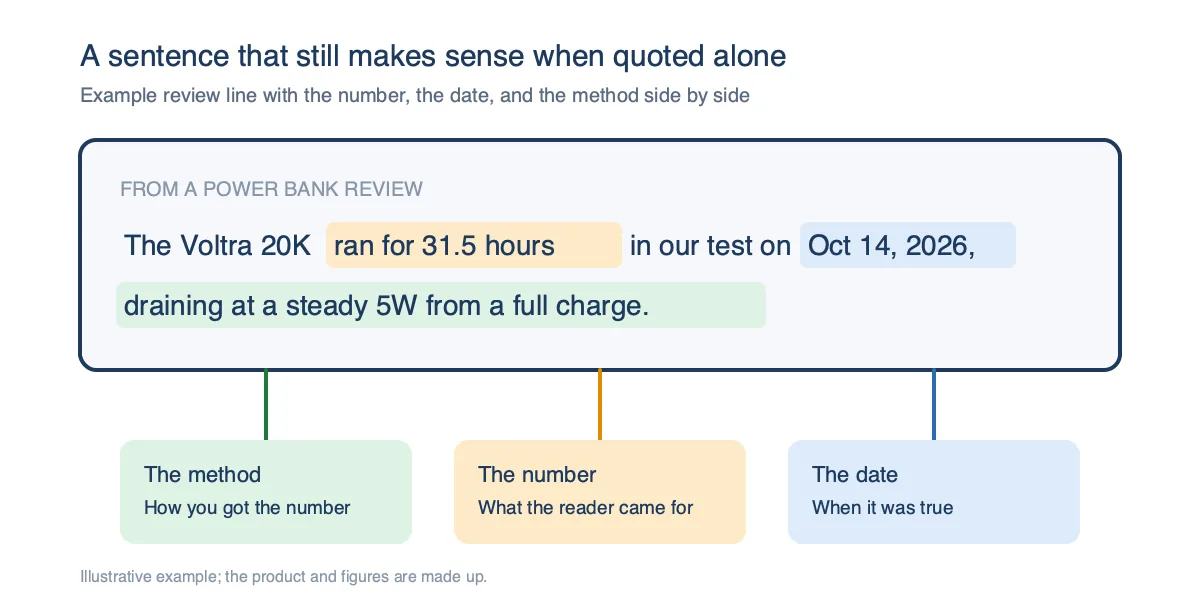
A reviewer who runs every power bank through the same drain test and reports the hours of runtime gives readers a number that decides which one to buy. Evidence like that sets a page apart when hundreds of others repeat the same advice.
Google’s guide makes the same point about first-hand work. “A first-hand review provides a unique perspective based on personal experience, whereas a summary of existing content simply restates information already available elsewhere.” That’s guidance for Google Search, not a published ChatGPT rule, but it holds up as advice for readers either way.
Academic research on generative search engines points in the same direction. In the GEO study, adding cited sources, quotations, and statistics raised a page’s position-weighted share of the words in AI-generated answers by 30-40%, while keyword stuffing scored 10% worse than the unedited page on Perplexity. The study measured visibility inside generated answers, not ChatGPT citations or clicks, so read it as a direction and not a forecast.
That guide also uses “7 Tips for First-Time Homebuyers” as its example of commodity content, a fair warning for any list post, this one included. A numbered format is fine, as long as each item carries something a reader can’t get from the next ten results.
- Your own test results, with the method written next to them.
- Prices, specs, or counts you collected, with the date you checked.
- Reader survey results, with the number of people who answered.
- Notes and photos from products you actually used.
Numbers you borrow from someone else aren't original, but they still need a named, linked source.
Put each number in a sentence that stands on its own, with the date and method beside it, so a quoted line still makes sense out of context.
Way 4 - Structure Pages So They’re Easy to Quote
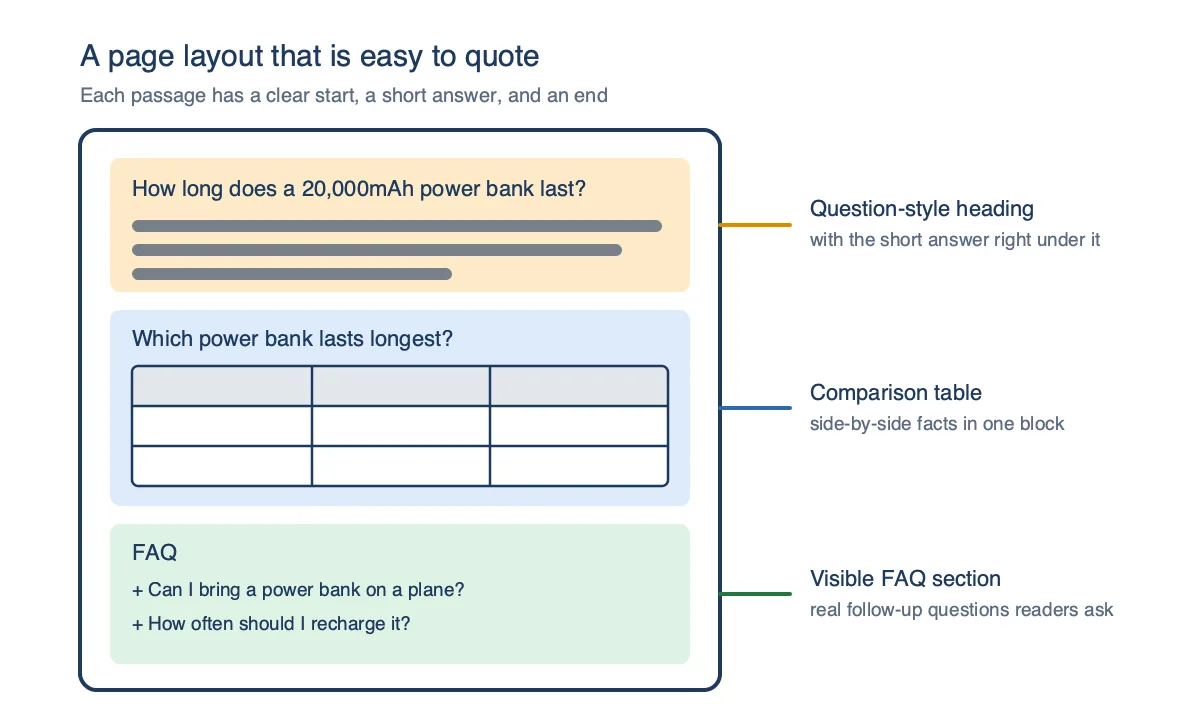
A quoted passage has to make sense without the rest of the page, and your layout decides how easy that is. Headings phrased as the questions readers ask, a short answer under each one, and tables for side-by-side comparisons all give a passage a clear start and end.
Advice on this topic tends to lump together two separate things, the structure a reader sees and the schema markup that only machines read.
“Clear headings, tables, and FAQ sections help surface key information and make content easier for AI systems to reference accurately,” Bing’s Webmaster Tools team wrote in its AI Performance announcement. That’s about the visible page, the part your readers use too.
“Structured data isn’t required for generative AI search, and there’s no special schema.org markup you need to add,” Google’s guide says. Google also says a page only needs to be indexed and eligible for a snippet to show as a link in AI Overviews, with no extra technical requirements. So write visible FAQ sections where readers have real follow-up questions, and treat FAQ schema as optional.
| What | What the source says | What to do |
|---|---|---|
| Headings, tables, FAQ text | Bing: helps AI systems reference content |
Add FAQ sections where readers have real follow-up questions |
| Schema markup | Google: not required for its AI features |
Don't add it for AI features alone |
| Indexing | Google: AI Overview links need an indexed, snippet-eligible page |
Fix indexing problems before formatting |
We see a small version of this on our own site, though it’s about Google rather than ChatGPT. Our roundups, including the list of AI search engine affiliate platforms, show up in Google’s top five for long, question-shaped queries like “which affiliate content platforms help scale buying guides optimized for llm citations?”, at a handful of impressions a month.
That result is a Google ranking at tiny volume, and we don’t count it as proof of a ChatGPT citation.
Way 5 - Get Mentioned Where the Models Read
In Google’s AI summaries, a handful of community and reference sites show up again and again. In Pew Research’s study, Wikipedia, YouTube, and Reddit were the most cited sources in those summaries, making up 15% of the sources listed, and the same three sites topped Google’s regular results too.
Pew measured Google, not ChatGPT, and nothing in that study shows that posting on Reddit is how to get cited by AI yourself. Do the community work for its own payoff, which is readers who already trust your answer.
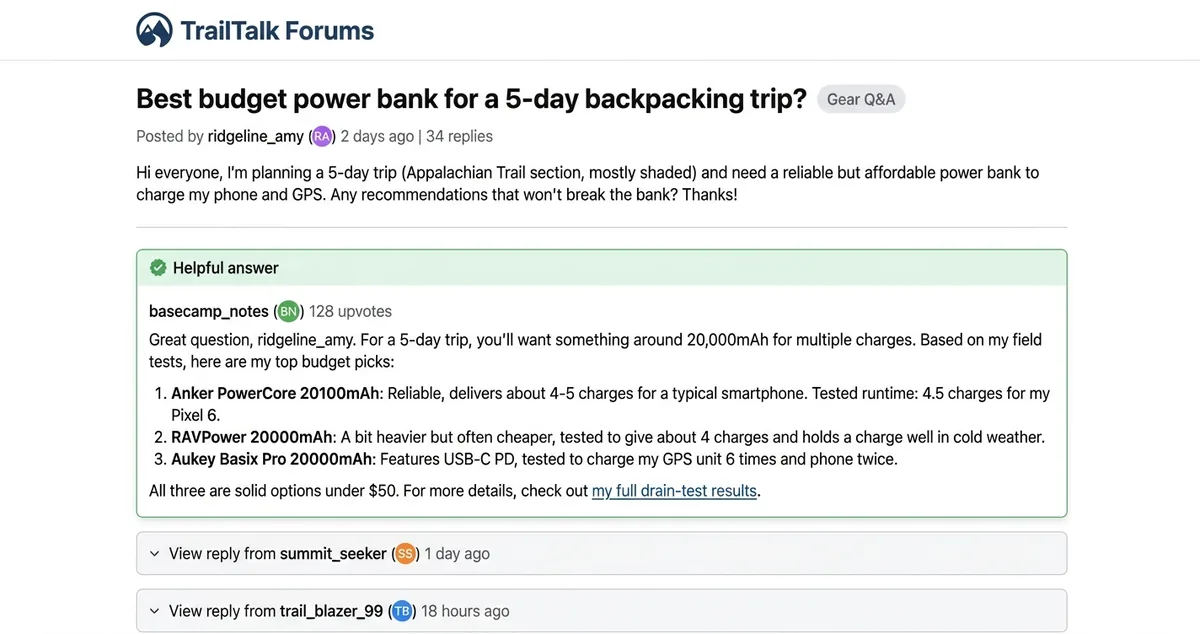
For a solo blogger, Reddit and niche forums are the realistic place to start. Answer questions in the communities your readers already use, link your post only when it truly answers the thread, and follow each community’s rules on self-promotion.
Wikipedia is a long shot for most personal blogs, since its editors want independent sources and frown on site owners adding links to their own work.
- Roundups in your niche: a short pitch to the writer, built around your own test data from Way 3.
- Resource pages: a polite request to join link lists that already cover your topic.
- YouTube: a big extra job for one person, so only worth it if video already suits your niche.
Way 6 - Keep Pages Dated and Fresh
A visible date tells readers, and any system reading the page, how current the information on it is. Bing’s team ties updates to AI answers in the same Webmaster Tools post. “Regular updates help ensure AI systems reference the most current version of your content.”
Show both the published date and a “last updated” date near the title, and change the updated date only when the content changes. Bumping a date without editing anything misleads readers, and it gives no one a fresh reason to quote the page.
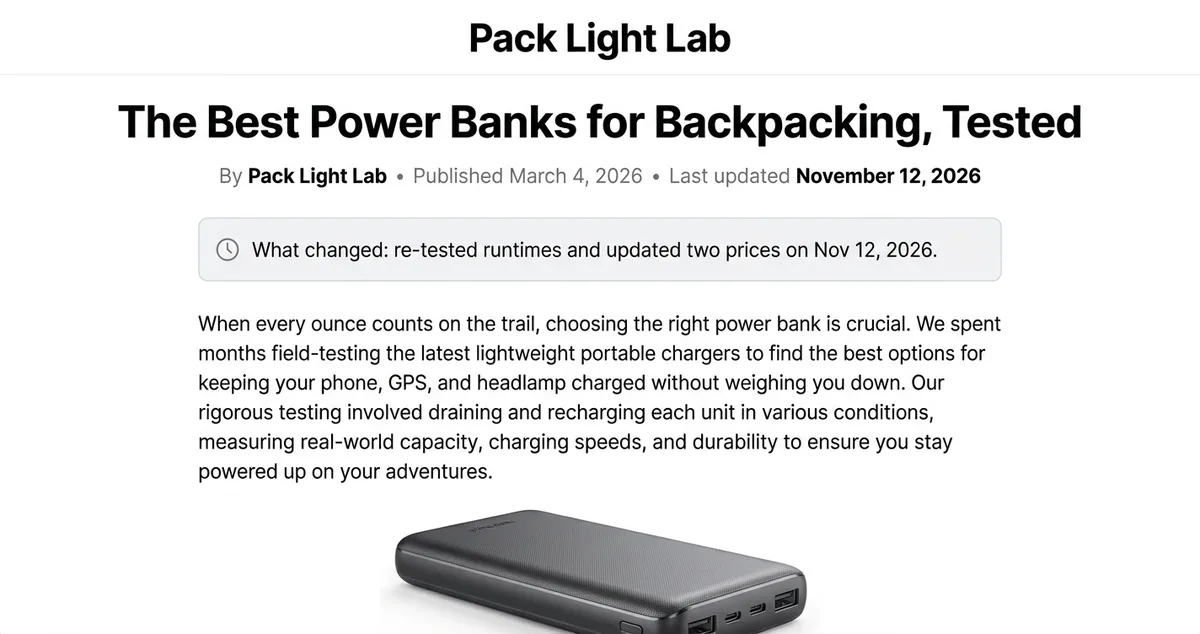
The checklist below is one example schedule, not a proven cadence for citations. Start with posts whose facts change, like prices, tool features, or rules, and with the posts that bring the most visits, since a stale number there does the most damage. Evergreen how-to pieces can go longer between edits, as long as every step still works the way the post says it does.
- Check every price, spec, and product link for changes.
- Replace screenshots that show an old interface.
- Rewrite the opening if the answer itself has changed.
- Add a one-line note at the top on what changed and when.
ChatAds is a free AI chat widget for blogs. Readers chat with an on-page assistant about the page they're reading, and it works out of the box with no training. If you turn on monetization, in-line affiliate links appear in those chats, and ChatAds takes 0% of commissions. The free plan covers 100 messages a day with no credit card.
Way 7 - Track Whether It’s Working
SparkToro’s volunteers ran 12 prompts through three AI tools a combined 2,961 times, and the brand lists they got back almost never matched. By SparkToro’s count, if you ask ChatGPT or Google’s AI the same prompt 100 times, there’s under a 1 in 100 chance that any two responses list the same brands. That study tracked brand recommendations rather than links to blogs, but it shows why one check of any AI answer tells you very little.
Rand Fishkin’s advice is to ask the same prompt “usually at least 60-100X, then average these out.” A solo blogger can start smaller, with 10 to 20 prompts your readers would actually type, run several times a month. Log the prompt, the date, whether the answer used search, and whether your site shows up in ChatGPT as a linked citation or only as a name mention, then read the log as a trend and not a precise score.
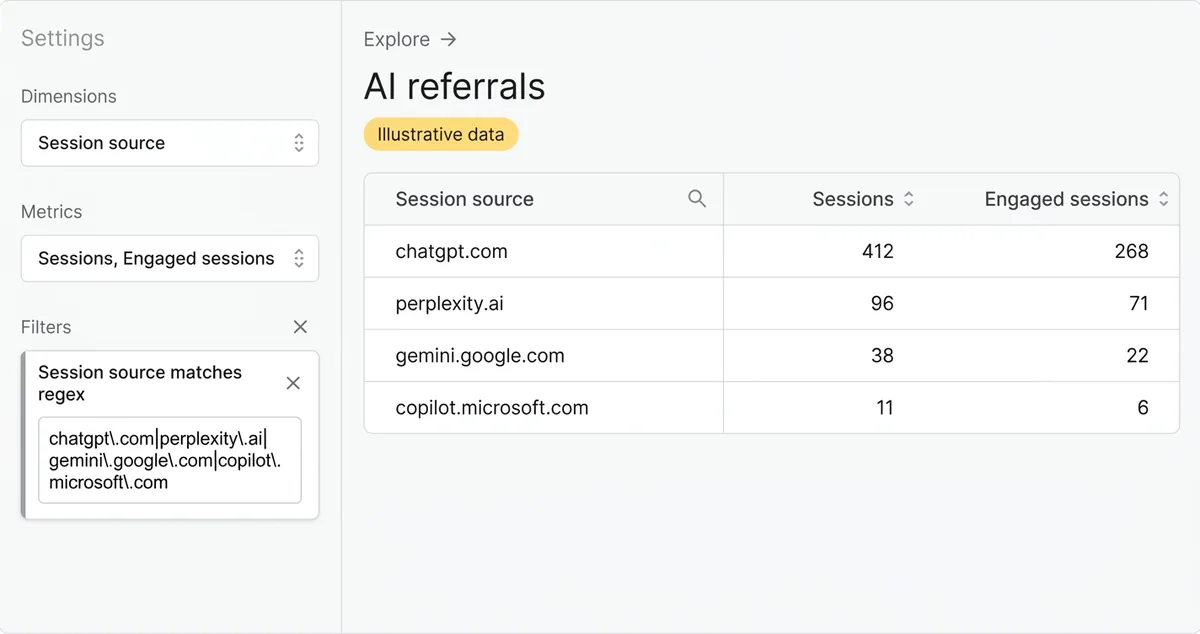
In GA4, build a free-form exploration with Session source as the dimension and Sessions and Engaged sessions as the metrics. Add a Session source filter set to “matches regex,” paste the pattern below to catch the four AI sites, and save the exploration.
chatgpt\.com|perplexity\.ai|gemini\.google\.com|copilot\.microsoft\.com
| Tool | What it counts | What it misses |
|---|---|---|
| GA4 exploration | Visits from AI tools that pass a referrer |
Visits that arrive without one |
| Prompt log | Linked citations and mentions in your sampled runs |
Every prompt you didn't test |
| Bing Webmaster Tools AI Performance |
Citations in Copilot, Bing AI summaries, and select partners |
ChatGPT, which Microsoft doesn't say it covers |
| Search Console Generative AI report |
Performance in Google's AI features, per Google's guide |
Every non-Google AI tool |
Session counts alone won’t tell you whether those visits matter for your blog. Compare AI-referred sessions with engaged sessions and, where your affiliate dashboard allows it, clicks from those landing pages, knowing some visits lose their attribution. For what each of those visits can earn, see making more money without more traffic.
A reader who clicks through from a ChatGPT citation arrives with a question already in mind. An on-page assistant like ChatAds can answer it on your page, using that page’s content, though we haven’t measured whether that keeps readers around longer. For the defensive side of this shift, see how to protect your blog traffic from AI Overviews.
Start with one post that already gets search traffic for a direct question. Check that robots.txt lets OAI-SearchBot in, rewrite the opening so the answer comes first, and write down today’s AI referral sessions and prompt-log results for that page.
Check the same numbers again in about 30 days, then decide whether to repeat the work on more posts. It may produce no citation at all, and a citation by itself doesn’t prove engaged readers or affiliate income, so judge it by the visits and clicks that follow.
How to Get Cited by ChatGPT: FAQ
How do I get my blog cited by ChatGPT?
Put a direct answer near the top of the page, let OAI-SearchBot crawl your site, and publish first-hand evidence other pages don't have. Clear question-style headings, helpful forum answers, and honest update dates can make those pages easier to quote. No step guarantees a citation, so track results with repeated test prompts.
Does ChatGPT use Google or Bing to search the web?
OpenAI says ChatGPT search draws on third-party search providers and content from its partners, without naming the providers. Many guides say Bing, which we couldn't confirm on an OpenAI page, so submitting your sitemap to Bing Webmaster Tools is a cheap precaution rather than a known requirement.
Can I block GPTBot and still get cited by ChatGPT?
Yes, because OpenAI treats GPTBot and OAI-SearchBot as independent settings. GPTBot covers training, while OAI-SearchBot decides whether your pages appear in ChatGPT search answers, so you can disallow the first and allow the second.
Does llms.txt help you get cited by AI?
Google's John Mueller said in 2025 that, as far as he knew, none of the AI services had said they use it, and we have no data showing ChatGPT or Perplexity reads ours. Google says Google Search doesn't use llms.txt or other AI text files, so treat it as an optional extra rather than a citation tactic.
Does schema markup help you get cited by ChatGPT?
Google says structured data isn't required for its generative AI features and there's no special schema to add. Bing's team says visible headings, tables, and FAQ sections help AI systems reference content, which is about the page itself, not the markup. So write FAQ sections for readers and treat the schema as optional.
How do I check if ChatGPT is citing my site?
Pick 10 to 20 prompts your readers would type, run each several times a month, and log whether your site appears as a linked citation or only as a name mention. SparkToro's Rand Fishkin suggests asking the same prompt 60 to 100 times for a reliable read, so treat a small log as a trend line. In GA4, filter Session source with a regex covering chatgpt.com and perplexity.ai to see the visits those citations send.