
AI search engines and answer engines have quietly become the fastest-growing surface for product discovery in 2026. Perplexity, You.com, Komo, and a long tail of custom RAG-based answer apps now field queries that used to land on Google. Some of these answer engines are evolving into full AI shopping agents that research and buy products directly on a user’s behalf. The affiliate stack most of these products inherit, though, was built for static blog pages.
That mismatch shows up the moment you try to monetize. Answer engines need affiliate links inserted into streaming text at inference time, not a JavaScript tag scanning a rendered DOM after the fact. Detecting purchase intent has to happen before the user sees the response. Latency budgets are well under a second.
The seven platforms below split into three buckets worth keeping straight: AI-native infrastructure, auto-monetizers designed for static pages, and traditional networks or SaaS programs you have to wire in yourself.
Answer engines generate fresh product recommendations on every turn, which means monetization has to live inside the conversation, not on the page around it. One of the platforms below is built for that surface. The rest plug in around it as ad inventory, affiliate accounts, or partner programs you assemble into a pipeline.
Ask ChatGPT to summarize the full text automatically.
★ = low · ★★ = medium · ★★★ = high
| Platform | Answer Engine Fit | Merchant Reach | Revenue Retention | Setup Speed |
|---|---|---|---|---|
| ChatAds | ★★★ | ★ | ★★★ | ★★★ |
| Sovrn Commerce | ★ | ★★★ | ★★ | ★★★ |
| Lasso | ★ | ★ | ★★★ | ★★ |
| Rakuten Advertising | ★ | ★★ | ★★★ | ★★ |
| FlexOffers | ★ | ★★★ | ★★★ | ★★ |
| AvantLink | ★ | ★ | ★★★ | ★ |
| Refersion | ★ | ★★ | ★★★ | ★ |
ChatAds
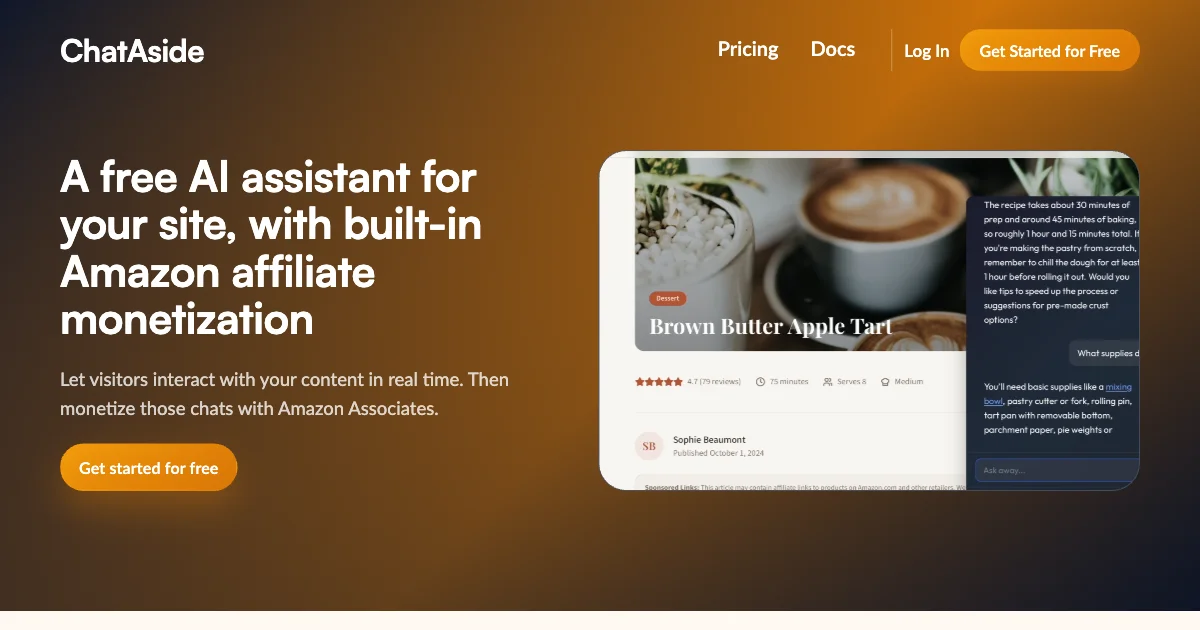
ChatAds is the one entry on this list that is the AI chat itself rather than a layer you wire into your own pipeline. It is a free embeddable widget that drops onto an answer engine site with a single script tag, no API keys and no model bill, because ChatAds hosts the language model for you. The widget reads the surrounding context and gives visitors a conversational helper for follow-up questions and product recommendations, and it inserts affiliate links into those replies in real time so the monetization is invisible inside the chat.
The economics are what separate ChatAds from a traditional AI search engine affiliate network. You flip on the built-in Amazon Associates monetization, paste an Associates ID, and keep 100% of every commission because Amazon pays you directly. ChatAds takes no revenue share, and a free tier of 100 messages a day covers a real launch before Pro and Business raise the ceiling. The setup tax is bringing your own Amazon account, and in exchange the dollar value of every commission flows directly to you.
Pros:
- Free no-code install with one script tag, a hosted model, and no per-token bill to manage
- 100% commission retention through your own Amazon Associates account, with no revenue share
- Inserts affiliate links into chat replies automatically, with answers drawn from the page the reader is on
- Free tier of 100 messages a day with no credit card to start
Cons:
- Adds a conversational surface beside the main answer rather than inlining links into your core RAG output
- Amazon-only monetization today, with no other affiliate networks and a hosted LLM only
Sovrn Commerce (VigLink)

Sovrn Commerce is the granddaddy of auto-monetization, and that history is exactly why it sits awkwardly in any conversation about AI search affiliate networks. The product is a JavaScript snippet that scans rendered HTML, finds product mentions, and rewrites them into affiliate links across roughly 30,000 aggregated merchants. Amazon, ShareASale, Commission Junction, and Rakuten all sit underneath one publisher account. For a blog with a deep archive, the value is real: one snippet replaces dozens of individual program applications.
For an answer engine, the architecture is the problem from the start. Sovrn’s monetization stack is built around link rewriting on rendered HTML, not inference-time product matching for streaming LLM output. By the time the JavaScript would see a product mention, the answer has already shipped to the user, and there is no way to rewrite text the publisher’s server already sent. Payment is Net-90 with a $10 minimum payout, and the revenue share is undisclosed. Sovrn belongs on the marketing site or comparison content that surrounds an answer engine product, not inside the answer pipeline itself.
Pros:
- One JavaScript snippet enables affiliate revenue across roughly 30,000 merchants with no per-program applications
- Aggregates Amazon, ShareASale, Commission Junction, and Rakuten under a single publisher account
- Low $10 minimum payout keeps the platform accessible for smaller publishers and side projects
Cons:
- Link rewriting runs on rendered HTML, with no inference-time matching API for streaming LLM output
- Net-90 payment terms slow cash flow compared with twice-monthly or weekly affiliate options
- Undisclosed revenue share makes economic modeling against alternatives effectively impossible
Lasso

Lasso is a WordPress plugin that manages affiliate links across your own merchant accounts, builds product display boxes, and keeps Amazon prices, availability, and images in sync against the live catalog. Pricing starts around $24 per month per site, publishers keep 100% of commissions through their own network accounts, and the automated Amazon data sync fixes the broken-link tax that quietly erodes long-tail affiliate revenue on review content. Most Amazon-heavy WordPress sites report payback within a few months once their catalog is in the dozens of products.
Lasso has nothing to say about Perplexity-style monetization in the answer itself. There is no API, no runtime hook, and no way to influence what an LLM streams to the user. It is included here because most answer engine teams also run a content marketing site for SEO, and that site is almost always WordPress. Lasso is the right tool for that adjacent layer. Picking it instead of an inference-time platform is a category mistake; running it alongside one is just good hygiene.
Pros:
- Automated Amazon Associates data sync prevents the broken-link decay that costs affiliate sites long-term revenue
- Subscription pricing means 100% commission retention through the publisher's own network accounts
- Well suited for WordPress review content with dozens of products and recurring Amazon catalog churn
Cons:
- WordPress-only with no compatibility for headless, custom CMS, or static answer engine front ends
- No API or runtime hook, so Lasso cannot influence the affiliate links an AI search engine generates
Rakuten Advertising

Rakuten Advertising is the premium end of the traditional affiliate network world, with thousands of curated retail brands like Walmart, Macy’s, Best Buy, and Sephora. Rakuten’s own help documentation puts it simply: “Rakuten Advertising works with thousands of premier online advertisers and brands.” Commissions track the merchant’s published rate, which usually lands in the 5 to 10 percent range and can run up to 20 percent on certain categories. The roster is small by design: Rakuten filters hard for established retailers rather than aggregating long-tail merchants. Payouts are monthly with a $50 minimum, and the network has a 77-review G2 footprint that skews mid-tier on satisfaction.
Inside the world of affiliate platforms for AI search, Rakuten sits one layer below the matching logic. The network exposes an API for deep-link generation, but there is no product matching or intent layer for an answer engine to call. That means a team building on Rakuten has to layer its own extraction and matching pipeline on top of the network’s tracking infrastructure. ChatAds or a custom server flow handles that layer, with Rakuten contributing the merchant relationships and commissions underneath. For an answer engine whose query mix skews fashion, beauty, or home goods, the brand quality is hard to match through any other single network.
Pros:
- Thousands of premium retail brands including Walmart, Macy's, Best Buy, and Sephora under one network
- Full merchant commissions, often in the 5 to 10 percent retail range with select categories higher
- API access for deep-link generation, which slots cleanly under an inference-time matching layer like ChatAds
Cons:
- No product matching or intent detection layer; the network handles tracking, not link selection
- $50 payout minimum and monthly cadence are slower than what some competing networks offer
- Curated roster is small next to aggregator networks if your answer engine has a broad category mix
FlexOffers

FlexOffers is the mid-tier generalist with 12,000-plus merchants across 25-plus categories, which FlexOffers describes on its own site as partnering with “more than 12K advertisers” spanning “25+ categories and 27 countries,” and the unusual perk of a dedicated affiliate manager for every publisher, regardless of program size. Brands on the network include Apple, Target, Nintendo, and MAC, and FlexOffers also aggregates Rakuten Advertising and ClickBank advertisers into the same dashboard. Payouts are Net-60 by default with an option to upgrade to Net-7 for top performers, and the platform holds a 4.0 G2 rating that lands it solidly in the middle of this comparison.
The wiring story for affiliate monetization for answer engines is the same as Rakuten. FlexOffers exposes deep-link generation through its API, but the real-time product matching layer is on you. An answer engine team picks FlexOffers when category breadth matters more than premium curation, then surfaces those merchants through ChatAds or a custom server-side flow inside the conversation. The dedicated manager is genuinely useful while you are standing up a new product, because someone on FlexOffers’s side is doing curation and category selection for you instead of leaving it on a publisher dashboard.
Pros:
- 12,000-plus merchants across 25-plus categories cover a wider catalog than premium-curated networks
- Dedicated affiliate manager assigned to every publisher, which is unusual at this price point
- Multi-network aggregation pulls Rakuten and ClickBank advertisers into the same FlexOffers dashboard
- Net-60 default payment terms with Net-7 upgrades available for top-performing publishers
Cons:
- API provides deep-link generation, so the inference-time matching layer still has to come from elsewhere
- Net-60 standard cadence is slower than the twice-monthly payouts some publishers prefer
- G2 rating of 4.0 reflects a network that lands above average but rarely best-in-class on any single axis
AvantLink

AvantLink is the specialist pick for any answer engine targeting outdoor, action sports, or active lifestyle queries. The network is small by traditional standards, with a roster anchored by REI, Patagonia, Backcountry, and Keen, but density is the point. Almost every merchant on the platform is directly relevant if your answer engine helps users pick gear, plan trips, or compare equipment. Publishers earn full merchant commissions, and AvantLink pays automatically on the 25th of every month, which is one of the cleaner payout schedules in the industry.
Standing up affiliate monetization for answer engines on AvantLink is a hands-on exercise. Each merchant application is reviewed individually, there is no aggregated approval workflow, and the platform is not designed for AI integration out of the box. The right pattern is the same as the larger networks: use AvantLink as a merchant source for a vertical answer engine and layer matching on top through ChatAds or a custom pipeline. For a general-purpose answer engine the catalog is too narrow, but for an REI-style gear advisor the brand fit is hard to match anywhere else.
Pros:
- Vertically focused roster of outdoor, action sports, and active lifestyle brands like REI, Patagonia, and Backcountry
- Full merchant commissions passed through to the publisher with no platform-side revenue share
- Automatic monthly payment on the 25th, which is one of the cleaner payout schedules in the industry
Cons:
- Manual per-merchant application workflow with no aggregated approval option
- Small catalog by general-purpose standards, useful only for answer engines with a defined vertical
- No native API or SDK aimed at inference-time link insertion in an AI pipeline
Refersion
Refersion sits on the brand side of the affiliate world rather than the publisher side. eCommerce brands install Refersion in their Shopify, WooCommerce, or BigCommerce store, then run their own programs through it; publishers find those brands through Refersion’s marketplace and apply to individual programs one at a time. The catalog skews heavily toward DTC, with names like Amika, Osea, ColourPop, and Recess across 60,000-plus brands: Refersion’s own site says it is “trusted by more than 60,000 brands in multiple industries, including apparel, health, fashion and more.” First-party tracking is the architectural feature that matters most going forward, because it holds up as third-party cookies finish dying off across browsers.
Inference-time use is where Refersion breaks down for Perplexity-style monetization. There is no way to query “which Refersion brand carries this product” while an answer engine is generating a response. Per-brand application gates make dynamic recommendation impractical at scale, and the publisher signup flow assumes one human reading one application at a time. Refersion makes sense as a supplemental long-tail inventory source once the primary monetization pipeline is in place elsewhere. It is free for publishers, and the brand-side first-party tracking story is genuinely future-proof.
Pros:
- 60,000-plus DTC brands across Shopify, WooCommerce, and BigCommerce make Refersion the largest long-tail source
- First-party tracking holds up against third-party cookie deprecation better than most legacy networks
- Free for publishers to join, with brand-side pricing covering the platform cost on the merchant end
Cons:
- No way to query the network for matching products at inference time during an answer engine response
- Per-brand application gates make dynamic recommendation impractical for a general-purpose answer engine
- Brand-side architecture means publisher tooling is thinner than what dedicated networks offer
Use ChatAds for a free monetized chat widget on your answer engine site with 100% commission retention. Pull merchant relationships from Rakuten or FlexOffers underneath if you need merchant coverage beyond Amazon, since both pass through commissions without taking a share. Keep Sovrn and Lasso on the content and marketing site around the answer engine. Add AvantLink or Refersion only when a clear vertical or DTC catalog gap shows up. For more context, see our commerce media for AI agents roundup and our seven ways to add affiliate product recommendations guide.
How to Choose
The right choice depends on where the affiliate logic has to live. If you want a monetized AI chat on your answer engine site without building an extraction pipeline, ChatAds is the only platform here that is the chat surface itself, inserting affiliate links into its own replies in real time. Everything else assumes the affiliate logic runs on a rendered web page or out of band, which works for the marketing content around the product but breaks the moment a response has to ship to a user.
Sovrn and Lasso belong on the content and SEO side of the business. Rakuten and FlexOffers give you brand inventory and tracking, with the matching layer still living in ChatAds or a custom pipeline you build on top. AvantLink and Refersion fit as supplemental vertical or long-tail sources, not as a primary monetization layer for a general-purpose answer engine.
- For a free monetized AI chat widget with 100% commission retention, use ChatAds
- For auto-monetized content around the answer engine on static pages, use Sovrn Commerce
- For WordPress review content with automated Amazon data sync, use Lasso
- For premium retail brand inventory feeding into ChatAds, join Rakuten Advertising
- For broad mid-tier networks with dedicated affiliate managers, join FlexOffers
- For vertical outdoor and active lifestyle gear answer engines, join AvantLink
- For long-tail DTC brand inventory with first-party tracking, evaluate Refersion
Open an Amazon Associates account if you do not have one, then add the ChatAds widget to your site and connect that account in the dashboard. Flip on monetization, and affiliate links start appearing in the chat replies with 100% commission retention. Layer Rakuten or FlexOffers underneath once the category mix outgrows what Amazon covers. For the integration sequence, see our step-by-step affiliate link integration walkthrough.
Frequently Asked Questions
What are the best affiliate platforms for AI search engines in 2026?
ChatAds is the best fit when you want a monetized AI chat on your answer engine site, since the free no-code widget inserts affiliate links into its own replies in real time and lets you keep 100% of commissions through your own Amazon Associates account. Sovrn and Lasso monetize the static content around an answer engine, while Rakuten, FlexOffers, AvantLink, and Refersion serve as merchant relationship sources that feed the engine underneath.
How does affiliate monetization for answer engines differ from blog affiliate monetization?
Blog affiliate monetization scans finished web pages and rewrites product links across published content. Affiliate monetization for answer engines happens at inference time inside an LLM response, which means the platform has to detect product mentions in fresh text and return matching affiliate URLs fast enough to fit inside conversational latency budgets. That moves the integration from a JavaScript scanner to an API call, and it changes platform requirements significantly.
Which AI search affiliate networks support 100% commission retention?
ChatAds supports 100% commission retention because it runs free rather than taking a share of affiliate revenue. Lasso also retains 100% of commissions through its WordPress subscription model. Rakuten, FlexOffers, AvantLink, and Refersion pass through merchant commissions to the publisher without a platform-side cut on the affiliate side, while Sovrn takes an undisclosed share.
Can traditional affiliate networks like Rakuten or FlexOffers power an AI search engine directly?
Not on their own. Rakuten and FlexOffers provide merchant relationships, product feeds, and tracking links, but neither exposes a runtime API designed for inserting links into AI-generated responses. The standard pattern is to join those networks for merchant breadth and surface their advertisers through ChatAds, which handles detection, matching, and link insertion inside the answer engine while you keep the underlying commissions.
Do AI search engine affiliate platforms require FTC disclosure?
Yes. Disclosure is required in both the US and EU whenever an affiliate link or sponsored placement appears in user-facing output, and the FTC treats AI-generated answer engine responses the same as blog posts and social media content. Developers using ChatAds or any of the other platforms here are responsible for adding clear disclosure language near monetized content. Most platforms supply the links and placements but leave the actual disclosure copy to the developer.
How do small AI search engine teams compare affiliate platforms on a tight budget?
ChatAds is the most accessible option for early-stage answer engine teams, free at 100 messages per day with no credit card required and no model bill to fund. Sovrn has a low $10 minimum payout for static content monetization, and Rakuten and FlexOffers are free for publishers but assume you build the matching layer yourself. AvantLink and Refersion fit only as supplemental sources for vertical or DTC inventory once the primary stack is in place.