In 2026, a blog can put an AI chat assistant right on its pages, so readers ask questions instead of scrolling for answers. When that assistant recommends a product, the recommendation can carry the site’s affiliate tag and earn a commission on a qualifying purchase.
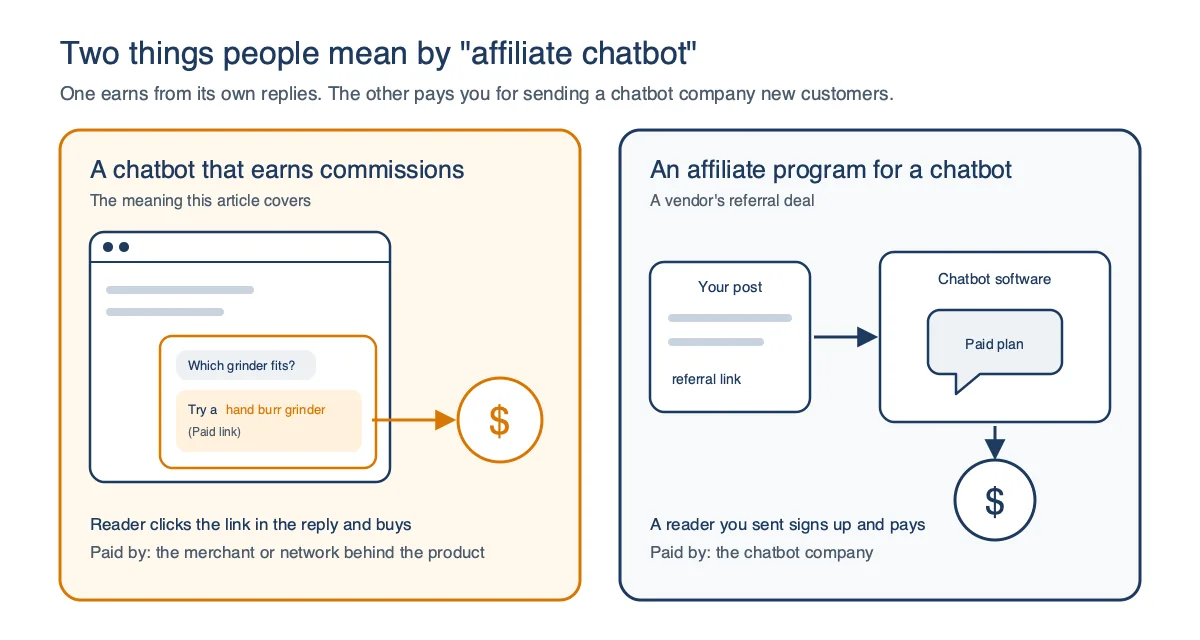
That setup is what most people mean by an affiliate chatbot, though the term has a second use as well. Some chatbot companies also describe their referral programs this way, and those programs pay you for sending them new customers instead. The two get mixed together in search results, so it helps to separate them before looking at how the money moves.
An affiliate chatbot earns only when its links carry your own tags, the network tracks and approves the sale, and the disclosure sits right beside the reply.
An affiliate chatbot is an AI assistant on your site whose replies can carry your affiliate links, so a reader's question can end in a commission. A chatbot affiliate program is a different thing, a vendor deal that pays you for referring customers to its software. This guide covers the first meaning in depth and points to a separate roundup for the second.
Ask ChatGPT to summarize the full text automatically.
What Is an Affiliate Chatbot?
An affiliate chatbot is an AI chat assistant that earns commissions from its own conversations, because a product mentioned in a reply can become an affiliate link. When a reader clicks that link and buys, the network tracks the sale back to the site owner’s tag.
The idea matters because many readers already ask a chatbot what to buy before they shop. In an Adobe survey of 5,000 US consumers, 39% had used generative AI for online shopping, and 47% of respondents named product recommendations as one of the ways they used it.
The same two words also name something else in search results, which is where much of the confusion starts. Many ranking pages about chatbot affiliate marketing come from chatbot vendors describing programs that pay you to refer customers to their software.
| Chatbot that earns commissions | Affiliate program for a chatbot | |
|---|---|---|
| What it is | An AI assistant on your site whose replies carry affiliate links |
A vendor program that pays you for referring paying customers |
| Who pays you | The merchant or network behind the linked product |
The chatbot company you referred |
| What gets promoted | Products your readers ask about | The chatbot software itself |
| Where the link lives | Inside a chat reply on your own page |
In your articles, emails, or social posts |
How Does an Affiliate Chatbot Turn a Reply Into a Commission?
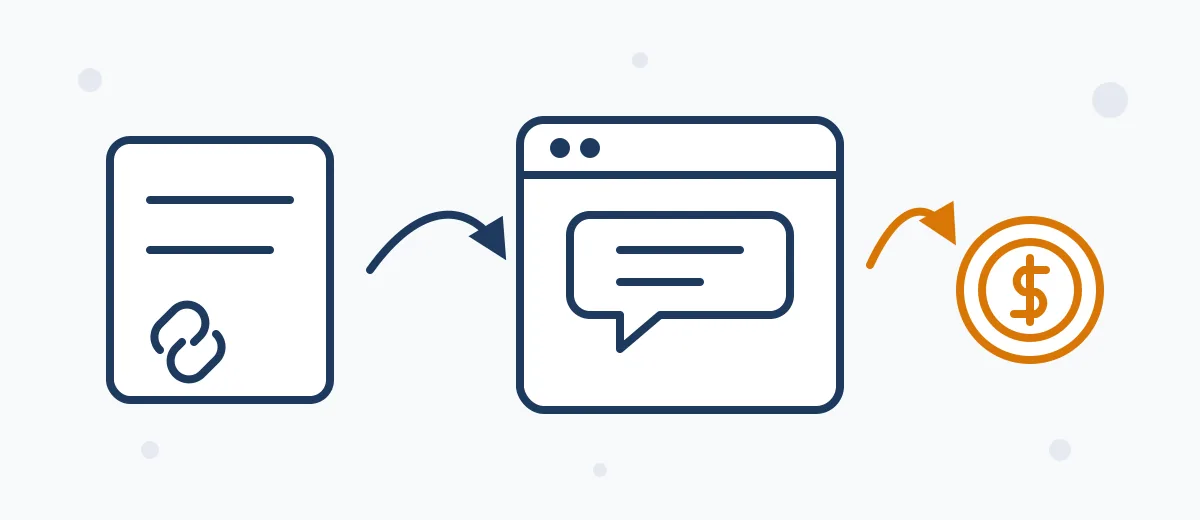
A commission from a chat reply follows the same path as a link in an article, with a few extra steps at the front. The chain starts with a reader’s question and ends only after the network approves the sale and pays it out.
- The reader asks a question in the chat box, such as which coffee grinder suits a small kitchen.
- The AI answers with a reply that names the products it thinks fit the question.
- A product name gets a link that carries the site’s own affiliate tag.
- The reader clicks that link and lands on the merchant’s product page.
- The network tracks the visit. Amazon, for example, describes a 24-hour session that starts at the click and can end sooner, such as when the customer places an order.
- The network reviews the order and decides whether it qualifies under the program’s rules.
- The commission gets paid later, on the network’s own schedule and payment terms.
ChatAds works this way once a publisher turns monetization on, which is off by default. Its server places inline links in the AI’s answer before the widget shows it. They come from affiliate links already on the page, or from an Amazon search link built with the publisher’s own tag.
- The site belongs to the affiliate program behind the product.
- The link in the reply carries the site's own tag.
- The reader buys inside the network's tracking window.
- The network approves the purchase under that program's rules.
One common design picks the answer first and attaches a link afterward, so the commission doesn’t choose the product. That order doesn’t make the answer correct, though, so the reply still needs accurate product facts and a clear label. OpenAI CEO Sam Altman described the trust risk on Conversations with Tyler, saying “If ChatGPT were accepting payment to put a worse hotel above a better hotel, that’s probably catastrophic for your relationship with ChatGPT.”
How Is an Affiliate Chatbot Different From Affiliate Links in Articles?
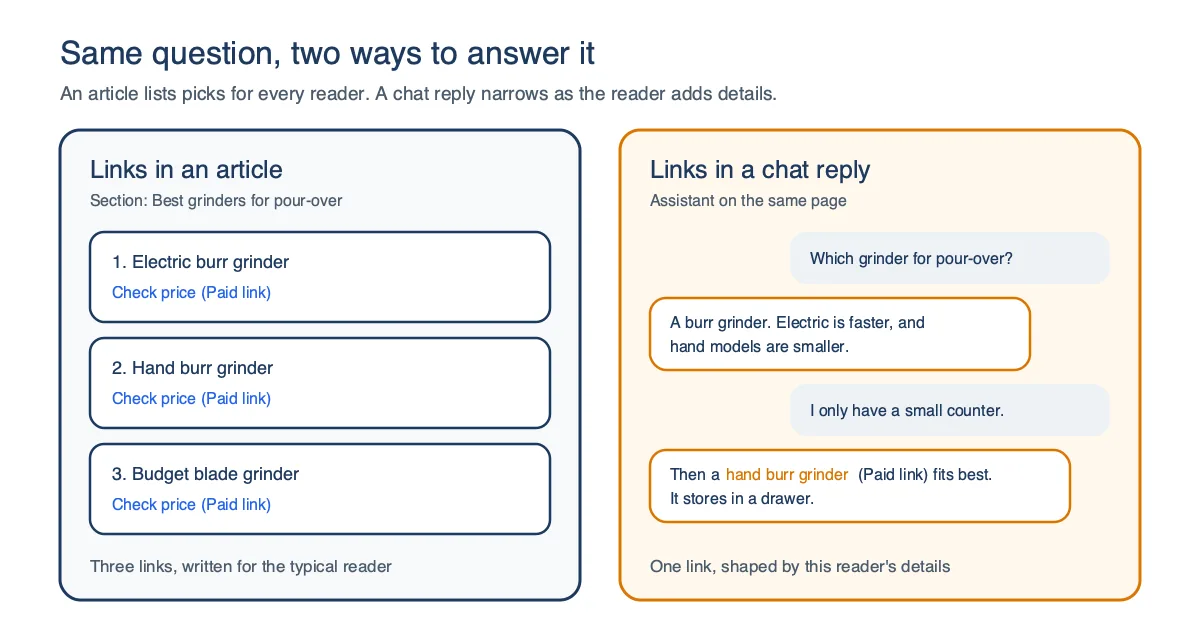
A good article is researched for the readers most likely to land on it, and it can be updated whenever products change. A chat reply works differently, because it responds to the one reader who typed a question and to any details they add next.
That typed question is a strong buying signal on its own, since the reader has already named what they need help choosing. That fit is why affiliate links rank among the common ways to monetize AI chatbots, since a link appears only when a reply actually recommends a product.
| Links in an article | Links in a chat reply | |
|---|---|---|
| What shapes the answer | The writer's research on what readers need |
The reader's own question and follow-ups |
| Which links appear | Whatever the piece covers, often several options |
Only the products that reply names |
| When it changes | When the writer edits the post | Written fresh for each question, though product facts are only as current as its sources |
| Details it can use | The needs the writer planned for | Budget, size, or use case the reader just typed |
We couldn’t find a public study that compares how affiliate links in chatbot replies convert against article links, and we have no blog widget results to share either. The figures below come from large companies measuring other things, so treat them as context for AI affiliate marketing rather than a forecast.
- Amazon said customers who used its Rufus assistant were about 60% more likely to complete a purchase. That is Amazon's own store, and shoppers who use Rufus may already be closer to buying.
- Adobe measured traffic from generative AI tools to US retail sites rising 693.4% in the 2025 holiday season, from a modest base. That figure counts visits from outside AI tools, not purchases.
What Do the Affiliate Networks and the FTC Require?
The FTC’s Endorsement Guides treat an affiliate link as a paid relationship that your readers deserve to know about. Their own blogger example says a coffee maker review with affiliate links “should clearly and conspicuously disclose the compensation.”
For anything published online, the same Guides say that “the disclosure should be unavoidable.” FTC staff go further on wording in their Endorsement Guides FAQ, writing that “‘Paid link’ right next to an affiliate link should be an adequate disclosure of the nature of the link.”
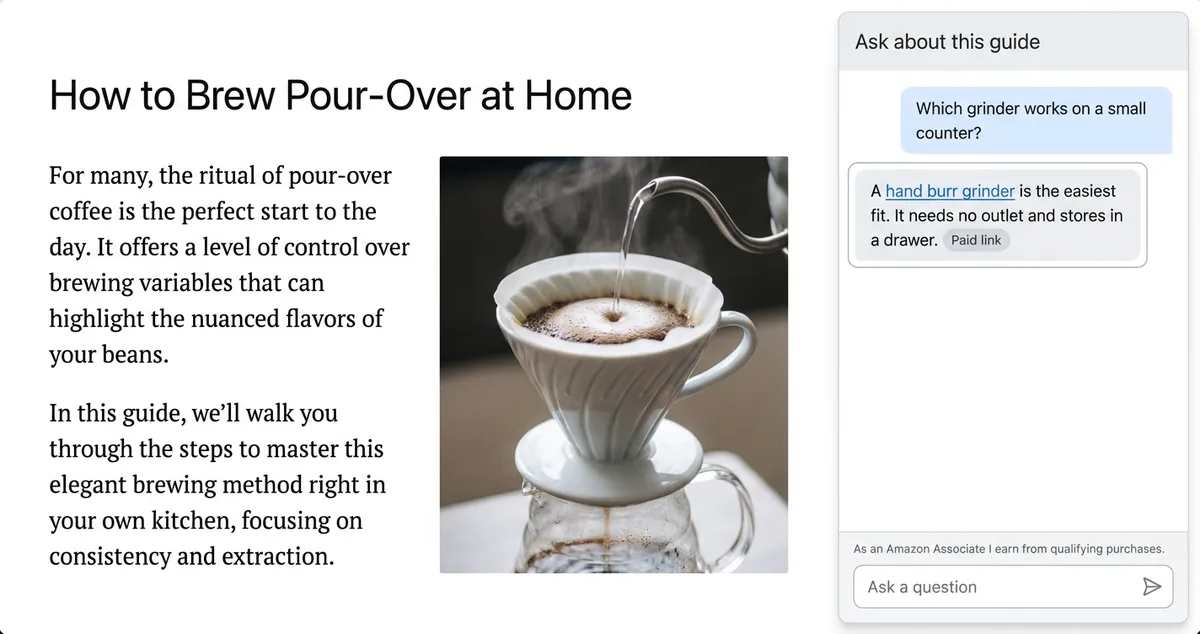
The Guides never mention chatbots, so applying them to a chat reply is our reading rather than an FTC ruling. A link inside an answer is still a recommendation with a paid link, which makes a label close to that reply the safe choice.
Amazon Associates adds its own rules on top of the FTC’s, and the Operating Agreement requires the statement “As an Amazon Associate I earn from qualifying purchases” on your site. Its program policies also hold several rules that bear directly on AI-written replies, and the table below lists each one.
| Rule | Source | What to do in a chat |
|---|---|---|
| Disclose near the link | FTC Guides, 16 CFR Part 255 | Label the link beside the reply, not only on a separate disclosure page |
| Use plain wording | FTC staff FAQ | "Paid link" next to the link works; "affiliate link" alone may not |
| Show the required statement | Amazon Operating Agreement | Put the Associates line on the site |
| No unsupported prices | Amazon Program Policies | Show prices only if Amazon serves the link that displays them or the data comes from Creators API or PA API |
| Accurate product claims | Amazon Program Policies | Don't let a reply misstate specs; Amazon's own example bans calling a 64 GB phone a 128 GB phone |
| No fake clicks | Amazon Program Policies | Never artificially generate clicks or sessions, "whether by way of a robot or software program or otherwise" |
| No client-side software | Amazon Program Policies | Special Links can't go in software a user installs, such as a browser extension |
Amazon’s policies don’t mention chatbots or chat widgets by name anywhere. Our reading is that a widget running on your own web page is part of your site rather than software a reader installs, but Amazon hasn’t ruled on it.
Other networks set their own cookie windows and disclosure terms, so check each program you plan to link. For the Amazon side in more depth, see our breakdown of the Associates agreement for AI apps.
What Are the Ways to Get One on Your Site?
There are three broad ways to put an affiliate marketing chatbot on a site, and each trades control for setup time. The right one depends on how much code you’re willing to maintain and who pays for the AI service.
A generic chat plugin is a familiar starting point, though many of these tools are built for support questions and lead capture. Whether one can turn product mentions into tagged links depends on the tool, so check that before you count on it earning.
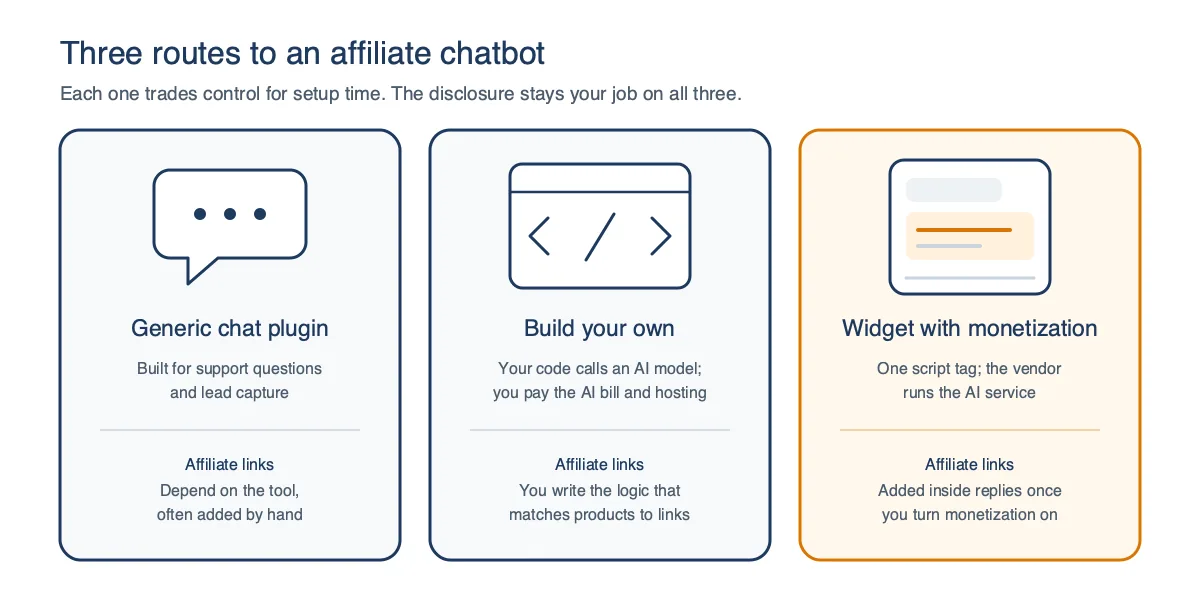
Building your own chatbot gives you full control over prompts, links, and design. It also means paying the AI bill, writing the link-matching logic, and running the hosting yourself, which makes it a real project for most bloggers.
A widget with monetization built in is the third option. ChatAds works this way, as a free AI chat widget that reads the page it’s installed on and runs the AI service for you, so there’s no API key to manage. Once you turn monetization on, it can reuse your on-page affiliate links or add Amazon search links with your own tag, though those Amazon links only reach readers in the US and UK.
| Route | How it works | Pros | Cons |
|---|---|---|---|
| Generic chat plugin | An off-the-shelf support or lead-capture bot |
Familiar tools, quick to try | Affiliate linking varies by tool and is often manual |
| Build your own | Your code calls an AI model and adds links to replies |
Full control over prompts, links, and design |
You pay the AI bill and maintain the code |
| Widget with monetization (e.g., ChatAds) |
One script tag; links added inside replies once turned on |
Free tier, hosted AI, reuses links already on the page |
Amazon search links reach only US and UK readers; free tier caps at 100 messages a day |
No route takes the disclosure and program rules off your plate, because the publisher still owns those with a hosted tool too. For install steps, see how to add a chatbot to your affiliate blog. For a vendor-by-vendor look, the six ways to get a chatbot with affiliate monetization roundup compares the options.
- Join the affiliate programs you want to earn from and keep your tags handy.
- Install the chatbot through the option your site platform supports.
- Turn on the link settings and add your tags, since installing alone earns nothing.
- Place a disclosure next to the replies, plus the Amazon statement if you use Amazon.
- Test on one product-review page and read the replies before you expand.
ChatAds is a free AI chat widget for blogs. Paste one script tag and readers get an on-page assistant that answers from the page they're reading, and once you switch on monetization its replies can carry your own affiliate links. The free plan covers 100 messages a day with no credit card, and ChatAds takes 0% of commissions.
What About Chatbot Affiliate Programs?
The second use of the term is a referral deal, where a chatbot company pays you for sending it paying customers. You promote their software in posts or emails, and the commission comes from the vendor rather than from a retailer.
Several chatbot vendors run programs like these, and their terms change often. As of November 2026, Landbot pitches a 20% recurring commission in a post about chatbot affiliate income. BotPenguin’s partner page says its program reopens on January 1, 2027.
Rates, cookie terms, and payout rules for those programs deserve a list of their own. Our chatbot affiliate programs roundup covers them, so this page stays with chatbots that earn from their own replies.
- Confirm the program is open, since some pause new signups for a while.
- Check whether the commission recurs every month or pays only once.
- Disclose referral links the same way you disclose product links.
Once a chatbot that earns from its replies is live, the useful test is whether it helps readers, not just whether it gets clicks. Read real conversations for accuracy and unanswered questions, then compare link clicks and approved commissions with how the same page did before. Some chat clicks may replace clicks the article would have earned anyway, so judge the whole page rather than counting every chat sale as extra.
For most bloggers, the commission-earning kind of chatbot is the one worth testing first, as long as the site already has affiliate links and readers who ask buying questions. Start with one product-review page, check the answers and the disclosure label, and expand only once the replies hold up.
Frequently Asked Questions
What is an affiliate chatbot?
An affiliate chatbot is an AI chat assistant that earns commissions from its own conversations, because a product mentioned in a reply can become an affiliate link. When a reader clicks that link and buys, the network tracks the sale to the site owner's tag, reviews whether it qualifies, and pays the commission on its own schedule.
Is an affiliate chatbot the same as a chatbot affiliate program?
No, the two terms describe different things. An affiliate chatbot earns from product links inside its own replies, while a chatbot affiliate program pays you for referring customers to a chatbot company's software.
Can I put Amazon affiliate links in a chatbot?
Amazon's policies don't mention chatbots by name, and Amazon hasn't ruled on chat widgets, though our reading is that a widget on your own page is part of your site. You still need the required "As an Amazon Associate I earn from qualifying purchases" statement, accurate product claims, and no prices unless Amazon serves them or they come from its API.
Do I have to disclose affiliate links in chatbot replies?
The FTC Guides don't address chatbots directly, but they say online disclosures should be unavoidable, and FTC staff say the closer the disclosure is to the recommendation, the better. FTC staff also say "Paid link" right next to an affiliate link should be adequate, so labeling links beside the reply is the safe approach.
Do chatbots convert better than affiliate links in articles?
We couldn't find a public study that compares the two, so any exact multiplier is a guess. Amazon says customers who used its Rufus assistant were about 60% more likely to complete a purchase, but that measures Amazon's own store, not a blog widget.
Does the chatbot provider take a cut of my affiliate commissions?
It depends on the provider, so check whether the links use your own affiliate tags. ChatAds links use the publisher's own tags, so commissions are paid directly by Amazon or the network and ChatAds takes 0%.