
The Amazon Associates Operating Agreement was written for bloggers and content publishers, not developers embedding affiliate links into AI chatbot responses. In 2026, that gap is causing real problems.
Most AI developers adding Amazon affiliate links are reading the commission rate tables and skipping the compliance sections entirely. That approach works fine right up until it doesn’t. The “material breach” clause in the Operating Agreement means Amazon can terminate your account with no warning and withhold any unpaid commissions the moment you cross a line, whether you knew about it or not. Amazon doesn’t publish reinstatement statistics, but affiliates who’ve been through the appeal process consistently describe successful reinstatement as rare, which makes compliance worth taking seriously upfront.
This article covers the specific rules from the Amazon Associates Operating Agreement that AI app developers need to understand before they ship: what the agreement actually prohibits, how disclosure requirements translate to chat interfaces, the pricing data rules, what the Amazon v. Perplexity case means for your app, and what actually triggers account termination.
- The agreement spans four interlocking documents (updated Oct 2025, Dec 2024, Apr 2026)
- Material breach = immediate termination with no advance warning required
- Creators API access requires 10 qualifying sales in the trailing 30 days, per locale
- Price data from the Creators API must be refreshed within 1 hour or disclaimed
- PA-API deprecation hits May 15, 2026, and Creators API migration is required
- Amazon Alexa Associates requires per-recommendation disclosure, setting the precedent for AI chat interfaces
Ask ChatGPT to summarize the full text automatically.
What Is the Amazon Associates Operating Agreement?
The Amazon Associates Operating Agreement is not a single document. It’s four interlocking agreements: the Operating Agreement itself, the Program Policies, the Participation Requirements, and an IP License. All four apply to your account simultaneously, and Amazon updated them in October 2025, December 2024, and again in April 2026, when it narrowed its onsite “halo” commission rules, a change covered in our breakdown of Amazon Associates commission cuts and what bloggers should do. Most affiliate guides focus on commission rates and link placement and skip these documents entirely.
For AI developers, the risk profile is different from that of a standard blogger. The agreement was designed for content sites where a human author adds links manually to static pages. When you’re programmatically inserting links into AI-generated responses, several clauses that seem routine for bloggers become active compliance questions.
The piece of the agreement with the highest stakes is the “material breach” clause in the Operating Agreement, which states that “any violation of Section 5… and as specified in the Program Policies will be deemed a material breach of this Agreement.” Any violation of the Participation Requirements constitutes material breach, and material breach allows Amazon to terminate your account immediately without advance notice. They don’t have to warn you, give you time to fix it, or explain which rule you violated. Your account goes dark and any unpaid commissions go with it.
- Operating Agreement. Core terms, termination rights, payment conditions
- Program Policies. Link format rules, prohibited promotion methods, cookie terms
- Participation Requirements. Disclosure requirements, pricing rules, what counts as a qualifying site
- IP License. Rules for using Amazon trademarks, logos, and product images
Does the Agreement Prohibit Using Affiliate Links in AI Apps?
This is the most contested question among AI developers right now, and the answer is more nuanced than most articles suggest. Amazon added “generative AI” language to the agreement in March 2024, which set off a wave of concern in the developer community. The current live agreement focuses that prohibition on using Amazon data to train machine learning models, not on serving affiliate links through AI systems.
Section 22 of the Participation Requirements explicitly permits displaying API-generated Special Links on registered sites. The plain reading of that section carves out exactly what a compliant AI app does: your AI generates recommendation text, the Creators API generates a tracked link, and the two are displayed together. Those are separate acts under the agreement, and neither one violates the training prohibition.
Amazon’s own Alexa Associates program is the clearest signal that Amazon has no categorical objection to AI systems earning affiliate commissions. Alexa is an AI voice assistant that surfaces Amazon products and earns commissions on qualifying purchases. Amazon built that program and publishes compliance requirements for it. The existence of Alexa Associates as a sanctioned program means the question isn’t whether AI can participate in Associates, it’s whether your specific implementation follows the rules.
The contractual risk that remains is that Amazon retains broad termination rights and can interpret the agreement more narrowly than the text requires. There’s no public record of Amazon terminating an account specifically because affiliate links were served through an AI chatbot. The risk isn’t zero, but it’s not a clear prohibition either.
Using Amazon product data to train an AI model is explicitly prohibited. Displaying a Creators API link inside an AI response to a user who asked for a product recommendation is what Section 22 permits. Keep those two actions clearly separate in your architecture and documentation.
How Do Disclosure Rules Apply to AI Chat Interfaces?
Amazon requires all Associates to display the exact phrase “As an Amazon Associate I earn from qualifying purchases” clearly and conspicuously. That requirement applies regardless of the medium. The question for AI developers is where exactly to display it in a chat interface, because “clearly and conspicuously” is doing a lot of work in an environment that feels like a direct conversation.
The best precedent comes from Amazon’s own Alexa Associates developer documentation, which states: “each time your customer engages with your skill with voice or text, you must disclose that your skill earns a commission from product recommendations.” In practice, the Alexa Associates program requires same-medium disclosure: if the recommendation is delivered by voice, the disclosure must be in voice. If it’s delivered in text, the disclosure must be in text. A site-wide footer or a one-time consent screen is not sufficient.
For a chat interface, that precedent points to disclosure that appears in the chat UI adjacent to each product recommendation, not buried in a separate page or displayed as a one-time popup during onboarding. The FTC’s updated Endorsement Guides from 2023 add a layer on top of this. In its own guidance on AI and consumer trust, the FTC warns about “automation bias,” where people “may be unduly trusting of answers from machines which may seem neutral or impartial,” a reason disclosures in AI contexts need to be more prominent, not less. Disclosures must be “unavoidable,” meaning users can’t miss them while reading the recommendation.
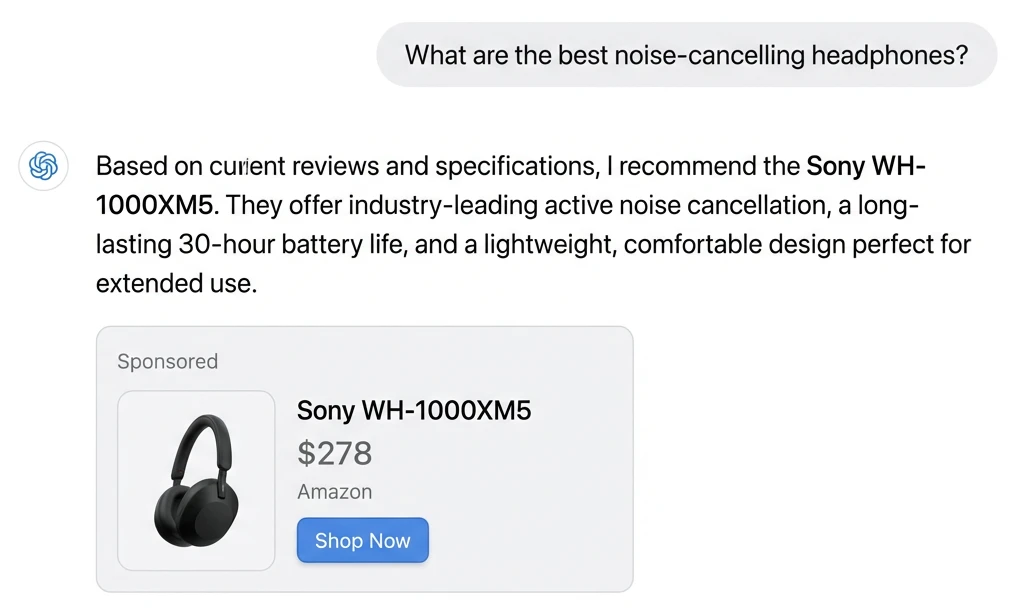
The safest pattern for a chat app is a persistent inline disclosure that appears with every message containing a product recommendation. Something like “As an Amazon Associate I earn from qualifying purchases” on its own line below the recommended product. Per-message disclosure is a higher bar than most blog implementations, but it’s what the combination of Amazon’s Participation Requirements and FTC guidance points toward. If you want the exact wording for your setup, our free Affiliate Disclosure Generator & FTC Checker produces a compliant Amazon Associates disclosure and audits the one you already have.
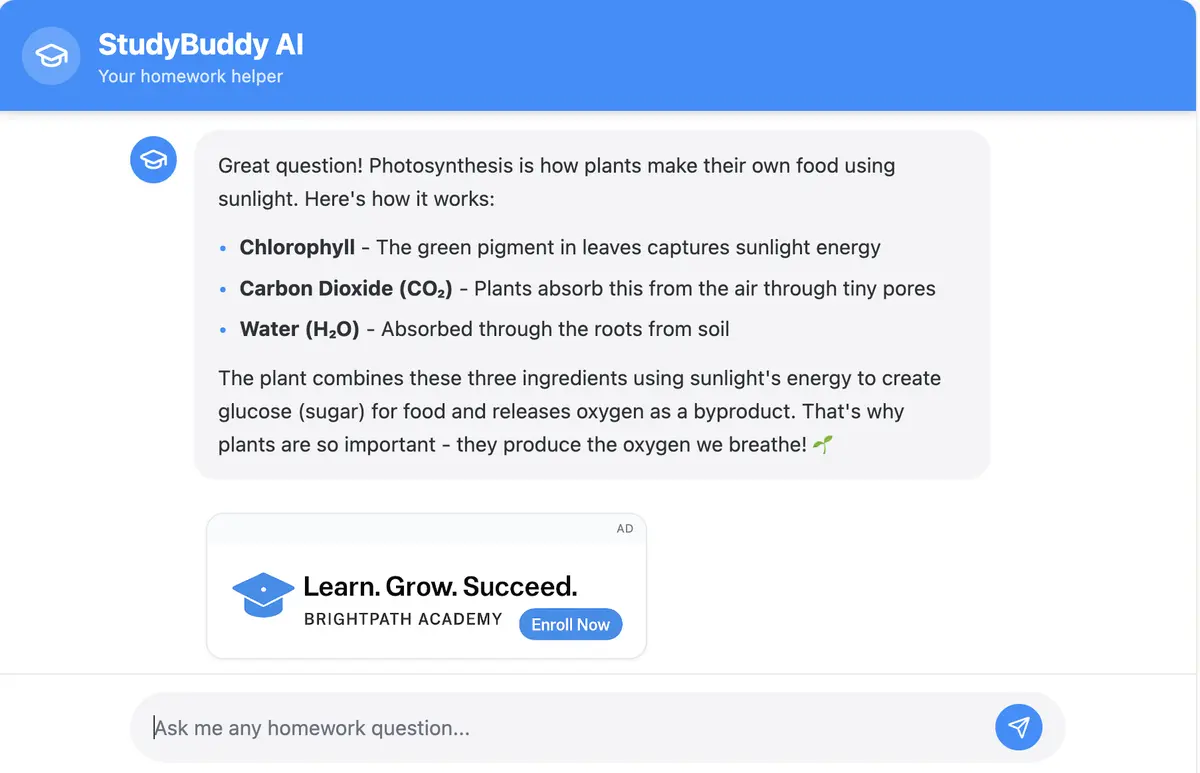
- Per-message inline. Disclosure appears below every response containing a product link. Follows Alexa Associates same-medium precedent.
- Persistent banner in chat UI. Fixed disclosure text always visible within the chat window. Acceptable if unavoidable while reading recommendations.
- Session-start disclosure. Single disclosure when the chat session opens. Weaker but possible if prominently displayed and acknowledged.
- Footer or separate page. Not sufficient under Amazon's Participation Requirements or FTC guidance. Avoid this approach.
What Are the Price, Product Data, and Link Format Rules?
Pricing is where AI apps most commonly fail the Amazon Associates compliance test. The core rule is that prices must come from the Amazon Creators API in real-time, never from your model’s training data or a stale cache. Amazon knows that LLMs are trained on historical data that includes Amazon pricing. Citing a price from that training data, even accidentally, violates the Participation Requirements because the data isn’t live.
The Creators API (which replaces the deprecated Product Advertising API after May 15, 2026) has specific caching rules you need to follow. Prices and availability can be cached for up to one hour. Titles and descriptions can be cached for up to 24 hours. Product images cannot be stored at all, so you must link to them directly with the URL expiring after 24 hours. Any displayed price also requires a disclaimer indicating when the data was retrieved, because Amazon prices change frequently and they don’t want users making purchase decisions based on stale numbers.
Links must be genuine Amazon URLs containing your Associate tag. URL cloaking and redirect services that obscure the amazon.com destination are explicitly prohibited. The tag must be your registered tag, not a shared tag, not a placeholder, and not a hardcoded tag from a code example you copied. For more on the technical requirements for link construction, see our guide to Amazon affiliate marketing for AI apps.
Publishers doing this inside articles rather than inside an app hit the same tag rules from a different direction, which is the ground covered in our walkthrough on adding Amazon affiliate links with Claude.
The safest approach to pricing in AI responses is to skip stating the price entirely and use a call-to-action like “Check current price on Amazon” linked to the product. This eliminates the risk of displaying a stale price and the need to manage cache expiration logic in your response pipeline.
Caching limits apply from time of API call
| Data Type | Max Cache Duration | Additional Requirement |
|---|---|---|
| Prices & availability | 1 hour | Must show retrieval timestamp |
| Titles & descriptions | 24 hours | None specified |
| Product images | Cannot be stored | Link directly, URL expires in 24 hours |
| Training data prices | Never | Prohibited entirely |
What Does Amazon v. Perplexity Mean for AI Developers?
Amazon filed suit against Perplexity in early 2026 over Perplexity’s Comet AI browser agent, which could navigate Amazon’s site and complete product purchases on behalf of users. A preliminary injunction was granted in March 2026. The case created anxiety in the AI developer community that went well beyond what the facts support.
The core violations in that case were specific: Perplexity’s agent disguised automated sessions as standard Chrome browser traffic, ignored technical access controls, and made purchases through a bot that Amazon hadn’t authorized. That’s meaningfully different from an AI app that surfaces product recommendations and generates affiliate links through Amazon’s own Creators API.
For affiliate link developers who aren’t making purchases on Amazon, the practical takeaway from the case is the bot identification requirement. The court’s reasoning reinforced that platform Terms of Service override user consent. U.S. District Judge Maxine Chesney’s ruling put it precisely: Comet accessed Amazon accounts “with the Amazon user’s permission, but without authorization by Amazon.” Even if a user explicitly authorizes an AI agent to act on their behalf, the platform can still refuse and enforce its ToS against the developer. Your users can’t give you permission to violate Amazon’s rules.
The actionable implication is agent transparency. If your AI app makes API calls to Amazon’s systems, those calls should identify themselves accurately in the user-agent header rather than masquerading as a browser or a human user. The format Amazon’s developer documentation describes is Agent/[your-agent-name]. Your app should also respond truthfully if asked whether it’s automated. Disguising bot identity creates both ToS risk and potential exposure under the Computer Fraud and Abuse Act, regardless of whether affiliate links are involved. For a broader look at building compliant affiliate systems, see our guide to how to add Amazon affiliate ads to your AI app.
ChatAds is an API that handles product detection, Creators API integration, link generation, and Associate tag management. You send the AI response, ChatAds returns affiliate links. Compliance logic is built into the pipeline, so you're not maintaining it yourself. See how it works at getchatads.com. For the integration approach, see our guide to integrating affiliate links into AI chatbot responses.
What Triggers Account Termination and How Do Appeals Work?
Amazon’s termination process has no warning step built in. The Operating Agreement is explicit: any violation of the Participation Requirements constitutes material breach, and material breach entitles Amazon to terminate the account immediately and withhold any earned commissions that haven’t been paid yet. You don’t get an email saying “fix this by Friday.” The account is simply gone.
The violations most relevant to AI apps fall into a few patterns. Displaying stale or hardcoded prices (from training data or long-expired cache) is the most common technical failure. Missing the required disclosure statement is the most common compliance failure. Cloaking affiliate URLs, generating artificial clicks through automated systems, or having your AI app click its own affiliate links are the fastest paths to a trust violation. Trust violations are treated differently in appeals and are nearly impossible to reverse.
Appeals work in two tiers, though the distinction matters primarily for understanding what you’d need to prove. Non-trust violations (things like a missing disclosure or a cached price that was too old) go through a process where Amazon gives you a five-business-day window to demonstrate the issue is corrected. Trust violations require proving that Amazon’s factual determination about what happened is wrong, which is a much higher standard. Amazon doesn’t publish reinstatement numbers, but the consistent account from affiliates who’ve gone through the process is that reinstatement is the exception, not the rule, so the appeal process should not be treated as a safety net.
There’s no documented case of Amazon terminating an account specifically because affiliate links were served through an AI chatbot rather than a static blog post. The contractual machinery for termination exists and is in active use, but the specific AI-delivery scenario hasn’t produced a public enforcement action. That’s worth knowing, though it’s not a reason to skip the compliance work covered in this article. The rules that exist are clear enough, and the consequences of getting it wrong are final.
- Displaying prices that came from model training data instead of the Creators API
- Missing the required "As an Amazon Associate I earn from qualifying purchases" disclosure
- Using URL cloaking or redirect services that hide the amazon.com destination
- Generating artificial clicks through automated systems
- Disguising automated API sessions as human browser traffic
The Amazon Associates Operating Agreement is manageable once you know which sections apply to AI apps specifically. The disclosure rules are stricter than most developers expect but concrete: same-medium, adjacent to the recommendation, every time. The pricing rules are clear: Creators API only, with the caching windows Amazon specifies, and a timestamp disclaimer on any displayed price. The link format rules are straightforward: genuine Amazon URLs, your registered tag, no cloaking.
If you’re building affiliate monetization into an AI app and want to avoid maintaining all of this compliance infrastructure yourself, ChatAds handles the product detection, Creators API integration, and link generation. The compliance logic is built into the API so you’re not implementing it from scratch on top of everything else you’re building. The agreement itself isn’t going to get simpler as Amazon’s AI policies evolve, but the core requirements described here are stable and enforceable right now.
Frequently Asked Questions
Does the Amazon Associates Operating Agreement allow affiliate links in AI chatbots?
The agreement does not explicitly prohibit serving affiliate links through AI chatbots. The "generative AI" language added in March 2024 targets using Amazon data to train machine learning models, not displaying Creators API links in AI responses. Section 22 of the Participation Requirements permits displaying Special Links generated through the API on registered sites. Amazon's own Alexa Associates program is an AI assistant earning affiliate commissions, which is the strongest signal that the program is open to AI-served recommendations when compliance requirements are met.
What disclosure is required for Amazon affiliate links in an AI app?
You must display the exact phrase "As an Amazon Associate I earn from qualifying purchases" clearly and conspicuously. For AI chat interfaces, the Alexa Associates program documentation requires same-medium disclosure, meaning if the recommendation is in text, the disclosure must be in text. A site-wide footer or one-time consent screen is not sufficient. The FTC's 2023 Endorsement Guides add that disclosures must be unavoidable, which in practice means displaying the disclosure adjacent to each message containing a product recommendation.
Can my AI app use cached Amazon prices, or does it need real-time data?
You can cache prices from the Creators API for up to one hour. Prices from model training data are prohibited entirely because they aren't tied to a live API call. Any displayed price must include a timestamp indicating when it was retrieved. Product images cannot be stored and must be linked directly. The Product Advertising API is deprecated as of May 15, 2026, so any app still using PA-API needs to migrate to the Creators API, which also requires 10 qualifying sales in the trailing 30 days per locale.
What does the Amazon v. Perplexity lawsuit mean for my Amazon affiliate AI app?
The Perplexity case involved an agent that made purchases on Amazon while disguising automated sessions as browser traffic. That's a different scenario from serving affiliate links through the Creators API. The relevant takeaway for affiliate developers is the bot identification requirement. API calls to Amazon systems should identify themselves accurately in the user-agent header rather than impersonating a browser. The court also reinforced that platform ToS overrides user consent, so your users can't authorize you to violate Amazon's rules on their behalf.
What are the amazon affiliate link requirements for AI apps specifically?
Links must be genuine Amazon URLs containing your registered Associate tag. URL cloaking and redirect services that hide the amazon.com destination are prohibited. The tag must be your account's registered tag. Shared tags and placeholder tags from code examples don't count. Links must be generated through the Creators API, not constructed manually or from hardcoded URLs. For a full breakdown of link construction requirements, see our guide to Amazon affiliate marketing for AI apps.
What happens if Amazon terminates my Associates account for a compliance violation?
Termination is immediate with no advance warning. Amazon can withhold unpaid commissions upon termination. The appeal process has two tiers: non-trust violations (like a missing disclosure or stale price) allow a five-business-day window to demonstrate the issue is corrected; trust violations (like artificial clicks or disguised bot traffic) require proving Amazon's factual determination was wrong. Amazon doesn't publish official reinstatement rates, but affiliates who've gone through the process describe successful reinstatement as uncommon, so the appeal process is not a reliable fallback. Compliance from the start is the only viable strategy.