Readers now ask a chatbot the product questions they used to type into Google. In 2026, that shift moved the highest-intent moment in the buyer journey out of your articles and into a chat window. Most chatbot tools leave that high-intent moment completely unmonetized.
Two different kinds of publishers and builders feel this same revenue gap. Bloggers want a chat widget that earns instead of one more thing they pay for, and developers want commissions from their AI assistants without wrecking the conversation. The dividing line is simple: a few tools have affiliate monetization built in, while most chatbot platforms make you add it yourself.
We lined up five ways to end up with chatbot affiliate monetization, from paste-one-line turnkey to bring-your-own-model WordPress plugins, with exactly what each one needs to actually pay out.
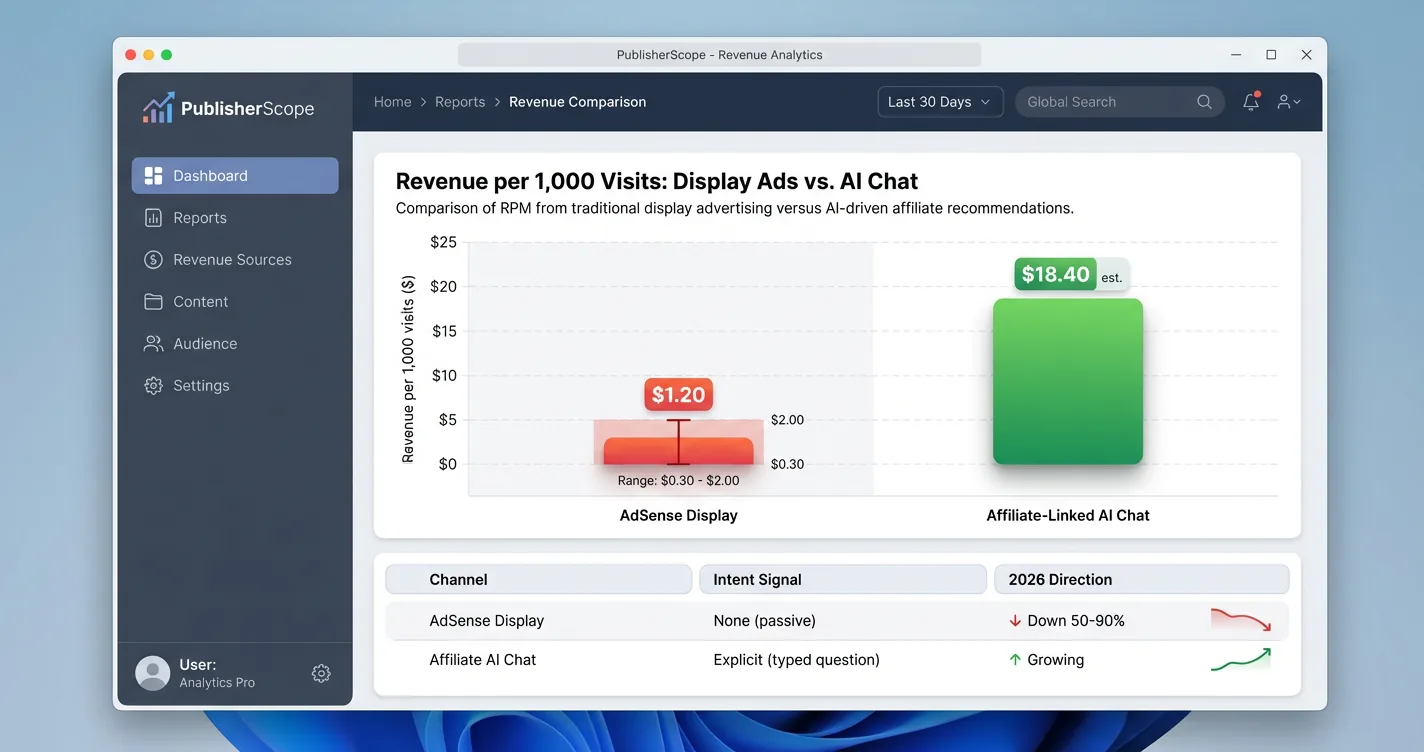
- Built-in affiliate links: product mentions become commission links inside the reply, not an afterthought you bolt on later
- You keep the commissions: 100 percent retention, with no platform taking a cut of what you earn
- Earns where readers already are: the chat window, exactly where the buying question now gets asked
- No monetization tax: a tool that earns from the chat instead of only billing you for every reply
Ask ChatGPT to summarize the full text automatically.
★ = low · ★★ = medium · ★★★ = high
| Tool | Setup Speed | Monetization | Platform Reach | Cost Value |
|---|---|---|---|---|
| ChatAds | ★★★ | ★★★ | ★★★ | ★★ |
| Chatbase | ★★ | ★ | ★★★ | ★ |
| Chatling | ★★ | ★ | ★★★ | ★ |
| AI Engine | ★ | ★ | ★ | ★★ |
| Kognetiks Chatbot | ★ | ★ | ★ | ★★ |
ChatAds
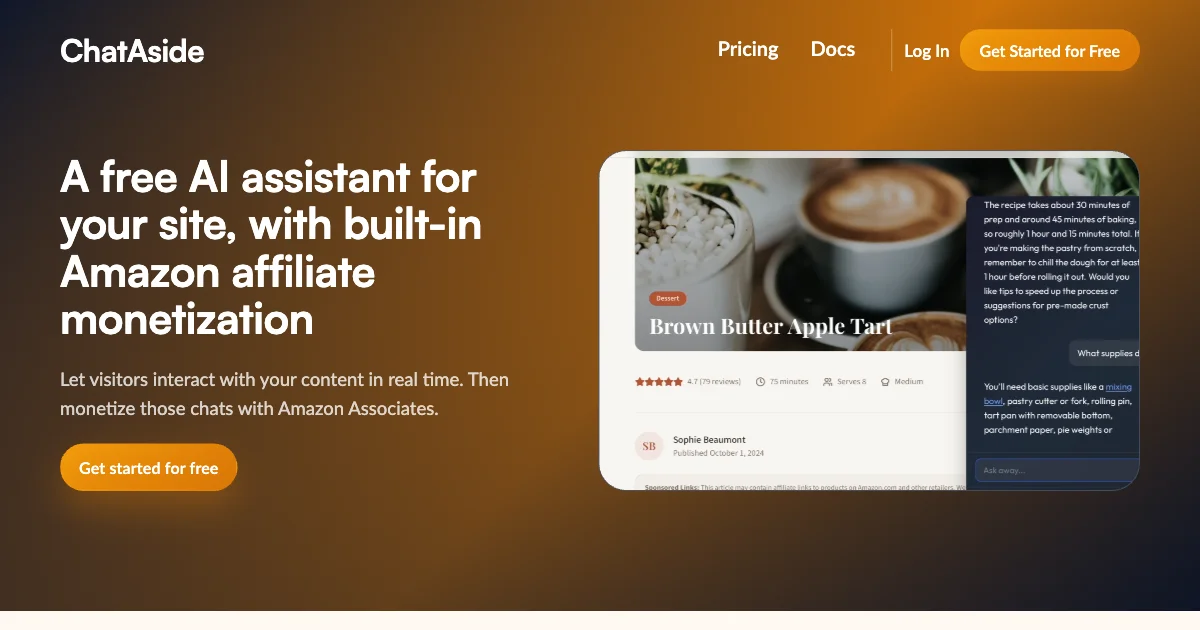
ChatAds is the turnkey route to an affiliate chatbot, a free embeddable widget you install with one line of JavaScript. There are no API keys to create and no model bill to track, because ChatAds hosts the language model for you. The widget reads the post the reader is on, so it answers questions from your own content rather than generic web knowledge.
The real difference here is monetization built right into the chat. When a reader asks about a product, ChatAds inserts your Amazon Associates links into the answer, and it reuses affiliate links already sitting on the page from any network, whether ShareASale, CJ, or Impact. Those existing non-Amazon relationships keep earning through chat, with Amazon as the fallback catalog, and you keep 100 percent of every commission. For a non-technical publisher, it is the lowest-effort way to end up with a commission-earning chatbot.
Pros:
- Completely free, including widget hosting and the hosted language model behind every reply
- Built-in affiliate monetization where you keep 100 percent of commissions across Amazon and existing on-page links
- One-line install on any platform, from WordPress to Squarespace to static HTML, live in minutes
- Answers from the post the reader is viewing automatically, so replies stay grounded in your articles
Cons:
- Built-in product matching is Amazon and US-focused, so other networks earn only through links already on the page
- Daily message caps on the free tier, so a high-traffic blog needs a paid plan
Chatbase
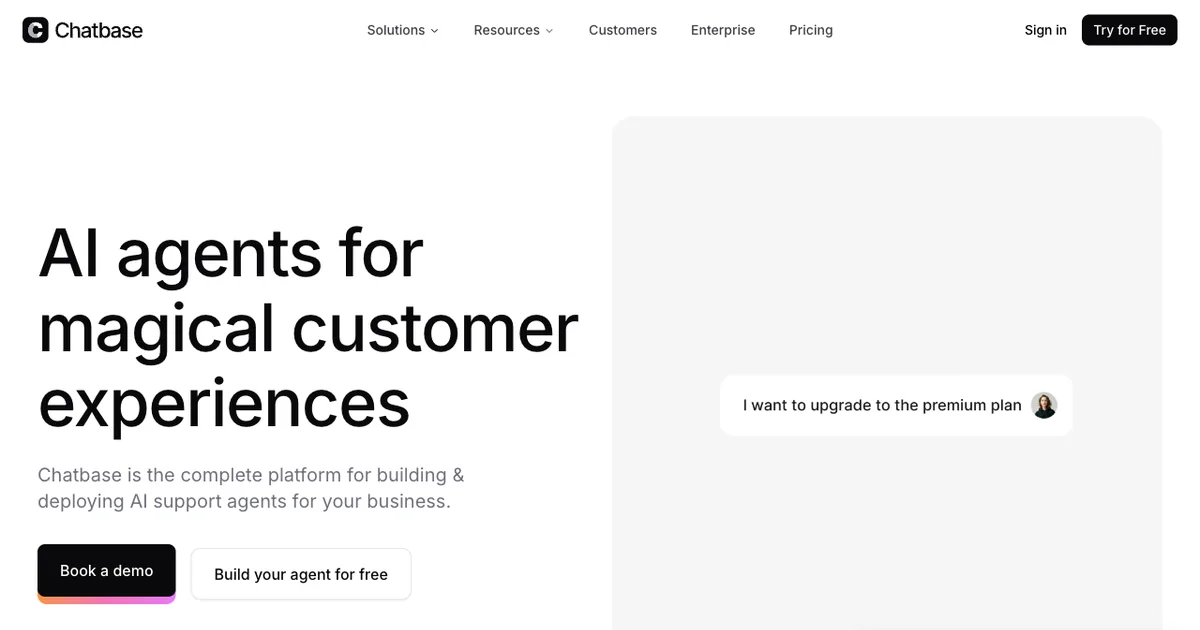
Chatbase is a mature, no-code platform for a chatbot trained on your own data, and it builds a capable bot fast. You crawl your site or upload files, pick from the GPT, Claude, and Gemini families, and have a working assistant in about 10 minutes with no API keys to manage. As a way to monetize an AI chatbot, though, it is a cost center rather than a revenue source.
There is no built-in affiliate or ad layer anywhere in the product. Chatbase’s own pricing page lists the free tier at “50 message credits/month,” with the entry paid tier, Hobby, starting at $32 a month, and Chatbase is pitched at support and sales teams rather than publishers.
To earn commissions you would hand-place affiliate links in the response text or route the bot’s output through an API like ChatAds for chatbot affiliate marketing. Most Chatbase users are support teams who would bolt monetization on afterward, not publishers chasing commissions, and for those teams the dedicated guide to affiliate monetization for AI customer support bots maps the more direct path.
Pros:
- Strong content training through site crawls, sitemaps, and file uploads grounded in your own articles
- Hosted model with no API keys to manage, and a working bot live in about 10 minutes
- Mature product that runs on any website, with model choice across GPT, Claude, and Gemini
Cons:
- No built-in affiliate or ad monetization, so for a publisher it stays a pure cost
- Free plan is effectively a 50-credit demo rather than a tier you can run live
- Built for support and sales, with pricing that climbs steeply as reader traffic grows
Ratings: Capterra: 4.3 / 5 (~73 reviews)
Chatling
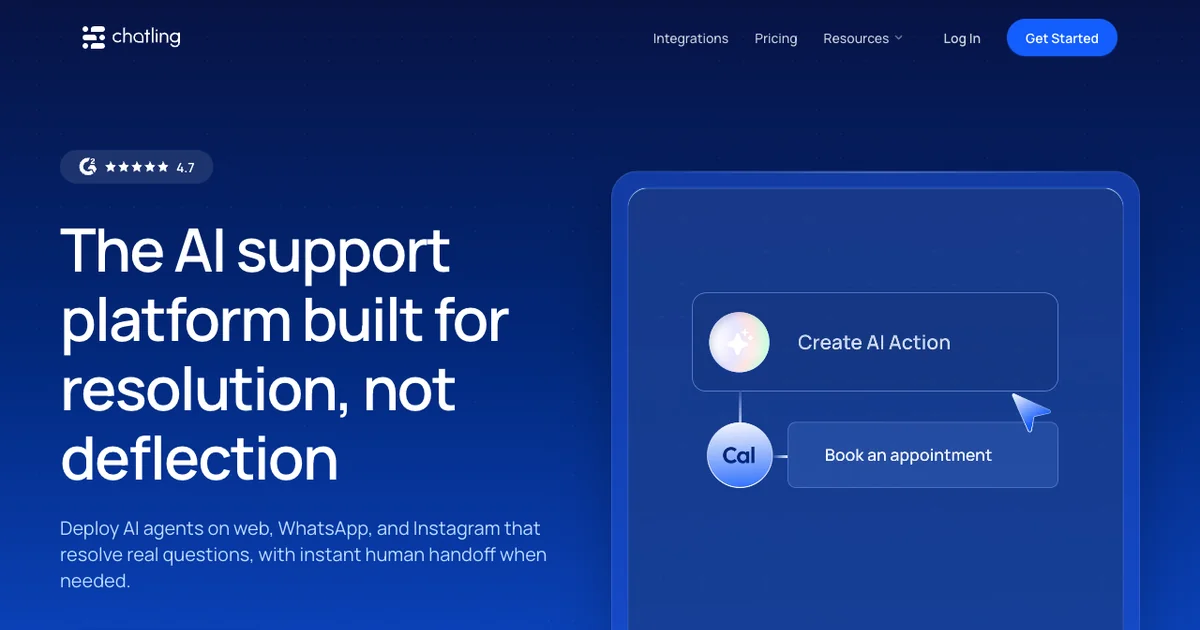
Chatling takes a different shape from the others, built around a visual drag-and-drop flow builder for your conversations. You map out the logic, pick from “28 AI models” per Chatling’s own pricing page, spanning OpenAI, Anthropic, Google, and other providers, and deploy the same bot to your website, WhatsApp, and Instagram. That channel breadth and flow control are its real strengths, backed by a 4.7 rating on G2.
Chatling has no built-in monetization, the same gap as every other builder on this list. Chatling is a paid SaaS the publisher pays into, with AI-credit billing that a premium model can burn through fast, and no native way to earn from the widget. To turn it into an affiliate chatbot, you add product links by hand or route its responses through an API like ChatAds. Chatling makes sense for a small business after a polished support bot, with monetization treated as a separate add-on. If support is the main use case, the dedicated rundown of solutions for AI customer support chatbot monetization ranks the options built for that flow.
Pros:
- Permanent free tier with no card, plus a visual builder that stands a bot up quickly
- Hosted models with no BYOK, and content training through crawls, sitemaps, and uploads
- Wide model choice and multi-channel reach across web, WhatsApp, and Instagram from one builder
- Strong 4.7 G2 rating across roughly 62 reviews from real users
Cons:
- No affiliate or ad monetization, so the widget never earns anything back for a publisher
- Usage-based credits make monthly cost hard to predict as reader volume rises
Ratings: G2: 4.7 / 5 (~62 reviews)
Chatbase, Chatling, AI Engine, and Kognetiks are all capable chatbots, but none of them has an affiliate or ad layer. On those four, every reply is a cost you pay for and never a dollar you earn back, so commissions only happen if you hand-place links or route the bot's output through an API like ChatAds. Only ChatAds treats the chat as something that can pay for itself.
AI Engine
AI Engine is the WordPress power-user route, a freemium plugin that drops a whole AI toolkit into your dashboard. The free core is genuinely capable: its official WordPress.org listing reports “100,000+” active installs and a 4.9 out of 5 rating, and a Pro license adds content-trained chat through its embeddings feature. You fund your own OpenAI or Claude key, so every conversation runs on a model bill that you manage yourself.
On monetization, AI Engine gives you nothing out of the box, the same gap as the hosted builders above. A developer-leaning owner adds affiliate links through prompts and function calling, or routes the chatbot’s responses to an API like ChatAds for automated AI chatbot affiliate links. It runs only on WordPress and expects hands-on configuration before the answers feel right. Technical WordPress owners get real control here, as long as they handle the monetization plumbing themselves.
Pros:
- Free, full-featured core with chatbots, content tools, embeddings, and an MCP server included
- Huge install base and a 4.9 WordPress.org rating, with frequent updates and an active community
- Broad provider choice across OpenAI, Claude, Gemini, and self-hosted models, with no lock-in
Cons:
- WordPress only, so it cannot run on Shopify, Squarespace, Ghost, or static sites
- Bring-your-own-key means you fund and manage every conversation's model bill directly
- No built-in monetization, plus hands-on configuration that is not a five-minute setup
Ratings: WordPress.org: 4.9 / 5 (846 reviews)
Kognetiks Chatbot
Kognetiks Chatbot is the free, open-source WordPress route, released under GPLv3 (“License: GPLv3 or later,” per its GitHub README), with the full source on GitHub. Its standout trait is breadth of model choice, supporting OpenAI, Claude, Gemini, Mistral, and DeepSeek, plus a local JAN.AI server that avoids external API fees entirely. That local-model option is the privacy angle here, since visitor data never has to leave your own server.
Like every plugin on this list, it offers no affiliate or ad layer of any kind. Kognetiks is a chat and insight utility, so commissions require manual links or pairing the bot with an API like ChatAds for chatbot affiliate marketing. It is bring-your-own-key, WordPress-only, and deeply configurable, which power users love and beginners find slow. Kognetiks wins on model choice and privacy, not on earning from the chat the way a managed widget can.
Pros:
- Free and open source under GPLv3, with no per-message vendor fee on top of your provider
- Wide model choice, including a local JAN.AI option for privacy and full cost control
- Trains on your own posts and pages through scheduled Knowledge Navigator refreshes
Cons:
- WordPress only, excluding every other site platform a publisher might run
- Bring-your-own-key, so you manage and fund the provider account directly
- No monetization, and deep configuration that carries a real learning curve
Ratings: WordPress.org: 4.5 / 5 (22 reviews)
How to Choose
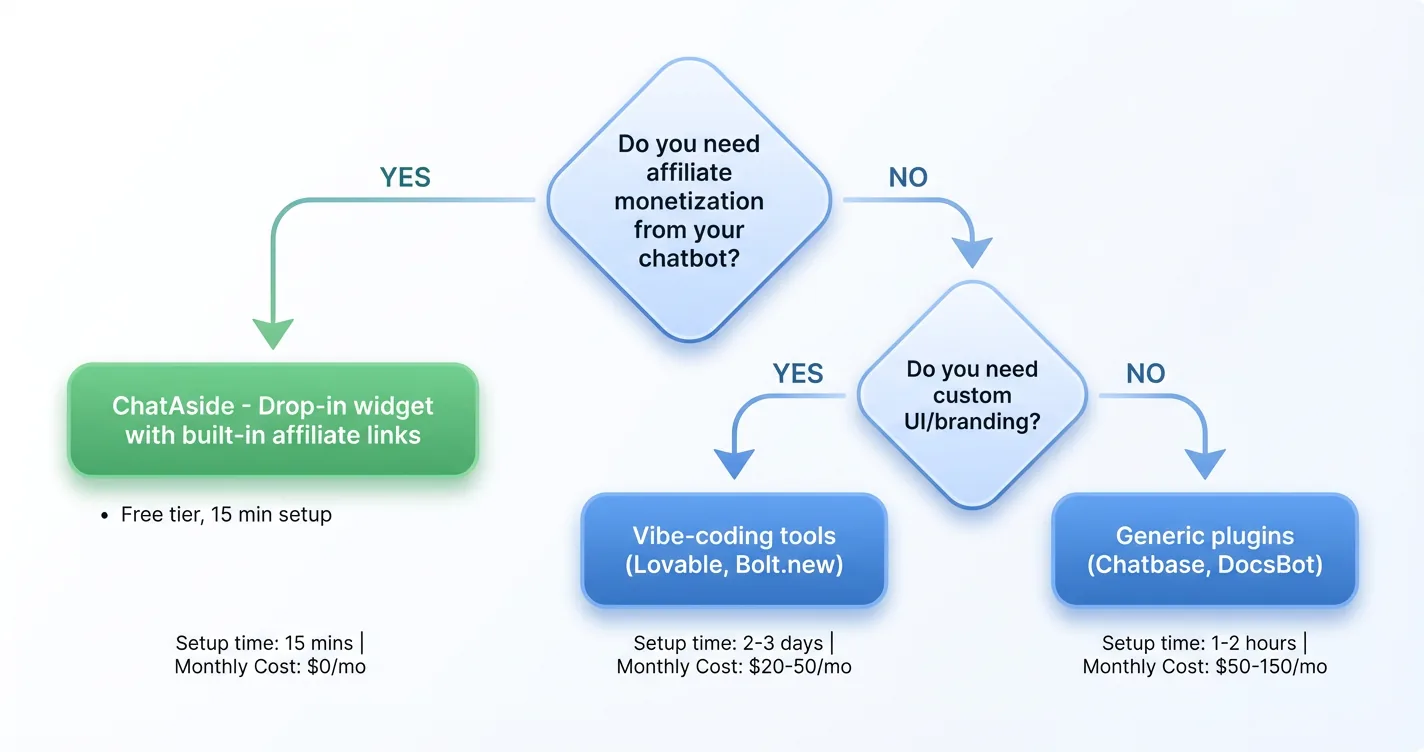
The choice comes down to two questions worth answering before you sign up for anything. Do you want monetization built in, and do you want to build the bot yourself? Those two answers sort this list faster than any feature chart.
If you are a blogger who wants commissions with the least work, the turnkey path gets you a free, monetizing chat widget on any site in minutes. ChatAds is the one option here where affiliate earning is native rather than bolted on, and pairing it with a bot you add to your affiliate blog keeps you in full control of both the conversation and the earnings.
The other four are strong chatbot tools that simply will not earn on their own, which is the same reason a plain language model cannot monetize itself. Chatbase and Chatling cover hosted no-code builds, while AI Engine and Kognetiks serve WordPress owners, each one needing affiliate links added on top.
Decide on monetization before you pick a tool, not after. If earning from the chat matters at all, start with ChatAds, since retrofitting affiliate links onto a tool that was never built for them is the slowest path on this list. Stand up your top choice on one real article, watch what readers actually ask, and only then judge whether the commissions justify a paid tier.
Frequently Asked Questions
What is the best chatbot with affiliate monetization in 2026?
For most publishers, ChatAds is the best chatbot with affiliate monetization because it is free, installs with one line of JavaScript, and inserts Amazon affiliate links into replies while you keep 100 percent of commissions. The other tools on this list need affiliate monetization bolted on by hand.
How do you add affiliate links to an AI chatbot?
You can add AI chatbot affiliate links in two ways: use a tool with monetization built in, or route an existing bot's responses through an API. ChatAds handles it automatically for blog widgets, inserting affiliate links into replies in under a second. Tools without that option require placing links in the response text by hand.
Can you monetize an AI chatbot with affiliate marketing?
Yes. Affiliate marketing is the most direct way to monetize an AI chatbot, since the bot already answers product questions where buying intent is high. The catch is that most chatbot platforms have no affiliate layer, so you either choose a tool like ChatAds that builds it in or add a monetization API to a bot you already run.
Is there a free chatbot with affiliate monetization?
ChatAds is free, including the hosted language model behind every reply, and its built-in Amazon affiliate monetization lets you keep 100 percent of commissions. The free tier has daily message caps, so a high-traffic blog may need a paid plan. Other free tools like Kognetiks or AI Engine have no monetization and still require you to fund your own model account.
Do you keep 100 percent of affiliate commissions with these tools?
With ChatAds you keep 100 percent of affiliate commissions, because it uses your own affiliate accounts and takes no cut of what you earn. The widget itself is free, so it never takes a share of revenue. The remaining tools have no native affiliate program, so commissions depend entirely on links you add yourself.