Support chatbots crossed a real line in 2026 by shifting from canned deflection into genuine problem solving. When a bot truly resolves an issue, it lands right on top of a purchase moment. A clogged filter needs a replacement, a dead cable needs a reorder, and a slow plan probably needs an upgrade.
Support is a trust context, so monetization there cannot feel like an ambush upsell. Push the wrong product mid-complaint and you lose the customer and the sale at the same time. It is a legal context too: the FTC’s disclosure guidance says “your endorsement message should make it obvious when you have a relationship (“material connection”) with the brand,” and it counts an affiliate commission as exactly that kind of financial relationship, so any link a bot drops has to be clearly disclosed. The goal is affiliate monetization for AI customer support bots that helps the user finish the job they came to do.
This guide covers one layer built for live AI replies plus the affiliate programs that supply the products behind it. ChatAds reads the resolved answer and inserts the link, while networks like Amazon and Awin provide the catalog and the commission. If you also want to weigh ad formats alongside affiliate links, the broader set of solutions for AI customer support chatbot monetization compares both in one place.
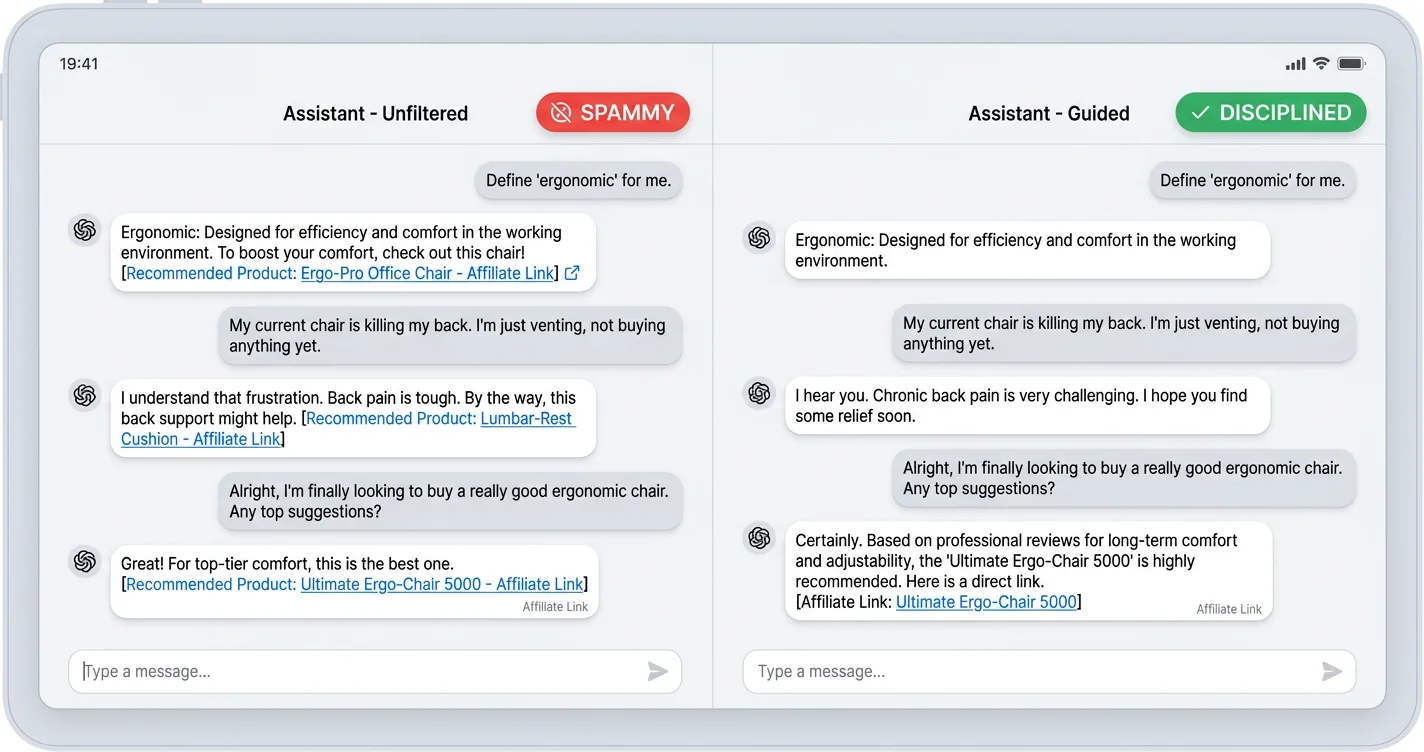
- Fires only on the fix: the link should appear on a clear replacement or accessory question, not a vent or a how-to
- Skips sensitive threads: brand-safety controls keep links out of refund, outage, and complaint chats
- Adds no perceptible wait: the match has to return in under a second so the resolution never stalls on it
Ask ChatGPT to summarize the full text automatically.
★ = low · ★★ = medium · ★★★ = high
| Option | Live Reply Fit | Catalog Breadth | Commission Value | Cost Value |
|---|---|---|---|---|
| ChatAds | ★★★ | ★★★ | ★★★ | ★★ |
| Lasso | ★ | ★★ | ★★ | ★★ |
| Amazon Associates | ★ | ★★★ | ★ | ★★★ |
| Awin | ★ | ★★★ | ★★ | ★★ |
| Rakuten Advertising | ★ | ★★ | ★★ | ★★ |
| Impact | ★★ | ★★★ | ★★ | ★ |
| PartnerStack | ★★ | ★ | ★★★ | ★ |
ChatAds

ChatAds is the only entry here built to monetize the live output of an AI conversation. Your support bot resolves the ticket, you send that reply text to the API, and it detects the product mention inside the answer and returns a matching affiliate link in under a second. You bring your own affiliate accounts, like Amazon Associates, and you keep 100 percent of the commission. For a support flow, that sub-second speed matters, because the link lands inside the resolution without making the user wait.
For support work specifically, the real differentiator is how much it holds back. Brand-safety filters and keyword blocklists suppress any link inside sensitive flows like refunds, outages, and complaints, so the bot never sells into a frustrated moment. PII sanitization keeps customer data out of the matching step, which matters when conversations carry order numbers and emails. It ships eight ad formats and five integration paths across REST, TypeScript, Python, MCP, and n8n, so it drops into most support stacks. For any team that already holds affiliate accounts and wants real AI support chatbot affiliate revenue, ChatAds is the layer that decides when and what to recommend.
Pros:
- Keep 100 percent of affiliate commissions, with only a small per-request API fee
- Built for live AI replies, with sub-second detection that does not stall the support flow
- Brand-safety filters suppress links inside refunds, outages, and other sensitive tickets
- Five integration paths across REST, TypeScript, Python, MCP, and n8n fit most support stacks
Cons:
- Requires existing affiliate accounts, so you set those up before earning
- US-focused today, with matching tuned for the US catalog and English content
Lasso

Lasso does not monetize the live chat, and it helps to be honest about that up front. It is a WordPress plugin built for the help center and knowledge base articles that sit behind most support bots. When your bot links a user to a how-to guide or a troubleshooting page, Lasso turns the products mentioned on that page into clean affiliate displays. Auto Amazon data sync keeps prices and availability current, and automatic broken-link detection has been credited with revenue lifts near 20 percent.
The fit here is the static half of a support operation rather than the conversation itself. Conversion-focused product boxes and comparison tables make those backing articles earn instead of just inform. It runs 24 to 29 dollars a month, stays WordPress-only, and leans on manual curation rather than automatic insertion. As a piece of customer service bot monetization, Lasso covers the documentation layer while a tool like ChatAds handles the live reply. Teams running their support content on WordPress will get the most out of it.
Pros:
- Auto Amazon data sync keeps product prices and stock current without manual edits
- Broken-link detection has been credited with revenue lifts near 20 percent
- Conversion-focused product boxes and comparison tables for help-center articles
Cons:
- WordPress-only, so it does not fit other content platforms
- Does not monetize the live chat, only the backing articles
- Manual curation rather than automatic link insertion
Amazon Associates

Amazon Associates is the catalog a support bot reaches for more than any other. Replacement parts, consumables, and accessories are exactly what a resolved ticket tends to point toward, and Amazon stocks hundreds of millions of them. The program is free to join, and the trusted checkout converts well on clear fix-it intent like buy the part that broke. Once a user clicks through, you earn on the whole cart for the next 24 hours, not just the item you linked.
The limits are worth knowing before you build economics around it. Amazon’s program terms set commissions at 1 to 10 percent across paying categories, and its policies close the qualifying session once “24 hours elapse from that click,” so the cookie is short and every link has to be generated by hand.
The Amazon Associates operating agreement also sets rules an automated bot has to respect, so read it before you wire one up. That manual step is fine for a static review blog, but it breaks down for a support bot that surfaces a different product on every ticket. This is the exact case for pairing Associates with ChatAds, which creates the link in real time while the commission still flows to your account. As a base for affiliate platforms for support agents, Amazon supplies the breadth that most fix-it answers need.
Pros:
- Free to join, with hundreds of millions of products for fix-it answers
- Trusted checkout converts well on clear replacement and accessory intent
- Cart-wide commissions for 24 hours after the first click
Cons:
- Commission rates run a modest 1 to 10 percent by category
- The 24-hour cookie is weak for considered replacement decisions
- Manual link creation does not fit a live support bot on its own
Every network below supplies products but expects hand-built links, which is fine for a static page and wrong for a bot that surfaces a different item on every ticket. The working stack is one live layer that creates the link in real time, sitting on top of one or two networks that hold your affiliate accounts. Pick the sources by what your bot tends to recommend, then let the layer decide when a link actually belongs in the reply.
Awin
Awin earns its place for the moments when the product in question is not an Amazon item. Its network spans more than 25,000 merchants, including direct brand programs from names like Nike, Etsy, and AliExpress. That breadth matters when an international support queue needs local merchants, or when the broken item only sells through the brand’s own store. Cookie windows of 30 to 90 days also suit the considered replacement decisions that support tickets often kick off.
Payments land twice a month, and publishers keep the full commission set by each advertiser, since Awin charges its fee on the advertiser side. Awin reports it “generated $19 billion in revenue for its advertisers and $1.4 billion for its publishers globally in the last financial year,” which points to steady reliability at scale. The tradeoff is manual application to each program and hands-on link management, the same friction Amazon has. Paired with ChatAds, Awin becomes a source the bot can pull the right merchant link from during the conversation. For non-Amazon and global affiliate monetization for AI customer support bots, it is the most complete network here.
Pros:
- More than 25,000 merchants, including direct brand programs beyond Amazon
- Long 30 to 90 day cookies fit considered replacement purchases
- 4.2 G2 rating across 367 reviews signals reliability at scale
Cons:
- Manual application and link management for each merchant program
- Twice-monthly payments are slower than some instant networks
Rakuten Advertising

Rakuten Advertising fits the support bot that belongs to, or recommends, a major retail brand. Its network is curated down to roughly 1,000 premium brands like Walmart, Best Buy, Macy’s, and Sephora. That smaller and vetted roster means less noise and more trust, which tends to lift conversion when a retail bot suggests an upgrade or an accessory. Dynamic and tiered commission structures also reward higher volume as a program scales.
Multi-touch attribution is the other draw, since it credits the earlier support content that helped guide a buyer. For a retail customer experience bot, that captures value the last-click models tend to miss. The catalog is smaller than a general network, the focus stays on retail and lifestyle, and some users flag dashboard and data-accuracy quirks. Rakuten is a strong pick for retail-facing customer service bot monetization, and a weak one for B2B or deeply technical support. Match it to the brands your bot actually serves.
Pros:
- Roughly 1,000 curated premium retail brands mean less noise and more trust
- Dynamic and tiered commissions reward higher referral volume
- Multi-touch attribution credits earlier support content in the path
Cons:
- Smaller catalog than a general affiliate network
- Retail and lifestyle focus leaves B2B and technical gaps
- Users report dashboard and data-accuracy quirks
Impact

Impact is built for the brand that runs its own support bot rather than the publisher joining a network. A company sets up a private partnership program where its bot recommends complementary partner products, instead of plugging into someone else’s catalog. The platform brings 330,000-plus vetted partners, dynamic commissions, and multi-touch attribution that tracks the full path to purchase. Fraud prevention and payouts across 70-plus currencies cover the operational side for programs running at scale.
This is enterprise infrastructure, and the pricing makes that plain. Plans start near 500 dollars a month and add a 2.5 percent transaction fee on partner-driven sales, which only pencils out past roughly 1 million dollars in annual revenue. For a large brand whose support bot can route users to vetted partners, the attribution and control are worth the cost. Smaller teams will find it heavier than they need, and the network options above will serve them better. As AI helpdesk monetization for an enterprise brand, Impact gives the most ownership over the program itself.
Pros:
- Build a private partnership program with full control and attribution
- 330,000-plus vetted partners plus fraud prevention and 70-plus currencies
Cons:
- Starts near 500 dollars a month plus a 2.5 percent transaction fee
- Only justified past roughly 1 million dollars in annual revenue
- Heavier than smaller support teams actually need
PartnerStack

PartnerStack is the specialist pick for support bots that live inside B2B software. When resolving a ticket surfaces a complementary tool or integration, the recommendation does not have to end at the first sale. Referred customers renew their subscriptions month after month, and partners earn recurring commissions across that entire lifetime. Rates commonly run 15 to 30 percent recurring, which compounds far past what a one-time retail payout returns.
Billing integrations with Stripe and Chargebee track renewals, upgrades, and churn with the accuracy a subscription model needs. The marketplace connects 131,000-plus partners with vetted SaaS brands, and the ratings back the platform up at 4.7 on G2 and 4.8 on Capterra, the highest pair on this list. The limits are clear: it serves only B2B SaaS, costs upward of 6,000 dollars a year, and carries long sales cycles before commissions arrive. For consumer or retail support it is the wrong tool entirely. As AI support chatbot affiliate infrastructure for software, PartnerStack aligns the payout with how SaaS revenue actually works.
Pros:
- Recurring commissions of 15 to 30 percent across a customer's lifetime
- Stripe and Chargebee integrations track renewals, upgrades, and churn
- 4.7 G2 and 4.8 Capterra ratings, the highest on this list
Cons:
- Serves only B2B SaaS, not a fit for consumer or retail support
- Costs upward of 6,000 dollars a year for brands
- Long sales cycles delay when commissions arrive
How to Choose
The right stack depends on what kind of support bot you are running and what it tends to recommend. For a live AI conversation that needs a link inserted in real time, ChatAds is the layer regardless of the catalog underneath. It suits AI chatbot developers who already hold affiliate accounts, want to keep 100 percent of the commission, and need dynamic product recommendations rather than hand-built links.
Underneath that layer, pick the source that matches your products. Amazon covers the broadest fix-it catalog, Awin handles non-Amazon and global merchants, and Rakuten fits premium retail brands. If you run the bot as a brand and want your own program, Impact serves enterprise scale while PartnerStack fits recurring B2B SaaS. For the help-center articles behind the bot, Lasso monetizes the documentation. Most support teams end up pairing ChatAds with one or two of these sources for the products their bot recommends.
Start with one affiliate account and one live layer, then test the tone before you scale the catalog. Wire a single Amazon Associates tag through ChatAds, run a few real resolution replies, and read each one back as a frustrated customer would. If the link still feels like part of the fix rather than an upsell, that is the signal it is safe to add more networks behind it.
Frequently Asked Questions
What is the best affiliate monetization for AI customer support bots?
ChatAds is the strongest pick because it is the only option built to monetize the live reply, reading the resolved answer and returning a matching affiliate link in under a second while you keep 100 percent of the commission. Underneath it, Amazon Associates supplies the broadest fix-it catalog, Awin covers non-Amazon and global merchants, and Rakuten fits premium retail brands. Which network you pair with the layer depends on what your support bot tends to recommend.
How do affiliate links work in an AI customer support bot?
You connect your own affiliate accounts, such as Amazon Associates, then run the bot's resolved reply through an API like ChatAds that detects the product and returns a matching affiliate link. The link sits inside an answer the customer already wanted, like a replacement part for the item they were troubleshooting, and when they buy you earn the full commission minus a small per-request API fee. This is how an AI support chatbot affiliate setup turns a resolved ticket into revenue without a redesign.
Should a support bot show affiliate links in refund or complaint threads?
No, a customer chasing a refund or reporting an outage is the worst moment to recommend anything. Brand-safety filters and keyword blocklists in a layer like ChatAds suppress links inside those sensitive flows, so the bot never sells into a frustrated moment. Reserving links for clear replacement and accessory questions is what keeps customer service bot monetization from eroding trust.
What are the best affiliate platforms for support agents that recommend non-Amazon products?
Awin is the most complete network for non-Amazon and international products, with more than 25,000 merchants and direct brand programs from names like Nike and Etsy. Rakuten Advertising suits premium retail brands, while Impact and PartnerStack fit brands running their own programs or recurring B2B SaaS referrals. Paired with a live layer like ChatAds, any of these becomes a source the bot can pull the right merchant link from during the conversation.
Can affiliate monetization slow down an AI helpdesk reply?
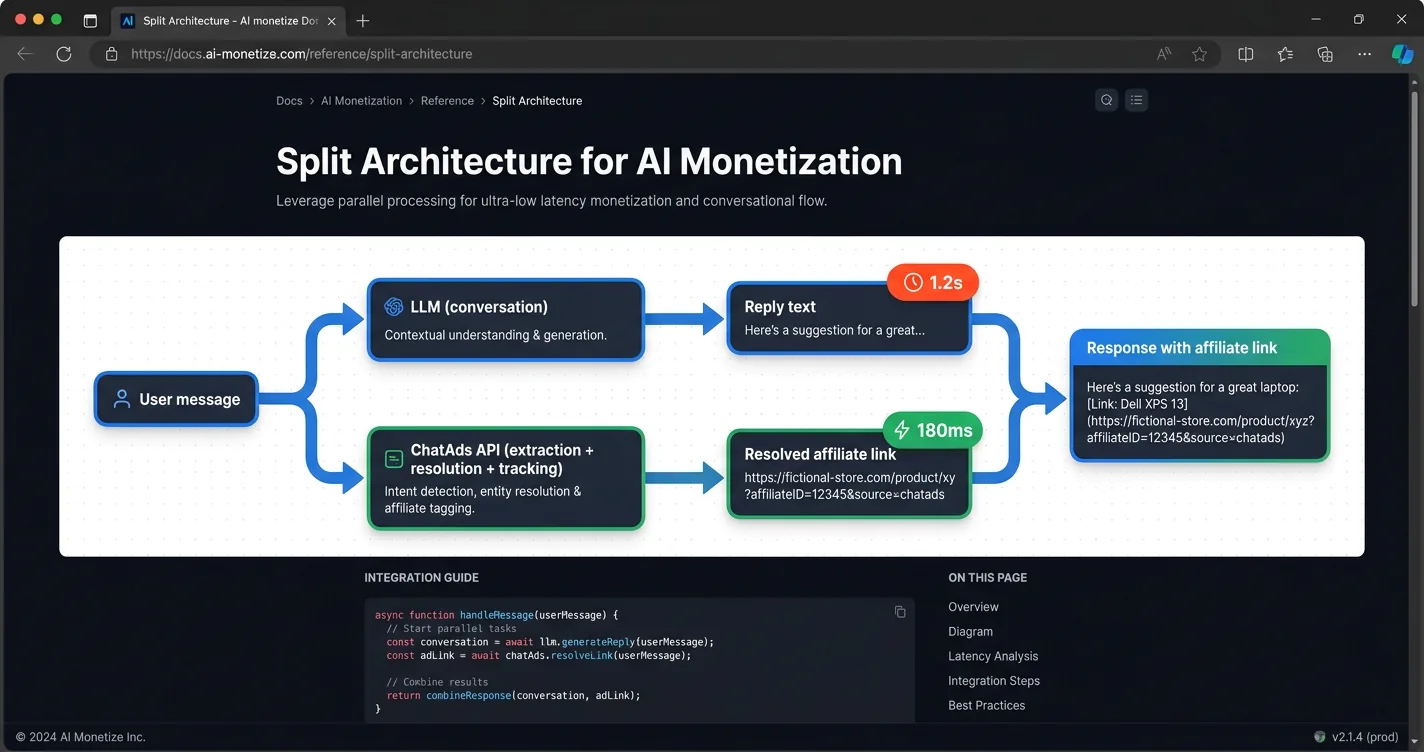
It does not have to, as long as the matching step returns fast enough to ride the answer rather than block it. ChatAds returns a link in under a second and can run in parallel with the model, so a billing or troubleshooting reply never stalls waiting on it. Latency is the main risk in AI helpdesk monetization, which is why a sub-second layer matters more here than in a static blog.
Do I keep the full affiliate commission with ChatAds?
Yes, you bring your own affiliate accounts and keep 100 percent of the commission, paying only a small per-request API fee to ChatAds. That differs from networks that take a cut of the payout, since here the commission flows straight to your Amazon Associates or other account. The tradeoff is that you set up those affiliate accounts yourself before any earnings start.