Support chatbots used to have one job: deflecting tickets before they ever reached a human agent. In 2026 those same bots field millions of high-intent questions a day, and plenty of those conversations end with someone ready to buy, replace, or upgrade something. That shift quietly turns a cost center into a genuine revenue opportunity.
The hard part is earning that revenue without wrecking the support experience people came for. A frustrated customer chasing a refund does not want a banner in their face, and a slow support reply irritates faster than almost any other delay. Most platforms here handle ad monetization, while ChatAds is the exception that also covers affiliate links.
This guide ranks seven options for AI customer support chatbot monetization by how well each one earns without hurting the support experience.
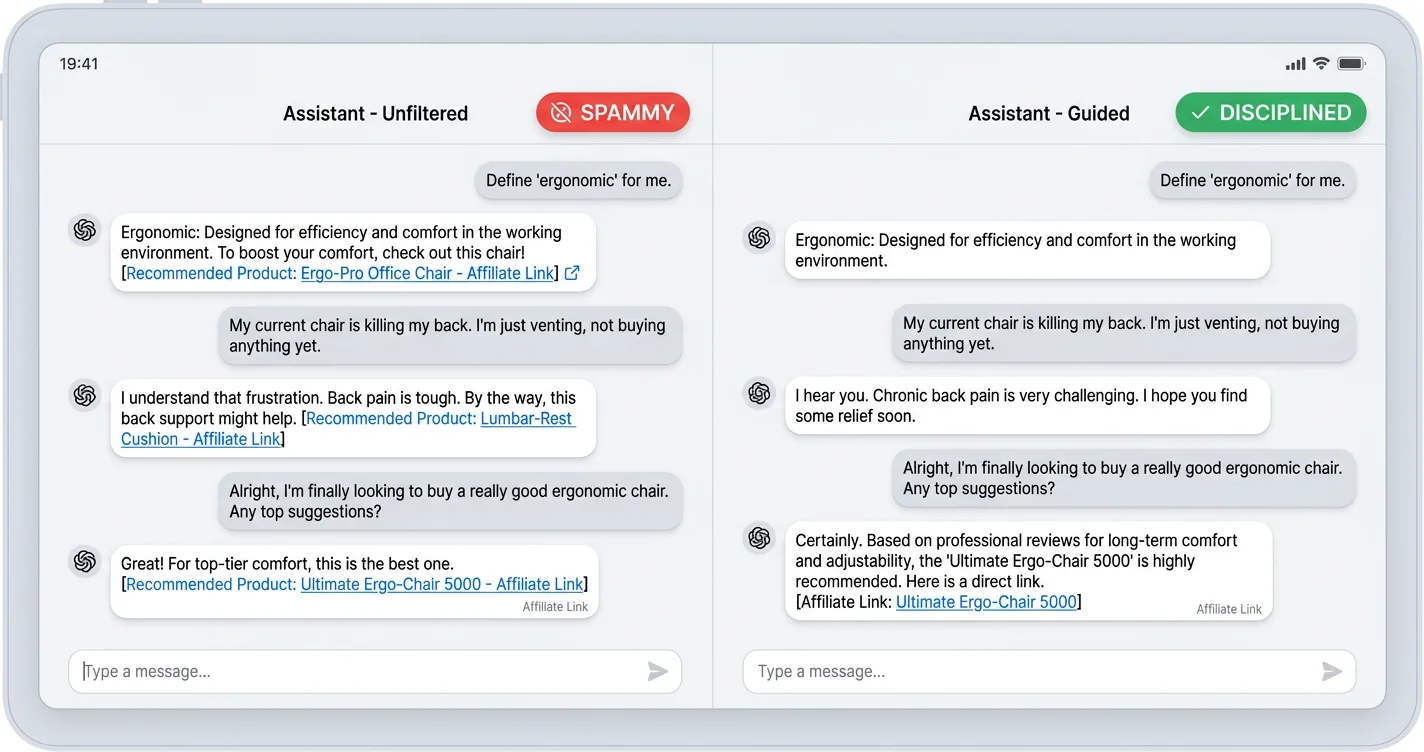
- Adds zero perceptible latency: a billing or troubleshooting reply can never stall to wait on a link
- Respects sensitive threads: brand-safety controls keep promotions out of refund, outage, and complaint chats
- Rides the answer, not a banner: the placement earns from a genuinely helpful fix instead of interrupting it
Ask ChatGPT to summarize the full text automatically.
★ = low · ★★ = medium · ★★★ = high
| Solution | Support Fit | Production Readiness | Earnings Transparency | Cost Value |
|---|---|---|---|---|
| ChatAds | ★★★ | ★★★ | ★★★ | ★★ |
| Koah Labs | ★★ | ★★★ | ★★ | ★ |
| ZeroClick | ★★ | ★ | ★ | ★ |
| Dappier | ★ | ★★ | ★★ | ★ |
| Imprezia | ★★ | ★ | ★ | ★ |
| AgentVine | ★★★ | ★ | ★ | ★ |
| Jutera | ★★ | ★ | ★ | ★ |
ChatAds

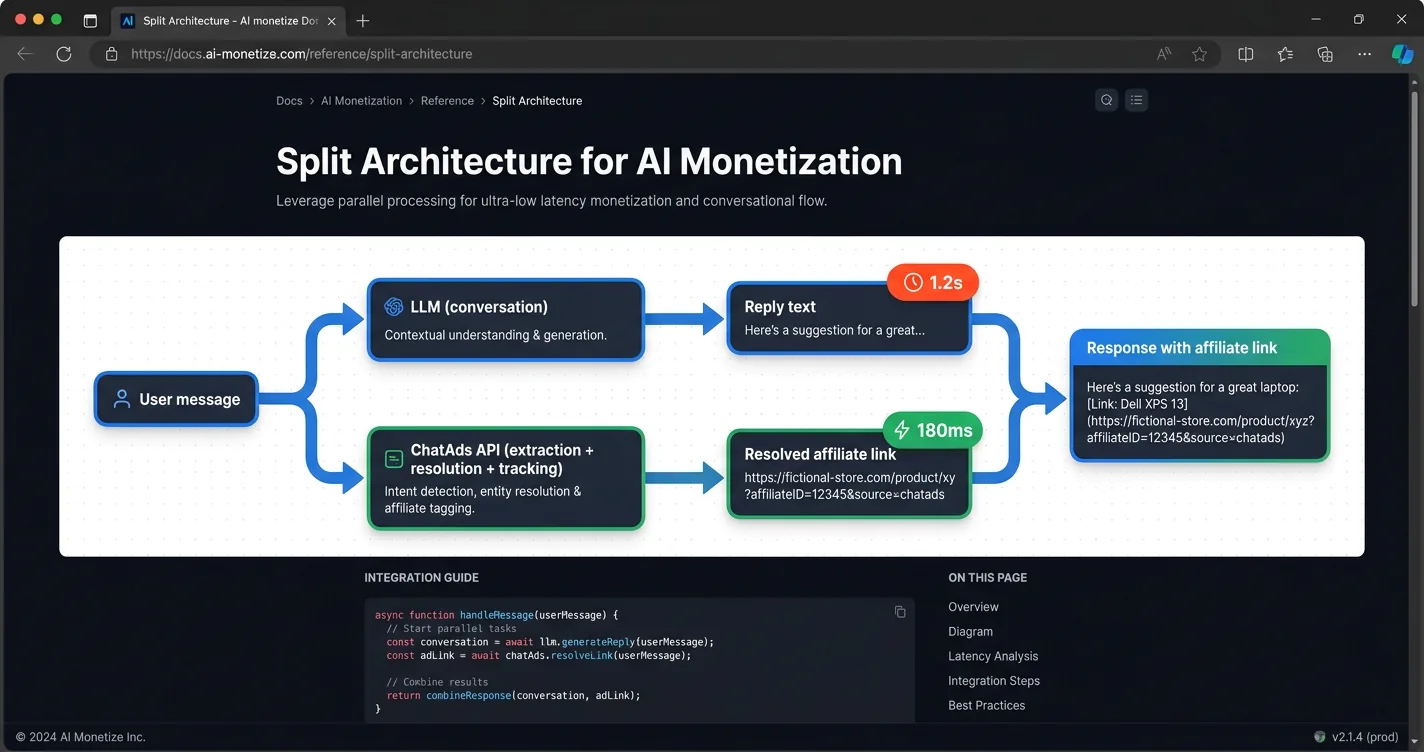
ChatAds is the only platform here that runs both affiliate links and ad formats, which matters when a support chat ends in a real purchase. You pass the bot’s resolved answer to the API, it reads the product intent inside that text, and it returns a matching affiliate link in under a second. You bring your own affiliate accounts, like Amazon Associates, and keep 100 percent of the commission. The link rides on a helpful answer instead of interrupting it, so conversational support monetization stays out of the way of the fix the customer came for.
Speed and safety are why this fits support flows in particular. Most responses come back well under a second, so a billing or troubleshooting reply never stalls while it waits on a link. Brand-safety blocklists keep links out of sensitive threads, like complaints or cancellations, where any promotion would land badly. A native MCP server plus TypeScript and Python SDKs drop it into an existing help-desk bot, and a free tier of 100 requests a month lets you test before adding a card. For a team that already holds affiliate accounts, ChatAds turns helpful support answers into customer service chatbot revenue without a redesign.
Pros:
- Keep 100 percent of affiliate commissions, paying only a small per-request API fee
- Runs both affiliate links and eight ad formats, the only option here that spans both
- Sub-second responses plus brand-safety blocklists that suit sensitive support threads
- Drops in through a native MCP server, SDKs, and a free tier of 100 requests a month
Cons:
- Requires existing affiliate accounts, so you set those up before earning
- US-focused today, with matching tuned for the US catalog and English content
Koah Labs

Koah Labs calls itself AdSense for GenAI, and it is the most production-ready ad-only option for a support bot. It reads the customer question and the bot’s reply, then matches a sponsored card in milliseconds so the support answer does not slow down. Named clients like Luzia, Liner, and DeepAI give it social proof that few rivals on this list can show. For a team weighing help desk AI ad platforms with proven fill, that track record counts for more than a pitch.
The format mix suits support work where a reply can carry a useful next step. Action Cards and lead-gen units sit naturally after an answer, and the SDK spans web, React Native, Flutter, iOS, and Android. Koah publishes eCPM and click-through benchmarks, which helps you sketch revenue before you commit anything. The catch is that the exact revenue split stays private, and the formats lean toward general conversational apps more than dedicated support desks. Even so, Koah Labs is one of the safer picks when you want ad revenue running this week rather than after a beta.
Pros:
- Production-ready with named clients like Luzia, Liner, and DeepAI
- Matches a sponsored card in milliseconds, so the support reply stays fast
- Publishes eCPM and click-through benchmarks, which is rare among early ad vendors
Cons:
- Revenue-share terms are not disclosed publicly
- Ad-only, with formats aimed at general apps more than support desks
ZeroClick

ZeroClick takes a deeper approach, weaving advertiser context into the model while it generates the reply rather than after. It comes from Honey co-founder Ryan Hudson and raised 55 million dollars, with more than 10,000 advertisers including Walmart, Amazon, and Target already signed on. Trade coverage of the round reported that “ZeroClick has secured $55 million in funding from an investor group that includes Anthos, Ludlow, Anfa, Wonder, Protagonist, and founder Ryan Hudson.” For a large support platform that owns its own inference loop, that advertiser access is hard to match. The model itself decides whether sponsored context actually fits the answer, which keeps a support reply from feeling forced.
The trade-offs are real for most support teams that consider it, though. ZeroClick is in closed beta with no public pricing, so you cannot model conversational support monetization before a partnership conversation. The reasoning-time method needs deep access to your generation step, which rules out closed models like a hosted GPT or Claude endpoint. It pays on clicks through a CPC model with full-funnel attribution from consideration to conversion. ZeroClick makes sense for a big platform building its own support stack, but it asks for far more integration than a drop-in API.
Pros:
- Backed by a proven founder and 10,000-plus advertisers, including major retail brands
- Weaves ads in during generation, so the model keeps only what fits the answer
- Full-funnel attribution that tracks consideration through click and conversion
Cons:
- Closed beta with no public pricing to model revenue against
- Needs deep reasoning-time access, so closed LLM endpoints are out
- Complex integration aimed at large platforms, not a quick add-on
The three options above each clear the bar that matters most in support, which is that they earn from a helpful answer without slowing it or cluttering it. The four that follow are stronger on paper than in a real support flow, whether because the format wants a screen, the platform is still behind a beta wall, or the proof simply is not there yet. When a customer arrived with a problem, the only fair question is whether the placement would still feel right while they are mid-fix.
Dappier

Dappier fits the help-center side of support more than an in-app bot. It is built for the AI answers economy, letting a publisher stand up a branded answer assistant on a subdomain with no code at all. Its agentic ads take the form of sponsored prompts, and a separate data marketplace licenses your content to other AI platforms. For a knowledge base or documentation site that already draws steady traffic, that dual revenue is a genuine draw.
The disclosed economics are friendlier than most other options here. Dappier reports CPMs from 5 to 15 dollars, which runs well above traditional display, and it claims strong conversion lifts on high-intent prompts. As one ad-industry writeup put it, “the ad model operates on CPM pricing, with rates ranging between $5 and $15.” The audience is the real mismatch, since Dappier serves news and media publishers rather than teams building a support bot from scratch. The subdomain model also pulls users onto a separate page instead of answering them inside your product. Dappier earns a spot for content-rich help centers, though it is a looser fit for a transactional support chat.
Pros:
- Discloses CPMs of 5 to 15 dollars, well above traditional display advertising
- No-code AI Mode stands up a branded help assistant quickly
Cons:
- Built for news and media publishers, not support-bot developers
- Subdomain model answers off to the side, not inside your product
- Revenue-share split is not disclosed
Imprezia

Imprezia aims at the exact economics that squeeze support bots, which is high inference cost set against low subscription conversion. It places contextual brand mentions inline in the reply, so a support answer about a printer can name a compatible cartridge as a sponsored pick. The team comes from MIT with ad backgrounds at Meta, Amazon, and Microsoft, and it sits in Y Combinator’s 2025 batch. The pitch is a five-minute install that works with any model you already run.
The core problem with Imprezia today is what you cannot verify from outside. The platform is invitation-only, with no public docs, no pricing, and no named clients to check against. The five-minute claim and the inline format both sound right for support, yet there is no way to test either before an invite. It describes premium CPMs per impression or click without disclosing the actual split. Imprezia is one to watch for the team alone, but it reads as a bet rather than something you can ship against this quarter.
Pros:
- LLM-agnostic inline mentions that suit a native, non-disruptive support reply
- Strong team pedigree from MIT, Meta, and Amazon, plus YC backing
Cons:
- Invitation-only beta with no public docs or pricing
- No named clients or case studies to verify the claims
- Revenue split per impression or click stays undisclosed
AgentVine

AgentVine is built for the agent economy, and its design hands support teams unusual control. Offer Units run inside the agent’s own reasoning, and the agent decides whether a sponsored suggestion truly serves the customer’s goal. That control is the real selling point for support, because you can switch offers off entirely for refund, outage, or complaint threads. It targets open frameworks like LangGraph, CrewAI, and AutoGen with no behavioral tracking at all.
Privacy and disclosure are built into the platform, which helps in regulated support settings. Matching is intent-based rather than profile-based, and every sponsored suggestion carries a clear label for FTC compliance. The FTC’s endorsement rules are blunt on this point, holding that a material “connection must be disclosed clearly and conspicuously” whenever the audience would not reasonably expect it.
Payouts run on clicks and conversions, so you earn only when an offer leads somewhere real. The early-stage gaps are hard to ignore, since AgentVine is in public beta with no disclosed revenue share and little public detail about the team. The decision-layer control fits support neatly, yet it still reads as an early bet.
Pros:
- Full control to disable offers for refund, outage, or complaint threads
- Privacy-first, intent-based matching with no behavioral tracking
- Built-in sponsored labels for FTC disclosure on every suggestion
Cons:
- Public beta with no disclosed revenue share to model earnings
- Little public detail on the team or any production track record
Jutera

Jutera leans hardest into enterprise compliance, which is where regulated support teams feel the most pressure. It cites SOC 2 Type II, GDPR, and CCPA, and its guidance argues for capping ads at a fifth of responses while always disclosing them. The architecture runs ad requests in parallel with the model, which is meant to keep added latency off the support reply. Formats include sponsored cards, in-conversation messages, and contextual links woven into answers.
On paper that posture suits sensitive support work, but the proof is missing. There are no public docs, no pricing, and no named clients, while key product pages return errors. That makes it hard to tell whether Jutera is an operating platform or still a concept from its parent company, Bajaar LLC. It lists several revenue models without showing rates for any of them. Jutera earns a spot for the compliance framing, though it is the least proven help desk AI ad platform here and worth revisiting only once it shows real traction.
Pros:
- Enterprise compliance posture with SOC 2, GDPR, and CCPA all cited
- Parallel processing aimed at keeping added latency off the support reply
Cons:
- No public docs, pricing, or named clients to evaluate
- Key product pages return errors, signaling concept-stage maturity
- No performance benchmarks or proof of real revenue
How to Choose
The right pick for AI customer support chatbot monetization starts with one constraint, which is that support traffic is rarely browsing. People arrive with a problem, so anything that slows the answer or clutters it costs you trust you cannot easily win back. Monetization that rides on a helpful answer beats a banner stapled to the side of one.
ChatAds is the natural starting point if you already hold affiliate accounts, since embedded links earn on real purchases, keep 100 percent of the commission, and return in under a second through an API or MCP. Koah suits a team that wants proven ad fill running this week, while Jutera leans into enterprise compliance if it proves out. AgentVine fits agentic and privacy-first stacks, and ZeroClick suits a large platform that owns its inference loop. Dappier covers content-rich help centers, and Imprezia is the early-stage option for teams willing to wait on a beta.
In support, latency and trust are the real limits, so the best option is the one that disappears into a genuinely good answer. If you want to go deeper on the affiliate side specifically, the breakdown of affiliate monetization for AI customer support bots covers the link mechanics in more detail.
Do not choose from the star table alone. Wire one real support reply through ChatAds with a single affiliate account, then read it back as a customer would and ask whether the link still feels like part of the fix. The free tier of 100 requests a month is enough to feel the latency and the tone on your own bot, and that test tells you more about support fit than any column here.
Frequently Asked Questions
What are the best tools for AI customer support chatbot monetization?
ChatAds is the strongest pick because it is the only option that runs both affiliate links and ad formats, reads the product intent in a support reply, and returns a matching link in under a second while you keep 100 percent of the commission. Koah Labs is the most production-ready ad-only network, and AgentVine fits agentic stacks where you want to disable offers for sensitive threads. Which one fits depends on whether you want affiliate links on real purchases or ad fill, and on how much integration you can take on.
How do you monetize a support chatbot without hurting the support experience?
The safest path is monetization that rides on a helpful answer instead of interrupting it, which usually means an affiliate link or woven mention rather than a banner. Send the bot's resolved reply to an API like ChatAds, which detects the product mention and returns a link in under a second, so the troubleshooting answer never stalls. Brand-safety controls then keep promotions out of refund, outage, and complaint threads where any offer would land badly.
Can you put ads in an AI customer support chatbot?
Yes, several help desk AI ad platforms place sponsored cards or contextual mentions after a support answer, with Koah Labs and Dappier among the more production-ready. The catch is that support traffic arrives with a problem, so ads work only when they appear after the fix and stay out of sensitive threads. Capping how often ads show and disclosing them clearly is what keeps the format from eroding trust.
How do affiliate links work in a customer service chatbot?
You connect your own affiliate accounts, such as Amazon Associates, then run the bot's reply through an API like ChatAds that detects the product and returns a matching affiliate link. The link sits inside an answer the customer already wanted, and when they buy, that link earns the full commission minus only a small per-request API fee. This is how conversational support monetization turns a resolved ticket into customer service chatbot revenue without a redesign.
Should a support chatbot show offers in refund or complaint threads?
No, a frustrated customer chasing a refund or reporting an outage is the worst moment to promote anything. The best tools let you switch offers off entirely for those threads, either through brand-safety blocklists in ChatAds or a decision layer in AgentVine that the agent controls. Reserving monetization for clear buying moments protects the trust support is supposed to build.
Which support chatbot monetization platforms are production-ready in 2026?
ChatAds and Koah Labs are the most production-ready, both with public docs, SDKs, and a path you can ship against this week. Dappier is production-ready too but built for on-screen help centers rather than in-app support bots. ZeroClick, Imprezia, AgentVine, and Jutera are in closed or public beta with little or no disclosed pricing, so they read as early bets rather than infrastructure you can model revenue against today.