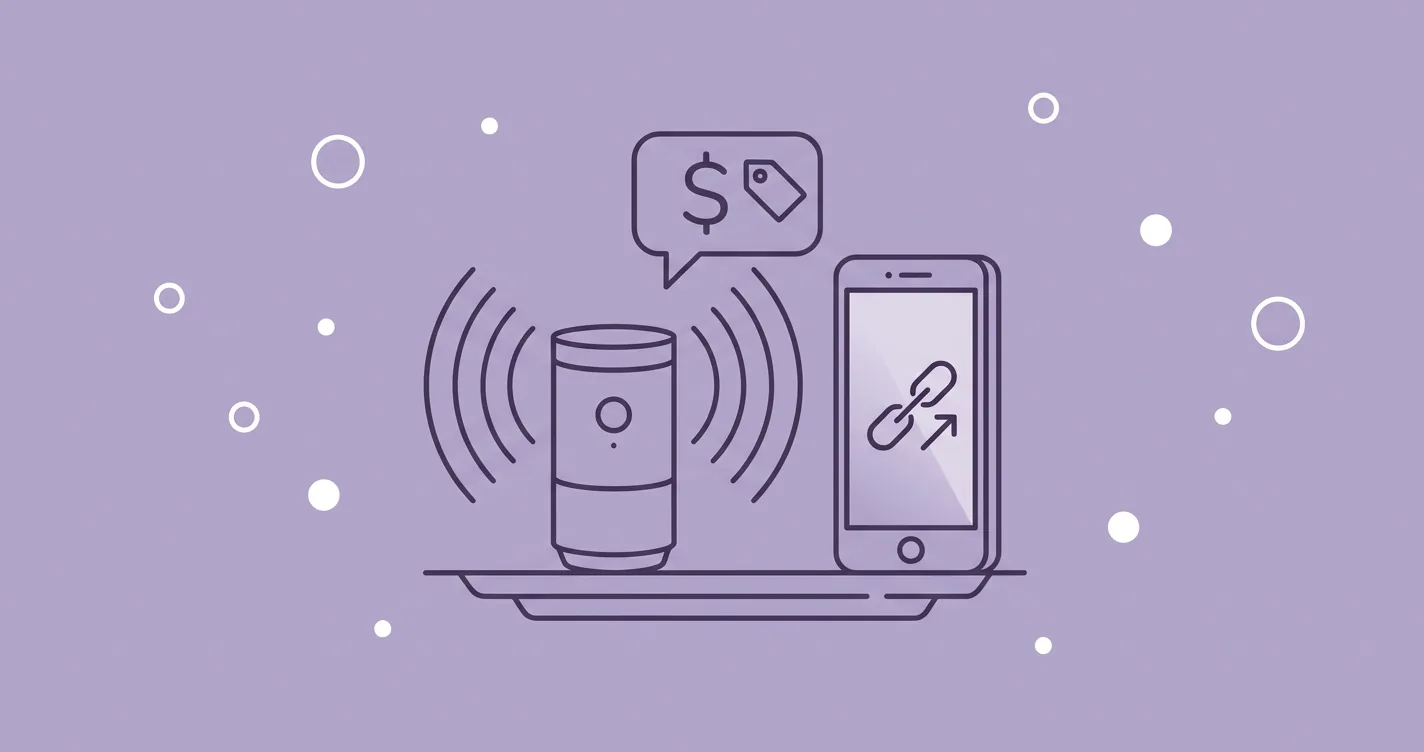
Voice AI grew up in 2026, moving past timers and weather into real buying questions. Smart speakers, in-car assistants, and standalone voice agents now field requests that end in a purchase. The money question follows close behind, and the answer is not obvious.
Every monetization playbook developers inherited assumes a screen the user can look at. Banners, sponsored cards, and clickable prompts all need pixels that a voice-only surface simply does not have. That gap is the whole reason voice AI monetization needs its own shortlist.
This guide ranks the tools by how well each one survives being spoken aloud, and it flags honestly where a platform was really built for a screen.
- Survives being spoken: the format works as audio, with no banner or card to render
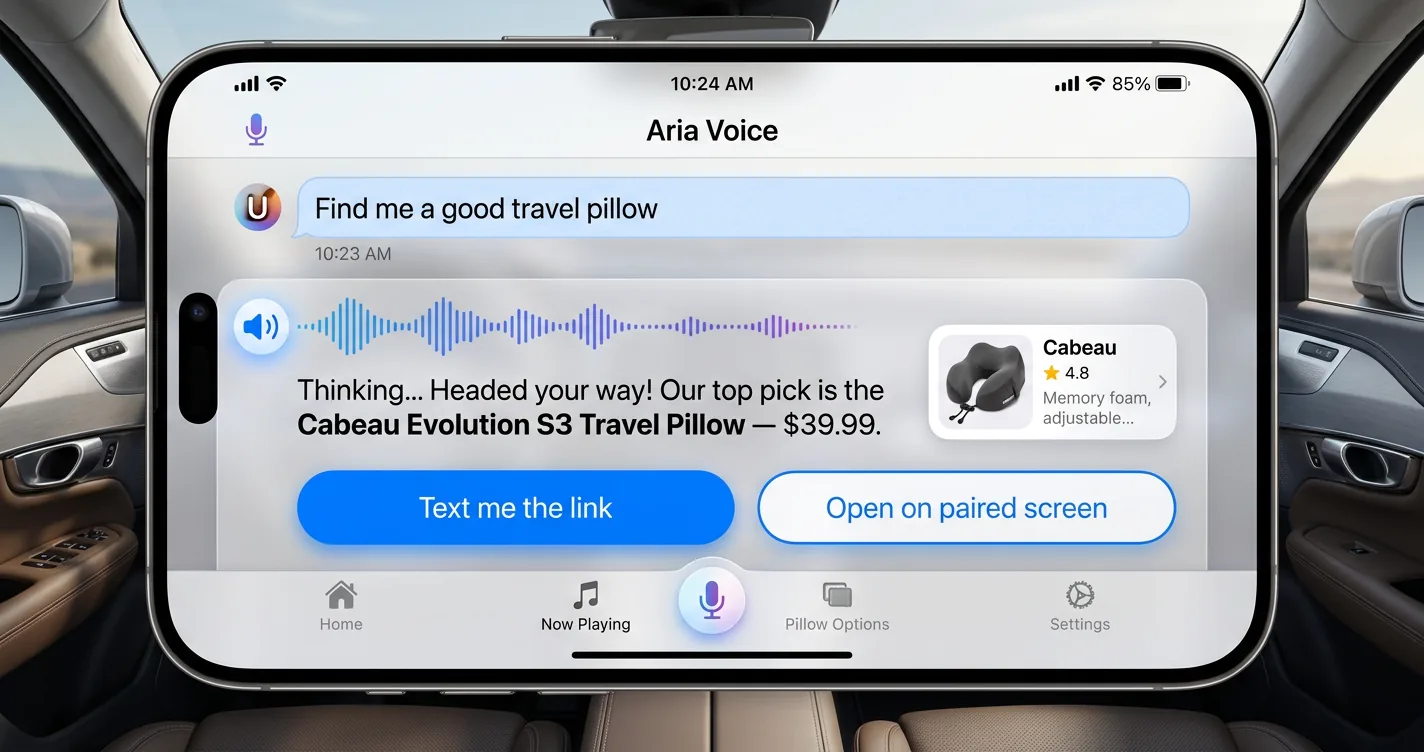
- Speaks the offer, then sends it: name the item and price aloud, then text or cast the link (ChatAds)
- Fails on a screenless device: sponsored prompts and visual cards need pixels a speaker does not have
Ask ChatGPT to summarize the full text automatically.
★ = low · ★★ = medium · ★★★ = high
| Tool | Voice Fit | Production Readiness | Earnings Transparency | Cost Value |
|---|---|---|---|---|
| ChatAds | ★★★ | ★★★ | ★★★ | ★★ |
| ZeroClick | ★★★ | ★ | ★ | ★★ |
| Imprezia | ★★ | ★ | ★ | ★★ |
| AgentVine | ★★★ | ★ | ★ | ★★ |
| Adsbind | ★ | ★ | ★ | ★★ |
| Dappier | ★ | ★★ | ★★ | ★ |
ChatAds

ChatAds is the one tool here built for a surface with no screen at all. You send the assistant’s spoken reply to the API, it reads the product intent inside that text, and it returns a matching affiliate link in under a second. The assistant can then say the item name and the price out loud, and offer to text the link or open it on a paired screen. That flow makes voice AI monetization feel like part of the answer instead of an ad break.
This is also the only option on the list that runs both ad formats and affiliate links, so your voice AI affiliate links sit next to product cards and other placements when a screen is present. You bring your own affiliate accounts, like Amazon Associates, and you keep 100 percent of the commission. ChatAds charges only a small per-request fee for the API, never a cut of what you earn. A native MCP server drops it into voice agents and custom GPTs, and a free tier of 100 requests a month lets you test the spoken flow before you add a credit card. For developers who already hold an affiliate account, ChatAds is the cleanest path to audio-native revenue.
Pros:
- Keep 100 percent of affiliate commissions, with only a small per-request API fee
- Speaks the item name and price, then offers to send the listing, so no banner is needed
- API-first with a native MCP server that drops into voice agents and custom GPTs
- Sub-second responses and a free tier of 100 requests a month to test the flow
Cons:
- Requires existing affiliate accounts, so you set those up before earning
- US-focused today, with matching tuned for the US catalog and English content
ZeroClick

ZeroClick comes from Ryan Hudson, who co-founded Honey before its sale to PayPal. PayPal’s acquisition announcement confirmed it “agreed to acquire Honey Science Corporation … for approximately $4 billion,” and Hudson’s newer venture raised $55 million in 2025, with trade coverage reporting that “ZeroClick has secured $55 million in funding from an investor group that includes Anthos, Ludlow, Anfa, Wonder, Protagonist, and founder Ryan Hudson.” The model weaves advertiser context into the response while the model is still reasoning, so what comes out is plain spoken text rather than a visual unit. For a voice assistant that reads its answer aloud, that fit is strong on paper, since there is nothing to render. The network already lists more than 10,000 advertisers, including Walmart, Amazon, and Target.
Payment runs on a cost-per-click model with full-funnel attribution from consideration through conversion. The catch for voice assistant monetization is access, because ZeroClick sits in a closed beta with no public docs or pricing. It also needs deep integration into the reasoning loop, which rules out closed platforms that will not expose that step. ZeroClick is a credible bet for funded, voice-native teams that can wait out the beta, but it is not something an indie developer can ship this week.
Pros:
- Woven, reasoning-time text reads and speaks naturally with no visual unit to display
- Backed by a proven founder, $55 million, and more than 10,000 advertisers
- Full-funnel attribution tracks the path from consideration through conversion
Cons:
- Closed beta with no public docs or pricing to evaluate before joining
- Needs deep reasoning-loop integration, so closed platforms are out
- No disclosed revenue share, so you cannot model earnings yet
Imprezia

Imprezia calls itself the world’s first AI ad network, built by MIT graduates who ran ad systems at Meta, Amazon, and Microsoft. Its format is the inline brand mention, where a question about a luxury hotel in Tokyo prompts the assistant to name a sponsored property like the Park Hyatt. A mention like that reads cleanly when spoken, since it is woven into the sentence rather than boxed off as an ad. The company is part of Y Combinator’s 2025 batch and pitches a one-line SDK that works with any model.
The approach lands in roughly the same place as ZeroClick, though the mention is added after generation rather than during it. For honest voice AI monetization, the gaps are hard to ignore. Imprezia runs an invitation-only beta, its docs and pricing pages return errors, and there are no case studies to check. It also sells sponsored brand mentions rather than affiliate links, so Imprezia earns on awareness, not on the purchase your assistant might actually drive.
Pros:
- Inline brand mentions speak naturally, with no banner to render on a screen
- LLM-agnostic SDK works across OpenAI, Anthropic, and Gemini without a model swap
Cons:
- Invitation-only beta, with docs and pricing pages that return errors
- Brand mentions only, so there are no affiliate links or per-sale earnings
- No case studies or public metrics to verify the marketing claims
AgentVine

AgentVine bills itself as the first ad network for the agent economy, and that aim suits voice agents well. Its Offer Units are structured payloads with suggested phrasing and a call to action, scored inside the agent’s own reasoning instead of placed on a screen. A voice agent can simply speak the suggestion when it fits the task, which maps neatly onto a screenless flow. The platform targets open frameworks like LangGraph, CrewAI, and AutoGen, plus custom GPTs.
Matching is intent-based with no behavioral tracking, and payouts run on clicks and conversions. For a team weighing voice commerce AI, the offer-as-suggestion design is one of the better conceptual fits on this list. The standard early-stage caveats still apply, and they are not small ones. AgentVine sits in public beta, discloses no revenue share, and ships no case studies or company background, so it reads as a promising bet rather than infrastructure you can model revenue against today.
Pros:
- Offers live inside agent reasoning, so the agent speaks them with no screen needed
- Built for open frameworks like LangGraph, CrewAI, and AutoGen with no lock-in
- Intent-based matching with no behavioral tracking or user profiling
Cons:
- Public beta with no disclosed revenue share to model earnings against
- No case studies or company background, which makes it an early bet
The tools above all produce something a voice assistant can read aloud, whether a woven mention or a spoken offer. The next two were built for a screen first, so most of their formats never reach a listener who has no display. When the only output is audio, the honest test is simple: would the placement still make sense if your assistant had to say it out loud? That question rules out banners and sponsored cards faster than any feature list.
Adsbind

Adsbind is a developer-first ad platform whose pitch is to turn conversations into revenue. It leans on a short Python SDK, though the pip install command in its own developer guide does not resolve to a published package, and a dashboard that sets how often ads appear, from one in two messages down to one in five. Adsbind’s revenue share is not publicly disclosed. Automated brand-safety checks keep ads out of sensitive chats without a manual keyword list.
The honest problem for voice is the format itself, since the lineup is banners, sponsored cards, and post-answer ads served through a widget. Most of those need a screen, so only the post-answer slot really translates into something an assistant can speak. For voice AI ads specifically, that makes Adsbind a partial fit rather than a native one. Adsbind is also waitlist-only and Python-only today, with a revenue share that has not been disclosed.
Pros:
- Dashboard-controlled ad frequency, from one in two messages down to one in five
- Automated brand-safety checks keep ads out of sensitive chats without a manual keyword list
Cons:
- Banner and card formats need a screen, so the voice fit is only partial
- Waitlist-only and Python-only, and the pip install command in its own developer guide does not resolve to a published package
- Revenue share has not been publicly disclosed
Dappier

Dappier approaches this from the publisher side, built for the AI answers economy rather than for app builders. Its agentic ads take the shape of sponsored prompts, paired with a no-code AI Mode that stands up a branded answer engine on a subdomain. The company has raised a $2 million seed, lists nearly 100 publisher sites, and reports CPMs well above traditional display. TechCrunch described it as “a startup helping publishers license their content to artificial intelligence developers … raised $2 million in seed funding.” Public documentation makes it easy to evaluate before you commit.
All of that is real, but it points away from screenless voice. Sponsored prompts and an on-screen AI Mode assume a display where a user reads and taps, which is the opposite of what it takes to monetize a voice AI assistant. A voice assistant has nowhere to show a sponsored prompt, so the core format never reaches the listener. Dappier earns a spot here as a production platform worth knowing, yet it is built for media publishers, not for the screenless assistants this list is about.
Pros:
- No-code AI Mode and sponsored prompts are production-ready for publishers
- Public docs and disclosed CPM ranges make revenue easy to model
Cons:
- Sponsored prompts need an on-screen surface a voice assistant lacks
- Built for news and media publishers, not screenless voice apps
- Needs an existing content library to reach meaningful revenue
How to Choose
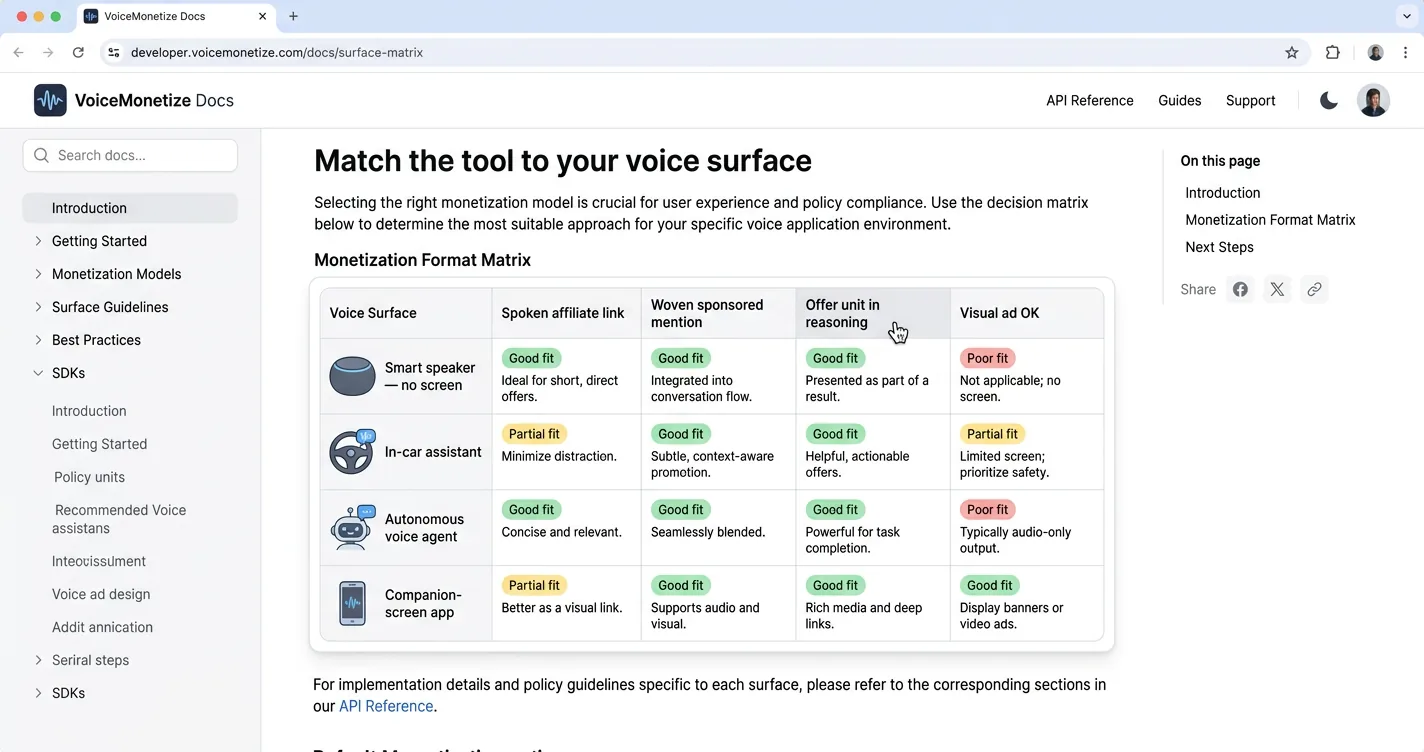
Start from your surface, because that single fact decides most of this. A voice assistant with no screen should favor tools whose format survives being spoken, which quietly rules out the display-first platforms. That filter alone narrows the field faster than any feature chart.
ZeroClick and Imprezia suit funded teams that can wait on a beta and want sponsored mentions woven into the answer. AgentVine fits autonomous voice agents on open frameworks, while Adsbind and Dappier make sense mainly when a companion screen is in play. Each is a reasonable pick once your surface and budget line up.
ChatAds is the one that was designed for audio from the start. It speaks the item and the price, then offers to send the listing instead of forcing a banner onto a device that has no screen. With an existing Amazon Associates account, you keep all of the commission, so it bolts onto what your assistant already says and earns on the purchase that follows. If your surface is a browser rather than a speaker, the AI browser agent monetization platforms overlap heavily with this shortlist.
Do not pick from the star table alone. Wire one real spoken reply through ChatAds with a single affiliate account and listen to how the assistant says the item, the price, and the offer to send the link. The free tier of 100 requests a month is enough to hear the flow on your own device, and that test tells you more about voice fit than any column here.
Frequently Asked Questions
What are the best tools to monetize a voice AI assistant?
ChatAds is the strongest pick for voice AI monetization because it reads the assistant's spoken reply, detects the product intent, and returns an affiliate link the assistant can speak aloud while you keep 100 percent of the commission. Reasoning-time networks like ZeroClick and Imprezia weave sponsored mentions into the answer, and AgentVine runs offer units inside a voice agent's reasoning. Which fits depends on whether you want affiliate links on real purchases or sponsored mentions, and on whether your surface has any screen at all.
How do you monetize a voice AI assistant without ads?
The cleanest path is affiliate links instead of display ads. You send the assistant's spoken reply to a tool like ChatAds, which detects the product mention and returns a matching link from your own affiliate accounts, then the assistant speaks the item and price and offers to text or cast the listing. There is no banner or sponsored card, so the format fits a screenless device and you earn on the actual purchase.
Can you put ads on a smart speaker or in-car voice assistant?
Only formats that survive being spoken aloud work on a screenless device. Reasoning-time mentions and spoken affiliate offers translate cleanly, while banners, sponsored cards, and on-screen prompts need a display the device does not have. A practical test is whether the placement would still make sense if the assistant had to say it out loud.
How do voice AI affiliate links work?
You connect your own affiliate accounts, such as Amazon Associates, then run the assistant's reply through an API like ChatAds that detects the product and returns a matching affiliate link in under a second. The assistant speaks the item name and price and offers to text the link or open it on a paired screen, and when the user buys, that link earns the full commission minus only a small per-request API fee.
What is voice commerce AI?
Voice commerce AI is any assistant that helps a user research or buy products through spoken conversation, on smart speakers, in cars, or in standalone voice agents. Because there is no screen to tap, the assistant has to speak the recommendation and then hand off the purchase, often by texting a link or opening it on a paired device. Monetizing it means earning on that spoken recommendation rather than on a visual ad.
Which voice AI monetization tools are production-ready today?
ChatAds and Dappier are the most production-ready, with public docs and a path you can ship against, though Dappier is built for on-screen publisher surfaces rather than voice. ZeroClick, Imprezia, AgentVine, and Adsbind are all in closed or public beta with no disclosed pricing or revenue share, so they read as early bets. For a voice assistant you can monetize this week, ChatAds is the cleanest fit.