A few years ago, shopping online meant typing keywords into a box and scrolling through a wall of blue links. That habit is fading faster than most people expected. AI shopping agents now take a plain-language request and do the legwork for you.
These agents research products, compare options, and in some cases complete the purchase while you do something else. The companies you already know ship them today, including ChatGPT, Perplexity, and Amazon’s Rufus. What used to feel like science fiction has become a 2026 reality with real buttons and real checkouts behind them.
As of 2026, agentic commerce is shifting from quiet demos to default behavior on the big platforms. Salesforce reported that across Cyber Week 2025, “AI and agents influenced a staggering 20% of all global orders”, driving $67 billion in sales. This guide explains what AI shopping agents are, how they work under the hood, who is building them, and how everyone in the chain actually earns a cut.
- Bain projects $300–500B in US agentic commerce by 2030, roughly 15–25% of e-commerce
- Salesforce tracked AI agents influencing $67B, about 20% of global orders, during Cyber Week 2025
- Adobe measured gen-AI retail referral traffic up 4,700% year over year in July 2025
- Only about 1 in 3 shoppers say they would let an AI pay on their behalf today
Ask ChatGPT to summarize the full text automatically.
What Is an AI Shopping Agent?
An AI shopping agent is software that takes a natural-language shopping goal and acts on it. You describe what you want in one or two sentences, and the agent reasons through the request, researches options across sources, and hands back a pick. The most capable versions go a step further and complete the purchase within limits you set ahead of time.
The keyword search box defined online shopping for two decades, and the agent breaks the core habit behind it. A search engine returns a list and leaves the final judgment entirely to you. An AI shopping agent makes that judgment itself, then explains its reasoning in plain language you can question.
The category spans a spectrum, from agents that only suggest to agents that transact on your behalf within preapproved spending rules. You have probably used the early end already without calling it an agent. ChatGPT can research products for you, Perplexity can pull live prices, and Amazon’s Rufus answers buying questions right on the product page. None of this sits on a distant roadmap, since these AI shopping assistants shipped to hundreds of millions of people over the past year.
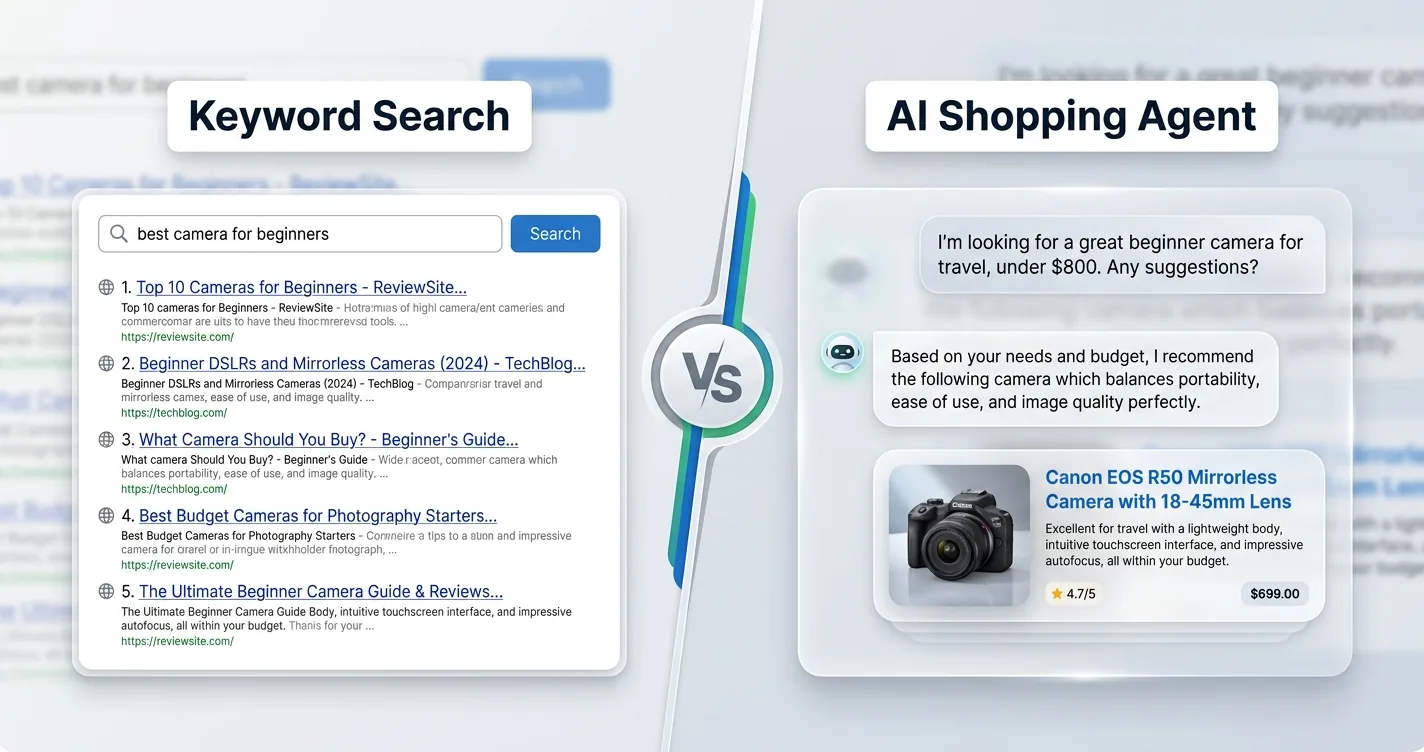
An AI shopping agent turns a spoken or typed goal into research, comparison, and a recommendation, and sometimes a finished checkout. The plain test is whether the system acts for you rather than just handing you links to act on yourself.
How Do AI Shopping Agents Differ From Recommendation Engines?
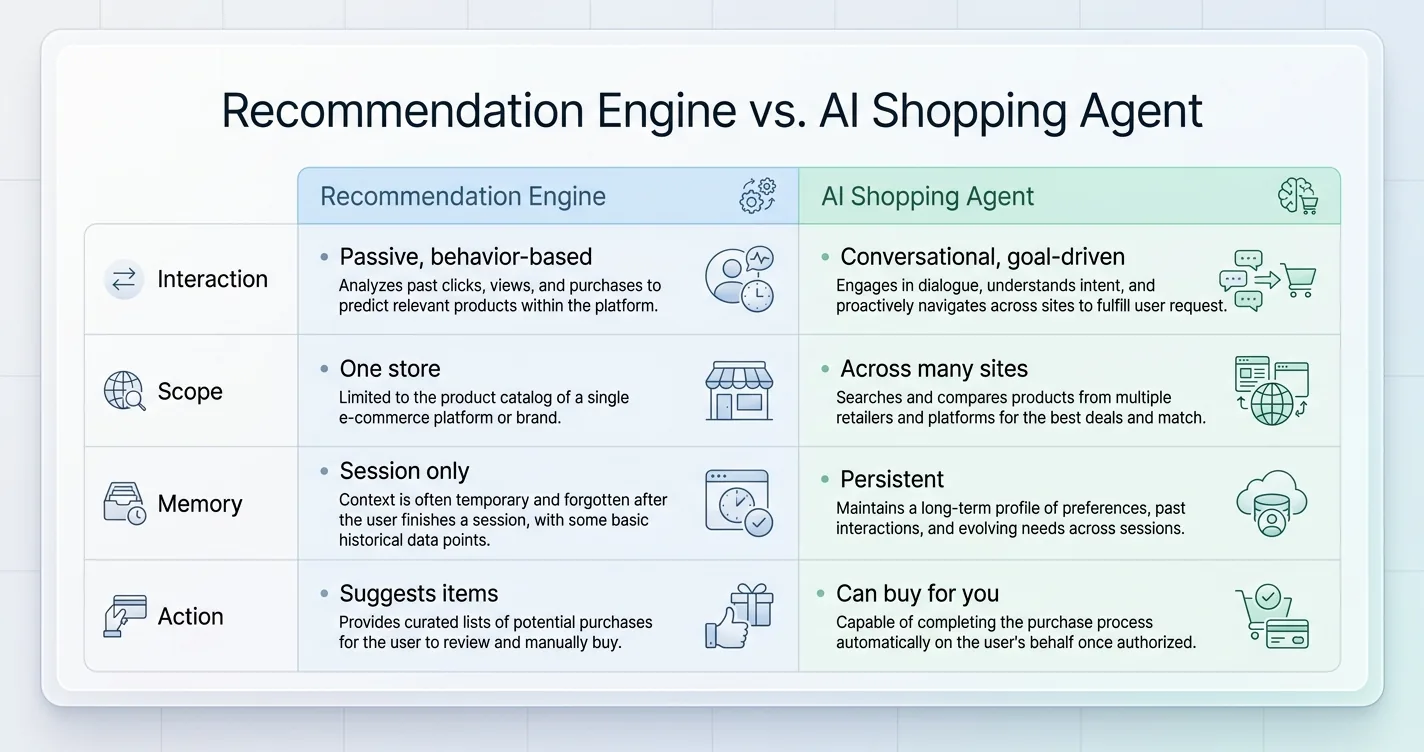
The difference comes down to who is doing the work and how far the system can reach. A recommendation engine is passive and session-bound, so it watches your behavior and suggests items you might also like. The agent works the other way around, taking instruction, reasoning across sites, and acting on what it finds.
Recommendation rails live inside one store and only know that store’s catalog. Agents are not tied to a single merchant, which means they can compare a product on one site against an alternative on another. That cross-site reach is the behavioral leap, because an agent can skip a retailer’s own interface entirely and still complete the trip.
Memory is the other dividing line that gets overlooked. A “you might also like” widget forgets you the moment the session ends, while an agent can hold your budget, sizes, and past choices across many conversations. This is why the shift matters for anyone building on top of AI, since the agent, not the merchant, increasingly owns the customer relationship and the moment of choice.
| Dimension | Recommendation Engine | AI Shopping Agent |
|---|---|---|
| Interaction | Passive, behavior-based | Conversational, goal-driven |
| Scope | One store's catalog | Across many sites |
| Memory | Session only | Persistent across chats |
| Action | Suggests items | Can buy on your behalf |
How Does an AI Shopping Agent Actually Work?
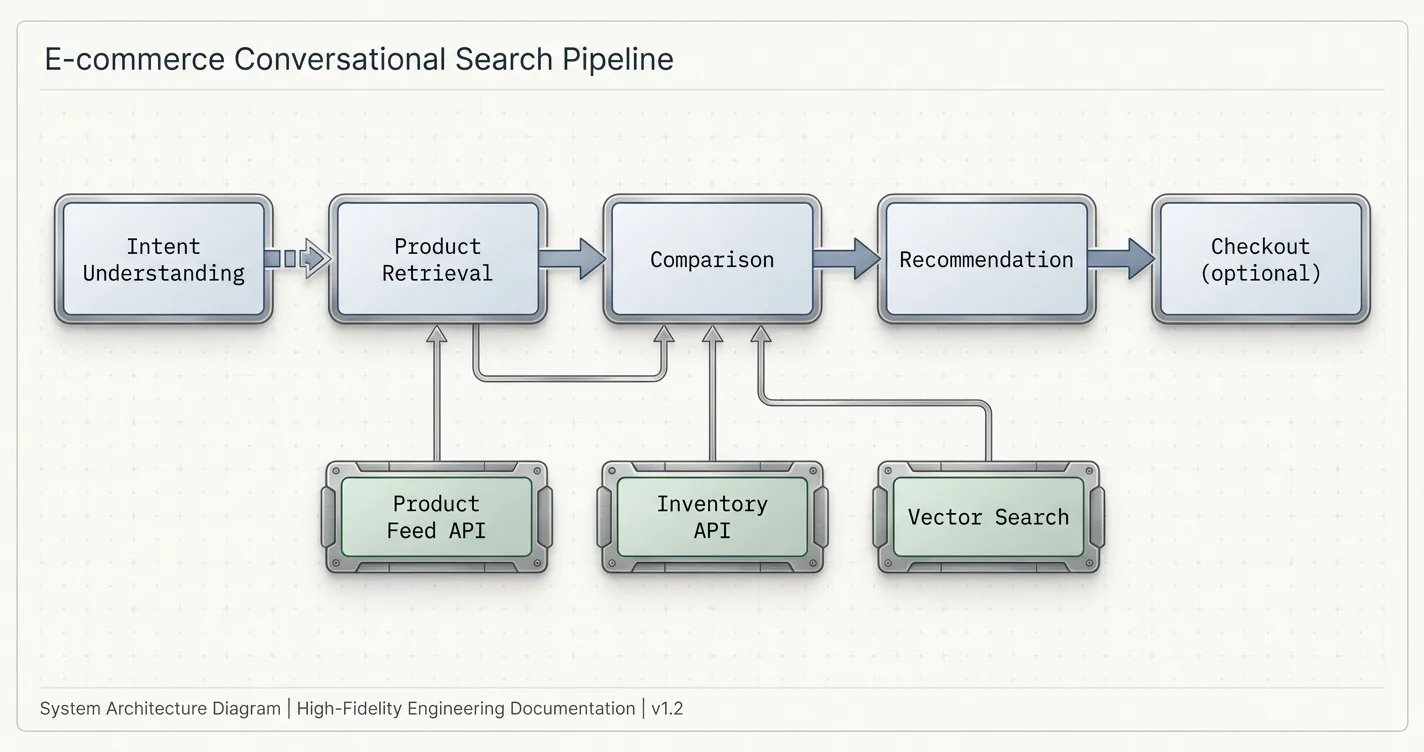
An AI shopping agent runs a pipeline that turns one request into a confident recommendation. It starts by understanding intent, then retrieves matching products, evaluates and compares them, presents a pick, and optionally moves to checkout. Each stage hands structured information to the next, so the final answer rests on real data rather than a single guess.
One rule sits underneath all of that and is easy to miss. The language model is the planner and the narrator, not the source of truth for price or stock. It calls deterministic tools like product feeds and inventory APIs through retrieval and structured requests, which is exactly how Amazon built Rufus on a retrieval-grounded design. Google’s Shopping Graph plays the same role at scale. As Google describes it, “The Shopping Graph now has more than 50 billion product listings”, with more than 2 billion of them refreshed every hour.
This separation explains why feed quality decides what an agent can even see. If your product data is thin or stale, the agent cannot evaluate or recommend it well, no matter how smart the underlying model is. Understanding how AI shopping agents work means accepting that the catalog feeding the model matters as much as the model itself.
def shopping_agent(request, budget):
    intent = parse_intent(request)        # LLM plans, does not invent prices
    products = retrieve(intent)           # live feeds + inventory APIs via RAG
    ranked = compare(products, intent)    # deterministic data, not a guess
    pick = recommend(ranked)
    if budget.autobuy_allowed(pick):
        return checkout(pick, budget)     # optional, within preset limits
    return pick
Which Companies Are Building AI Shopping Agents?
Every major AI platform now ships a shopping agent of some kind. OpenAI added Shopping Research to ChatGPT in late 2025 and ran an Instant Checkout pilot built with Stripe. Perplexity launched Buy with Pro for paying users and then released Comet, an agentic browser that can navigate and act on real sites.
For developers, those browser-native agents open a fresh question of how to monetize an AI browser agent when no human is watching the screen.
Amazon says Rufus helped “over 300 million customers in 2025 research, compare, and buy the products they want”, and it now handles agentic auto-buy features tied to your account. Google brought agentic checkout into Search and AI Mode during the 2025 holiday season, backed by the Shopping Graph. Microsoft followed with Copilot Checkout in early 2026, connecting more than 500,000 merchants through PayPal, Shopify, and Stripe rails.
The space is contested enough to produce real fights, not just press releases. Perplexity and Amazon ended up in a federal dispute over whether the Comet browser could act inside Amazon accounts, which signals how much control of the agent layer is worth. Each player ships a slightly different bet, but the direction is shared, since all of them want to stand between you and the merchant at the moment of purchase.
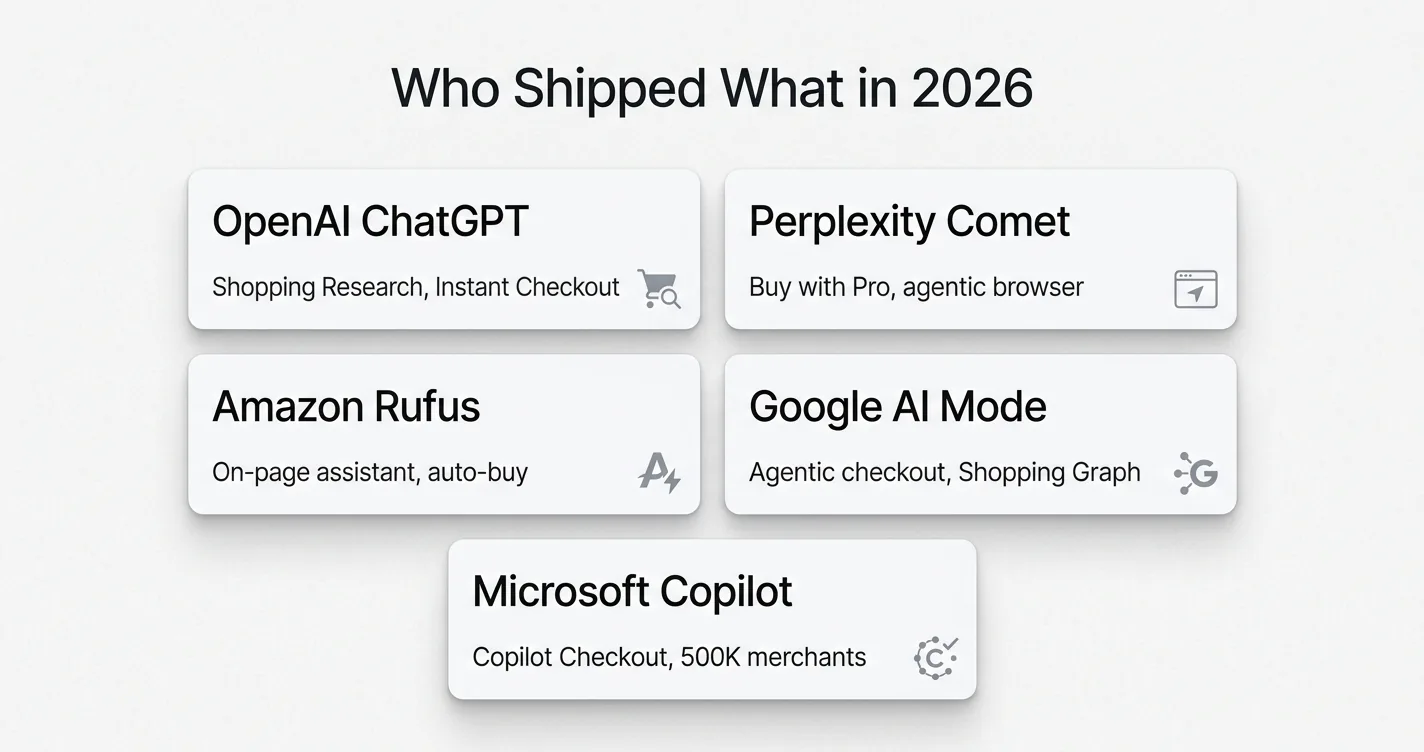
| Company | Agent | Capability |
|---|---|---|
| OpenAI | ChatGPT | Shopping Research, Instant Checkout pilot |
| Perplexity | Comet | Buy with Pro, agentic browser |
| Amazon | Rufus | On-page assistant, auto-buy features |
| AI Mode | Agentic checkout, Shopping Graph | |
| Microsoft | Copilot | Copilot Checkout across 500K merchants |
What Are Agentic Commerce Protocols (ACP, AP2, UCP)?
Agents and merchants need a shared language before money can move between them. That plumbing layer is where the new protocols live, and three names show up most often. ACP, from OpenAI and Stripe, is an open-source standard for passing carts and orders between an agent and a store.
Google’s AP2 takes a different angle, using cryptographically signed “Mandates” that capture intent and a specific cart so both sides can prove what was authorized. UCP, a Google and Shopify coalition with backers like Walmart, Target, and Visa, aims to standardize how product and checkout data flow. Underneath all of them sits MCP, the connectivity standard that lets an agent call any tool in the first place.
The cleanest way to keep these straight is by job. MCP is how an agent calls tools at all, while ACP and UCP are commerce-specific data structures layered on top of that connection. Fragmentation is the real story here, since several standards compete and no single winner has emerged yet. Developers should care because the protocol a merchant supports decides whether an agent can discover and transact with that merchant at all.
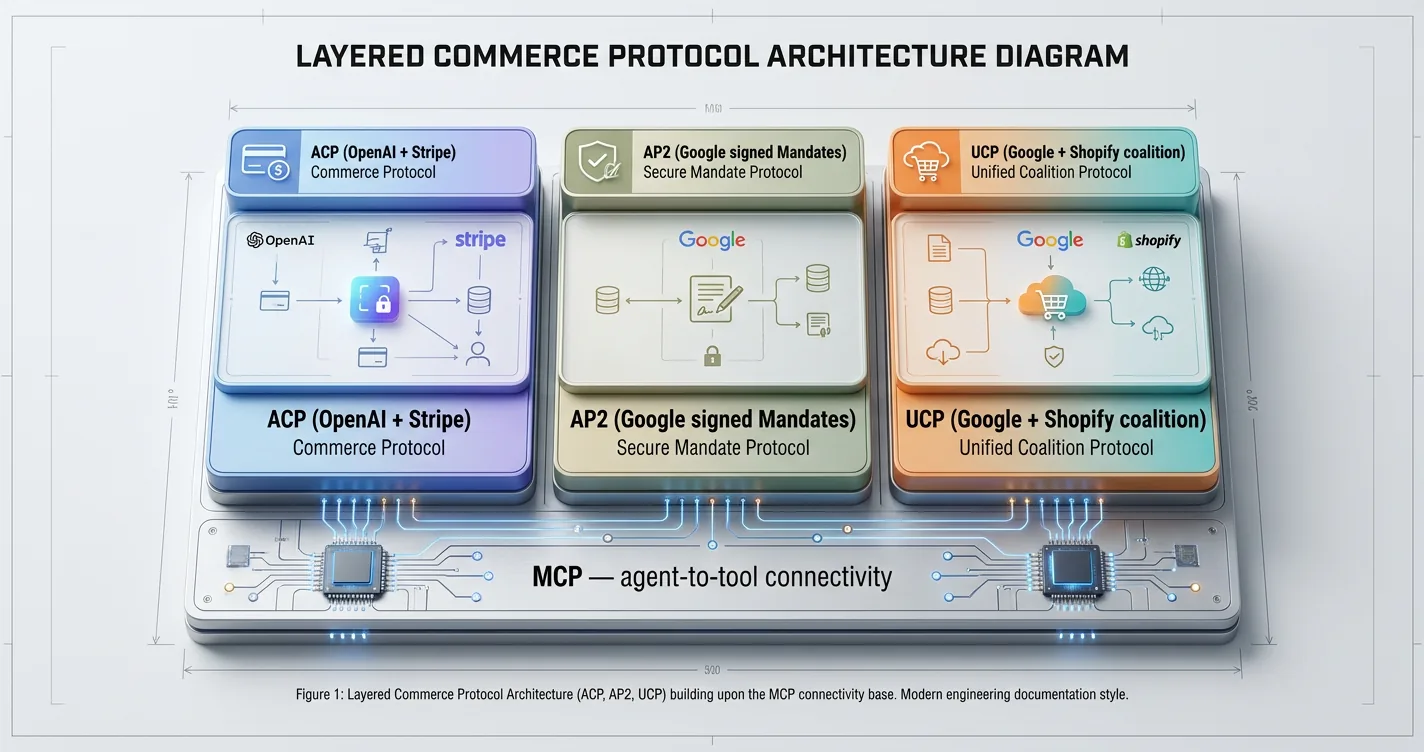
- MCP: how an agent connects to tools and data sources at all
- ACP: OpenAI and Stripe's open-source cart and order standard
- AP2: Google's signed Mandates proving intent and an approved cart
- UCP: a Google and Shopify coalition for shared commerce data
How Do Payments Work When an Agent Buys for You?
The core payment problem is that an agent should never touch your real card number. Handing raw credentials to an autonomous system would break every fraud model banks rely on. So the industry moved to tokenization, where a temporary stand-in replaces the actual card for a single scoped purchase.
Several rails now do this in different ways. Stripe issues Shared Payment Tokens for agent transactions, Mastercard built Agentic Tokens under its Agent Pay program, and Visa shipped Intelligent Commerce for the same job. Each one lets an agent pay without ever seeing or storing the underlying card details, which keeps the sensitive data out of the model’s reach.
A delegated mandate is what makes the charge legitimate. You approve a scoped purchase ahead of time, naming the merchant, the amount, and the consent behind it, and the token only works inside those limits. The merchant still stays the merchant of record, so returns and support run through the store as usual. This token-and-mandate backbone is what makes autonomous checkout thinkable without handing your wallet to a bot.
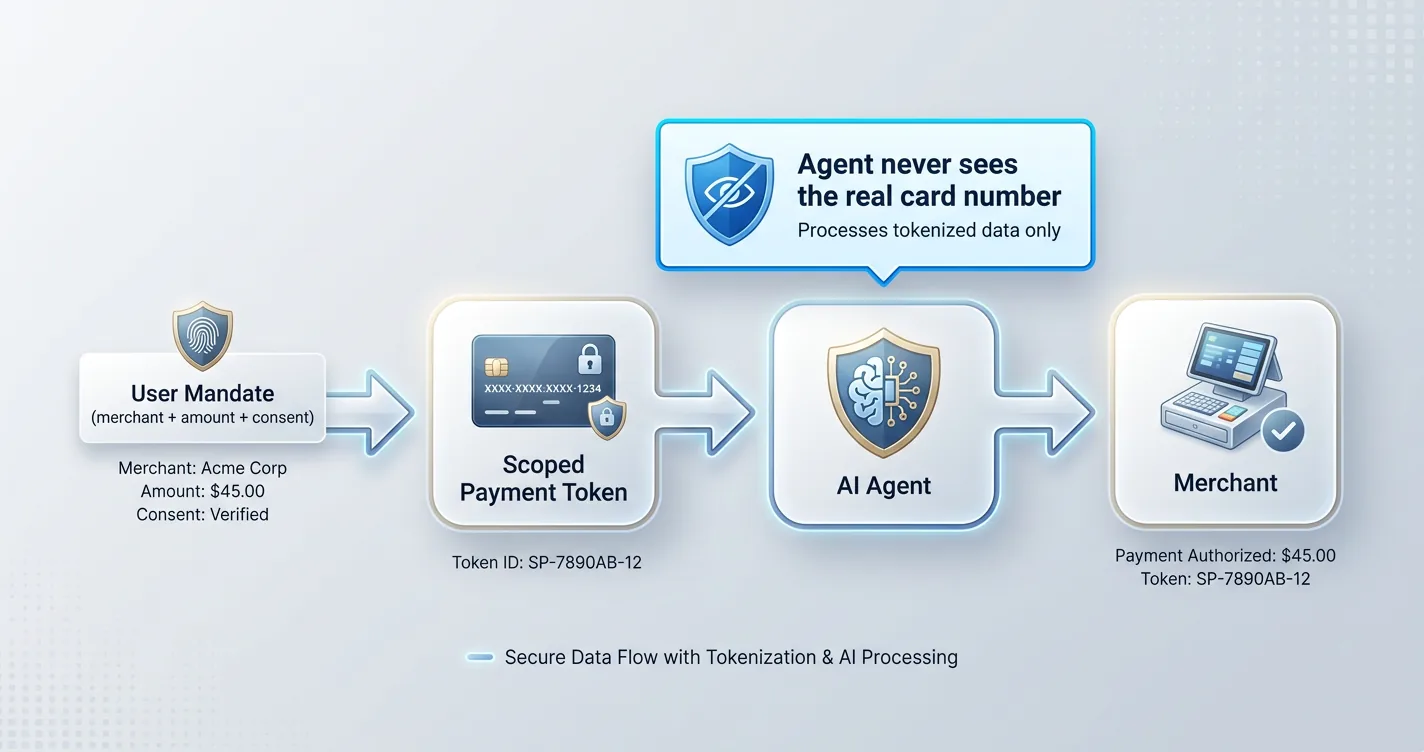
- A scoped mandate naming the merchant, amount, and consent
- A single-use token standing in for the real card number
- Spending limits the agent cannot exceed on its own
- The merchant remaining the merchant of record for support
How Do AI Shopping Agents Make Money?
AI shopping agents earn through four models, and most platforms mix more than one. Affiliate and commission revenue is the most common, where the agent attributes a sale through networks like CJ, Rakuten, or Awin and collects a percentage. Retail media sits right beside it, where merchants pay for sponsored placement inside the agent’s answers, and both feed into the broader set of e-commerce AI agent monetization platforms developers are now choosing between.
Transaction fees work in a different way, charged directly on each completed purchase. OpenAI reportedly took a 4% merchant fee on its Instant Checkout pilot, which puts a number on what the buy button is worth. Subscription rounds out the set, where the agent gates its best shopping features behind a paid tier, the way Perplexity Pro does for $20 a month.
The trade-offs decide which model survives in a given product. Ads strain the promise of an unbiased answer, and Perplexity learned this the hard way, pulling its advertising experiment in early 2026 after it brought in little revenue. Affiliate revenue aligns better, since the agent earns by sending a genuinely good pick rather than the highest bidder. That alignment is why affiliate is emerging as the least intrusive way to fund agentic commerce, and it holds even for resale and auction use cases, as our look at affiliate monetization for AI marketplace agents shows.
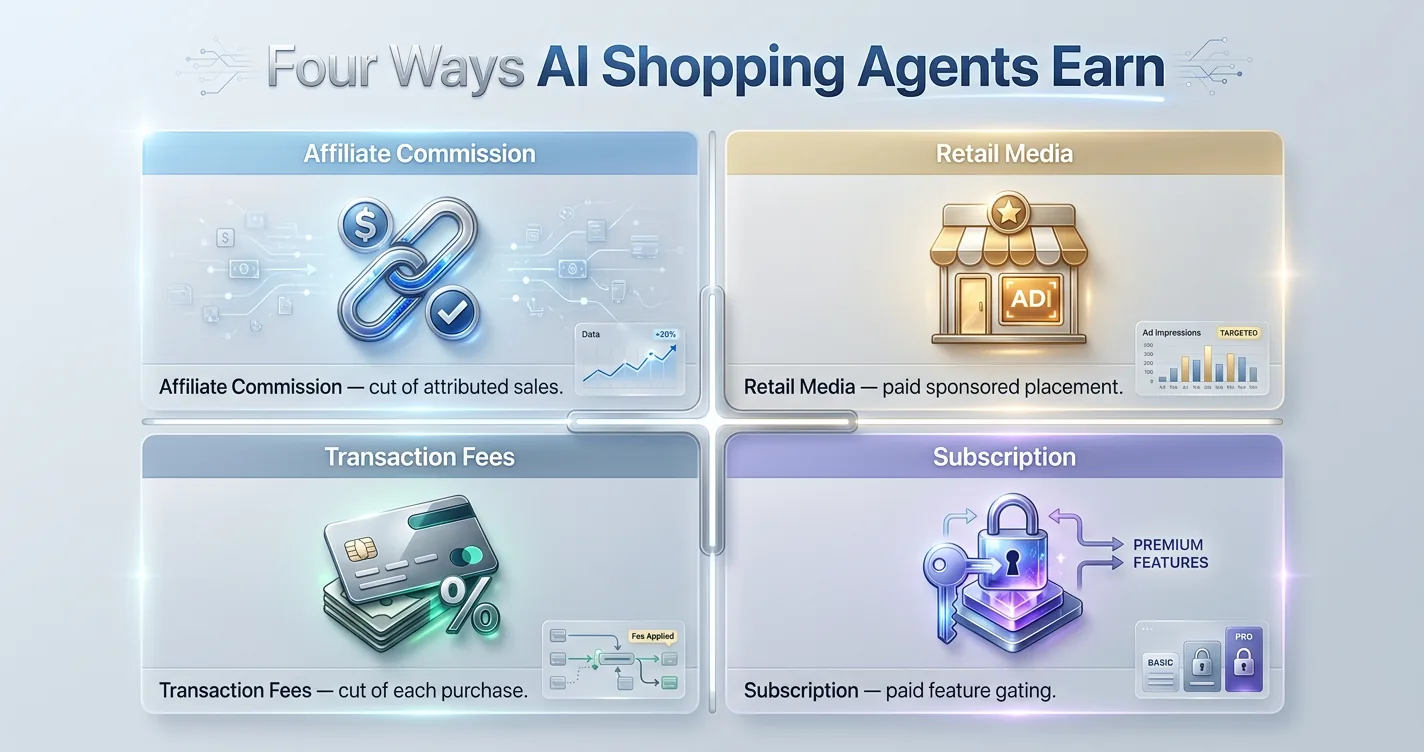
| Model | How It Works | Main Tension |
|---|---|---|
| Affiliate | Commission on attributed sales | Needs accurate attribution |
| Retail media | Paid sponsored placement | Erodes trust in answers |
| Transaction fee | Cut of each purchase | Merchants resist the tax |
| Subscription | Paid feature gating | Limits reach to payers |
Why Is Autonomous Checkout Still So Hard?
The hardest part of agentic commerce is not the model, it is the merchant integration. OpenAI’s Instant Checkout makes the point bluntly, since the company pivoted away from native checkout in early 2026 after only around 30 merchants went live. Discovery turned out to be tractable, while the buy button stayed stubborn.
The failures here are operational rather than a question of model intelligence. Agents struggled with real-time inventory sync, so an item could sell out between the recommendation and the charge. Stale pricing, missing multi-item carts, no loyalty integration, and order failures that triggered chargebacks all piled up. None of that is glamorous, but each one breaks a purchase the moment it happens.
Shopper hesitancy compounds the technical mess. Only about one in three people say they would let an AI pay through an answer engine, which caps demand even where the plumbing works. The lesson is consistent across every player, since recommending a product is far easier than reliably completing the transaction behind it. Checkout will get there, but the bottleneck is plumbing and trust, not smarter language models.
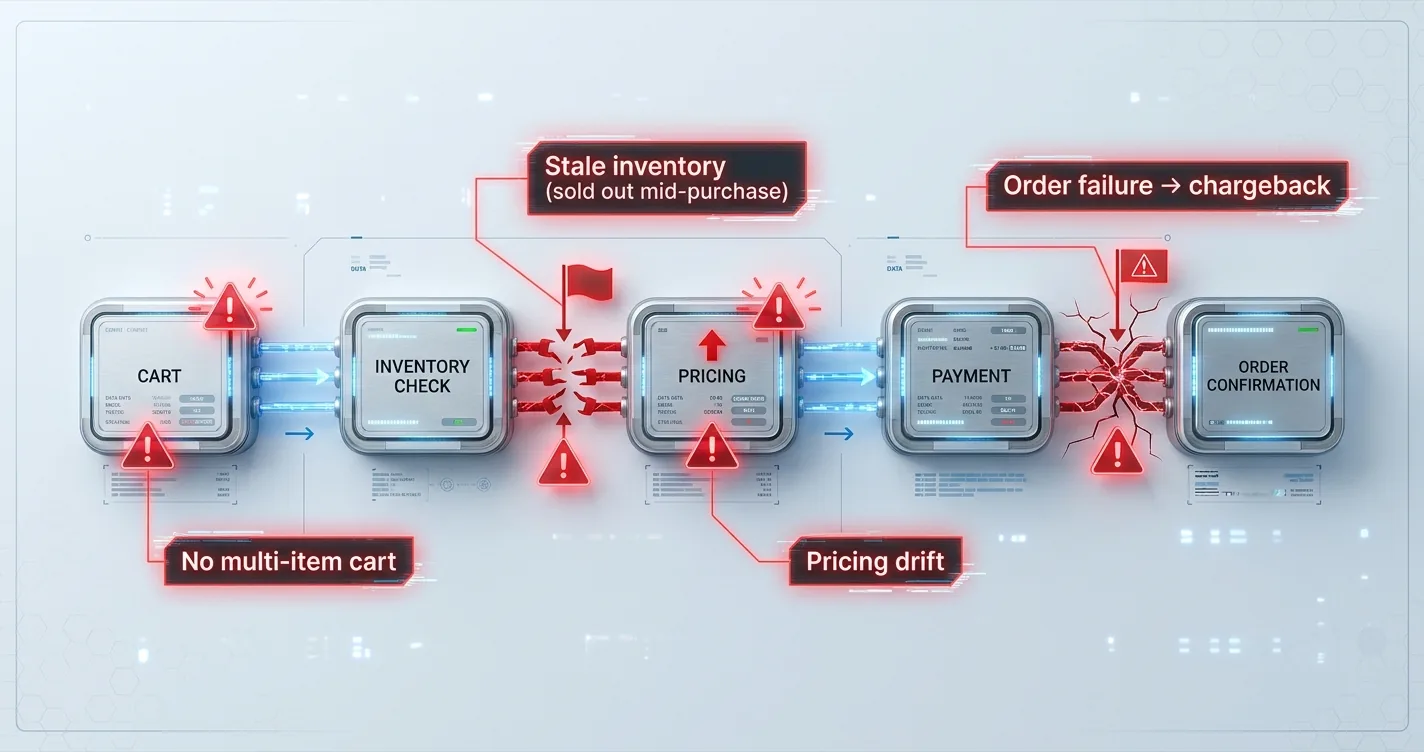
- OpenAI's native checkout pivoted after roughly 30 merchants went live
- Real-time inventory and pricing sync remain the top breakpoints
- Missing multi-item carts and loyalty integration block real baskets
- Only about 1 in 3 shoppers will pay through an answer engine
What Are the Risks: Hallucinations, Trust, and Disclosure?
Accuracy is the first risk, because a language model can confidently state a wrong spec. Hallucinated product details, incorrect delivery dates, and stale promotions all reach the user as if they were facts. When intent and checkout get separated across systems, those errors also slip past the fraud checks that once sat in one place.
Disclosure is the second risk, and it is becoming a legal one. The FTC expects double disclosure, meaning an agent should reveal both any paid relationship and the AI involvement, clearly and up front. Penalties run as high as $53,088 per violation, and enforcement attention is rising as these tools scale.
Trust is the thread that ties accuracy and disclosure together. Capgemini found that “More than half (58%) have replaced traditional search engines with Gen AI tools” as their go-to for recommendations, and its 2026 consumer research reports that two-thirds now expect brands to disclose AI-generated advertising.
That signal is a warning and an opening at once. Disclosure done well, stated plainly instead of buried, can actually raise trust rather than spend it, which is the opposite of how many teams treat it.
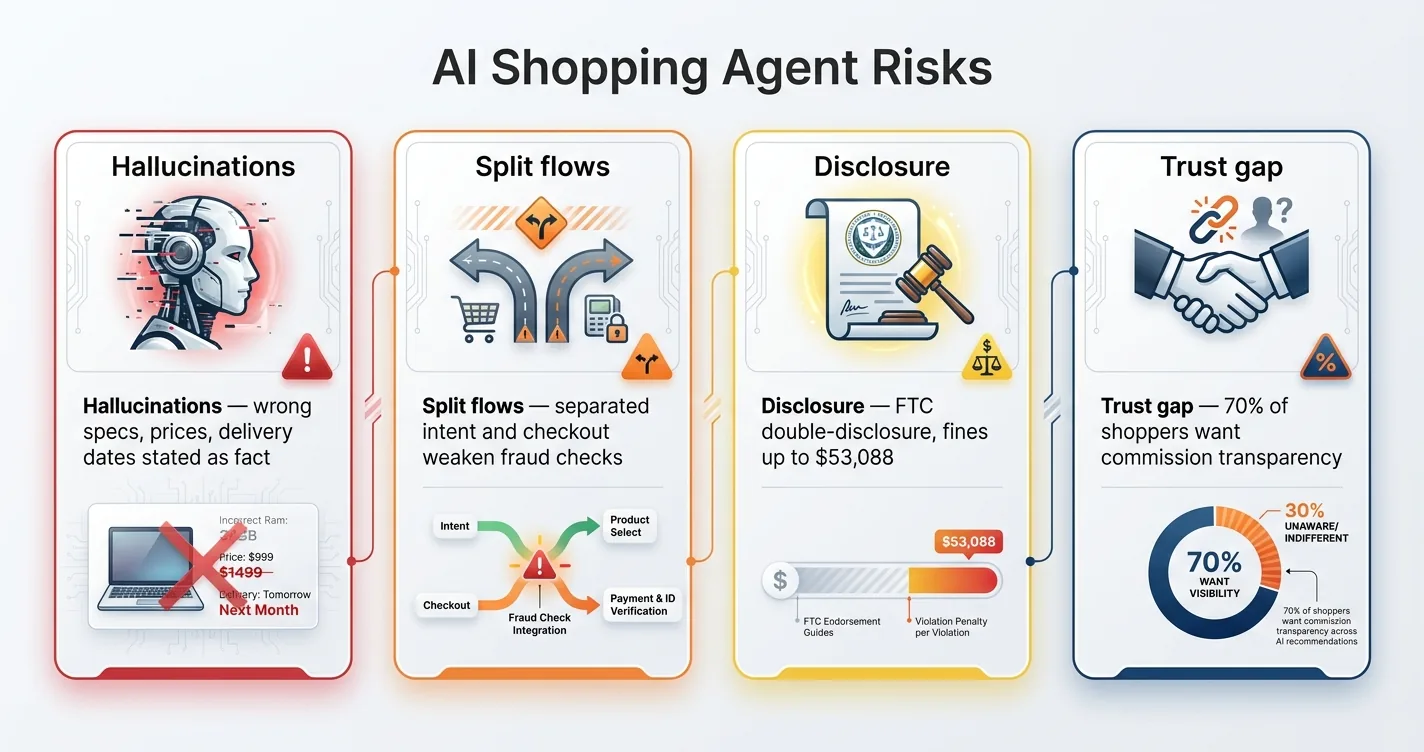
- Hallucinations: wrong specs, prices, or delivery dates stated as fact
- Split flows: separated intent and checkout that weaken fraud checks
- Disclosure: FTC double-disclosure rules with fines up to $53,088
- Trust gap: two-thirds of shoppers want AI-generated ads disclosed
Who Controls the “Buy Box” in Agentic Commerce?
Control of the final pick is the real prize here, and whoever owns the agent holds it. In classic search, you see a list of results and click whichever one you want. With an agent, the system narrows everything to a single pick, so control of that pick shifts from the shopper to whoever built the agent.
This power shift reshapes how brands have to compete for attention. Traditional paid-search bidding does little when there is no list of links to bid against. Instead, feed quality and protocol integration win, since the agent can only choose from products it can read cleanly. In practice, brands with richer structured data get chosen more often, which rewards good feeds over big ad budgets.
The strategic stakes are large for merchants and platforms alike. A retailer that lags on structured data and protocol support risks getting filtered out before the shopper ever hears its name. A platform that owns a popular agent gains the kind of gatekeeping power the buy box always conferred, now applied to a single spoken recommendation. The buy box did not disappear, it just moved inside the agent.
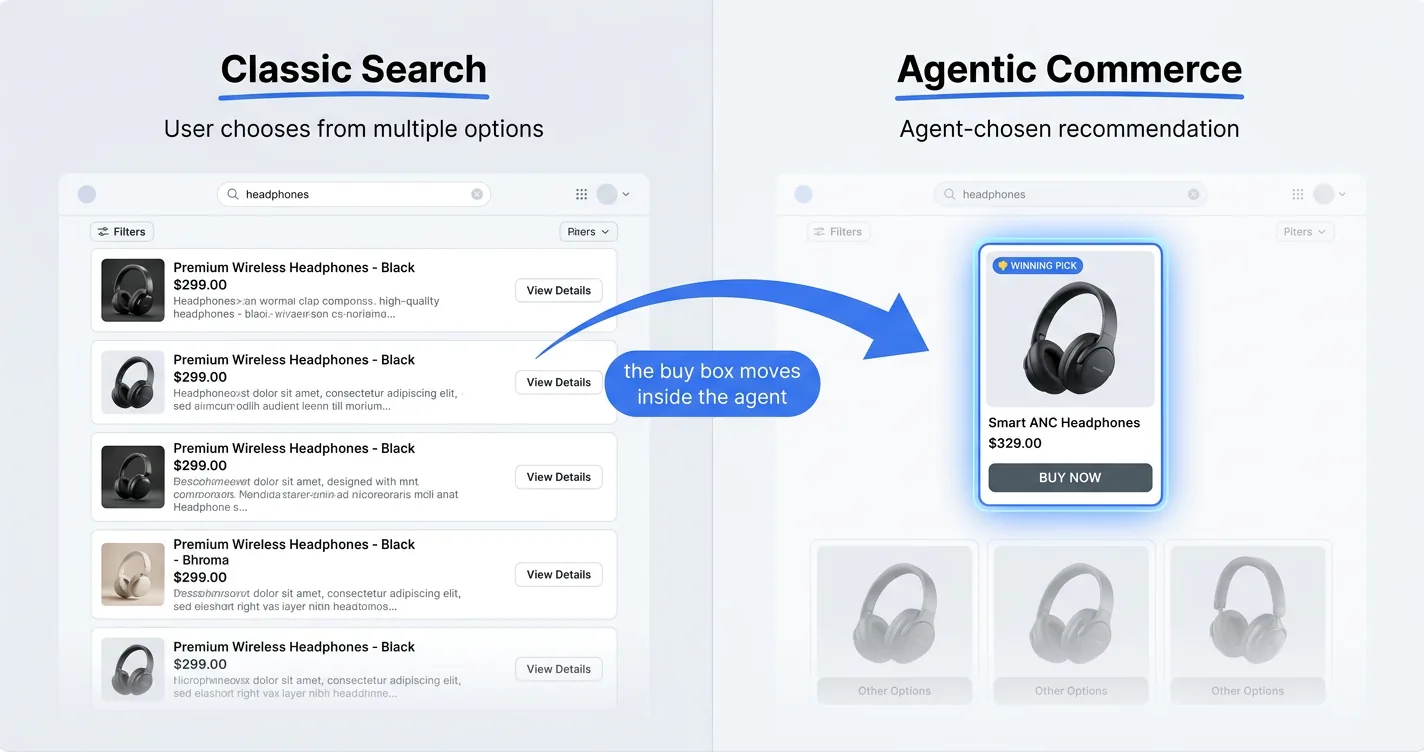
Rich, structured product feeds beat ad spend, because the agent can only pick from data it parses cleanly. Protocol support decides whether your products are even visible to the agent in the first place. The brands that invest in clean feeds early get chosen more often later.
How Can Developers Monetize Their Own AI Shopping Agents?
You do not need OpenAI’s checkout stack to earn from an agent you build. If you run a chatbot or assistant, the affiliate model lets you make money without owning feeds, protocols, or payment tokens. You analyze the conversation, detect product intent, return an affiliate link, and keep 100% of the commission with no disruption to the user experience.
The alternative of building everything yourself looks far less appealing up close. Standing up inventory feeds, protocol integrations, and tokenized payments is a multi-quarter project with real risk. Detecting a product mention and inserting a tracked link is a single API call, which is exactly the gap ChatAds fills. It reads the assistant’s reply, finds genuine product intent, and returns a link only when one belongs there. Agents connecting over MCP can reach the same resolution step through Commerce Match.
This keeps the heavy infrastructure off your plate while still capturing the revenue. You stay focused on the assistant, the conversation, and the user, and the monetization runs quietly underneath. Starting small here beats waiting for a perfect agentic checkout stack that may never standardize.
ChatAds turns product mentions in your assistant's replies into tracked affiliate links with one API call. It stays silent when there is no real intent and surfaces a link only when one fits. See how ChatAds adds affiliate links to AI chatbots for the integration overview.
AI shopping agents have moved from demo to daily habit, and the open questions now are commercial rather than technical. Discovery already works well, while reliable autonomous checkout stays the genuinely hard part that trips up even OpenAI. Every major platform is running a live experiment on which revenue model survives contact with real shoppers.
For developers, the practical takeaway is that you can join this shift without rebuilding the whole stack. Detect intent, disclose honestly, and return a useful link only when it helps, and an assistant earns trust and revenue at the same time. The agents that win in 2026 are the ones that recommend like a helpful expert, not a sales bot.
Frequently Asked Questions About AI Shopping Agents
What are AI shopping agents?
AI shopping agents are software that takes a natural-language shopping goal and acts on it, researching products, comparing options, and recommending a pick. The most capable versions can also complete the purchase within limits you set ahead of time. They differ from a search box because the agent makes the judgment for you instead of handing you a list of links.
How do AI shopping agents work?
An AI shopping agent runs a pipeline that understands intent, retrieves matching products, compares them, recommends a pick, and optionally moves to checkout. The language model plans and narrates, but it calls deterministic tools like product feeds and inventory APIs for real prices and stock. This is why feed quality decides what an agent can find and recommend.
How do AI shopping agents make money?
AI shopping agents earn through four models: affiliate commissions on attributed sales, retail media for sponsored placement, transaction fees on each purchase, and subscriptions that gate premium features. Most platforms mix more than one. Affiliate revenue is emerging as the least intrusive option because the agent earns by sending a genuinely good pick rather than the highest bidder.
Can an AI shopping agent buy products on its own?
Some can, but only within a scoped mandate you approve ahead of time that names the merchant, amount, and spending limit. A single-use payment token stands in for your real card so the agent never sees your card number. Reliable autonomous checkout is still the hardest part of agentic commerce, since inventory sync, pricing drift, and cart failures break purchases that discovery handles easily.
What is the difference between an AI shopping agent and an AI shopping assistant?
The terms overlap, and many products use them interchangeably. In practice, an AI shopping assistant usually suggests and answers questions, while an AI shopping agent can take action across sites and sometimes transact on your behalf. The dividing line is whether the system acts for you or just hands you information to act on yourself.
How can developers monetize their own AI shopping agents?
The simplest path is the affiliate model, which lets you earn without owning feeds, protocols, or payment tokens. You analyze the conversation, detect product intent, and return a tracked affiliate link only when one fits. ChatAds does this in a single API call, reading the assistant's reply and inserting a link only when there is genuine buying intent.