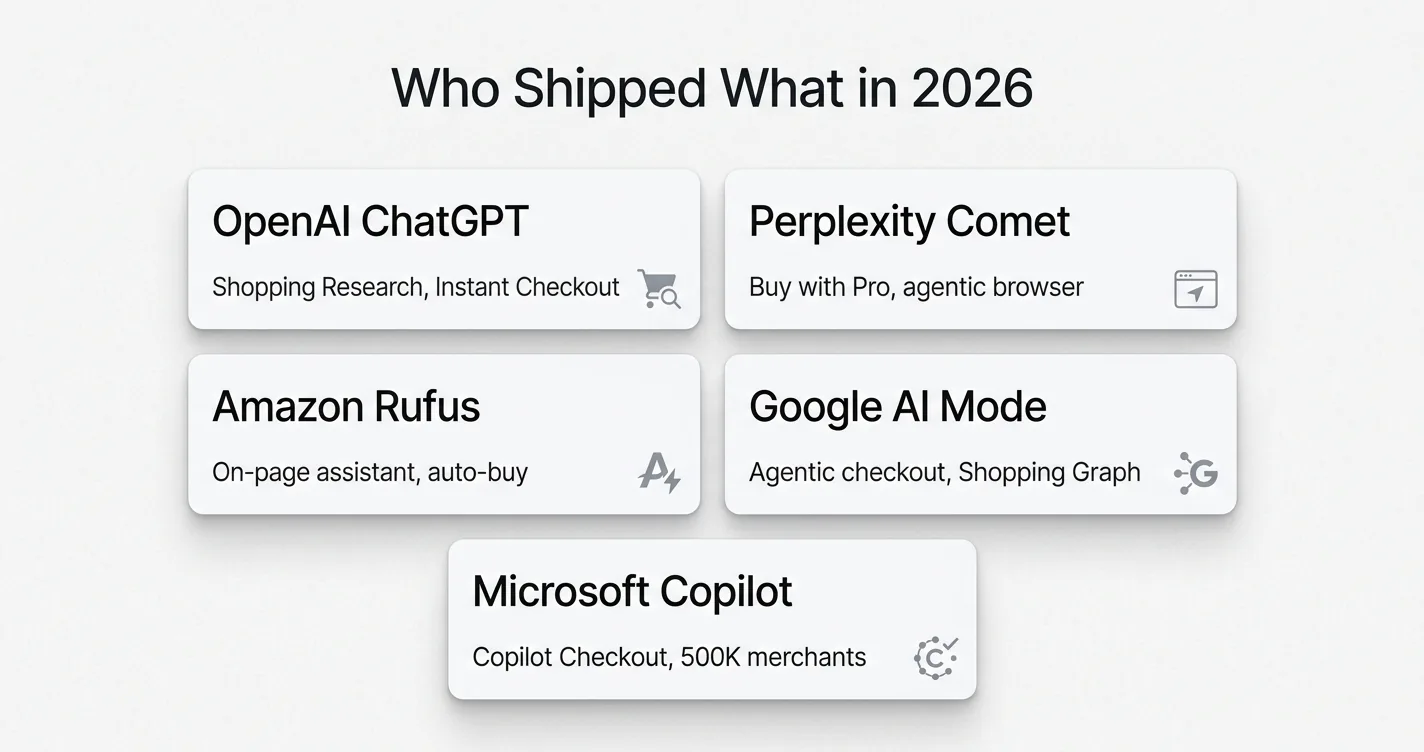
AI browsers went mainstream in 2026, and they shop in a way people never did. Perplexity’s Comet and OpenAI’s Atlas now browse, compare, and check out on a user’s behalf. Perplexity pitched Comet as an assistant “actively conducting entire browsing sessions while you focus on what matters.”
Amazon’s Buy for Me goes a step further, and Amazon describes it this way: “Using agentic AI capabilities, Amazon makes the purchase by securely providing the customer’s encrypted name, address, and payment details to complete the checkout process on the brand’s website.” That breaks the old web playbook, where a human eyeballs a page and a banner earns its keep. The same screenless shift is hitting voice AI assistants, which have no page to put a banner on at all.
When the agent does the shopping, the question shifts to who actually gets paid. There is no impression to sell and no human click to count when software finishes the purchase on its own. Developers building these agents need revenue that does not break the agent’s flow or the user’s trust.
Two paths exist for AI browser agent monetization: ad placement and affiliate commissions. This guide walks through the platforms chasing both, from AI shopping agents that close the sale to the ad networks betting on agent attention.
- Affiliate commissions earn on the real purchase an agent completes, paid from your own accounts (ChatAds)
- Agentic ad networks place sponsored offers inside or beside the agent's reasoning and pay on clicks or conversions (AgentVine, Koah, Dappier, Aryel, Adsbind, Jutera)
- Match the model to the agent: affiliate fits agents that buy, ads fit agents that surface options a human still chooses
Ask ChatGPT to summarize the full text automatically.
★ = low · ★★ = medium · ★★★ = high
| Platform | Browser-Agent Fit | Production Readiness | Earnings Transparency | Cost Value |
|---|---|---|---|---|
| ChatAds | ★★★ | ★★★ | ★★★ | ★★ |
| AgentVine | ★★★ | ★ | ★ | ★★ |
| Koah Labs | ★★ | ★★★ | ★ | ★★ |
| Dappier | ★★ | ★★ | ★★ | ★ |
| Aryel | ★★ | ★★ | ★★ | ★ |
| Adsbind | ★★ | ★ | ★ | ★★ |
| Jutera | ★ | ★ | ★ | ★ |
ChatAds

ChatAds is the one platform here built around what a browser agent actually does, which is buy things. You send the agent’s output to the API, and it reads the product intent inside that text and returns a matching affiliate link in under a second. You bring your own affiliate accounts, like Amazon Associates, and you keep 100 percent of the commissions. When the agent finishes a purchase, that link earns on the real transaction rather than a view nobody ever saw.
This is also the only option on the list that runs both affiliate links and ad formats, so AI agent affiliate monetization sits right next to eight ad types like text links, product cards, and banners. A native MCP server drops it into autonomous agents and custom GPTs without much wiring at all. Most responses come back in well under a second, which keeps the link from slowing the agent down. A free tier of 100 requests a month lets you test before any card goes in. For developers who already hold affiliate accounts and want every cent of the commission, ChatAds fits the browser-agent job cleanly.
Pros:
- Keep 100 percent of affiliate commissions, with only a small per-request API fee
- Earns on the real purchases an agent completes, not impressions a user may skip
- API-first with a native MCP server that drops into autonomous agents and custom GPTs
- Sub-second responses, eight ad formats, and a free tier of 100 requests a month
Cons:
- Requires existing affiliate accounts, so you set those up before earning
- US-focused today, with matching tuned for the US catalog and English content
AgentVine

AgentVine calls itself the first ad network built for the agent economy, and that label fits browser agents better than most. Offer Units run inside the agent’s own reasoning, not bolted onto a screen the user has to look at. The agent decides for itself whether a sponsored offer actually serves the goal in front of it. That decision-layer approach is the cleanest fit for agentic browser advertising, where there may be no human watching the interface at all.
The platform targets open agent frameworks like LangGraph, CrewAI, and AutoGen, with an intent-based model and no behavioral tracking. Payouts run on clicks and conversions, so you earn when an offer leads somewhere real. AgentVine is still in public beta, and that shows in the gaps. There is no disclosed revenue share, no case studies, and little public detail about the team behind it. The decision-layer model is a smart fit for autonomous agents, but this reads as an early bet rather than infrastructure you can model revenue against today.
Pros:
- Offers live inside agent reasoning, so they never force a banner into the interface
- Built for open frameworks like LangGraph, CrewAI, and AutoGen with no lock-in
- Privacy-first, intent-based matching with no behavioral tracking or user profiling
Cons:
- Public beta, with possible API changes and no production track record yet
- No disclosed revenue share, so you cannot model earnings before integrating
- No case studies or company background, which makes it a high-risk early bet
Koah Labs

Koah Labs pitches itself as AdSense for GenAI, and it is the most production-ready of the pure ad vendors here. It reads the user query and the model’s response, then matches a sponsored card in milliseconds. Named clients like Luzia, Liner, and DeepAI give it social proof that most rivals on this list cannot show. For a team that wants to monetize AI browser agents with proven ad fill, that track record counts for more than any pitch deck.
Action-oriented formats like Action Cards and lead-gen units suit task-driven agents that surface a next step for the user. The SDK spans web, React Native, Flutter, iOS, and Android, and the company markets a one-day integration. Koah also publishes performance benchmarks for eCPM and click-through, which helps you sketch revenue early. Koah Labs is aimed at conversational apps more than browser-native agents, and the exact revenue split stays private. Even so, it is one of the safer ad-only picks when you want fill today rather than a beta promise.
Pros:
- Production-ready with named clients like Luzia, Liner, and DeepAI
- Action-oriented formats and a cross-platform SDK across web and mobile
- Publishes performance benchmarks, which is rare among early ad vendors
Cons:
- Aimed at conversational apps more than browser-native agents
- Revenue-share terms are not disclosed publicly
Display advertising bills on a human seeing a placement, but a browser agent often finishes the task with no person watching the screen. When the agent itself completes the purchase, the event worth paying on is the transaction, not the view. That is why affiliate commissions line up with what an agent actually does, while ad networks ask you to monetize attention the agent may never route to a human at all.
Dappier

Dappier comes at this from the publisher side, built for the AI answers economy rather than agent builders. Its agentic ads take the form of sponsored prompts, paired with a content-licensing marketplace on the side. The angle that matters for browser agents is the real-time data API, which serves web, news, deals, and travel results. A shopping agent could pull fresh commerce context from that feed and act on it during a live session.
Dappier discloses CPM ranges that run well above traditional display, and it claims strong conversion lifts on high-intent agentic ads. A no-code AI Mode lets a publisher stand up a branded answer engine fast, which helps if you already own content. The real mismatch is the target market, since Dappier serves news and media publishers, not developers building browser agents from scratch. If browser agent ads are the goal and you have no content library, Dappier is a looser fit than the developer-first tools here. It earns a spot for the data API and the agentic-ad framing more than for any drop-in path.
Pros:
- Real-time data API serving web, news, and deals an agent can act on
- Discloses CPM ranges well above traditional display advertising
- No-code AI Mode stands up a branded answer engine quickly
Cons:
- Built for news and media publishers, not browser-agent developers
- Needs an existing content library to reach meaningful revenue
- Revenue-share split is not disclosed
Aryel

Aryel is an Italian enterprise adtech company with brands like P&G, Samsung, and Disney on its roster. In 2025 it launched In-Chat Ads for GenAI, a native format placed beside the model’s reply rather than inside it. A semantic engine scores intent and commercial value in real time without storing the conversation. Its Criteo partnership ties the format to conversion-ready commerce inventory, which matters when a browser agent’s session ends in a purchase.
Full-funnel formats run from awareness through retargeting, and the company reports click rates well above standard display. The enterprise client list is the real draw, and the reported metrics look strong for AI browser agent monetization at a brand level. The catch for most readers is access, because Aryel is sell-side and publisher-focused with no self-serve developer tools. In-Chat Ads are still beta and partner-only, and the company is Europe-centric today. Aryel makes sense for enterprise brand campaigns, yet indie agent builders will find little here to plug into.
Pros:
- Proven enterprise traction with Tier 1 brands and strong click-through metrics
- Native in-chat format plus Criteo commerce inventory aligned with purchases
Cons:
- Sell-side and publisher-focused, with no self-serve developer tools
- In-Chat Ads remain beta and partner-only for now
- Europe-centric, so US and global coverage is limited
Adsbind

Adsbind is a developer-first ad platform built to turn conversations into revenue. It leans on a Python SDK and a dashboard that controls how often ads appear, from one in two messages down to one in five. Automated brand-safety filtering keeps ads out of sensitive contexts without manual keyword lists. Revenue share is not publicly disclosed, so there is no rate to model before you join the waitlist.
The developer guide documents a pip install adsbind-sdk command, but that package is not published on PyPI, so you cannot actually inspect the integration before you commit. For developers weighing how to monetize AI browser agents, a few caveats land hard. The framing targets chatbot message streams rather than browser actions, the platform is waitlist-only, and the SDK covers Python only. Adsbind is worth a look for the dashboard-controlled frequency and brand-safety filtering, but it is not built for browser-native agents yet.
Pros:
- Dashboard-controlled ad frequency, from one in two messages down to one in five
- Automated brand-safety filtering keeps ads out of sensitive contexts without manual keyword lists
Cons:
- Waitlist-only and Python-only, with chatbot framing over browser actions
- Revenue share is not publicly disclosed at any stage
- The documented pip install command does not resolve to a published package
Jutera

Jutera bills itself as an advertising layer for conversational AI and LLM systems, run by Austin-based Bajaar LLC. Its architecture runs ad requests in parallel with inference, which is meant to keep added latency low. The formats include sponsored cards, in-conversation messages, and contextual links woven into replies. The company also publishes thoughtful guidance, like capping ads at a fifth of responses and always disclosing them.
On paper the compliance posture is serious, with SOC 2 Type II, GDPR, and CCPA all cited. The problem is everything you cannot see, since there are no public docs, no pricing, and no named clients to check. Key pages return errors, so it reads as concept-stage more than a platform you can ship on. For AI agent affiliate monetization or any browser-agent plan, Jutera is the least proven option on this list. It is here for completeness, and worth revisiting only once it shows real traction.
Pros:
- Parallel-processing architecture aimed at keeping latency low
- Enterprise compliance posture with SOC 2, GDPR, and CCPA cited
Cons:
- No public docs, pricing, or named clients to evaluate
- Key product pages return errors, signaling concept-stage maturity
- No performance benchmarks or proof of real revenue
How to Choose
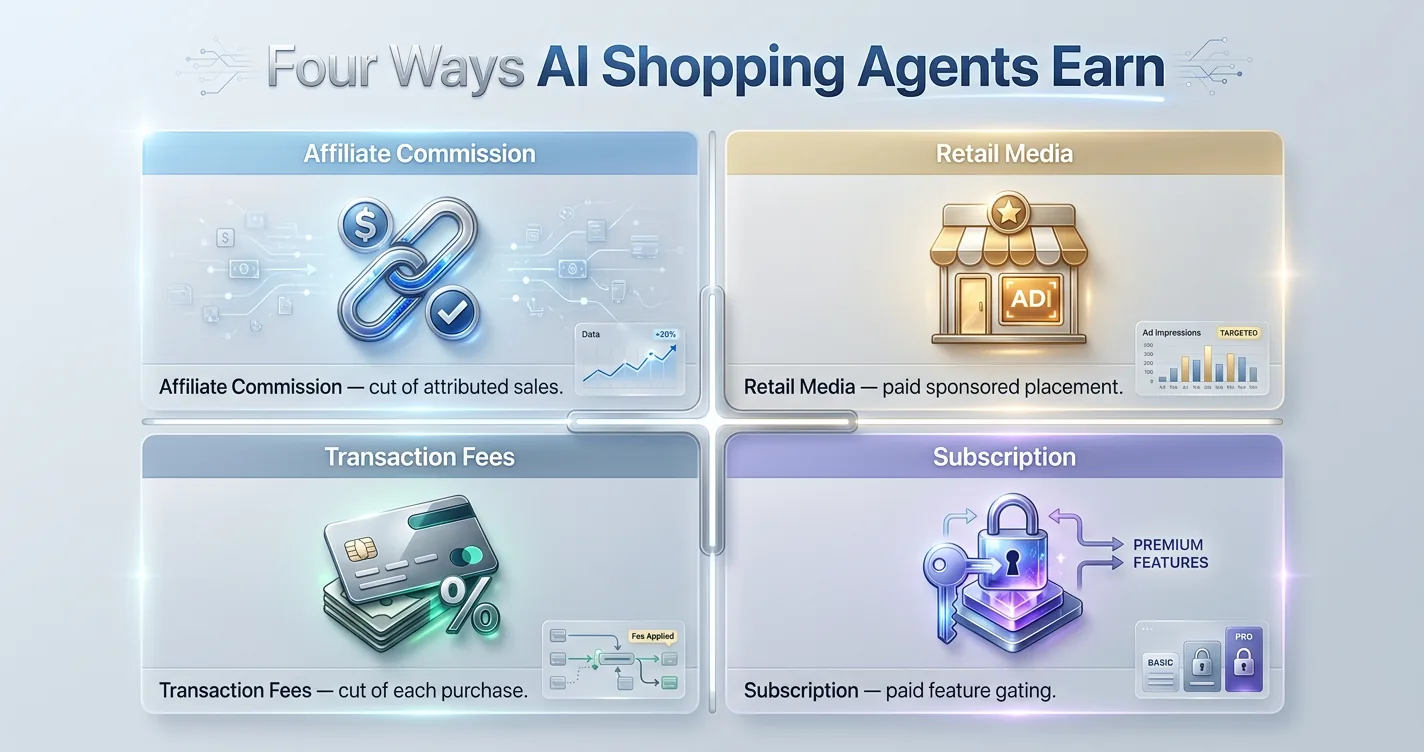
Choosing here starts with one fork, whether your agent shows things or actually shops. For browser agents that complete purchases, affiliate commissions on real transactions line up with what the agent does, while ad models monetize attention a human may never give. That difference is the whole reason browser agents deserve a fresh look at monetization.
ChatAds is the only option that runs both ads and affiliate, lets you keep all of the commission, and slots in through MCP. It is the lowest-friction path if you already hold affiliate accounts and want embedded links instead of banner ads. The others split along clear lines, so match the tool to your situation, and the broader field of tools for AI agent affiliate monetization is worth a look if none fit.
Pick AgentVine if you are betting on agent-native ad logic, Koah for production-ready ad fill with real benchmarks, and Dappier if you are a publisher with content to monetize. Aryel suits enterprise brand campaigns, Adsbind offers dashboard-controlled ad frequency once you’re off the waitlist, and Jutera is one to watch until it proves out. Match the model to whether your agent shows or shops, and the choice narrows fast.
Do not choose from the table alone. Wire one real agent reply through ChatAds with a single affiliate account and watch how the link lands inside an actual answer before you scale. The free tier of 100 requests a month is enough to prove the experience on your own agent, and that test tells you more than any star column here.
Frequently Asked Questions
What are the best platforms for monetizing AI browser agents?
ChatAds is the strongest pick for AI browser agent monetization because it reads the agent's output, detects the product intent, and returns an affiliate link in under a second while you keep 100 percent of the commission. Agentic ad networks like AgentVine, Koah Labs, and Dappier are the alternative, placing sponsored offers inside or beside the agent's reasoning and paying on clicks or conversions. Which fits depends on whether your agent completes purchases or surfaces options a human still chooses.
How do you monetize an AI browser agent?
The two paths are affiliate commissions and agentic ads. For affiliate, you send the agent's reply to a tool like ChatAds, which inserts a matching link from your own accounts so you earn on the real transaction the agent completes. For ads, an agentic ad network serves a sponsored offer the agent can act on and pays on clicks or conversions.
Should AI browser agents use ads or affiliate commissions?
If your agent finishes the purchase on the user's behalf, affiliate commissions line up with what it actually does, since they pay on the real transaction rather than a view nobody watches. Ad models fit agents that present options a human still picks from, where there is attention to monetize. Match the model to whether your agent shops or simply shows.
Do agentic ad networks work for autonomous browser agents?
Some are built for it. AgentVine runs offers inside the agent's own reasoning so there is no banner to display, which suits fully autonomous browser agents, though it is still in public beta with no disclosed revenue share. Others like Koah Labs and Aryel are aimed more at conversational apps and in-chat placements than browser-native agents.
How do AI browser agents earn affiliate commissions?
You connect your own affiliate accounts, such as Amazon Associates, then run the agent's output through an API like ChatAds that detects the product mention and returns a matching affiliate link in real time. When the agent completes the purchase, that link earns on the actual transaction and you keep the full commission, minus only a small per-request API fee.
Why do display ads fail for AI browser agents?
Display advertising bills on a human seeing a placement, but a browser agent often completes the task with no person watching the screen. There is no impression to sell and no human click to count when software finishes the purchase on its own. That gap is why affiliate commissions on real transactions fit browser agents better than browser agent ads priced on attention.