
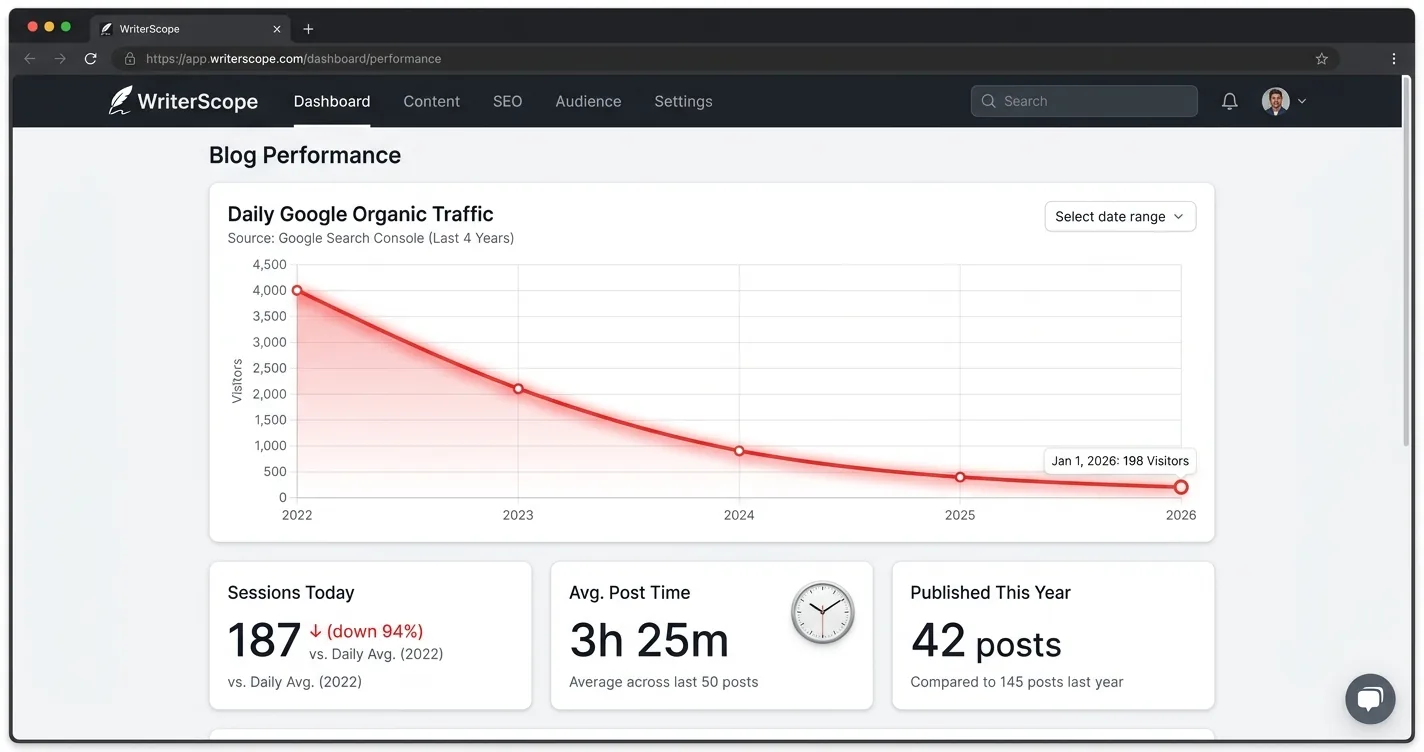
Plenty of blog visitors in 2026 bounce within seconds of landing on the page. The Nielsen Norman Group has long found that “the average page visit lasts a little less than a minute,” with most readers deciding whether to stay in the first 10 to 30 seconds. AI Overviews now answer the question inside the results page, so a hard-won click turns into a few idle seconds on your article. Pew Research Center found that once an AI summary appears, Google users “clicked on a traditional search result link in 8% of all visits,” down from 15 percent without one, and abandoned the session entirely on 26 percent of those pages versus 16 percent.
Bloggers and publishers cannot control how a search engine summarizes their work, but they can shape what happens after someone lands. An AI chat widget grounded in your own posts turns a flat page into a conversation, so the reader asks the follow-up on your site instead of returning to Google. That single habit shift lifts time on page and chips away at your bounce rate. Google Analytics 4 counts that follow-up: it defines an engaged session as one that lasts longer than 10 seconds, records a key event, or has two or more page views, and states that “the bounce rate is the percentage of sessions that were not engaged.” A reader opening the chat is exactly the extra interaction that flips a bounce into an engaged visit.
We compared six widgets on the question that matters most to a content site, which is how well each one keeps readers engaged and on the page. The things we weighed were on-content answers, setup friction, platform reach, and pricing you can predict, not raw feature counts. For a free-tier-first cut of an overlapping lineup, our roundup of no-code AI chat widgets for small blogs ranks a similar set on cost.
- On-content answers: it replies from your own posts, so readers stay for your guidance instead of bouncing back to search
- Low friction: a one-line install that goes live in minutes, not a plugin plus an API key plus a trained agent
- Broad reach: works on whatever platform your blog runs on, not just WordPress
- Predictable cost: hosted inference, so a popular post does not quietly run up a per-token bill
Ask ChatGPT to summarize the full text automatically.
★ = low · ★★ = medium · ★★★ = high
| Widget | On-Content Answers | Setup Speed | Platform Reach | Cost Value |
|---|---|---|---|---|
| ChatAds | ★★★ | ★★★ | ★★★ | ★★ |
| Bramble | ★★ | ★★ | ★★★ | ★ |
| Chatbase | ★★★ | ★★ | ★★ | ★ |
| Chatling | ★★ | ★★ | ★★★ | ★ |
| AI Puffer | ★★ | ★ | ★ | ★★ |
| Kognetiks Chatbot | ★★ | ★ | ★ | ★★ |
ChatAds
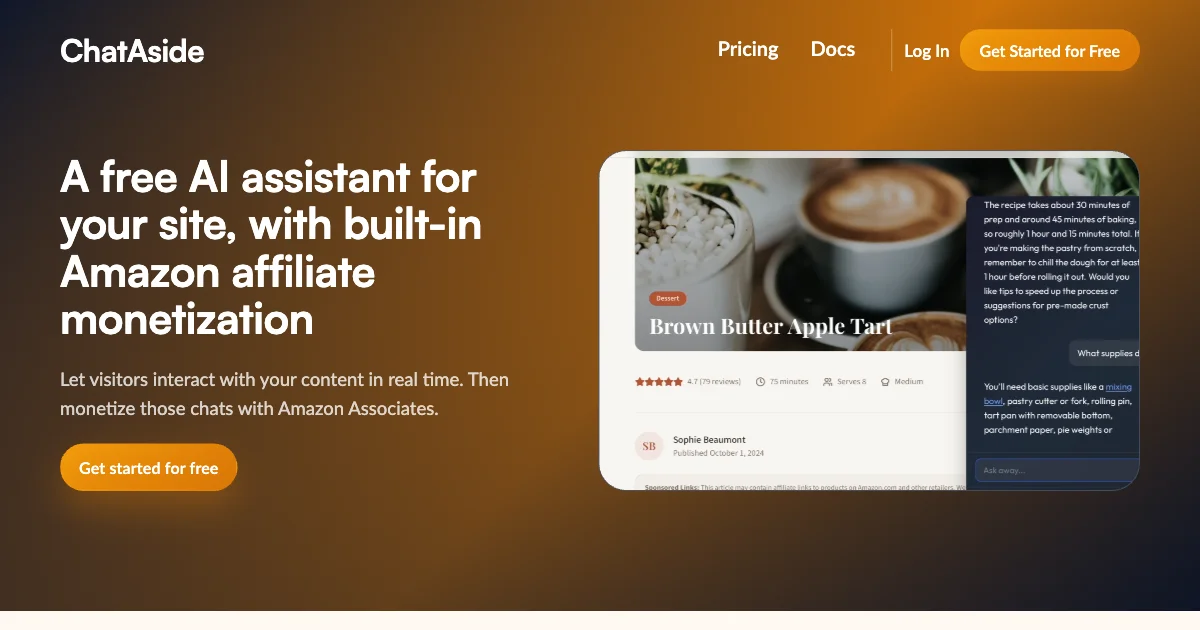
ChatAds is the one widget here built for publishers and reader engagement rather than support teams. You paste a single line of JavaScript into any site, and the assistant starts answering visitors within a few minutes. There is no API key to create and no monthly model bill to track, because ChatAds hosts the language model and the inference for you.
Its real strength as an AI chat widget for blog engagement is where the answers come from. The widget reads your published articles and replies from them, so a reader asking a follow-up gets your guidance instead of generic web text, which keeps them on your pages instead of returning to search. The free tier covers 100 messages a day with no credit card, runs on WordPress, Squarespace, and plain HTML alike, and ChatAds includes optional Amazon affiliate monetization where the publisher keeps every commission.
Pros:
- Completely free, including the hosted model behind every reply, with no card and no per-token bill
- One-line install on any platform, from WordPress to static HTML, live in a few minutes
- Answers from the post the reader is on, no training step, so replies keep readers on the page instead of back in search
- Built-in Amazon affiliate monetization where the blogger keeps 100 percent of commissions as a bonus
Cons:
- Monetization runs on Amazon Associates only, and it uses a hosted model with no bring-your-own-LLM option
- It launched in 2026 with no G2 or Capterra track record yet, and the free tier caps daily messages
Bramble
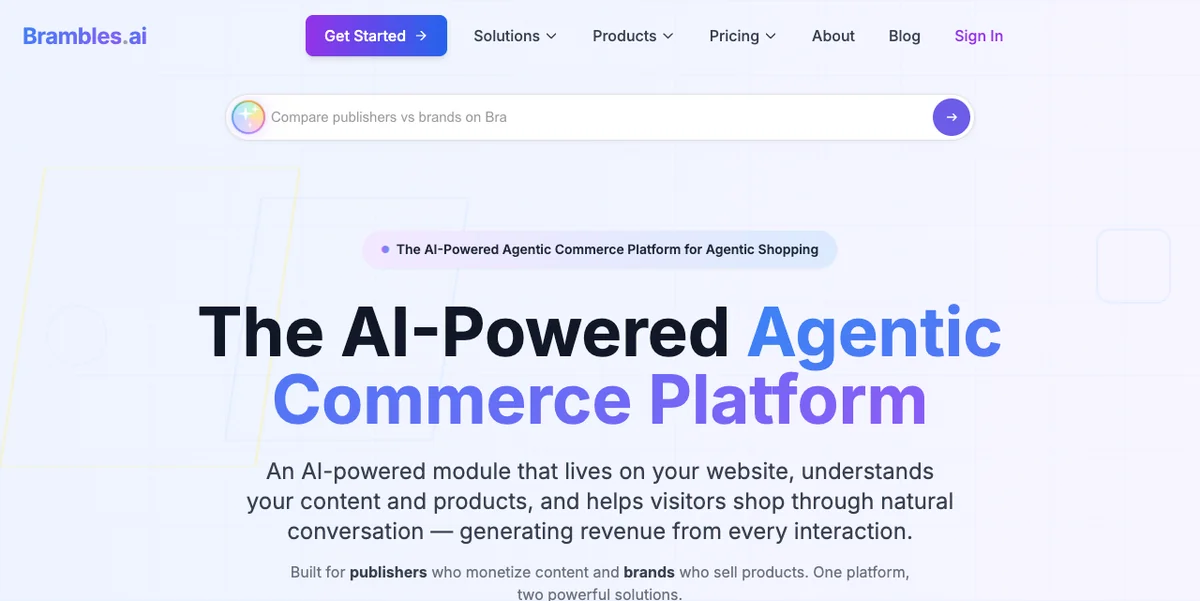
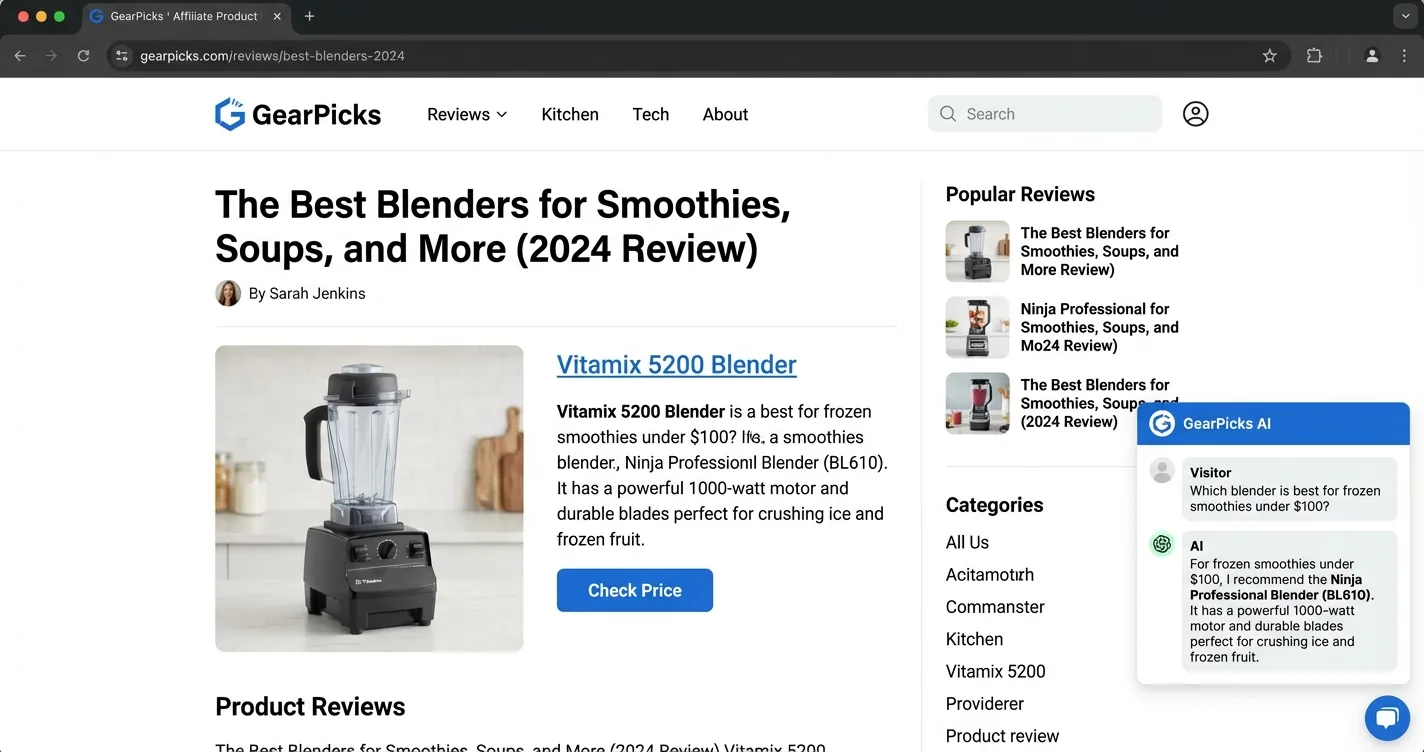
Bramble, from Brambles.ai, is a conversational shopping assistant that keeps buying-intent readers talking on the page. It reads your article in real time and answers product questions inside the chat, so a reader weighing options stays in your review instead of opening a new tab to compare. For shopping-heavy content like buying guides and gift roundups, that is a genuine way to increase blog dwell time.
Bramble is a commerce widget at heart, and not an engagement-analytics tool. It does not surface dwell-time or sentiment numbers, its revenue split with publishers stays undisclosed, and there are no third-party reviews on G2 or Capterra to verify the catalog claims. Install is friendly enough for a non-developer, with a one-click WordPress plugin or a JavaScript embed for everything else, but Bramble’s engagement value is narrow since a how-to or companion blog rarely triggers shopping intent.
Pros:
- Keeps shopping-intent readers engaged by answering product questions inside the chat instead of off-site
- One-click WordPress plugin or a framework-agnostic embed that works on any platform
- Large product catalog with real-time price comparison across many affiliate networks
Cons:
- Engagement value is narrow, since it only helps content with real shopping intent
- No dwell-time or sentiment reporting, so it does not measure reader engagement at all
- Undisclosed revenue split and no third-party reviews to verify the catalog claims
Chatbase
Chatbase is a mature platform for building a custom GPT trained on your own data, and its content-grounded answers retain readers. You point it at your site through a crawl, a sitemap, or uploaded files, and it embeds on any platform through a script or an official WordPress plugin. As an AI chatbot for content engagement it does the job, since replies stay anchored to your own articles rather than the open web.
The economics are where it turns awkward for a publisher focused on dwell time. Chatbase is pitched at customer support and sales, the free plan is a 50-credit-per-month demo with agents deleted after 14 days idle, and usable volume starts near $40 a month where credit metering means cost climbs with every reader question. Chatbase holds a 4.3 on Capterra across roughly 73 reviews, but its Trustpilot score sits at 2.1 with recurring complaints about billing and refunds, which makes it a polished tool aimed at the wrong job for most bloggers.
Pros:
- Content-grounded answers retain readers, since replies come from your own articles
- Works on any website through a script or an official WordPress plugin, with a fast setup
- Mature product with model choice and a deep set of business integrations
Cons:
- Pitched at support and sales teams, so the features and pricing do not fit publishers
- The free plan is a 50-credit demo, and agents are deleted after 14 days idle
- Credit metering scales cost with reader question volume, and Trustpilot flags billing complaints
Chatling
Chatling is a no-code chatbot builder that hosts the models for you across the GPT, Claude, and Gemini families. A blogger can install it on any platform, and content-trained answers from a site crawl or uploads will keep readers engaged on the page. The permanent free tier gives you 100 AI credits a month, two bots, and a large knowledge base without a credit card, which makes it easy to test.
The catch is that Chatling is built for support and lead generation, not for publishers trying to reduce bounce rate with AI chat. You build and train an agent and often configure conversation flows before it earns its keep, so it is not a drop-in widget, and paid tiers run near $40 and $140 a month with usage metered in model-dependent AI credits that can spike unpredictably. Chatling carries strong social proof with a 4.7 on G2 across roughly 62 reviews, but it is over-configured and priced for support deflection rather than content engagement.
Pros:
- Genuine permanent free tier with no card, plus hosted models and no key management
- Content training through crawls, sitemaps, and uploads keeps answers grounded in your posts
- Strong 4.7 G2 rating across roughly 62 reviews and a one-paste embed for any platform
Cons:
- Built for support and lead generation, so it expects agent setup rather than a pure drop-in
- Usage-based AI credits make monthly cost unpredictable as reader volume grows
- Paid tiers near $40 and $140 a month are steep for a content site
The support-grade tools here, Chatbase and Chatling, charge by AI credits, and the WordPress plugins below run on your own model key. Both models tie your bill to how much readers talk, which is the exact behavior you are trying to encourage. A widget that nudges dwell time up then bills you per reply works against itself, so a hosted free tier that absorbs inference keeps the engagement goal and the cost goal pointed the same way.
AI Puffer
AI Puffer, once known as AI Power, is an all-in-one WordPress AI plugin with more than 10,000 active installs. Its chatbot module trains on your posts, pages, and PDFs through a vector store, so it can answer grounded in your own material and keep readers on the page. That content-trained chat is a real engagement lever for WordPress owners who want everything inside their dashboard.
Two hard limits shape the engagement use case for AI Puffer. The plugin runs only on WordPress, so Shopify, Squarespace, and static sites are out, and the model side is strictly bring-your-own-key, meaning you fund your own OpenAI or Gemini account and absorb every token the chatbot spends. Chat is also just one module buried in a dense toolkit alongside a content writer, AI forms, and image generation, so AI Puffer has a real learning curve for anyone who only wants to boost reader engagement with AI widget chat, even with its strong 4.6 rating across 162 WordPress.org reviews.
Pros:
- Trains on your own posts, pages, and files through a vector store for grounded on-content answers
- Genuinely free core chatbot, with a strong 4.6 rating across 162 WordPress.org reviews
- Cheap Pro tier and broad model choice across several providers
Cons:
- WordPress only, so it cannot run on Shopify, Squarespace, or static sites
- Mandatory bring-your-own-key billing, so you fund and manage your own model account
- Chat is buried in a dense multi-tool plugin with a steep learning curve
Kognetiks Chatbot
Kognetiks Chatbot is a free, open-source WordPress plugin, and it is the most engagement-aware option here after ChatAds. Its Knowledge Navigator indexes your posts and pages so replies stay grounded in your content, which keeps readers asking follow-ups on your site. It also surfaces engagement and sentiment signals plus conversation-digest reporting, so you can see what is keeping readers talking instead of guessing.
That depth comes with the most hands-on setup of any widget in this roundup. It is bring-your-own-key, so you supply an API key and pay your provider directly for both chat and the content-indexing step, the plugin runs only on WordPress, and the settings are deep enough to carry a real learning curve. Kognetiks holds a 4.5 rating across 22 reviews on WordPress.org with a 600-plus install base, and it fits a technical WordPress owner who wants control and hard proof that the chat is boosting reader engagement.
Pros:
- Free and open source, with no plugin fee and no per-message vendor charge
- Knowledge Navigator keeps answers grounded in your posts to hold reader attention
- Surfaces engagement and sentiment signals plus conversation digests, rare among these widgets
- Local model option avoids API fees and keeps reader data on your own server
Cons:
- WordPress only and the most configuration-heavy option in this roundup
- Bring-your-own-key, so you pay the provider directly, including the content-indexing tokens
- Modest 600-plus install base means a smaller community and fewer tutorials
How to Choose
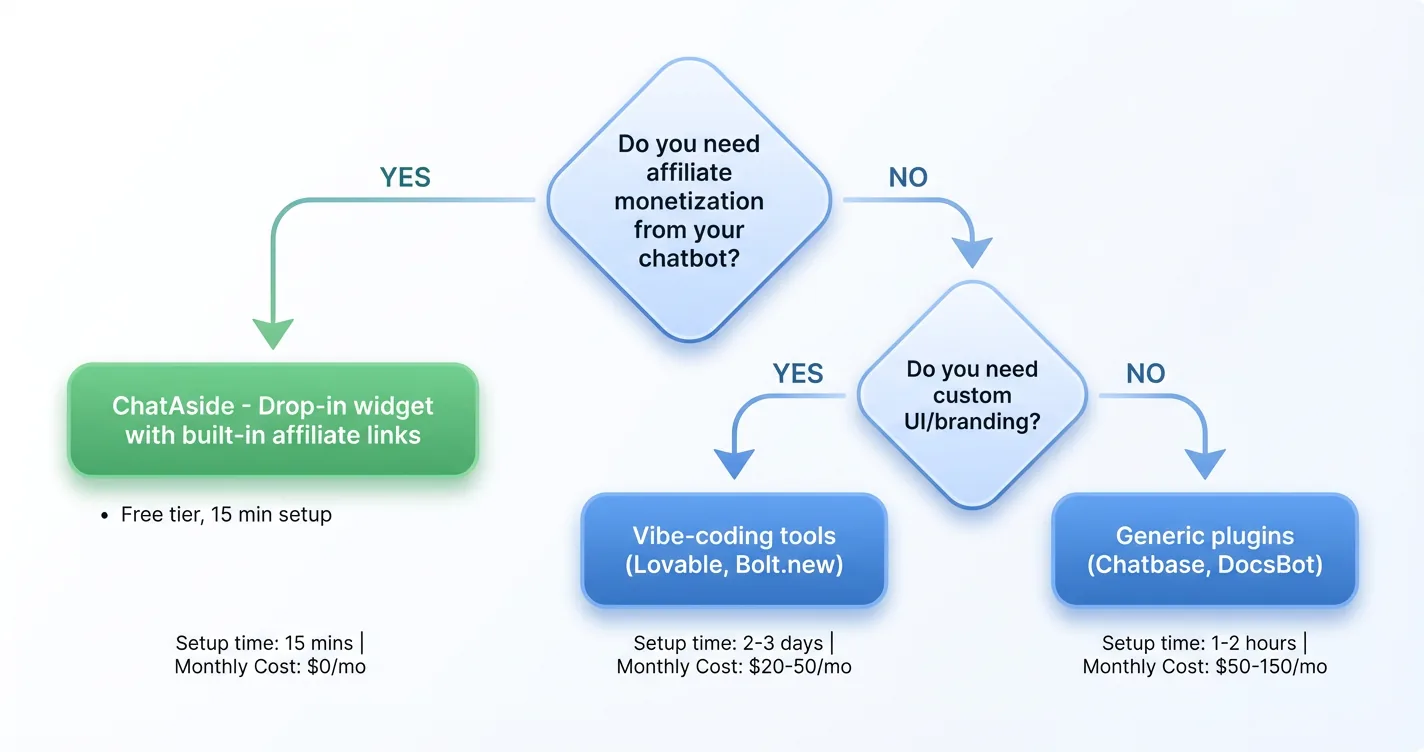
The right widget depends on your platform and your goal. Match the tool to where your blog lives and how much setup you want to take on, and the shortlist gets small fast.
A few questions narrow the field quickly:
- On WordPress and comfortable managing a model key? Kognetiks is free and open source and even surfaces engagement signals, while AI Puffer bundles chat with an all-in-one toolkit.
- Running a support or sales motion next to the blog? Chatbase and Chatling are polished, if paid, and built for deflection more than dwell time.
- Publishing shopping-heavy content? Bramble keeps buying-intent readers talking, though its revenue split stays undisclosed.
For the core job in this article, which is keeping readers on the page across any platform with the least friction, ChatAds is the natural place to start. It is free, needs no API key, answers from the page the reader is on with no training setup, and goes live in minutes, with optional affiliate monetization waiting if you want it later. The best engagement widget is the one readers use, which means the one that answers from your content without making you build or fund anything first.
Do not judge a widget from a comparison table alone, this one included. Install your top pick on a single busy article, leave it live for two weeks, and watch how often readers open the chat and what they ask. Real behavior on your own pages settles the engagement question faster than any feature list, and it tells you whether the dwell-time lift is worth turning monetization on.
Frequently Asked Questions
Which AI chat widget boosts blog engagement the most?
For most content sites, ChatAds lifts engagement the most because it installs with one line of JavaScript, reads the post readers are on, and answers them on the page so they stay for your guidance instead of returning to search. It is free, hosts the model with no per-token bill, and adds optional Amazon affiliate monetization. WordPress owners who want engagement and sentiment reporting can also look at Kognetiks, though it needs your own model key.
Can an AI chat widget increase blog dwell time?
Yes. A widget grounded in your own articles answers a reader's follow-up question on the page, so the next step happens on your site instead of back in Google. That extra interaction is exactly what raises time on page and trims your bounce rate, as long as the answers stay grounded in your own content rather than generic web text.
How does an AI chatbot for content engagement reduce bounce rate?
A bounce happens when a visitor leaves without a second interaction. An on-page chat gives readers a reason to take that second action by answering their next question right where they are, instead of sending them off to a search engine. Widgets that reply from your own posts reduce bounce rate best, since the answer keeps the reader inside your content.
Are there free AI chat widgets for blog engagement?
Yes. ChatAds is fully free, including the hosted model, with 100 messages a day and no credit card to start. Kognetiks and AI Puffer are also free to install, but their AI mode is bring-your-own-key, so you fund your own OpenAI or Gemini account for every reply. Hosted free tiers are the simplest way to test the engagement lift without a model bill.
Do AI chat widgets work on non-WordPress blogs?
Hosted widgets do. ChatAds, Bramble, Chatbase, and Chatling all run on Squarespace, Ghost, Wix, or plain HTML through a single embed. AI Puffer and Kognetiks are WordPress-only plugins and cannot be installed elsewhere. If your blog runs on anything but WordPress, a one-line hosted widget like ChatAds is the easiest engagement pick.
Can a reader engagement AI widget also make money for a blog?
Some can. ChatAds has built-in monetization where you connect an Amazon Associates account, flip a toggle, and product mentions inside chat replies become commission links you keep in full. Bramble can also monetize shopping-heavy chat, though it does not disclose its revenue split. Every other widget here is a pure cost center, so engagement is the only return.