Chatbot pricing in 2026 runs from free to several hundred dollars a month, depending on what each vendor counts as one unit of use. Most published price guides come from support-desk vendors, so they size plans by agent seats and resolved tickets rather than by readers.
A blog has a different traffic shape from a help desk, even at the same visitor count. Readers ask about the post in front of them, like which pan a recipe calls for, and very few of them need a support ticket.
Based on vendor pricing pages checked November 6, 2026, a blog’s monthly bill comes down to how many questions readers ask on its busiest days. For that pattern, a free tier or a flat plan with a daily cap fits better than per-resolution billing.
Flat website chatbot plans start around $40 to $100 a month, and under this article's traffic assumptions a blog below 50,000 monthly pageviews can fit a free tier or an entry plan. Building your own costs cents in tokens but adds hosting and upkeep. Check branding-removal and overage fees too, since they can cost more than the plan itself.
Ask ChatGPT to summarize the full text automatically.
How Much Does an AI Chatbot Cost in 2026?
An AI chatbot costs from $0 to a few hundred dollars a month in 2026, with flat website plans starting around $40 to $100. AI chatbot pricing sorts into three bands, which are free tiers, flat monthly plans, and per-outcome billing from support-desk tools. Each band targets a different buyer, so two vendors can quote prices 10 times apart for what looks like the same widget.
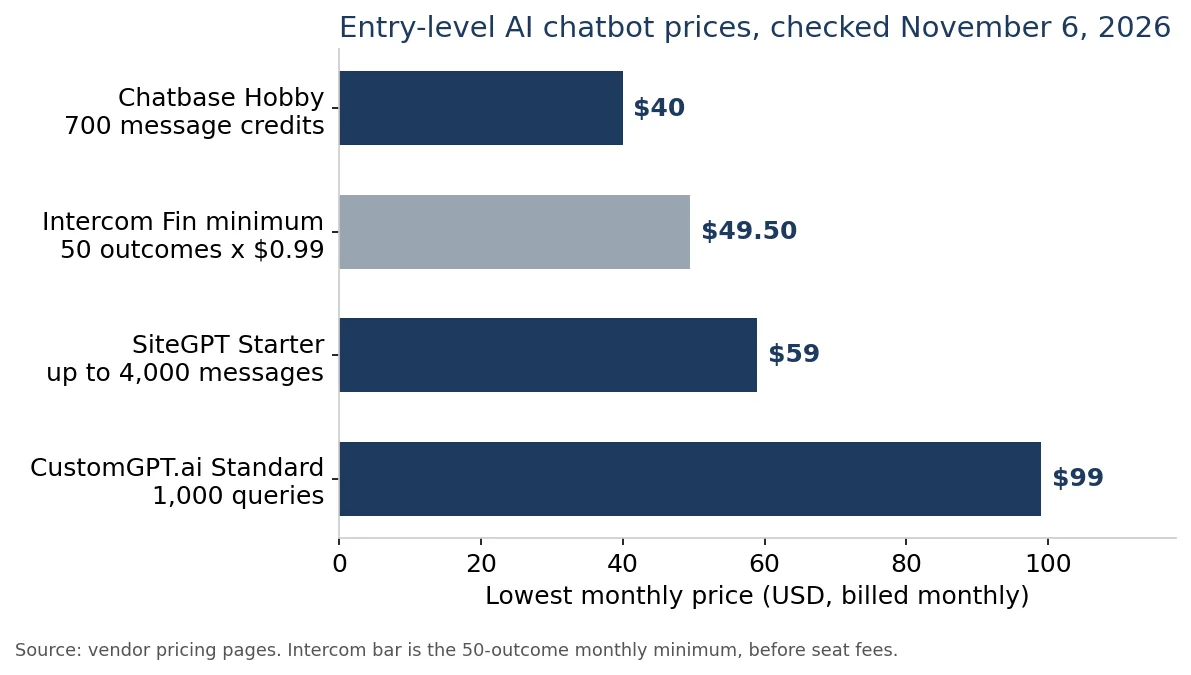
Flat plans for website chatbots start between $40 and $100 a month for roughly 700 to 4,000 messages. Chatbase lists its Hobby plan at $40 a month for 700 message credits, or $32 a month billed yearly. SiteGPT charges $59 a month on its Starter plan for up to 4,000 messages, with larger plans at $129 and $429.
Among these entry tiers, CustomGPT.ai costs the most at $99 a month for 1,000 queries, and it offers a free seven-day trial instead of a free plan. Chatbase no longer shows a free plan on its pricing page, while Tidio still lists a plan called Free that it pitches to solo entrepreneurs. If free is your only budget, our roundup of free no-code AI chat widgets for small blogs compares those options.
Enterprise support tools bill by results instead of by messages or months. Intercom prices its Fin agent at $0.99 per outcome with a monthly minimum of 50 outcomes, so the floor sits at $49.50 before any seat fees.
| Vendor | Lowest paid plan | Included usage | Billing unit |
|---|---|---|---|
| Chatbase | $40/mo ($32 billed yearly) | 700 message credits/mo | Credits |
| SiteGPT | $59/mo ($39 billed yearly) | Up to 4,000 messages/mo | Messages |
| CustomGPT.ai | $99/mo ($89 billed yearly) | 1,000 queries/mo | Queries |
| Intercom Fin | $0.99 per outcome | 50-outcome minimum ($49.50) | Outcomes |
| Zendesk AI agents | Rate not published on its help page | Plan allotments plus add-ons | Automated resolutions |
Why Do Chatbot Pricing Models Vary So Much?
Vendors price chatbots in the unit their typical customer already counts, which for support teams means agent seats and closed tickets. A blog owner counts pageviews, and none of the common pricing models bill on those directly.
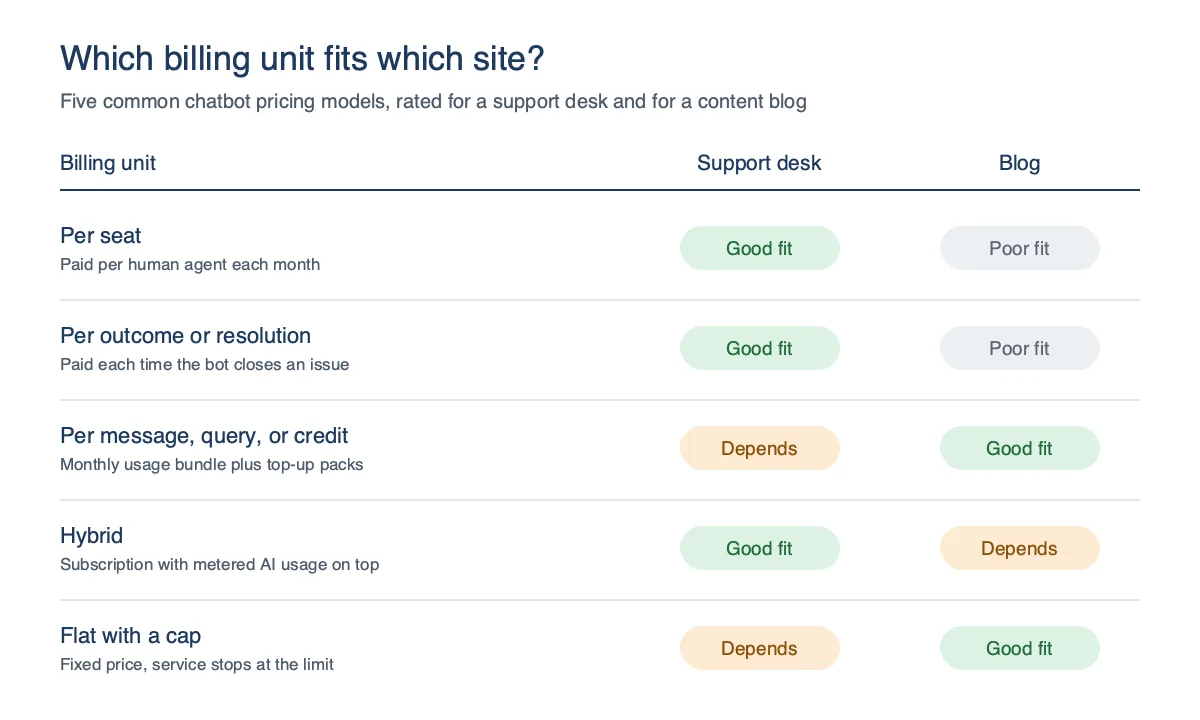
Five billing units cover nearly every chatbot plan on the market today:
- Per seat. Intercom sells its Copilot add-on at $29 per agent a month billed annually, which only matters when human agents answer chats.
- Per outcome or resolution. You pay each time the bot closes an issue, like Fin’s per-outcome rate or the automated resolutions that Zendesk bills on.
- Per message, query, or credit. Chatbase, SiteGPT, and CustomGPT.ai sell monthly bundles of usage, and Chatbase and SiteGPT also sell top-up packs.
- Hybrid. A subscription covers the base product, and AI usage gets metered on top of that monthly fee.
- Flat with a cap. One price buys a fixed allowance, and service stops at the limit instead of creating an overage bill.
Bret Taylor, co-founder of Sierra, explained the outcome model on Sequoia’s Training Data podcast. For his median customer, he said, “when the AI agent resolves the issue for the customer autonomously, there’s a pre-negotiated rate for that.” A reader asking which knife to buy for sourdough has no issue for anyone to resolve.
Hybrid plans are now the most common setup among the B2B software and AI companies in Kyle Poyar’s 2026 survey. There, 37% of participants reported a hybrid model that pairs a subscription with AI consumption on top. For a blogger, that means a monthly fee can still arrive with a metered AI charge attached.
Ask each vendor exactly what counts as one billable unit on its plan. If the answer is a seat, a ticket, or a resolution, the plan was built for a support team rather than a content site.
What Does It Cost to Build Your Own on an LLM API?
Building your own chatbot on an LLM API is cheap in tokens and expensive in time. Tokens are the small chunks of text a model reads and writes, and providers bill them per million. Current small models cost a fraction of what older pricing guides quote, since several of those guides still use GPT-4o-era rates.
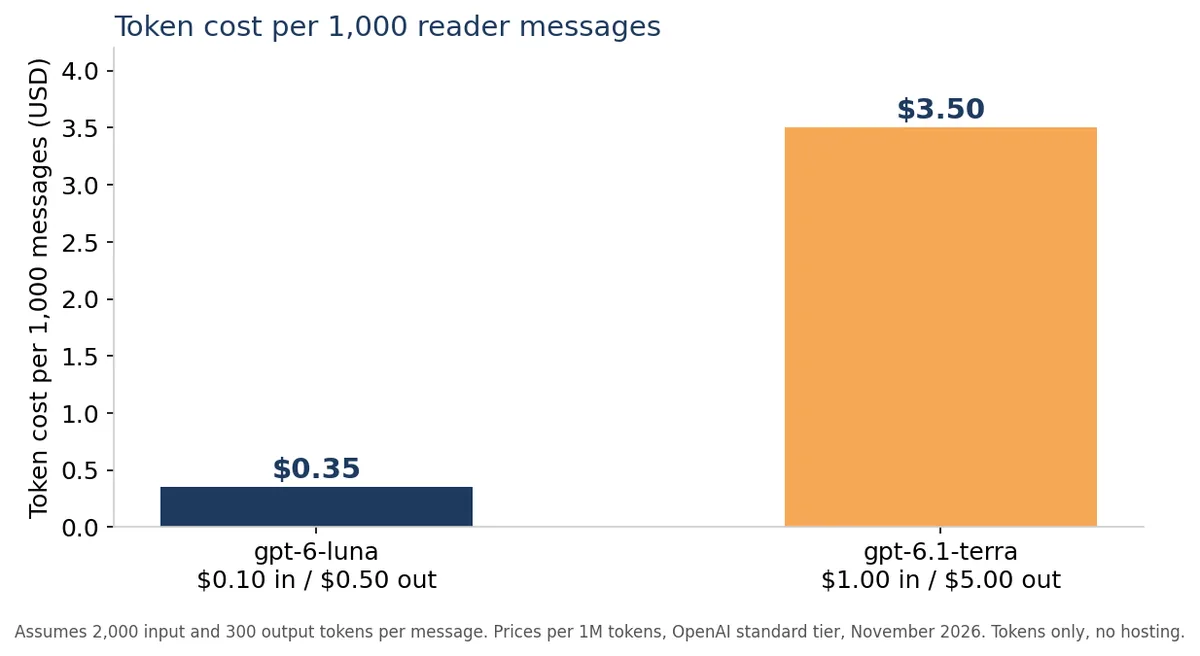
OpenAI lists gpt-6-luna at $0.10 per million input tokens and $0.50 per million output tokens on its standard tier. Assume each reader message sends 2,000 input tokens (system prompt, page text, and chat history) and gets a 300-token reply back.
That works out to about $0.00035 per message, or roughly 35 cents for every 1,000 messages your readers send. Moving up to gpt-6.1-terra at $1.00 and $5.00 per million tokens raises the same message to about $3.50 per 1,000, which is 10 times more.
| Messages per month | gpt-6-luna | gpt-6.1-terra |
|---|---|---|
| 3,000 | $1.05 | $10.50 |
| 6,000 | $2.10 | $21.00 |
| 18,000 | $6.30 | $63.00 |
Token bills also tend to skew toward a small group of very heavy users. Kyle Poyar of Growth Unhinged wrote that “the top 10% of power users drive 70%+ of token consumption,” a figure he frames as his own experience rather than a measured study. Without a per-visitor limit, a handful of chatty readers can set your monthly bill.
That table covers tokens only. You also pay to host the backend, and you own the chat interface, rate limiting, abuse protection, model upgrades, and the storage behind any search over your archive.
Longer chat histories also grow the input side of every message, so real token use creeps above the 2,000-token assumption. For ways to shrink the token side, see our guide on how to reduce LLM API costs for an AI chatbot.
What Will a Chatbot Cost at Your Blog’s Traffic?
Your monthly chatbot cost depends on messages, so the first job is turning pageviews into a message count you can plan around. Published chat engagement benchmarks conflict and mostly come from vendors, so the examples below use stated assumptions instead of a cited rate.
Assume that 1% to 3% of pageviews open the chat and that each chat averages three reader questions. Here one message means one reader question plus the reply it gets. At 10,000 monthly pageviews that gives you 300 to 900 messages a month, while 200,000 pageviews produces 6,000 to 18,000.
| Monthly pageviews | Chats per month | Messages per month | Average messages per day |
|---|---|---|---|
| 10,000 | 100-300 | 300-900 | 10-30 |
| 50,000 | 500-1,500 | 1,500-4,500 | 50-150 |
| 200,000 | 2,000-6,000 | 6,000-18,000 | 200-600 |
Our own product, ChatAds, is a useful data point because it caps usage by day instead of by month. Its free plan covers 100 messages a day, Pro costs $29 a month for 500 a day, and Business costs $59 a month for 1,500 a day. These are hard caps with no pay-as-you-go overage, and they reset each UTC day, so a quiet Tuesday doesn’t bank messages for a viral Friday.
Units differ across vendors, which makes any side-by-side table approximate. Chatbase sells message credits, while CustomGPT.ai sells queries instead of messages. SiteGPT counts a premium-model reply as 10 standard messages, so check what one reader question costs on each plan.
Each cell below uses the cheapest mix of base plan and top-up packs that covers the monthly range, assuming one Chatbase credit per reply. The ChatAds cells use the average daily count, so leave headroom for your peaks.
| Monthly pageviews | Chatbase | SiteGPT | CustomGPT.ai | ChatAds | DIY (tokens only) |
|---|---|---|---|---|---|
| 10,000 | $40-$80 | $59 | $99 | Free | $0.11-$0.32 |
| 50,000 | $80-$190 | $59-$118 | $499 | Free to $29 | $0.53-$1.58 |
| 200,000 | $230-$620 | $118-$236 | Custom (Enterprise) | $29-$59 | $2.10-$6.30 |
Plan for your busiest day rather than your average one, because the daily column above is just the monthly total divided by 30. A single popular post can push one day far past that average. A per-visitor daily limit helps here too, because it stops one curious reader from spending a large share of the site’s daily budget.
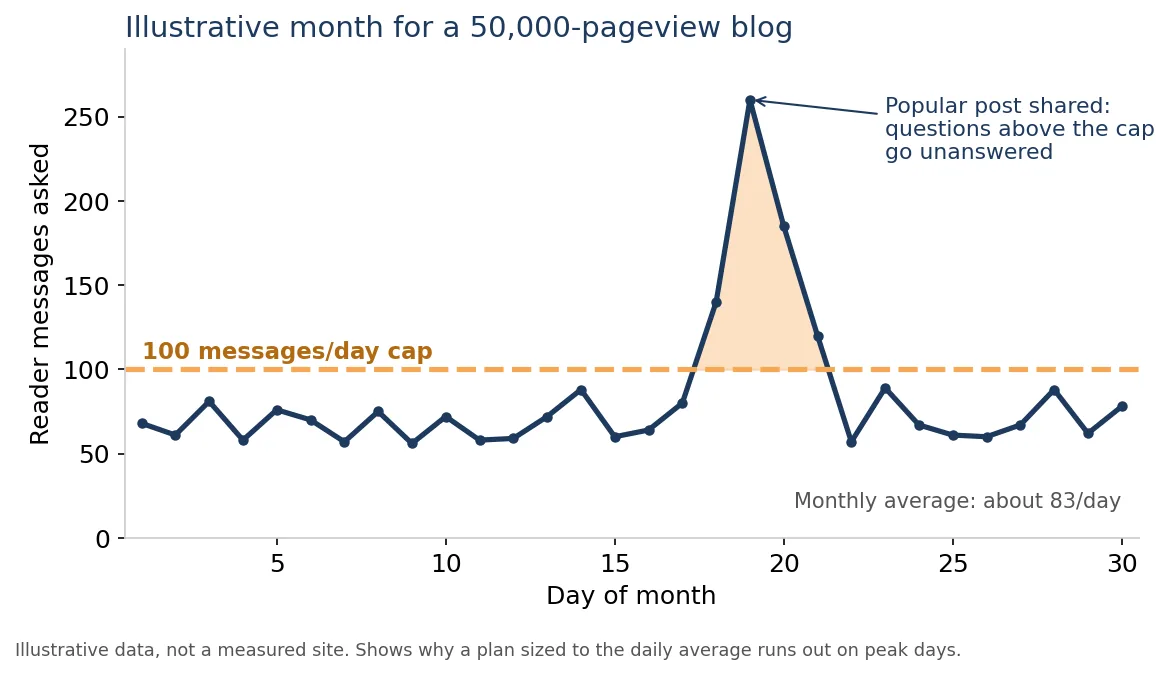
The ChatAds free plan includes 100 messages a day with no credit card, and the dashboard shows today's count against your plan limit. Owners also get an email on any day the site reaches its cap. If those emails arrive often, your real demand sits above 100 a day, which the counter alone can't show.
Can a Chatbot Pay for Itself?
A chatbot on a blog can pay for itself when its replies include affiliate links that readers click and buy through. Product questions create the clearest openings, since a reader asking which blender to buy is already shopping.
Amazon’s US Associates program publishes standard commission rates for each product category. The rate is 4.5% for kitchen products, while other categories range from 1% to 10%, so a $50 kitchen item earns $2.25 per sale.
At that rate, covering a $29 plan takes about 13 such sales a month, and a $59 plan takes about 27. These counts assume each commission is credited and kept after returns, and that the sales come from chat rather than from links readers would have clicked anyway. Whether you reach them depends on your niche and readers, and nobody can promise you a click or conversion rate.
| Monthly plan cost | Example plan | Sales needed per month |
|---|---|---|
| $0 | Any free tier | 0 |
| $29 | $29 flat plan | 13 |
| $59 | $59 plan, such as SiteGPT Starter | 27 |
| $129 | SiteGPT Growth | 58 |
| $150 | Chatbase Basic | 67 |
| $499 | CustomGPT.ai Premium | 222 |
ChatAds builds this in as opt-in monetization, and the links in chat use your own affiliate tags. Our pricing page says you pay for message volume only and that “we take 0% of commissions,” so the commission on each sale goes to you.
Sites whose readers rarely ask shopping questions will see fewer chances for a link, whatever the plan costs. Amazon links in ChatAds also show only to US and UK readers. Monetized replies need a clear affiliate disclosure too, and our guide to disclosing ads in AI chats covers the FTC wording.
What Hidden Costs Should You Budget For?
Costs beyond the plan price come from add-ons, limits, page weight, and your own time. How much upkeep you face depends on how the widget gets its content. A widget that reads each page when a reader opens it stays current on its own, while one trained on uploaded copies of your posts needs retraining after edits.
Branding removal is a common upsell, and its price can exceed the plan it sits on. Chatbase charges $99 a month to remove its “Powered By Chatbase” label, which costs more than double its $40 Hobby plan.
Overage rules matter more than the base price once traffic spikes. SiteGPT sells extra packs of 5,000 messages for $59 a month, while capped plans stop answering until the limit resets. On a capped plan, some readers see a limit message on a record day, but the bill stays at the plan price.
Bret Taylor shared a story on the same Training Data episode that he said he’d only heard secondhand. In it, LinkedIn’s recruiting business started on usage-based pricing, but “HR departments don’t have a lot of license to spend in a variable amount,” so a subscription made buying easier. A blogger on a tight budget is in that spot, so a fixed bill with a hard limit can beat a cheaper metered one.
Every widget also adds script weight to your pages, and that cost lands on page speed rather than on your invoice. Check the bundle size and whether it loads lazily, since our post on whether an AI chat widget hurts your SEO shows how that plays out. Chat logs can also hold personal details, so read each vendor’s privacy terms and update your own policy before launch.
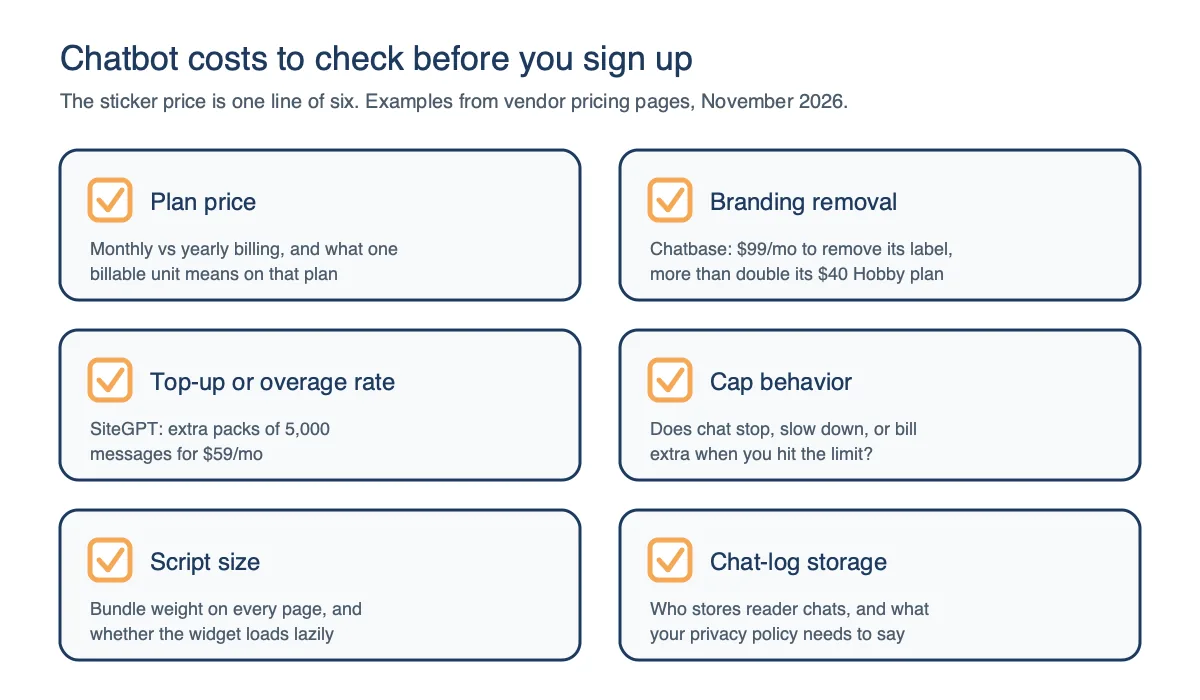
Before you sign up, confirm the branding-removal price, the overage or top-up rate, what readers see at the cap, the script size, and who stores chat logs. If the widget learns from uploaded copies of your posts, also schedule a refresh whenever you publish or update one.
To pick a plan, start by estimating billable questions from your pageviews, then check each plan’s daily and monthly allowance against your peak days. Confirm whether service stops or an overage pack kicks in at the limit, and add any branding or top-up fees to the sticker price.
If you turn on affiliate links, compare the commission that chat replies add against that total cost each month. Keep the plan if that number covers the bill, and move to a cheaper tier or a free plan if it doesn’t.
Frequently Asked Questions
How much does a chatbot cost per month?
An AI chatbot for a website costs from free to several hundred dollars a month in 2026. Flat plans start around $40 to $100 a month for roughly 700 to 4,000 messages, while Intercom Fin bills $0.99 per outcome with a 50-outcome minimum. Under this article's traffic assumptions, a blog under 50,000 monthly pageviews can fit a free tier or an entry plan.
Is there a free AI chatbot for my website?
Yes. Tidio has a plan called Free, and ChatAds offers 100 messages a day with no credit card, though Chatbase no longer lists a free plan on its pricing page. Free tiers limit message volume and often keep the vendor's branding on the widget.
How much does it cost to build your own chatbot with the OpenAI API?
On gpt-6-luna, tokens cost roughly 35 cents per 1,000 messages, assuming 2,000 input tokens and a 300-token reply per message. On top of that you pay to host the backend and you own the chat interface, rate limiting, and ongoing maintenance.
Is a chatbot worth it for a small blog?
It can be when readers ask product questions and the replies can carry your own affiliate links. At $2.25 per sale, a $29 plan needs about 13 commissioned sales a month from chat to break even, while a free tier needs none. Nobody can promise those sales, so compare chat-driven commission against the bill before you upgrade.
Can I remove chatbot branding on a free plan?
It depends on the vendor, and removal can cost more than the plan itself. Chatbase charges $99 a month to remove its "Powered By Chatbase" label. ChatAds shows its branding on the Free and Pro plans and removes it on Business.
What happens when I hit my chatbot's message limit?
It depends on the vendor, so check before you sign up. Some sell overage packs, like SiteGPT's 5,000 extra messages for $59 a month, while hard-capped plans such as ChatAds stop answering and show readers a "Chat limit reached" message until the daily limit resets.