
Monetization options for AI developers have expanded well beyond subscriptions and freemium models in 2026. AI chatbots, agents, companions, AI assistants, and conversational apps now have access to advertising networks specifically designed for how people actually interact with AI.
The category got its loudest validation in February 2026, when OpenAI began testing ads in ChatGPT for logged-in adult users on its Free and $8-per-month Go tiers. OpenAI framed the move around trust rather than yield, saying its “goal is for ads to support broader access to more powerful ChatGPT features while maintaining the trust people place in ChatGPT for important and personal tasks.” Money is following the same path: eMarketer analyst Nate Elliott projects that “AI ad spending will more than double in the next five years to $68.25 billion in 2030.”
The audience is worth reaching because it converts. Adobe data reported by TechCrunch found AI traffic to US retailers rose 393% year over year in the first quarter of 2026, and that “AI traffic converted 42% better than living, breathing customers in March 2026.” Revenue per visit ran 37% higher than non-AI traffic.
These aren’t traditional display ad networks trying to retrofit banner ads into chat interfaces. Most of the platforms covered here were built for conversational experiences from the ground up. Some insert ads during the AI reasoning process itself, while others handle post-processing insertion or sponsored messages. A few take affiliate commission approaches, others run on pure display advertising models.
If you’re building a thin wrapper around OpenAI or Claude APIs, see our dedicated ad monetization platforms for AI wrappers comparison. This guide covers 11 ad networks from different strategic positions in the AI monetization stack. ChatAds is listed first because it is the one we build, and it takes an infrastructure approach: developers bring their own affiliate accounts and keep the commissions, paying per-request API fees instead of a revenue share. The rest include reasoning-time ad innovators, managed affiliate platforms, privacy-first networks for autonomous agents, and tools built for large publishers.
A word on the numbers below. Several platforms here are young, and their public metrics move or vanish. Where a figure comes from a company’s own marketing rather than an audited source, we say so.
Most of these platforms serve banner ads, sponsored messages, or promoted products inside AI conversations. ChatAds takes a different approach as ad infrastructure for affiliate product linking, automatically detecting product mentions and inserting affiliate links rather than serving traditional CPM display ads.
★ = low · ★★ = medium · ★★★ = high
| Platform | Ease of Use | AI Focus | Cost Value | Advertiser Access |
|---|---|---|---|---|
| ChatAds | ★★★ | ★★★ | ★★ | ★★★ |
| Bramble | ★★ | ★★★ | ★★ | ★★★ |
| ZeroClick | ★ | ★★★ | ★★ | ★★ |
| Koah Labs | ★★ | ★★★ | ★★ | ★ |
| Imprezia | ★★ | ★★ | ★★ | ★ |
| Dappier | ★★★ | ★★ | ★★ | ★ |
| Jutera | ★ | ★★ | ★ | ★ |
| Adgentic | ★★ | ★★★ | ★ | ★★ |
| AgentVine | ★★ | ★★★ | ★★ | ★ |
| Adsbind | ★★★ | ★★ | ★★ | ★ |
| Aryel | ★ | ★★ | ★ | ★★ |
Ask ChatGPT to summarize the full text automatically.
ChatAds

ChatAds is not a traditional CPM ad network. It is ad infrastructure for affiliate product linking that automatically detects product mentions in AI conversations and inserts the right affiliate links in under 200 milliseconds. ChatAds uses a bring-your-own-account model: developers connect their existing affiliate accounts, so commissions land in those accounts directly and the billing relationship is per-request API fees rather than a share of earnings.
That structure is the main thing separating it from the revenue-share networks further down this list, and it cuts both ways. It rewards developers who already have approved affiliate accounts and enough product-related conversation volume to justify the request fees. It does nothing for a developer with no affiliate accounts and no interest in opening any, which is exactly who a managed network like Koah or Adgentic serves better.
The platform supports eight ad formats including text links, product recommendations, banner ads, ChatGPT apps via MCP integration, Facebook bots, priority listings, internal promotions, and native affiliate placements. Integration happens through five methods covering REST API, TypeScript SDK, Python SDK, MCP Server for autonomous agents, and n8n nodes for no-code workflows.
Whichever platform you pick, affiliate links carry a disclosure obligation. The FTC’s endorsement rules at 16 CFR 255.5 state that when a connection between endorser and seller “is not reasonably expected by the audience, such connection must be disclosed clearly and conspicuously,” and the rule’s Example 11 is a blogger earning commission on affiliate links.
Pros:
- Commissions go straight to your own affiliate accounts, with per-request pricing instead of a revenue share
- Sub-1-second API response time maintains conversation flow
- Five integration methods from REST API to no-code n8n nodes
- Free tier with 100 requests per month for testing
Cons:
- Requires existing affiliate network accounts (Amazon Associates, CJ, etc.)
- Per-request fees mean low-volume or low-intent apps may not clear the cost
- Currently focused on US market with English content optimization
Bramble
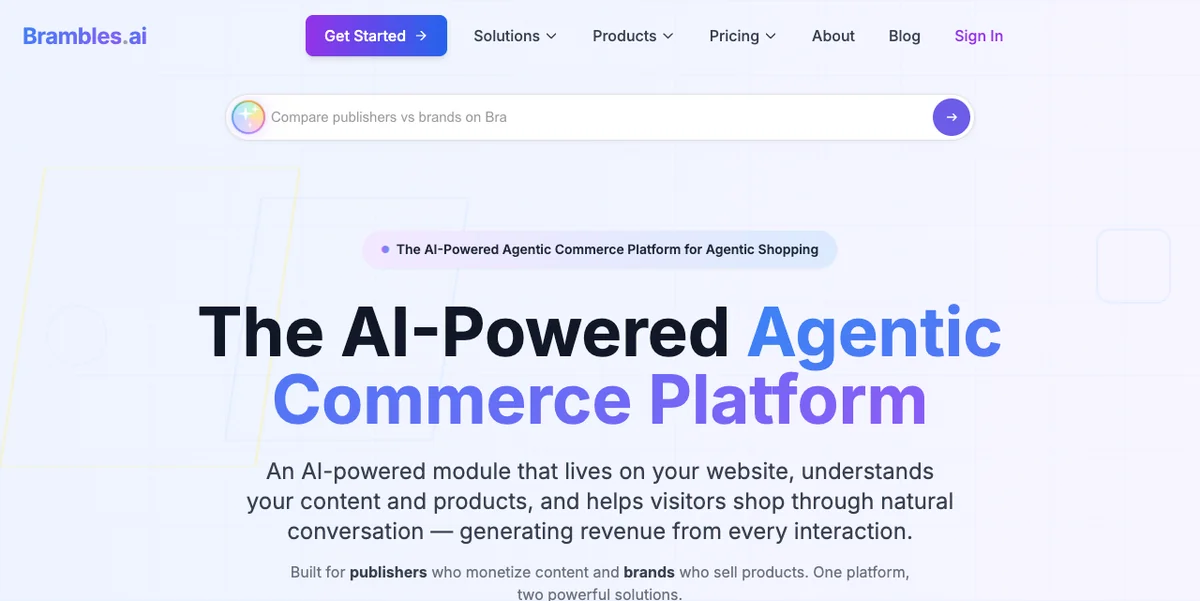
Bramble is an agentic commerce chatbot that drops onto a site through a WordPress plugin, a JavaScript module, or a white-label API. It reads the page in real time and helps visitors find and buy products through plain conversation. The monetization is hybrid, blending affiliate commissions across more than 15 networks with retail media, contextual CPC, and direct add-to-cart.
Among the networks here, Bramble leans hardest toward shopping intent. It claims access to more than a billion products across 50,000 merchants, and it runs real-time price comparison to surface the highest available commission, with attribution handled automatically through a Customer ID. The best fit is a content publisher or commerce site whose readers already arrive ready to buy. The trade-off is that Bramble ships its own chat interface, so it works better for website owners than for developers adding a revenue layer to a conversational product they already run.
Pros:
- Hands-free affiliate revenue with automatic attribution through a Customer ID
- Several income streams at once, including affiliate, retail media, and contextual CPC
- One-click WordPress install for the large base of WordPress publishers
Cons:
- Ships its own chat widget, so it fits site owners more than API-first developers
- Built around shopping intent, with little value for support or productivity bots
ZeroClick

ZeroClick takes a radically different approach by weaving advertiser context directly into the AI reasoning process rather than inserting ads after response generation.
Founded by Ryan Hudson, who previously co-founded Honey and sold it to PayPal for around $4 billion, ZeroClick raised $55 million in August 2025 from many of the same investors and funds that backed Honey.
Hudson described the design this way: “We created an ad system that integrates directly into AI assistants’ reasoning processes so ads are considered in real time as answers are formed” (source).
Read the company’s scale claim carefully. ZeroClick’s announcement says its platform is “already used to connect more than 10,000 advertisers with millions of users of internally developed products,” which describes the merchant relationships behind Hudson’s existing consumer products, not a roster of advertisers buying on the new reasoning-time network. Advertisers convert their landing pages and Google Ads data into “Ad Story Units” that AI models evaluate for relevance during response generation. ZeroClick uses a CPC model and acquired Sleek, a browser automation platform, to extend capabilities beyond chatbots into shopping experiences.
Pros:
- Deep existing merchant relationships carried over from the Honey and Sleek orbit
- Reasoning-time integration prevents gaming through organic SEO tactics
- Proven founder track record with $4 billion Honey exit
Cons:
- Closed beta with no public access or transparent timeline
- Incompatible with major LLM platforms like ChatGPT or Claude
- Complex integration requiring deep platform cooperation
Koah Labs

Koah Labs positions itself as “AdSense for GenAI,” creating native advertising infrastructure specifically for AI applications. The platform raised $5 million in seed funding led by Forerunner, with participation from South Park Commons and AppLovin co-founder Andrew Karam. TechCrunch names Luzia, Liner, Heal, and DeepAI as clients. CEO and co-founder Nic Baird pitched the company as plumbing rather than a sales channel: “Our mission is to provide the economic infrastructure for conversational AI, making Gen AI apps flexible, scalable, and investible” (source).
Koah combines CPC, CPM, and affiliate CPA revenue models in a single platform. Its September 2025 launch release claimed “click-through rates average 7.5%, 4x the industry standard, with 4-5x improved CPMs versus other industry platforms.” Those are the company’s own figures, and they have since moved: as of July 2026 Koah’s monetize page advertises “3x higher payouts vs. legacy platforms” and a “25% average increase in monthly revenue,” with a sample dashboard showing a $21.29 eCPM and 4.38% CTR. Treat any single number here as a marketing snapshot rather than a rate card.
Context-aware matching uses natural language models to match ads to user queries in milliseconds. The platform includes SDKs for JavaScript, React, React Native, Flutter, iOS, and Android, marketed as under one day integration time.
Pros:
- Publishes concrete performance figures, unusual in this category
- Named clients and press coverage provide real-world social proof
- Multiple revenue streams (CPC, CPM, CPA) in one platform
- Premium advertiser network with publisher controls
Cons:
- Revenue share percentages not disclosed publicly
- Custom pricing model requires sales engagement
- Platform launched September 2025 with limited operational history
Imprezia

Imprezia emerged from Y Combinator’s Summer 2025 batch with a team of MIT graduates who previously built billion-dollar ad optimization systems at Meta, Amazon, and Microsoft. The platform positions itself as the world’s first AI ad network, though it remains in invitation-only beta.
Imprezia’s core innovation is contextual brand mentions delivered inline within AI responses. When users ask about luxury hotels in Tokyo, the AI naturally mentions Park Hyatt Tokyo as a sponsored recommendation. The platform advertises a five-minute integration via one-line SDK that works with any LLM including OpenAI, Anthropic, and Gemini. The AI-powered matching engine processes user intent in real time to deliver relevant brand placements at decision-making moments.
Pros:
- Elite team with experience building billion-dollar ad systems
- LLM-agnostic compatibility works with any model provider
- Native brand mentions maintain user experience quality
Cons:
- Invitation-only beta with no guaranteed access timeline
- Zero public documentation or code examples
- No pricing transparency or revenue share terms disclosed
- Extremely early stage with no verified clients or case studies
Dappier

Dappier targets the fundamental shift in how users consume information, from traditional search clicks to AI-generated answers. Founded in 2023 by Dan Goikhman and Krish Arvapally, the platform raised $2 million in seed funding led by Silverton Partners in June 2024. Adweek reports that “nearly 100 sites across news, sports and lifestyle content are testing Dappier’s AI ad unit”.
The flagship AI Mode product allows publishers to deploy their own branded AI search and copilot on a custom subdomain in minutes with no coding required. Dappier monetizes through dual revenue streams including on-site agentic ads (sponsored prompts embedded in AI conversations) and off-site content licensing through a data marketplace.
Partnerships with Sovrn and LiveRamp extend that inventory across publisher networks with identity activation. Announcing the Sovrn deal, Goikhman said: “By enabling Sovrn Commerce with our unique agentic ads, we ensure consumers always receive highly relevant marketing messages alongside AI answers from publishers, creating a more powerful value exchange than traditional digital media” (source). Dappier does not publish a rate card, so publishers should expect to model revenue during a pilot rather than from a public CPM.
Pros:
- No-code AI Mode deployment for branded answer engines
- Dual monetization through agentic ads plus data marketplace licensing
- Real distribution through Sovrn and LiveRamp partnerships
- Roughly 100 publisher sites already testing the ad unit
Cons:
- Publisher-focused platform not designed for AI chatbot developers
- Revenue share percentages and CPMs not disclosed publicly
- Founded 2023, so the agentic ad product has a short track record
Jutera

Jutera positions as the advertising technology layer for conversational AI interfaces, chatbots, and LLM systems. Operated by Austin-based Bajaar LLC, the platform emphasizes user-centric design principles including limiting sponsored content to 20% of responses, transparent disclosure, and user controls for opt-out and relevance feedback.
The platform’s technical approach uses parallel processing architecture where ad requests run simultaneously with AI processing rather than sequentially, minimizing latency impact. Jutera offers multiple ad delivery methods including sponsored recommendation cards with badge labeling, in-conversation promotional messages, and contextual links embedded within AI-generated responses. The company maintains SOC 2 Type II, GDPR, and CCPA compliance certifications.
Pros:
- Enterprise-grade compliance with SOC 2, GDPR, and CCPA certifications
- Parallel processing minimizes latency impact on response time
- Multiple ad formats provide creative flexibility
Cons:
- No public documentation or API endpoints accessible
- Zero pricing transparency requires sales engagement
- No verified clients, case studies, or partnerships disclosed
- Unknown advertiser network size and demand
The platforms above give developers direct control over ad integration. The next four take a different approach, handling advertiser relationships, agent-level commerce, or enterprise campaigns on your behalf. Managed platforms trade some revenue share for reduced operational overhead.
Adgentic

Adgentic operates as a managed affiliate platform specifically designed for AI agent monetization. The platform eliminates operational complexity by managing relationships with multiple affiliate networks including Commission Junction, AWIN, Partnerize, and Impact. Developers get single integration accessing 100+ brand advertisers with an additional 1,000+ in the vetted directory.
Adgentic’s Commerce Search API delivers millisecond-latency access to millions of product SKUs with rich, LLM-optimized structured data. The platform provides geo-aware deep links with promotional codes, brand-accurate representations, and automated commission optimization across networks.
A Model Context Protocol server enables plug-and-play integration with autonomous agent frameworks including LangGraph, CrewAI, and AutoGen. The Revenue Intelligence Dashboard tracks app-level conversion performance and advertiser comparisons across the entire network.
Pros:
- Zero affiliate network management with consolidated dashboard
- MCP server for autonomous agents making purchase decisions
- LLM-optimized product data designed for AI context windows
- Commission optimization across multiple affiliate networks
Cons:
- Revenue share structure completely undisclosed
- No public case studies or client testimonials
- Platform likely takes commission percentage vs. 100% retention alternatives
AgentVine

AgentVine bills itself as the first ad network built for the agent economy, focusing on autonomous AI agents rather than user-facing chatbots. The platform’s core innovation moves advertising from screen real estate into agent decision logic, where Offer Units are evaluated during reasoning processes rather than forced into user interfaces.
The platform explicitly targets the open agent economy of developers using frameworks like LangGraph, CrewAI, and AutoGen. AgentVine uses intent-based matching to surface advertiser offers only when contextually relevant to the user’s current goal, without building user profiles or tracking behavior across sessions.
All sponsored content must be transparently disclosed with clear labels. The platform operates on performance-based CPC and CPA models, with developers receiving a portion when users click, sign up, or convert.
Pros:
- Privacy-first architecture with no user tracking or behavioral profiling
- Agent autonomy preserved where offers are suggestions, never forced
- Multi-framework compatibility with no vendor lock-in
Cons:
- Public beta maturity with potential API changes and instability
- Developer revenue percentage completely undisclosed
- Zero case studies proving real revenue generation
- Unknown company background with no funding or team information
Adsbind

Adsbind offers a streamlined path for developers who want to monetize their AI projects with minimal integration effort. The platform currently operates in early access mode with a waitlist, and markets an early adopter revenue share, though it does not publish the rate anywhere we could find.
Verify the integration story before you plan around it. Adsbind’s developer guide instructs you to run pip install adsbind-sdk, but that package is not published on PyPI.
As of July 2026 both adsbind and adsbind-sdk return a 404 from the PyPI API.
The same guide documents dashboard-controlled ad frequency, letting you set sponsored content anywhere from 1-in-5 messages (“most conservative”) to 1-in-2 (“strongest monetization”) without code changes, and recommends you “Start with 1 in 4, then ramp to 1 in 3.”
The company has published 52 blog articles covering AI monetization strategies, Answer Engine Optimization, and developer implementation guides. Conversation-native ads are designed to enhance rather than disrupt user experience.
Pros:
- Dashboard-controlled ad frequency without code changes
- Automated brand safety with context-eligibility checks
- Extensive thought leadership with 52 published articles
Cons:
- The documented pip package does not exist on PyPI, so the advertised five-minute integration is not currently reproducible
- Waitlist-only access with no guaranteed acceptance timeline
- Revenue share rates are not published, before or after launch
- Zero case studies or testimonials proving revenue generation
Aryel

Aryel is an Italian adtech company founded in late 2020 whose homepage says it is “trusted by 150+ major organizations worldwide,” with a logo wall spanning P&G, Samsung, BMW, Disney, and Warner Bros. The company raised 3.7 million euros in seed funding in February 2023, led by PranaVentures.
Aryel launched In-Chat Ads for GenAI in June 2025, positioning as a first mover in native advertising for AI conversations targeting platforms like ChatGPT, Claude, and Perplexity. CEO and co-founder Mattia Salvi tied the format to shopping behavior: “If people can move from curiosity to checkout without leaving a chat window, advertising has to be able to travel that same path, seamlessly, respectfully and with genuine utility.” The semantic-predictive engine analyzes prompts in real time to score intent, sentiment, and commercial value, matching ads contextually without storing conversation logs.
The platform offers full-funnel ad formats from awareness (loader ads, sponsorship) through consideration (video, immersive carousels) to conversion (recommendation ads, retargeting). A Criteo partnership integrates interactive ads into commerce media ecosystems, and Aryel reports that “early campaigns are already delivering exceptional results, with an average click-through rate of 4%.”
Pros:
- Proven enterprise traction with Tier 1 clients including P&G and Samsung
- Criteo distribution puts the format in front of existing commerce media budgets
- Privacy-first GenAI technology with no conversation logging
Cons:
- Publisher-focused platform not designed for AI app developers
- In-Chat Ads launched June 2025 still in beta phase
- No self-serve access requiring enterprise partnership model
- Geographic focus on Europe with limited US presence
To keep commissions in your own affiliate accounts with API-first control, go with ChatAds. For display ads with published performance figures, try Koah Labs. For autonomous agent monetization, look at AgentVine or Adgentic. For publisher sites, consider Dappier or Aryel. For WordPress commerce sites, look at Bramble.
How to Choose the Right AI Ad Network
Start by clarifying whether you want affiliate monetization or display advertising. If your users discuss buyable products and you already hold approved affiliate accounts, an infrastructure model like ChatAds fits: commissions stay in your accounts and you pay per API request. If neither is true, a managed network that sells the ads for you is the more realistic path.
When evaluating display advertising options, you need to consider your technical capabilities and expected user scale. Koah Labs publishes more performance detail than most and has named clients and public documentation, making it a reasonable default for developers who want clear economic modeling. ZeroClick has the deepest merchant relationships on this list, but requires closed beta access and deep reasoning-time integration.
Privacy-conscious teams building autonomous agents should evaluate AgentVine, which preserves agent autonomy and uses intent-based matching without behavioral profiling. Publishers seeking dual monetization through agentic ads plus content licensing will find Dappier’s AI Mode compelling, especially with its Sovrn and LiveRamp partnerships.
One caution across the whole category: it is young, and several vendors here are pre-revenue or pre-documentation. eMarketer’s 2026 forecast expects chatbot advertising specifically to lag while ads next to AI answers scale faster. Whichever way you go, run a paid pilot and measure real revenue per conversation before you commit a roadmap to it. ChatAds’ free tier with 100 requests per month exists for exactly that kind of validation before you commit to usage-based billing.
Frequently Asked Questions
What are the best ad networks for AI chatbots in 2026?
The top ad networks for AI chatbots in 2026 include ChatAds for affiliate monetization where commissions stay in your own accounts, Koah Labs for display ads, and ZeroClick for reasoning-time advertising. The best choice depends on whether you want affiliate links, display ads, or sponsored content in your AI conversations.
How do AI ad networks differ from traditional display ad networks?
AI ad networks are built for conversational interfaces rather than web pages. They insert ads contextually within AI responses, match advertiser content to user intent in real time, and maintain sub-second response times. Traditional display networks use banner and interstitial formats designed for static web pages, which disrupt the conversational flow of AI chatbots.
Can you keep 100% of ad revenue from AI chatbot monetization?
Yes, with a bring-your-own-account model like ChatAds. Developers connect their own affiliate accounts, so commissions are paid into those accounts and ChatAds bills per API request instead of taking a share. Most other AI ad networks on this list use revenue-sharing models, though few publish the exact split.
What is reasoning-time advertising in AI applications?
Reasoning-time advertising, pioneered by ZeroClick, weaves advertiser context directly into the AI response generation process. Instead of inserting ads after the AI produces a response, the model evaluates advertiser content during reasoning and includes only relevant recommendations. This approach differs from post-processing ad insertion used by most other platforms.
Which AI ad network is best for autonomous agents built with LangGraph or CrewAI?
AgentVine and Adgentic both target autonomous AI agent monetization. AgentVine focuses on privacy-first intent matching within agent decision logic for frameworks like LangGraph, CrewAI, and AutoGen. Adgentic provides a managed affiliate platform with an MCP server for agent frameworks. ChatAds also supports MCP integration for ChatGPT apps and autonomous agents.
How much can AI chatbot developers earn from ad networks in 2026?
Earnings vary significantly by platform and traffic volume, and most public figures are vendor marketing rather than audited results. Koah Labs advertises a 25% average increase in monthly revenue and showed a $21.29 eCPM in a sample dashboard as of July 2026. With ChatAds, earnings are your affiliate commissions, which depend on conversion rates and product categories. Most platforms are too new to have published reliable revenue benchmarks, so run a pilot.