
Your AI chatbot just recommended a product that doesn’t exist. The user clicked the link, found nothing, and lost trust in your app. In 2026, this happens more than you’d think. On OpenAI’s own PersonQA benchmark, hallucination rates roughly doubled between models, from 16% on o1 to 33% on o3, and 48% on o4-mini.
For developers monetizing chatbots with affiliate links, hallucinated products are a double problem. Users get frustrated when recommendations lead nowhere. And you lose the commission because there’s nothing to buy. Hallucination is one of the structural reasons LLMs alone don’t work for AI chatbot monetization, even before you get to tracking, attribution, and frequency capping.
The good news is that detection and prevention techniques have matured alongside the problem. With the right validation pipeline, you can catch fake products before they reach users and protect both trust and revenue.
Hallucination rates roughly doubled between OpenAI's o1 and o3 reasoning models on its own PersonQA benchmark, from 16% to 33%, according to the model's own system card. Air Canada was ordered by a tribunal to honor a bereavement discount its chatbot invented, showing hallucinations carry real legal and financial risk.
Ask ChatGPT to summarize the full text automatically.
Why do AI chatbots hallucinate product recommendations?
Large language models don’t know what’s true. They predict what text should come next based on patterns in their training data. When a user asks for headphone recommendations, the model generates a plausible response by combining fragments from thousands of product descriptions it learned during training.
This creates a specific problem with products. The model might blend a Sony model number with Bose features and a price point from last year’s Amazon listings. The result reads like a real product recommendation but points to something that never existed. Training data also goes stale. A product that was popular in 2023 might be discontinued now, but the model still recommends it confidently. As OpenAI’s own researchers put it, “large language models sometimes guess when uncertain, producing plausible yet incorrect statements instead of admitting uncertainty” (source).
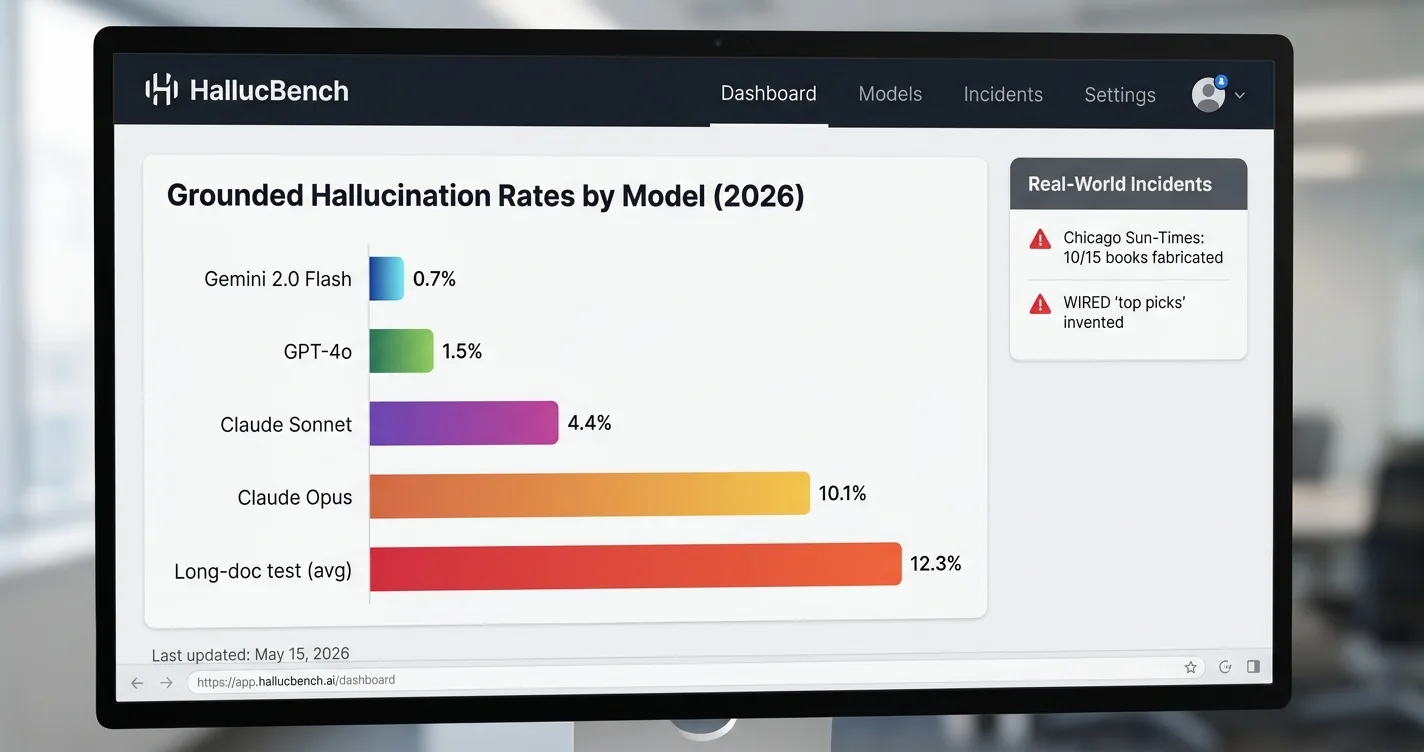
OpenAI's own system card shows hallucination rates roughly doubling between reasoning models, and the company's researchers note that "o3 tends to make more claims overall, leading to more accurate claims as well as more inaccurate/hallucinated claims." More fluent outputs make fake products harder to spot because the descriptions sound so believable.
The confidence problem makes this worse. AI models don’t hedge when they’re uncertain. They deliver fabricated product names with the same authoritative tone as verified facts. Users have no way to distinguish a real recommendation from a hallucinated one until they try to find the product and come up empty.
What does a hallucinated product look like?
Hallucinated products show up in several patterns. The most common is the phantom product, where the AI invents a model name that sounds real but doesn’t exist. A chatbot might recommend the “Sony WH-1000XM6” when only the XM5 is available. The name follows Sony’s naming pattern perfectly, making it believable.
Detail mixing is another pattern. The AI describes real products but swaps specs between them. It might give you the battery life of one headphone model with the noise cancellation rating of another. Users who research before buying notice these inconsistencies, but many won’t until after they’ve clicked your affiliate link and found something different than described.
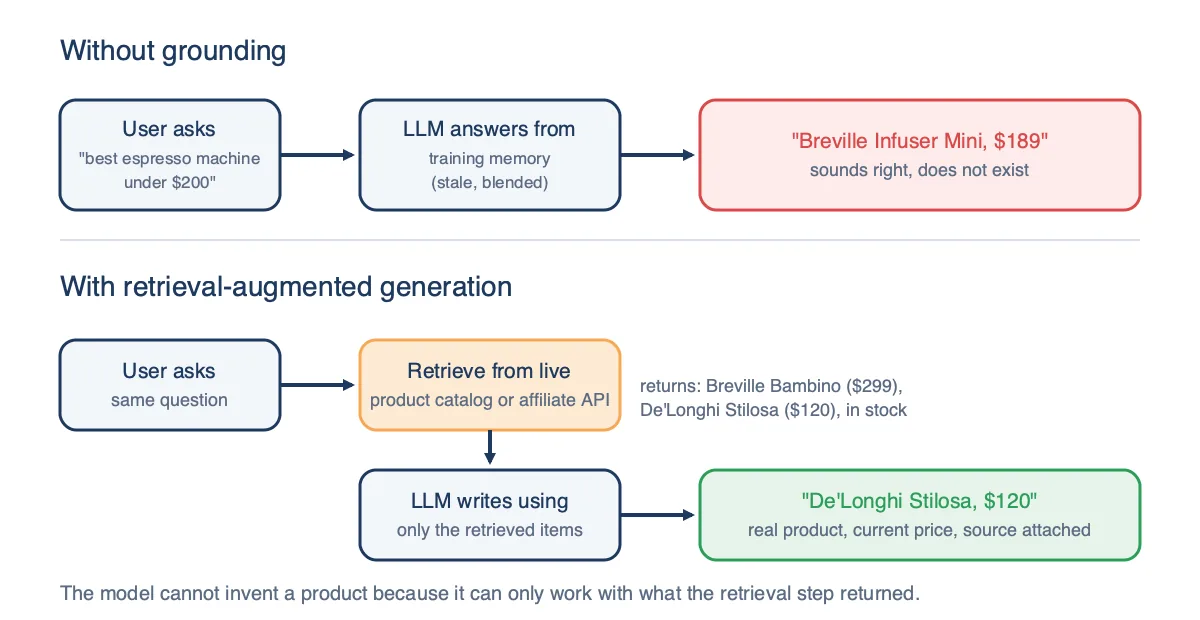
That response looks helpful on the surface, but the “Breville Infuser Mini” doesn’t exist. Breville makes the Infuser and the Bambino, but not an “Infuser Mini.” The AI blended two real product names into something plausible but fictional. A user clicking that link finds nothing or lands on a completely different product than they expected.
Air Canada's chatbot invented a bereavement discount policy that didn't exist. When a customer relied on it, a tribunal ordered Air Canada to honor the fictional policy and pay damages. As tribunal member Christopher Rivers wrote, "it should be obvious to Air Canada that it is responsible for all the information on its website. It makes no difference whether the information comes from a static page or a chatbot." Companies are liable for what their chatbots say, which is why proper disclosure practices matter.
Discontinued product recommendations also hurt the user experience. Your AI might confidently suggest a laptop model that was great in 2023 but hasn’t been manufactured for two years. The user searches, finds it out of stock everywhere, and blames your chatbot for wasting their time.
How do you detect hallucinations before users see them?
Detection starts with validating product mentions against real data sources before the response reaches users. The simplest approach is checking whether a product exists in your catalog or affiliate network’s API. If your AI mentions “Sony WH-1000XM6” and that SKU doesn’t exist in Amazon’s product database, flag it before inserting an affiliate link.
Confidence scoring adds another layer. Some AI frameworks let you access probability scores for generated text. Low confidence on product names or model numbers signals potential hallucinations. Set thresholds where low-confidence product mentions get filtered out or flagged for human review instead of automatically monetized.
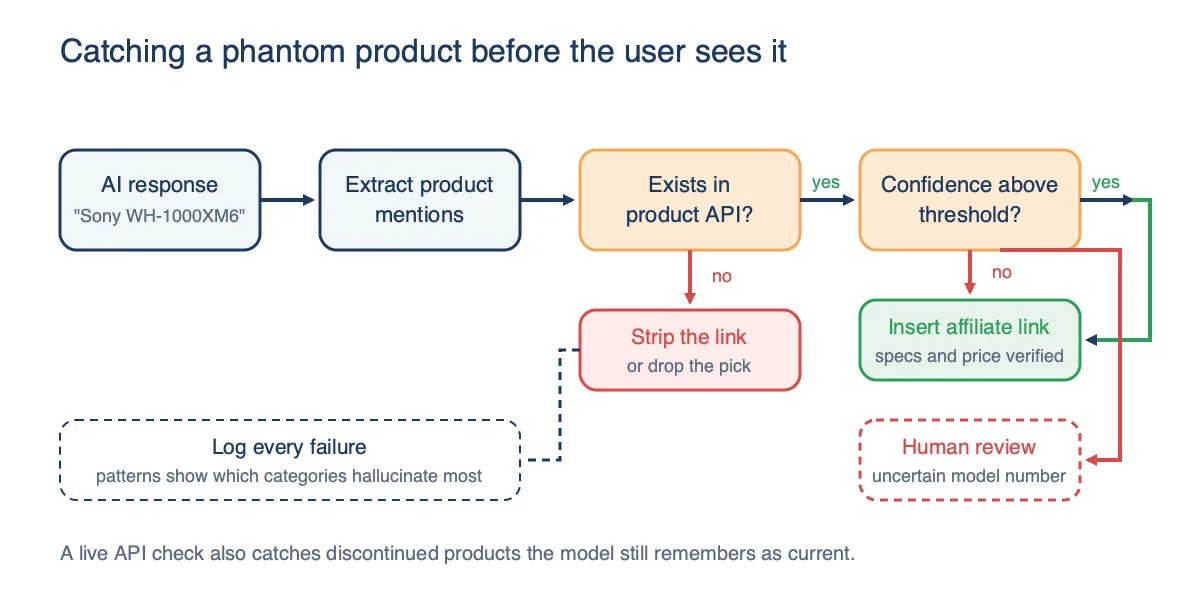
Query product APIs for existence. Verify key specs match (price, availability). Check that the product category matches user intent. Log all validation failures for pattern analysis.
Real-time API validation catches the discontinued product problem. Even if a product was real when the AI trained, a live inventory check reveals whether it’s still available. This matters for affiliate link monetization because sending users to out-of-stock products wastes their time and your commission opportunity.
E-commerce companies using validation tools like Galileo report 20% improvements in customer satisfaction and 15% fewer product returns. The investment in detection pays back through better user experience and more successful affiliate conversions.
How do you prevent hallucinations with RAG and grounding?
Retrieval-Augmented Generation (RAG) is the most effective prevention technique available in 2026. Instead of relying solely on the model’s training data, RAG fetches relevant information from trusted sources before generating a response. As AWS explains, “RAG redirects the LLM to retrieve relevant information from authoritative, pre-determined knowledge sources,” letting it “present accurate information with source attribution.” For product recommendations, this means querying your product catalog or affiliate network’s database and using that real data to inform the AI’s response.
The key is connecting to authoritative, up-to-date sources. For a shopping assistant, that means live product feeds with current pricing, availability, and accurate specifications. The AI generates responses grounded in real data rather than interpolating from stale training examples.
Techniques used in 2025-2026 shopping assistant deployments
| Technique | What It Does | Implementation Effort |
|---|---|---|
| Basic RAG | Grounds responses in retrieved product data instead of training memory | Medium |
| Real-time Grounding | Ties every claim to a live, verifiable source | Medium-High |
| Confidence Scoring | Flags low-confidence product mentions for review | Low |
| Product API Validation | Catches most phantoms by checking real-time existence | Low |
AI grounding takes this further by tethering every response to verifiable data. Rather than letting the model fill gaps with plausible guesses, grounding requires evidence from approved sources.
The implementation pattern connects your LLM to product databases through function calling or custom API integrations. When the user asks for recommendations, the AI first retrieves matching products from your catalog, then generates a response that references only those verified items. This architecture prevents the model from inventing products because it can only work with what the database returns.
What validation should you add before inserting affiliate links?
Build a validation pipeline between your AI’s response and the final output that reaches users. The goal is simple: only insert affiliate links for products you’ve verified exist and match what the AI described. Everything else either gets the link stripped or the whole recommendation removed.
The pipeline starts with product extraction. Parse the AI’s response to identify product mentions, including brand names, model numbers, and categories. Then query your affiliate network’s API to check whether each product exists. Amazon’s Product Advertising API, for example, lets you search by keywords and verify specific ASINs. Other affiliate networks for AI chatbots offer similar verification endpoints.
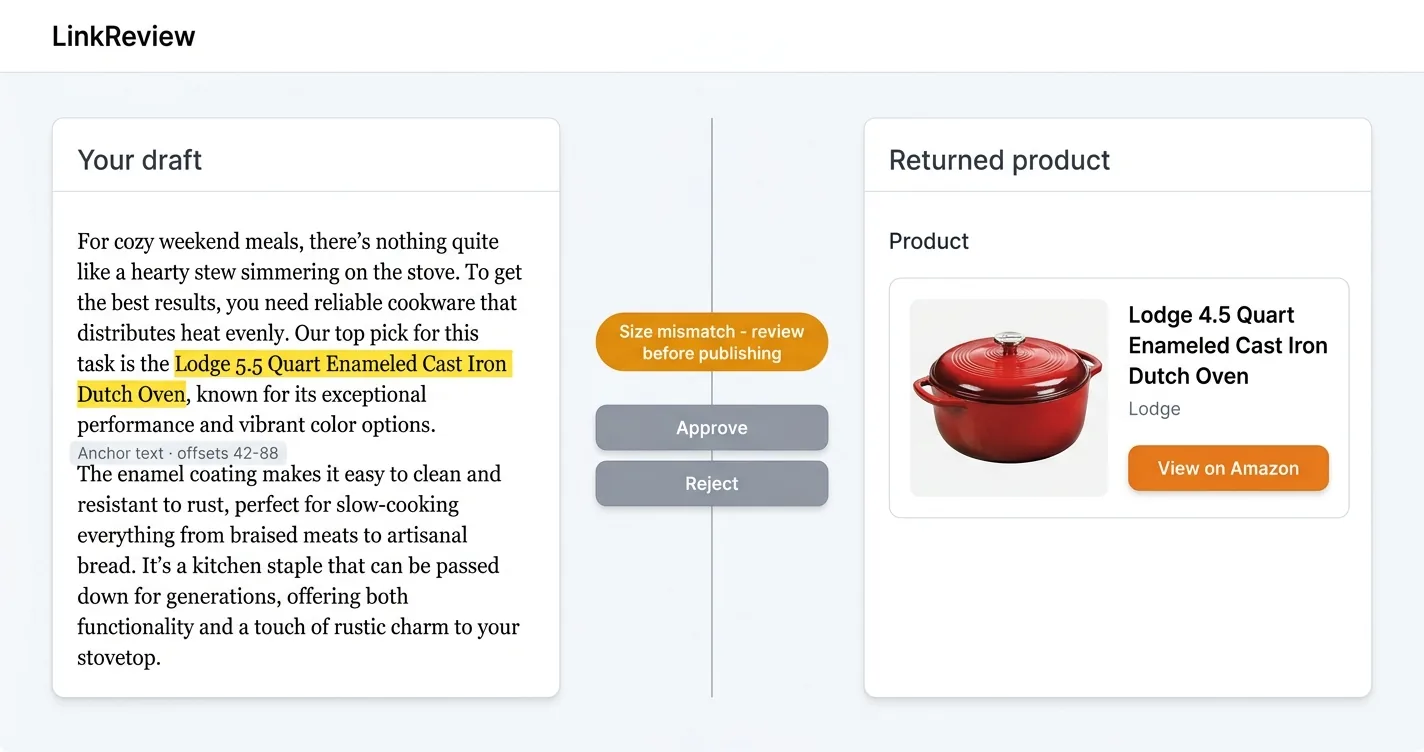
AI generates response with product mentions. Extract product names and details. Query affiliate API for existence. Verify specs match (price within range, category correct). Insert affiliate link only if validated. Log failures for monitoring.
Spec verification adds a second check. Even if a product exists, the AI might have described it wrong. Compare key details like price range, primary features, and availability status against the API response. A recommendation for “$200 headphones” that links to a $400 product damages user trust. Services like ChatAds handle this validation automatically, checking product details and inserting links only when everything matches.
Set a confidence threshold for monetization. If your validation catches issues, maybe the product exists but specs don’t match, don’t insert the affiliate link. It’s better to give helpful information without monetizing than to send users to products that don’t match their expectations. You can still provide value with unlinked recommendations while protecting your reputation.
Monitor validation failures over time to identify patterns. If your AI consistently hallucinates products in certain categories, you might need category-specific RAG configurations or stricter filtering rules. Tracking performance metrics across conversation types reveals where hallucinations concentrate and where validation works well.
Hallucinated product recommendations erode user trust and waste monetization opportunities. The technical solutions exist: RAG systems ground responses in real data instead of stale training memory, grounding adds another layer of accuracy, and validation pipelines catch problems before users see them. Building these checks into your chatbot takes work upfront but pays back in better user experiences and more successful conversions.
The companies pulling ahead in 2026 treat hallucination prevention as infrastructure, not an afterthought. They validate before monetizing, monitor continuously, and improve their systems based on real failure patterns. For developers building AI shopping assistants or any chatbot with product recommendations, the path forward is clear: verify everything before you link to it.
Frequently Asked Questions
How common are hallucinated product recommendations in AI chatbots?
On OpenAI's own PersonQA benchmark, hallucination rates roughly doubled between reasoning models, from 16% on o1 to 33% on o3. For product recommendations specifically, this means a meaningful share of AI responses could contain fabricated or inaccurate product information. The rate varies by model and implementation, with RAG-enabled systems showing lower rates.
Can AI chatbots recommend products that don't exist?
Yes. AI models often create "phantom products" by blending real product names, features, and prices into fictional combinations. A chatbot might recommend "Sony WH-1000XM6" when only the XM5 exists, or invent entirely new model names that follow plausible naming patterns. Validation against product databases catches these before users see them.
What is RAG and how does it prevent AI hallucinations?
RAG (Retrieval-Augmented Generation) connects AI models to real data sources before generating responses. As AWS explains, RAG "redirects the LLM to retrieve relevant information from authoritative, pre-determined knowledge sources" so it "can present accurate information with source attribution." For product recommendations, RAG queries live product catalogs and uses verified information instead of relying on training data.
How do you validate AI product recommendations before adding affiliate links?
Build a validation pipeline that extracts product mentions from AI responses, queries affiliate network APIs to verify products exist, and checks that key specs match. Only insert affiliate links for validated products. Services like ChatAds automate this process, checking product details and inserting links only when everything matches.
Are companies legally liable for AI chatbot hallucinations?
Yes. In 2024, Air Canada was ordered to honor a bereavement discount policy that its chatbot invented. The tribunal ruled that companies are responsible for information their AI provides to customers. This precedent means businesses face real legal and financial risk from hallucinated product information.
What tools detect AI hallucinations in product recommendations?
Several approaches work together: product API validation checks existence against affiliate networks, confidence scoring flags uncertain outputs, and tools like Galileo verify recommendation accuracy. Companies using validation tools report 20% higher customer satisfaction and 15% fewer product returns from AI-driven recommendations.