Bloggers are adding AI chat assistants to their sites at a growing rate in 2026. These assistants answer reader questions, recommend products, and guide visitors through topics the blog covers. The conversations carry real purchase intent, and most blogs are leaving that intent unmonetized right now.
Traditional affiliate strategies assume static content, and that creates a gap. A blogger can manually insert affiliate links into a written post, but an AI assistant generating answers on the fly does not have that same workflow. The link placement that works in a review article does not translate to a chatbot response about running shoes or kitchen knives.
This article compares six platforms that handle affiliate monetization for blogger AI assistants, from a turnkey AI chat widget built for dynamic conversations to established networks that provide the affiliate accounts powering those tools.
Blog readers asking an AI assistant about products are further along in the buying process than someone scanning a blog post. They are asking specific questions about specific items, which signals purchase intent. Connecting those conversations to affiliate links turns a helpful feature into a revenue channel without changing the reader experience.
★ = low · ★★ = medium · ★★★ = high
| Vendor | Ease of Use | AI Focus | Cost Value | Blog Relevance |
|---|---|---|---|---|
| ChatAds | ★★★ | ★★★ | ★★★ | ★★★ |
| Skimlinks | ★★★ | ★ | ★★ | ★★★ |
| Awin | ★★ | ★ | ★★★ | ★★ |
| FlexOffers | ★★ | ★ | ★★ | ★★ |
| Amazon Associates | ★★ | ★ | ★★★ | ★★★ |
| Rakuten Advertising | ★★ | ★ | ★★ | ★★ |
Ask ChatGPT to summarize the full text automatically.
ChatAds
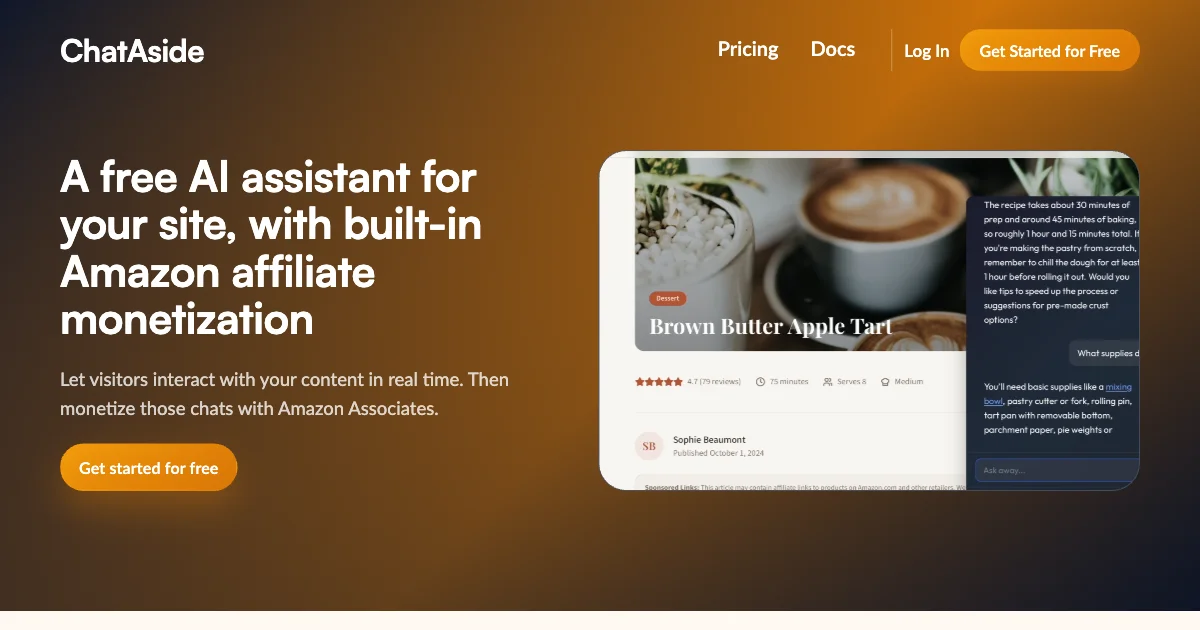
ChatAds is the only platform on this list that is the AI assistant rather than a layer you bolt onto one. Bloggers add one line of JavaScript to their site, and the free widget builds a conversational experience from the blog’s own published content, so readers get answers grounded in the site’s articles and reviews. There are no API keys to create and no model bill to track, because ChatAds hosts the language model for you.
Affiliate monetization is an opt-in toggle. When enabled, product mentions in the widget’s replies become affiliate links from the blogger’s own connected accounts before the reader sees the answer, and the whole match runs in well under a second so the chat never stalls. You connect your Amazon Associates or other network credentials, keep 100% of every commission, and the free tier handles 100 messages a day before any paid plan.
For a non-technical publisher, it is the lowest-effort way to end up with a commission-earning AI assistant, with no code to write and no infrastructure to manage.
Pros:
- One line of JavaScript to install, with automatic training on the blog's published content
- 100% affiliate commission retention through connected accounts, with no cut taken on earnings
- Free tier at 100 messages per day covers testing and low-traffic sites before any paid commitment
- Built for AI conversations, inserting affiliate links in under a second so replies stay smooth
Cons:
- Built-in product matching is Amazon and US-focused, so other networks earn only through connected accounts
- Knowledge base is the blog's own published content, not an external product database
Skimlinks

Skimlinks handles the other half of the equation for bloggers with AI assistants. While it cannot monetize dynamic chatbot conversations, Skimlinks auto-converts product mentions across all of your static blog content into affiliate links through a single JavaScript snippet. That covers the blog posts, product reviews, and archive pages that sit alongside your AI assistant and still drive the majority of your affiliate traffic.
The platform connects to 48,500 merchants across 50+ affiliate networks through one integration. Skimlinks negotiates exclusive rates on top of standard commissions, and according to the company, “55% of our publishers’ revenue comes from our exclusive rates.”
Retroactive archive monetization is the standout feature for bloggers: years of old posts get monetized automatically without editing a single article. That passive income from existing content is what makes Skimlinks worth adding even if you already handle AI conversation monetization separately through another tool.
Pros:
- 48,500 merchants with exclusive rates often double standard commissions
- Single JavaScript snippet auto-monetizes all existing and future blog content
- Retroactive monetization turns years of archived blog posts into passive revenue
Cons:
- Cannot monetize dynamic AI assistant conversations, only static page content
- Undisclosed revenue share and [payment terms that can stretch up to 92 days](https://www.skimlinks.com/terms-of-service/) create cash flow challenges
Awin
Awin is one of the world’s largest affiliate networks following its completed integration of ShareASale in 2025.
That merger gives bloggers access to over 30,000 advertisers across 180+ countries through a single account. As Adam Weiss, President of Awin North America, said of the merger, “now, all ShareASale advertisers are within the Awin ecosystem, giving them access to new distribution opportunities.”
For bloggers building an affiliate foundation to connect with their AI assistant, Awin provides the broadest selection of merchant programs available on any network. Fashion, tech, home goods, and lifestyle brands are all well-represented.
Twice-monthly payments on the 1st and 15th improve cash flow compared to networks that pay every 60 or 90 days. Awin also offers a color-coded payment reliability system that shows which merchants actually pay on time, which matters for bloggers treating affiliate revenue as a real income stream.
Awin requires manual link creation and individual merchant applications, so it does not auto-link blog content or plug into AI chatbot outputs directly. The value for bloggers with AI assistants is as a foundation: Awin affiliate credentials can serve as the BYOK keys in ChatAds, giving you access to 30,000+ merchants while a separate tool handles the conversation-level automation.
Pros:
- 30,000+ advertisers across 180+ countries through a single publisher account
- Twice-monthly payments with transparent merchant reliability scoring
- AI-powered merchant recommendations help bloggers discover relevant programs
Cons:
- Manual link creation and merchant-by-merchant applications are time consuming
- No auto-linking or AI conversation integration without additional tooling
- Platform complexity can overwhelm bloggers new to affiliate marketing
Awin holds a 4.2 out of 5 on G2 based on 367 reviews. Publishers highlight the merchant variety and twice-monthly payments as top strengths, while noting the learning curve and manual link management as common friction points.
FlexOffers

What sets FlexOffers apart from other networks is its emphasis on hands-on affiliate manager support for publishers from day one. For bloggers who are new to affiliate marketing and simultaneously figuring out how to deploy an AI assistant, that personal guidance cuts through the confusion of choosing between 12,000+ merchants across 25+ categories. Your manager recommends which programs fit your blog’s niche, which commission structures work for your traffic patterns, and which merchants convert well in your vertical.
FlexOffers also integrates with Rakuten Advertising and ClickBank, so bloggers can track commissions from multiple networks in one dashboard instead of switching between separate logins. Commission rates tend to run slightly above market average, and top performers can graduate from the standard Net-60 payment schedule to Net-30 or Net-7 terms.
The $25 minimum payout keeps earnings accessible even for smaller blogs just getting started with affiliate link insertion in AI assistant responses. For bloggers who want a human guide through the affiliate setup process, FlexOffers is the only network on this list that provides one by default.
Pros:
- Affiliate manager support available to publishers regardless of traffic size
- Multi-network integration centralizes commissions from Rakuten and ClickBank
Cons:
- Net-60 standard payment terms delay earnings by two months
- Smaller merchant catalog than Awin or Skimlinks limits niche coverage
- Manual merchant applications and link creation required for all programs
FlexOffers holds a 4.0 out of 5 on G2. Publishers praise the dedicated affiliate manager support and merchant variety, while noting the Net-60 payment terms and less advanced analytics compared to enterprise platforms.
Amazon Associates

Most bloggers start their affiliate strategy with Amazon Associates, and for bloggers building AI assistants, it remains the foundational account to have. Amazon’s catalog covers hundreds of millions of products with real customer reviews and Prime shipping. When your blog’s AI assistant recommends a specific book, kitchen gadget, or pair of headphones, Amazon likely has it listed with pricing and availability data your readers trust.
The Product Advertising API is what connects Amazon Associates to the AI monetization use case. Bloggers can use their Amazon credentials as the BYOK affiliate account in ChatAds, or build custom product lookups that feed recommendations into their assistant directly.
Commission rates range from 0-10% depending on category, and the 24-hour cookie window works in your favor because readers asking a chatbot about a specific product tend to purchase quickly. You also earn commissions on everything the reader adds to their cart during that session, not just the linked item. That cart-wide earning model makes Amazon the most common starting point for bloggers pairing an affiliate account with an AI assistant.
Pros:
- Largest product catalog available online with trusted brand recognition that drives conversions
- Product Advertising API enables programmatic access for AI assistant integrations
- Cart-wide commissions capture additional purchases beyond the initially linked product
- Free to join with no traffic minimums and a $10 payout threshold
Cons:
- 0-10% commission rates are lower than specialty merchant programs on other networks
- 24-hour cookie window misses delayed purchase decisions on higher-priced items
- Strict operating agreement with termination risk and a history of commission rate reductions
Rakuten Advertising

Rakuten Advertising takes a curated approach, offering a curated selection of premium retail brands backed by Rakuten Group’s roughly $16 billion in FY2025 revenue. Bloggers whose AI assistants frequently recommend products from major retailers will find names like Walmart, Macy’s, Best Buy, and Sephora on the network. Fewer merchants means less time filtering through irrelevant programs, and the brands that are on Rakuten carry strong consumer recognition that helps conversion rates.
Rakuten offers more flexible commission structures than most networks, letting merchants set tiered and dynamic rates. Merchants can reward top performers with higher percentages, adjust rates by product category, and offer advanced attribution models including first-touch credit.
Multi-touch attribution is where Rakuten adds real value for bloggers running AI assistants. If your chatbot introduces someone to a product they buy a week later, you still get credit for that awareness-stage recommendation rather than only the final click being rewarded.
Pros:
- Curated portfolio of premium retail brands with strong consumer trust and recognition
- Advanced attribution models credit bloggers for awareness-stage AI recommendations
- Flexible tiered commissions reward publishers as performance scales over time
Cons:
- A far smaller, more curated merchant list than Awin or Skimlinks for niche coverage
- Retail and lifestyle focus limits options for bloggers in B2B or technical niches
How to Choose the Right Affiliate Monetization Vendor for Your Blogger AI Assistant
The right vendor depends on where your affiliate links need to appear. For bloggers who want an AI assistant that recommends products during live reader conversations, ChatAds is the only tool on this list that is the widget itself. It installs in one line, answers from the post the reader is on, and inserts affiliate links into replies in real time with 100% commission retention.
Amazon Associates gives you the broadest product catalog as your affiliate foundation. Awin adds 30,000+ merchants across every niche, while FlexOffers pairs affiliate manager support with above-average rates for bloggers building their first portfolio. Rakuten focuses on premium retail brands for AI assistants that recommend from major names.
If your blog also publishes static content alongside the AI assistant, Skimlinks auto-monetizes those pages across 48,500 merchants without manual link insertion. Many bloggers combine multiple vendors: Amazon Associates as the foundation, Skimlinks for passive blog monetization, and ChatAds to extend those same affiliate accounts into AI conversation revenue. The key is recognizing that AI chatbot monetization requires its own tooling separate from what works for written blog posts.
- If you want a ready-made AI chat widget that recommends products in conversation, start with ChatAds
- If you need the broadest product catalog as your affiliate base, use Amazon Associates
- If you want maximum merchant diversity across 180+ countries, add Awin
- If you need guided affiliate manager support, try FlexOffers
- If your blog covers premium retail and lifestyle brands, consider Rakuten Advertising
- If you want to auto-monetize static blog content alongside your AI assistant, add Skimlinks
For a step-by-step walkthrough, see how to add affiliate links to AI assistant responses. If you’re deciding which chatbot tool to add in the first place, see our comparison of chatbot options for affiliate blogs.
For a broader look at revenue models across subscription, display, and affiliate, see how to monetize AI chatbots.
Start by signing up for Amazon Associates as your foundational affiliate account. Then add the ChatAds widget to your blog and connect those Amazon credentials to switch on affiliate monetization. This combination gives you the broadest product catalog with 100% commission retention and link insertion fast enough to keep reader conversations flowing naturally.
Frequently Asked Questions
What are the best affiliate monetization vendors for blogger AI assistants in 2026?
ChatAds leads for bloggers who want a ready-made AI chat widget that recommends products during reader conversations, because it installs in one line, answers from the post the reader is on, and inserts affiliate links automatically with 100% commission retention. Amazon Associates provides the broadest product catalog as the underlying affiliate account. Awin, FlexOffers, and Rakuten offer additional merchant access across different verticals. Skimlinks complements by auto-monetizing static blog content alongside the AI assistant.
How do bloggers monetize AI chatbot conversations with affiliate links?
Connect an Amazon Associates account for product coverage, then add the ChatAds widget to your blog and switch on its affiliate toggle. When a reader asks about a product and the assistant names it, ChatAds inserts the affiliate link before the response reaches the reader. You earn commissions on every resulting purchase without manually creating links.
Which blogger AI chatbot affiliate tools let you keep the most revenue?
ChatAds offers 100% commission retention because it never takes a percentage of affiliate earnings; the widget is free and every dollar your Amazon Associates or Awin account earns stays with you. Other platforms in this space use revenue-sharing models where the platform takes a cut of each commission.
Can you use affiliate links inside real-time AI blog assistant responses?
ChatAds is built specifically for inserting affiliate links into real-time AI responses, processing each request in under 200 milliseconds. Traditional affiliate networks like Amazon Associates and Awin require manual link creation that does not work for dynamic chatbot conversations. Using ChatAds as the automation layer with Amazon or Awin as the underlying account bridges that gap.
Do affiliate monetization tools slow down blogger AI assistant responses?
ChatAds processes affiliate link matching in under 200 milliseconds, which is fast enough to run between the AI completing a response and the reader seeing it. That speed matters because delays in a chat conversation feel more noticeable than on a static page. Post-processing platforms add minimal overhead since they analyze the completed response rather than interrupting generation.
Should bloggers use different tools for static content and AI assistant monetization?
Yes, bloggers should use different tools because static content and dynamic AI conversations require different monetization approaches. Skimlinks handles automated affiliate linking across written blog posts and archive pages, while ChatAds handles real-time product detection and link insertion inside AI assistant conversations. Most bloggers benefit from using both alongside a foundational affiliate account like Amazon Associates.