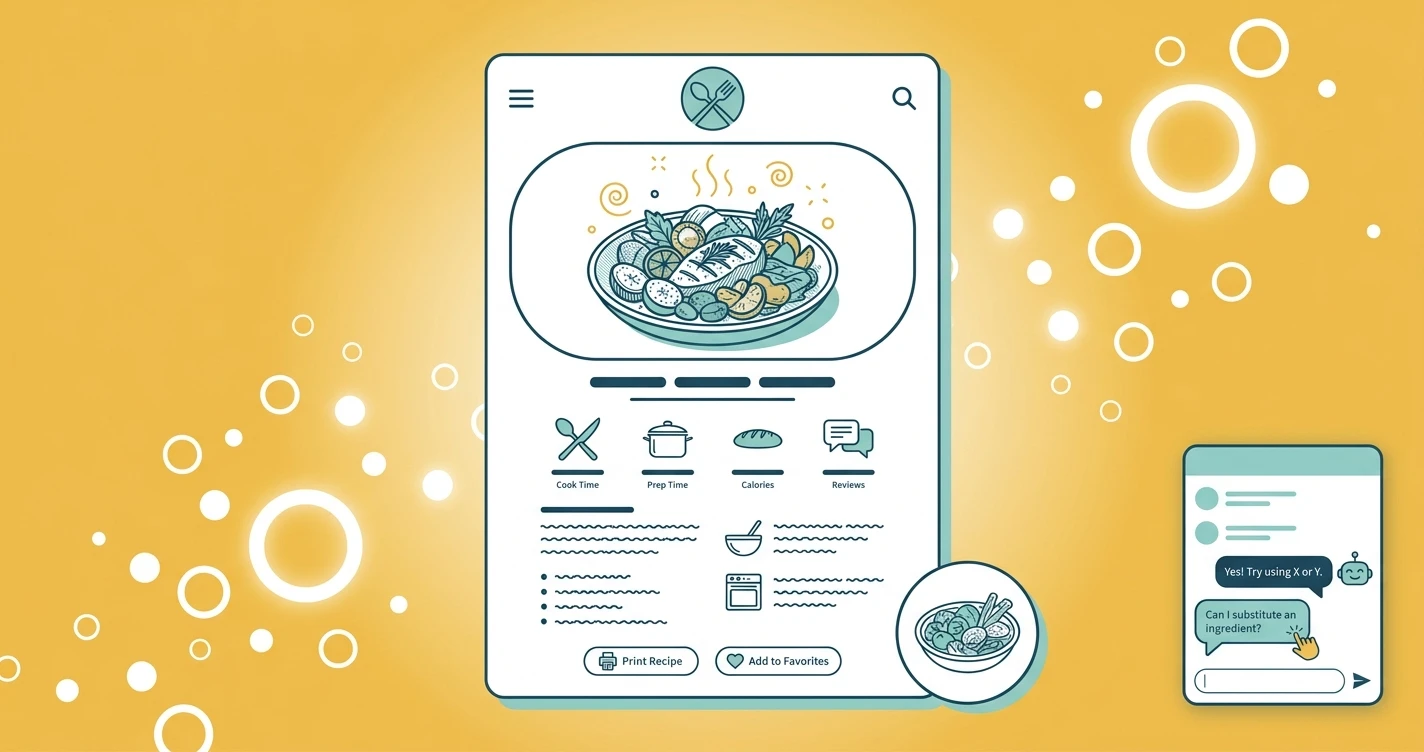
Recipe blogs in 2026 are quietly bleeding traffic to AI. A reader searches how long to bake chicken thighs, and Google’s AI Overview answers it above the results without a single click to your site. The readers who do land on your post scroll straight past the recipe card and fire off the same questions anyway, about swaps, pan sizes, and cook times.
An AI chat widget puts that conversation back on your own page. Grounded in your own recipes, an on-page assistant added to your blog handles substitution and timing questions instantly and keeps the reader with you instead of a search box. Most of these tools only cost you money, and a rare couple actually pay you back.
This guide ranks seven AI chat widget platforms for recipe blogs, starting with the one built to earn its keep.
Almost every widget here can answer a reader's recipe question, so install effort rarely decides it. The sharper test on a food blog is which way the money flows. Five of these seven tools charge you a subscription or your own model bill, and two pay you back through affiliate links. The ranking leads with the ones that fund themselves.
Ask ChatGPT to summarize the full text automatically.
★ = low · ★★ = medium · ★★★ = high
| Tool | Pays Publisher | Ease of Install | Recipe Fit | Cost Value |
|---|---|---|---|---|
| ChatAds | ★★★ | ★★★ | ★★★ | ★★★ |
| Bramble | ★★ | ★★ | ★ | ★★ |
| Chatbase | ★ | ★★ | ★★ | ★ |
| Chatling | ★ | ★★ | ★★ | ★★ |
| AI Engine | ★ | ★ | ★★ | ★★ |
| Kognetiks | ★ | ★ | ★★ | ★★ |
| Tidio | ★ | ★★★ | ★ | ★★ |
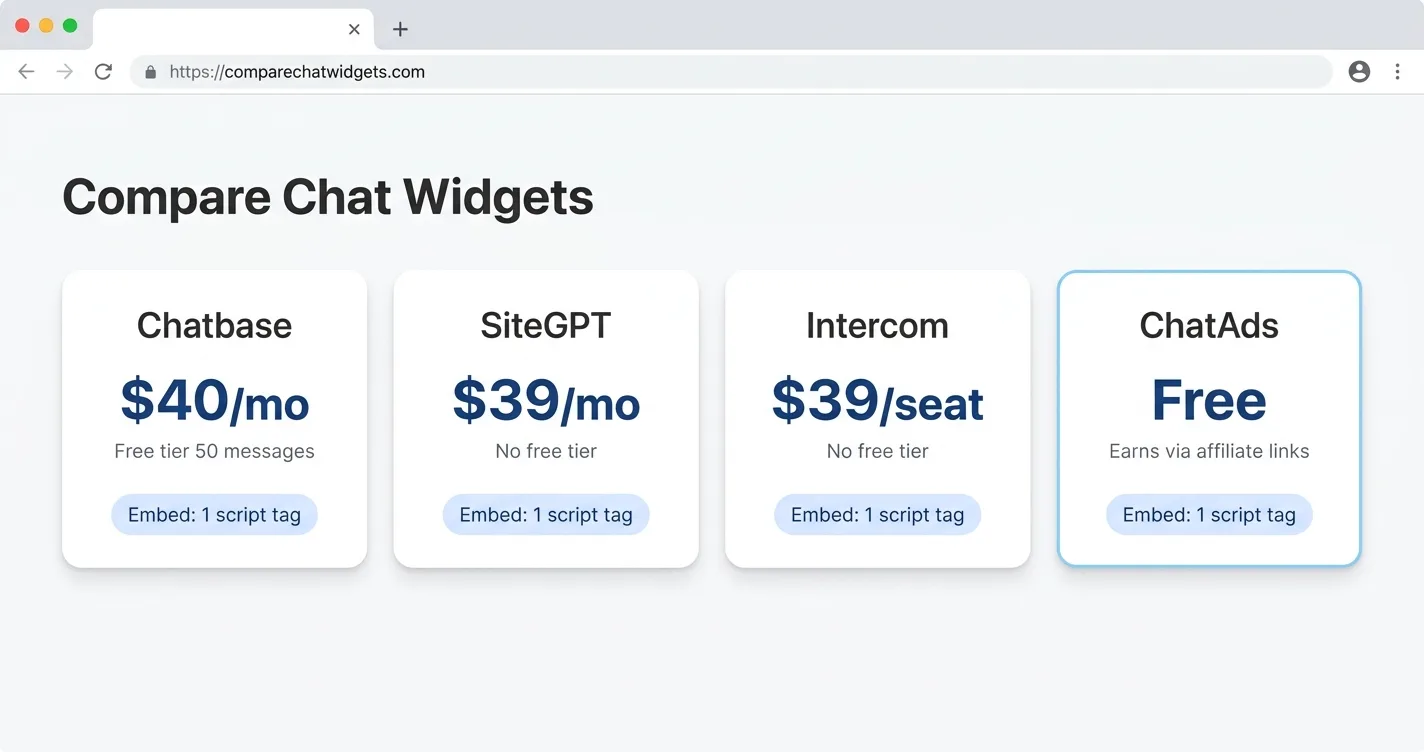
ChatAds

ChatAds is a free AI chat widget for recipe blogs that answers from your own recipes and earns you affiliate revenue. You add it with one line of JavaScript on any platform, from WordPress to Squarespace to a hand-built recipe site, on WordPress via a code-insertion plugin or Google Tag Manager. There are no API keys to create and no model bill to track, because ChatAds hosts the language model for you. The assistant reads the recipe the reader is on, so a reader asking about a butter swap or a smaller pan gets an answer pulled from that recipe instead of generic AI text.
What separates it from every other tool here is the revenue model. Once you connect an affiliate account and switch monetization on, the products the assistant mentions turn into your own affiliate links inside the reply. A question about a Dutch oven or a stand mixer can earn a commission, and ChatAds keeps zero percent, so the full payout from your affiliate program stays yours. It runs live on The Copper Pot recipe blog today, turning the AI Overview threat into on-page revenue. Daily limits run 100 messages on the free plan, 500 on Pro, and 1,500 on Business as your traffic grows.
Pros:
- One-line install on any platform, answering from the recipe the reader is on with no training step
- Built-in affiliate monetization where you keep 100% of every commission
- Hosted language model included, so there are no API keys or inference bills
- Free tier at 100 messages a day with no credit card required
Cons:
- Requires an existing affiliate account to monetize
- Monetization matching is currently US and English focused
Bramble
Bramble is the only other tool on this list that puts money back in the publisher’s pocket, which lands it nearest to ChatAds. It works as an affiliate AI shopping assistant, scanning the page as the reader chats and steering them toward products they can buy. The earnings stack, mixing affiliate commissions across more than 15 networks with retail media and contextual pay-per-click.
The company claims a catalog above one billion products across 50,000 merchants, with price comparison to surface the highest available commission. You add it as a one-click WordPress plugin, a framework-agnostic JavaScript module, or a full API. As an AI chatbot for food blog readers, it shines when someone arrives ready to buy a stand mixer or a set of sheet pans, but the dividing line from ChatAds is intent. Bramble is commerce-first and adds little on a technique or substitution question where nobody is shopping yet. Its share of each commission stays unpublished too, so your real take per sale is guesswork until the widget goes live.
Pros:
- Hands-free affiliate revenue across more than 15 networks with automatic attribution
- Multiple income streams from affiliate, retail media, and contextual ads
- Installs as a WordPress plugin, a JavaScript module, or an API
Cons:
- Revenue split with the publisher is not publicly disclosed
- Built for shopping intent, so it adds little on recipe how-to content
- No third-party reviews yet to validate the product claims
Bramble folds affiliate commissions, retail media, and contextual ads into a single shopping widget and tracks all earnings in its own dashboard. The pitch is hands-free commerce revenue for a store or buying-guide site. What it never lists is the size of its own cut, which keeps your net per sale a guess until you turn it on.
Chatbase
Chatbase is one of the established names for building a custom GPT trained on your own data. You crawl the site, upload files, pick a model from the GPT, Claude, or Gemini families, and paste a snippet into any page. The hosted model means no keys to manage, and reviewers report a working agent in about ten minutes.
As a recipe blog chat widget, it works fine on the technical side, but the product is aimed at support and sales teams. There is no affiliate or ad path anywhere in Chatbase, which pitches itself to “deliver exceptional AI customer support experiences,” so it stays a pure cost with nothing flowing back to you. The free plan is really a 50-credit monthly demo that deletes idle agents after two weeks, and usable volume starts near $32 a month before climbing on heavier traffic. Premium models burn two to five credits per reply, so a busy recipe page fielding endless substitution questions drains the allowance faster than the headline number suggests.
Pros:
- Trains on your own recipes through site crawl and document uploads
- Hosted models across GPT, Claude, and Gemini with no keys to manage
- Mature dashboard with a long list of integrations
Cons:
- No monetization, so it stays a cost center for a food blogger
- Free tier is a 50-credit demo, not a live deployment
- Usable volume starts near $32 a month and scales steeply
- Training data caps by tier limit large recipe archives
[Capterra puts Chatbase near 4.3 across roughly 73 reviews](https://www.capterra.com/p/10012414/Chatbase/reviews/), with ease of use rated above support. Its [Trustpilot score sits lower at about 3.8](https://www.trustpilot.com/review/chatbase.co), where individual reviews flag billing complaints about charges after cancellation and slow refunds.
Chatling
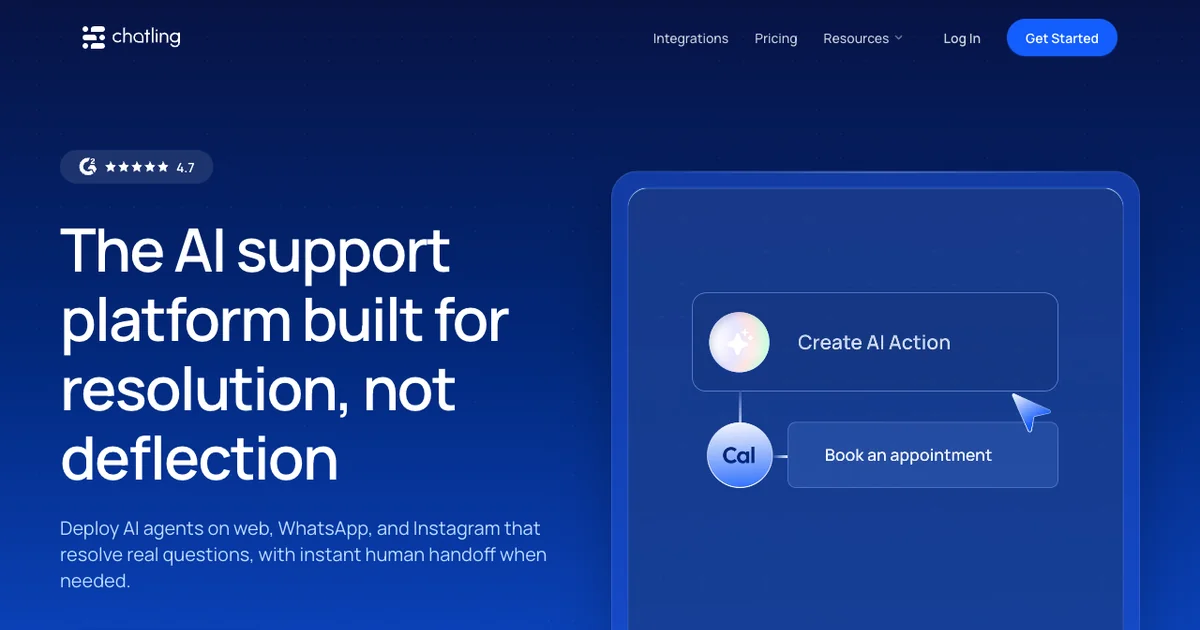
Chatling is a no-code builder set apart by a visual drag-and-drop flow editor and a wide model list. It hosts around 28 AI models and bills through usage-based AI credits, with deployment that Chatling lists across “web, WhatsApp, Instagram, Telegram, and Messenger.” The free tier is genuine, with 100 credits a month and no card, and the setup is documented for any major platform.
Like most tools here, Chatling has no monetization, so the AI credits you buy stay a pure expense with no income to offset them. The credit model is also hard to predict, since a single premium reply can burn around 14 credits and a viral recipe page drains an allowance fast. Standing up an AI assistant for recipe website questions means building and training an agent, then wiring up flows, not just pasting a tag and walking away. It is the build-your-own support bot option rather than a turnkey reader companion.
Pros:
- Genuine free tier with 100 credits a month and no card
- Visual drag-and-drop builder plus web, WhatsApp, and Instagram channels
- Wide model choice across 28 hosted options
Cons:
- No monetization, so it stays a cost center
- AI-credit usage is hard to predict on premium models
- Real setup means building and training an agent, not a drop-in
On G2, Chatling sits around 4.7 across roughly 69 reviews, backed by a Trustpilot score near 4.3. The praise centers on the visual flow builder and quick deployment, with a few notes about a learning curve on advanced features. Those are strong numbers for a tool that has not been on the market long.
AI Engine (Meow Apps)
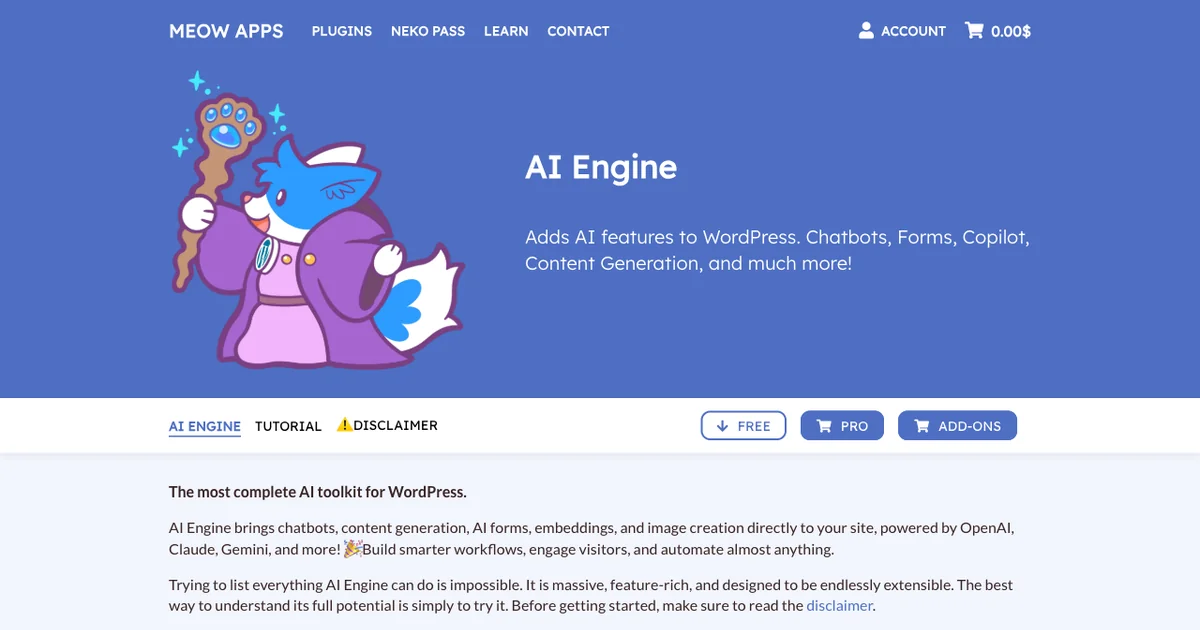
AI Engine by Meow Apps is the dominant WordPress-native AI plugin, with more than 100,000 active installations and a Swiss-army toolkit behind it. Everything runs inside the WordPress admin, from chatbots and content generation to embeddings and an MCP server, which Meow Apps sums up as turning “your WordPress site into an intelligent MCP server.” Its Pro embeddings feature builds a knowledge base from your posts, so the chatbot can answer straight from your recipe archive.
Two specific factors shape how well this fits a food blog. AI Engine is WordPress only, so anyone on Squarespace, Ghost, or a static recipe site cannot run it at all. It is also bring-your-own-key, which means you create an OpenAI or Claude key and fund every conversation yourself, on top of the Pro license. As an AI chatbot for food blog owners who are technical, it offers real control, but the best chat features sit behind Pro at $59 a year and up, setup takes hands-on tuning, and AI Engine has no monetization to offset that spend.
Pros:
- Free, full-featured core with a huge install base and a 4.9-star rating
- Trains on your posts through Pro embeddings for recipe-grounded answers
- Broad provider choice with no lock-in, including self-hosted models
Cons:
- WordPress only, so other platforms are excluded
- Bring-your-own-key, so you fund every conversation directly
- Best chat features are gated behind Pro and need hands-on setup
- No monetization, so it only ever costs the publisher
AI Engine holds about 4.9 stars across more than 800 ratings on WordPress.org, with more than 100,000 active installs. The overwhelming majority are five-star, and the plugin ships frequent updates with an active Discord behind it. Those marks reflect a trusted, well-maintained toolkit rather than a fit for content monetization.
Kognetiks Chatbot
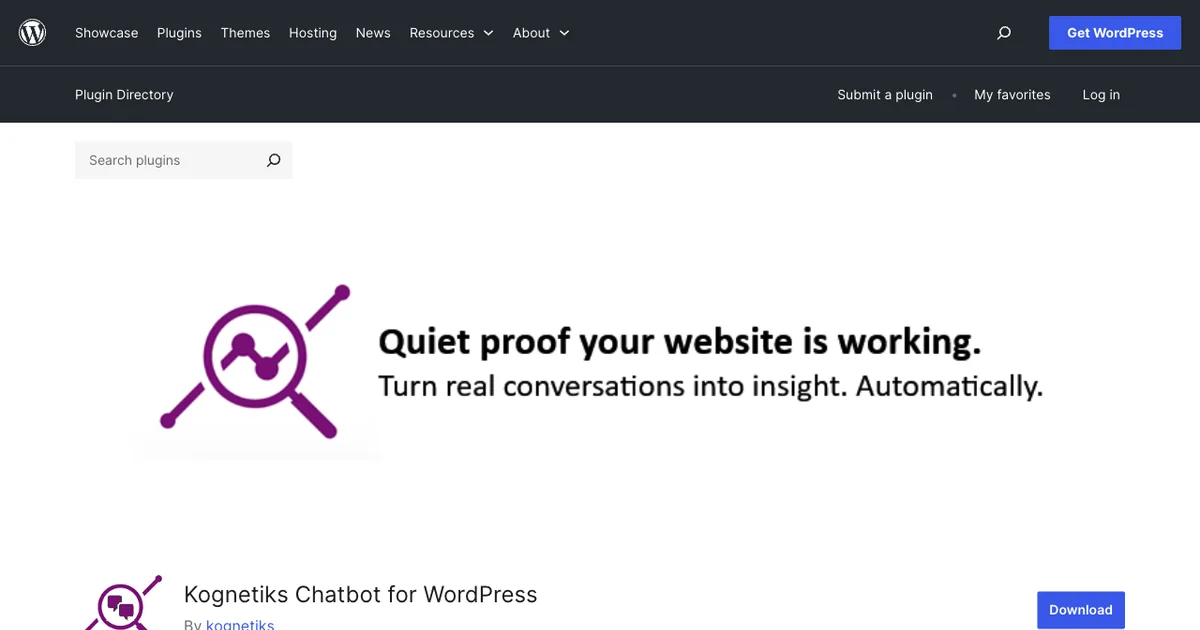
Kognetiks Chatbot is a free, open-source WordPress plugin built around model choice and control. It connects to OpenAI, Claude, Gemini, Mistral, DeepSeek, or a local JAN.AI server, so you decide which engine answers and where your data goes. Its Knowledge Navigator indexes your posts and pages on a schedule, a feature the plugin lists as “Knowledge Navigator for site-aware responses,” which is how it builds an AI assistant for recipe website questions grounded in your own content.
All that flexibility carries real trade-offs on cost and setup. Kognetiks is bring-your-own-key, so you create an API key and pay the provider directly for every chat and every indexing run. It is WordPress only, and the depth of its settings panels adds a learning curve for non-technical food bloggers. There is no monetization layer either, since Kognetiks is an assistant and reporting utility rather than a revenue product. It suits technical WordPress owners who want full control over models and data routing.
Pros:
- Free and open source under GPLv3, with no per-message vendor fee
- Wide model choice plus a private local-model option
- Knowledge Navigator trains the assistant on your posts and pages
Cons:
- WordPress only, so other platforms cannot use it
- Bring-your-own-key, so you pay the LLM provider and manage billing
- No monetization, and the configuration depth has a learning curve
Kognetiks holds about 4.5 stars across roughly 22 reviews on WordPress.org, with 600-plus active installs. Reviewers praise the free feature set and responsive support, while the install base stays small next to mainstream plugins. It reads as a capable niche tool with an engaged maintainer.
Tidio
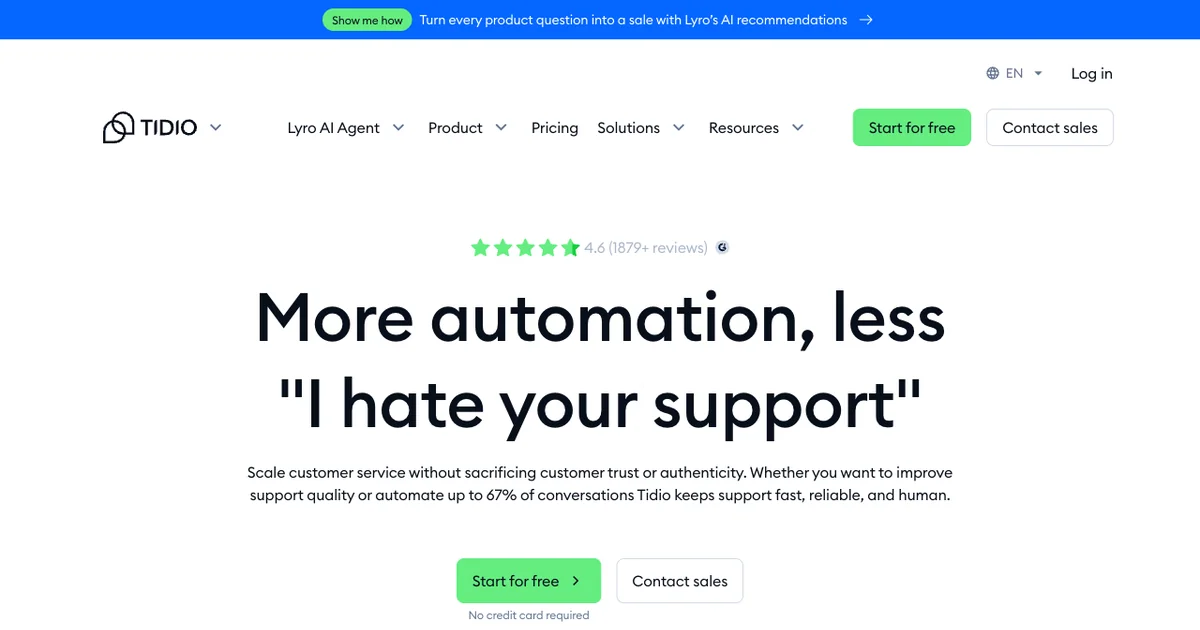
Tidio has been around since 2013, which makes it the most established name here and one many bloggers will recognize. It bundles live chat, ticketing, no-code flows, and an AI agent called Lyro that runs on Claude plus in-house models, so there are no keys to manage. You drop it on any site through an embed snippet or a native plugin for WordPress, Shopify, Wix, and Squarespace.
Where it falls down as a recipe blog chat widget is purpose, not capability. Tidio was built as a support and ecommerce desk, so a food blogger fielding ingredient-swap questions runs a fraction of a tool designed for a different job and gets no revenue out of it. The free tier covers 50 conversations a month plus only 50 lifetime Lyro chats, after which Lyro meters from about $0.65 per conversation. Costs ramp with traffic, the Plus tier opens around $749 a month, and no part of the product pays you back.
Pros:
- Works on any site through an embed or native CMS plugins
- Hosted Lyro AI on Claude with no keys to manage
- Strongest third-party reviews on this list across major sites
Cons:
- No monetization, so it only ever costs the publisher
- Built for support and ecommerce, overbuilt for recipe Q&A
- Lyro is metered separately and climbs with traffic
No tool here carries more reviews than Tidio, at about 4.6 on G2 across roughly 1,880 reviews and 4.7 on both Capterra and the Shopify App Store. Those marks point to a stable, well-supported product with a long history behind it. None of them speak to monetization, since a food blogger earns nothing from the widget.
How to Choose
Start with the job you actually want chat to do on your recipe blog. Most of these install in minutes, a couple ask for real setup, and either way the decision rides on fit and economics more than on install effort.
If you are still weighing the wider field, our roundup of tools for adding AI chat to your blog covers the general-purpose options too. Technical WordPress owners who want their own key and full model control will lean toward AI Engine or the open-source Kognetiks. Anyone also running support or selling products gets more from Tidio, Chatbase, or Chatling, though each is a monthly cost with nothing coming back. Those are all fine tools carrying the wrong price tag for a content site.
On a recipe or food blog, the sharper test is which assistant funds itself. Two do, and they split by reader intent, with Bramble built for shopping-heavy pages that accept an undisclosed cut and ChatAds at home on nearly any blog. Our roundup of six vendors for AI recipe assistant affiliate monetization digs deeper into that split. For most food bloggers ChatAds is the clear call, with a free no-code install anywhere, answers grounded in the recipe the reader is on, the only built-in affiliate monetization here that leaves you the full commission, and readers kept on your page instead of an AI Overview.
Connect an Amazon Associates or other affiliate account, drop the free ChatAds script onto any recipe page, and switch on monetization. The assistant reads the recipe your visitor is viewing, answers substitution and cook-time questions from it with no training step, and turns product mentions into commission links you keep in full. On-page chat starts earning instead of adding another monthly bill.
Frequently Asked Questions
What is the best AI chat widget for a recipe blog in 2026?
ChatAds is the best fit for most recipe blogs because it is the only option here that is both free and built to pay the publisher. It installs with one line of JavaScript, answers from the recipe the reader is on with no training step, and turns product mentions in chat into affiliate links you keep in full. Bramble also pays publishers, but only on shopping intent and with an undisclosed cut.
How do you add an AI chatbot to a food blog?
Most hosted widgets install by pasting one script tag into your site, which works on WordPress, Squarespace, Ghost, or a static recipe site. WordPress-only plugins like AI Engine and Kognetiks install through the plugin directory instead. With ChatAds you add a single embeddable script and it goes live in a few minutes with no API keys to manage.
Which recipe blog chat widgets pay you instead of charging you?
Only two tools in this guide pay the publisher: ChatAds and Bramble. Chatbase, Chatling, AI Engine, Kognetiks, and Tidio are cost centers you fund through a subscription, a license, or your own model bill. ChatAds is the only one that is both free and monetizing, and it keeps zero percent of your commissions.
Is there a free AI assistant for a recipe website?
ChatAds is a free AI assistant for a recipe website, with a tier covering 100 messages a day and no credit card required. It hosts the language model for you, so there are no API keys or inference bills. Most other free tiers, like Chatbase and Chatling, are credit-limited demos rather than live deployments.
Can an AI chat widget answer from your own recipes?
Yes, a content-trained AI chat widget reads your published recipes and replies with information pulled from your own posts instead of generic AI text. ChatAds reads the recipe your visitor is viewing and answers from it instantly, with no training step, while tools like Chatbase, Chatling, and Kognetiks let you crawl the site or index pages to build a trained knowledge base.
Does ChatAds take a cut of affiliate commissions?
No, ChatAds takes zero percent of affiliate earnings, so every commission your connected account generates stays with you. The links use your own affiliate accounts, which is what makes the full payout possible. Bramble, by contrast, pays publishers on an undisclosed split.