Most AI apps spend real money on every message and earn almost nothing back from the people reading those replies. In 2026, the obvious fix is advertising, yet the classic playbook of banners, pop-ups, and interstitials wrecks the one thing a chat interface has going for it. A clean conversation is the product, and bolting visual clutter onto it pushes users straight toward the close button.
Non-intrusive monetization means revenue that lives inside the reply instead of on top of it. That covers inline affiliate links, native product cards, reasoning-time context, and agent offer units that surface only when they fit the moment. This guide is for developers shipping chatbots, assistants, and agents who want income without watching retention slide.
The field now runs from affiliate APIs to ads woven into the model’s own thinking, and we lead with the one platform that pairs ad formats and affiliate links in a single call.
- Revenue lives inside the reply: links and cards ride on a recommendation the model already made, not on a banner bolted over it
- It surfaces only when it fits: an offer appears at the moment of intent and stays quiet the rest of the time
- The conversation keeps its shape: no pop-ups, interstitials, or display slots competing with the answer
- Disclosure stays clean: a sponsored label on the link instead of an ad unit hijacking the screen
Ask ChatGPT to summarize the full text automatically.
★ = low · ★★ = medium · ★★★ = high
| Platform | Non-Intrusiveness | Integration Ease | Proven Results | Cost Value |
|---|---|---|---|---|
| ChatAds | ★★★ | ★★★ | ★★★ | ★★ |
| ZeroClick | ★★★ | ★ | ★ | ★★ |
| Koah Labs | ★★★ | ★★ | ★★ | ★ |
| Dappier | ★★ | ★★ | ★★ | ★★ |
| AgentVine | ★★★ | ★★ | ★ | ★ |
ChatAds

ChatAds reads the reply your bot already wrote, spots the product intent inside it, and returns inline affiliate links or native product cards in under a second. The links ride on a recommendation the model already made, so nothing new gets bolted onto the screen and the conversation keeps its shape. For non-intrusive AI ad monetization, that means the user sees a normal answer with a working link rather than a banner.
The economics are the other half of the story for anyone set on monetizing an AI app without ads disrupting UX. You bring your own affiliate accounts, keep 100 percent of every commission, and pay only a flat fee per request with no revenue share carved out. ChatAds ships eight ad formats and five integration paths, including a REST endpoint, TypeScript and Python SDKs, an MCP server, and an n8n node. A free tier of 100 requests a month covers early testing, and it is the only platform here that runs ad formats and affiliate links from a single ChatAds integration.
Pros:
- Keeps 100 percent of affiliate commissions, with billing tied only to the API requests you send
- Returns inline links and product cards in under a second, so replies never stall for the reader
- Runs affiliate links and ad formats from one API, across eight formats and five integration methods
- Free tier of 100 requests a month lets you test the integration before any spend
Cons:
- Requires existing affiliate accounts, so there is account setup before the first commission arrives
- US-focused today, built around English content and a US product catalog
ZeroClick

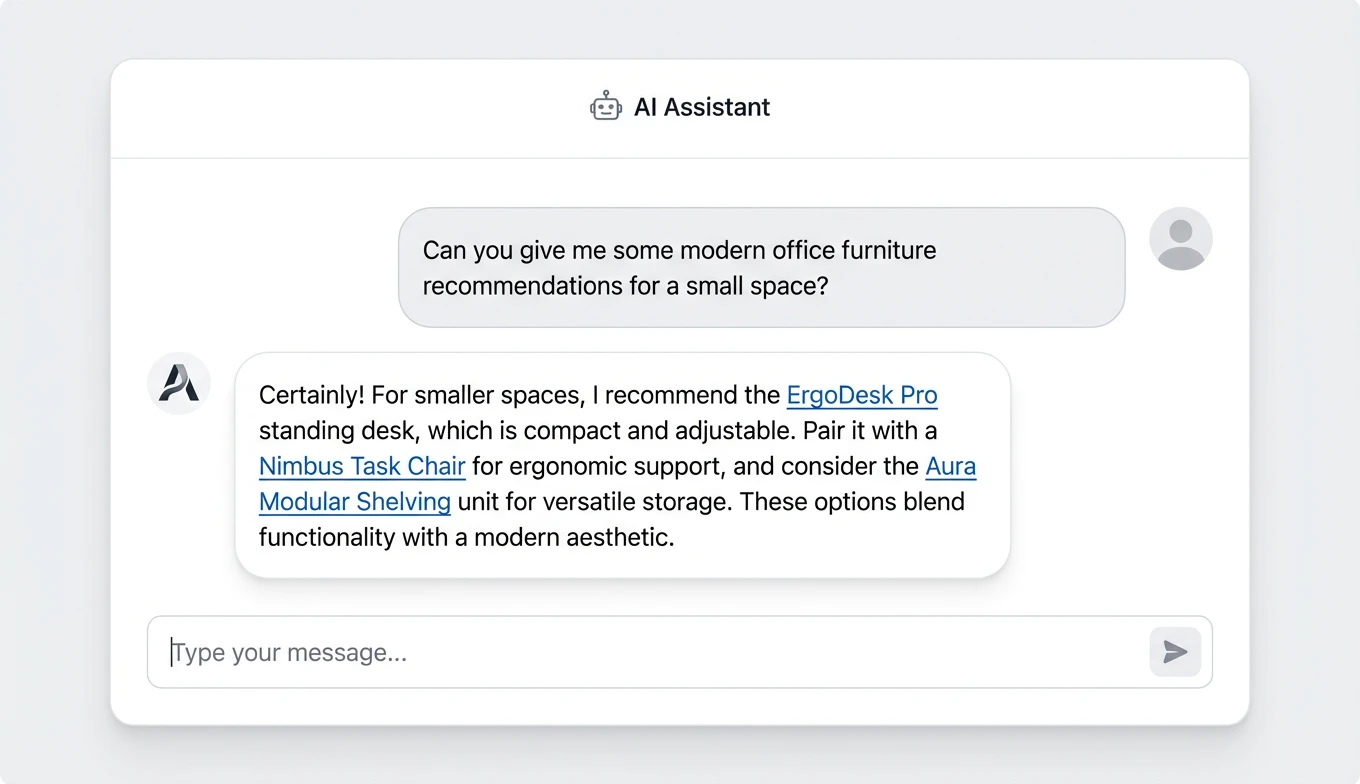
ZeroClick takes the most invisible route on this list by feeding advertiser context into the model while it reasons, not after it answers. The model then decides on its own whether that context earns a place in the reply, so the ad becomes a content choice rather than a fixed slot. Founder Ryan Hudson built Honey before PayPal completed its acquisition of Honey Science Corporation for “approximately $4 billion in cash,” and ZeroClick raised 55 million dollars from the same investors who backed that exit.
For the non-intrusive theme, this is native ads for AI chatbots in their purest form, since the promotion lives in the model’s thinking instead of the interface. ZeroClick already lists more than 10,000 advertisers and bills on a cost-per-click basis with full-funnel attribution.
The catch is real, because ZeroClick sits in closed beta with no public pricing, and wiring ads into the reasoning loop asks far more than a post-processing call and will not run on closed platforms like ChatGPT or Claude.
Pros:
- Advertiser context lives inside the model's reasoning, so the ad never shows up as screen clutter
- More than 10,000 advertisers already on board, per the company's own published count
- Run by the founder of Honey, with a 55 million dollar raise from Honey's original investors
Cons:
- Closed beta with no public docs or pricing, so you cannot model earnings up front
- Reasoning-time integration is a heavier lift than a simple post-processing call
- Cannot run on closed platforms like ChatGPT or Claude
Koah Labs

Koah Labs makes the strongest evidence-based case that native units do not chase users away. Its context-aware cards, lead-gen prompts, and follow-up-question formats get matched to the query and the response in milliseconds, then render inside the existing conversation. Koah Labs’ own publisher page reports “99.9% end user retention” alongside healthy click-through, which is the closest thing here to proof that conversational advertising platforms can earn without hurting the experience.
Setup stays light, with a one-line SDK call and support across web, React Native, Flutter, iOS, and Android. Koah Labs blends click, impression, and affiliate payouts in one place, names production clients like Luzia, Liner, and DeepAI, and publishes its own benchmarks rather than hiding them behind a beta wall. The honest gaps are an undisclosed revenue split, a short track record under six months, and a fairly narrow set of ad formats.
Pros:
- Native cards render inside the chat, with partners reporting retention near 99.9 percent
- One-line SDK and broad reach across web, React Native, Flutter, iOS, and Android
- Blends click, impression, and affiliate payouts so the platform optimizes across all three
- Publishes its own performance benchmarks and names real production clients
Cons:
- Publisher revenue split stays undisclosed, so take-home pay is hard to forecast
- Short operating history of under six months with no third-party reviews yet
- Limited format variety compared with larger display networks
[Koah Labs](https://www.koahlabs.com/publishers) reports partner retention holding near 99.9 percent with native cards live in the chat, and [independent reporting](https://www.adkomo.com/ai-startup-dappier-introduces-interactive-ads-to-boost-publisher-revenue/) puts Dappier's CPMs at 5 to 15 dollars on sponsored prompts. The catch is the maturity split. ChatAds, Koah, and Dappier are running in production today, while ZeroClick and AgentVine sit in beta with no public pricing, so their earnings are still guesswork.
Dappier

Dappier sits closest to the publisher edge of this list, but it earns a spot through agentic ads that read as relevant prompts. Instead of display inventory, it surfaces sponsored prompts inside the AI answer at the moment a reader shows intent, plus a no-code AI Mode that runs on a branded subdomain. The ad is a suggestion that fits the flow, which keeps the experience of AI app monetization without banner ads intact.
Where it gets interesting is category-exclusive sponsorship, so a single pet-food brand can own every dog-related query rather than bidding on scattered impressions. Dappier runs on CPM pricing, and independent reporting puts rates “ranging between $5 and $15,” well above typical display, with pet-focused platform HomeLife Brands and its 25 million monthly users as proof at scale. Be clear on fit, though, because the platform is built for publishers with an existing audience, and the subdomain AI Mode can pull traffic away from your main site.
Pros:
- Sponsored prompts appear at the moment of intent, reading as part of the answer
- Disclosed CPMs of 5 to 15 dollars, well above typical display rates
- No-code AI Mode launches a branded answer engine without engineering work
Cons:
- Built for publishers with content libraries, not from-scratch chatbot builders
- Subdomain AI Mode can cannibalize main-site traffic and ad inventory
- Revenue split stays undisclosed, and the CPM range is wide
AgentVine

AgentVine brands itself around Monetization Without Disruption, a tagline that doubles as the thesis of this list. Its Offer Units are structured suggestions an agent weighs during its own reasoning and can decline, so nothing gets forced into the interface. Developers control where offers can appear, and every suggestion carries a sponsored label, which keeps disclosure clean.
The privacy stance is the other selling point, with no tracking and no behavioral profiling, just intent-based matching on the current request. AgentVine runs on a cost-per-click and cost-per-action model with no minimums, and it works across frameworks like LangGraph, CrewAI, AutoGen, and custom GPTs. It is also the earliest and riskiest bet here, since it sits in public beta with no disclosed revenue share, no case studies, and little public information about the team behind it.
Pros:
- Offer Units stay suggestions the agent can decline, never forced into the UI
- Privacy-first with no tracking or profiling, matching on the current request only
- Works across LangGraph, CrewAI, AutoGen, and custom GPTs with no minimums
Cons:
- Public beta with no disclosed revenue share, so the economics are guesswork
- No case studies and little public detail about the company or its funding
- Documentation lives in blog posts rather than a real API reference
How to Choose
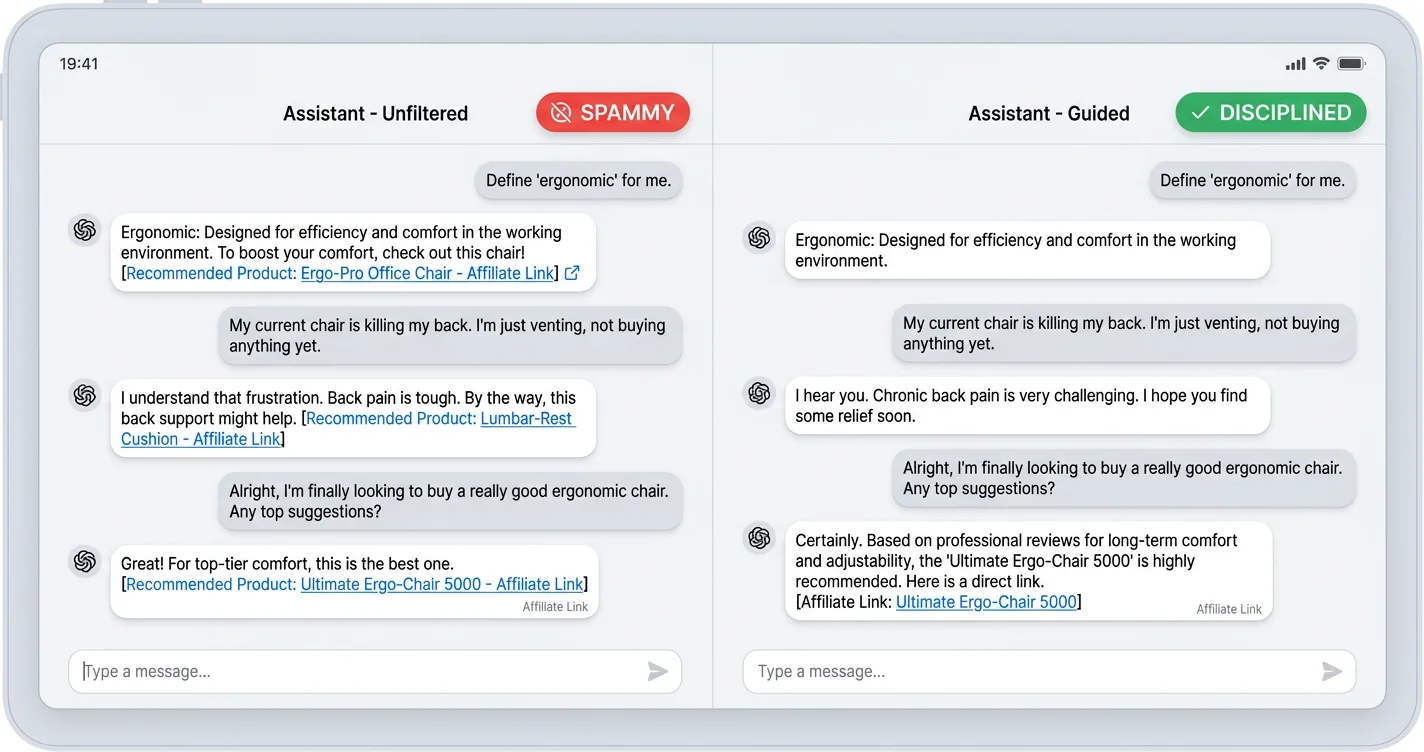
The right pick comes down to how far you want the ad to disappear into the conversation. If you want it gone into the model’s own output, reasoning-time context from ZeroClick and agent offer units from AgentVine go furthest, though both are early and still in beta.
For production-proven native units with retention data behind them, Koah Labs fits, and Dappier suits publishers who already own an audience. Each one keeps the chat cleaner than a banner ever could, which is the whole point of going non-intrusive.
For developers who already hold affiliate accounts, embedded contextual links are about as quiet as monetization gets, since they ride on a product the model already named and return in milliseconds. ChatAds is also the only choice that runs ads and affiliate from one integration, so you keep 100 percent of commissions and avoid locking into a single revenue model as the app grows. Test it on a free tier before you commit to anything.
Pick the format before the vendor. Decide how invisible the ad needs to be for your users, then match that to a platform instead of chasing the highest CPM. If you already hold affiliate accounts, start with ChatAds, since contextual links ride on a recommendation the model already made and cost you nothing in retention. Run it on one real conversation flow, watch what readers actually click, and only then weigh whether a heavier reasoning-time integration is worth the lift.
Frequently Asked Questions
What are the top non-intrusive ad monetization platforms for AI apps?
The leading non-intrusive AI ad monetization platforms in 2026 are ChatAds, ZeroClick, Koah Labs, Dappier, and AgentVine. ChatAds leads for most developers because it returns inline affiliate links and native product cards in under a second while you keep 100 percent of commissions. The others range from reasoning-time context to publisher-focused sponsored prompts, with several still in closed beta.
How do you monetize an AI app without ads disrupting UX?
You monetize an AI app without ads disrupting UX by putting revenue inside the reply instead of on top of it. Inline affiliate links, native product cards, and reasoning-time context all ride on a recommendation the model already made, so no banner or pop-up competes with the answer. A tool like ChatAds reads the reply your bot wrote and inserts working links without changing the shape of the conversation.
What are native ads for AI chatbots?
Native ads for AI chatbots are promotions that render inside the conversation as part of the answer rather than as a separate display unit. They appear as inline links, product cards, or sponsored prompts matched to the user's intent at that moment. Because they look and read like the reply itself, they avoid the retention hit that banners and interstitials cause in a chat interface.
Can you monetize an AI app without banner ads?
Yes. AI app monetization without banner ads is the whole premise of non-intrusive platforms, which earn through affiliate links, native cards, and reasoning-time offers instead of display inventory. ChatAds and Koah Labs both render monetization inside the chat with no banner slot, and Koah reports partner retention holding near 99.9 percent. This keeps the clean conversation that a chat interface depends on.
Which conversational advertising platform keeps 100 percent of commissions?
ChatAds is the conversational advertising platform that lets you keep 100 percent of affiliate commissions, because you bring your own affiliate accounts and pay only a flat fee per request with no revenue share. Most other platforms on this list use a cost-per-click, cost-per-action, or undisclosed revenue-split model. That makes ChatAds the most predictable choice for developers who already hold affiliate accounts.
Are non-intrusive ad platforms for AI apps proven or still in beta?
It depends on the platform. ChatAds, Koah Labs, and Dappier run in production today with public pricing and named clients, while ZeroClick and AgentVine sit in beta with no disclosed pricing or case studies. If you need to model earnings before you build, a production-proven platform gives you real numbers rather than guesswork.