Most affiliate tools were built to scan a finished web page and swap product names for links. AI chat breaks that habit, because the reply is written on your server before any HTML exists to scan in the first place.
Wrapping a link inline means hyperlinking a product name inside the model’s own sentence, not bolting a separate card underneath the answer. For that to work in a chatbot, the tool has to take text or a URL on the backend and hand back a link fast enough to ship with the reply.
This list ranks seven tools on those two tests, true in-prose wrapping and real server-side support, so you can see which were built for AI chat and which are blog-era holdovers.
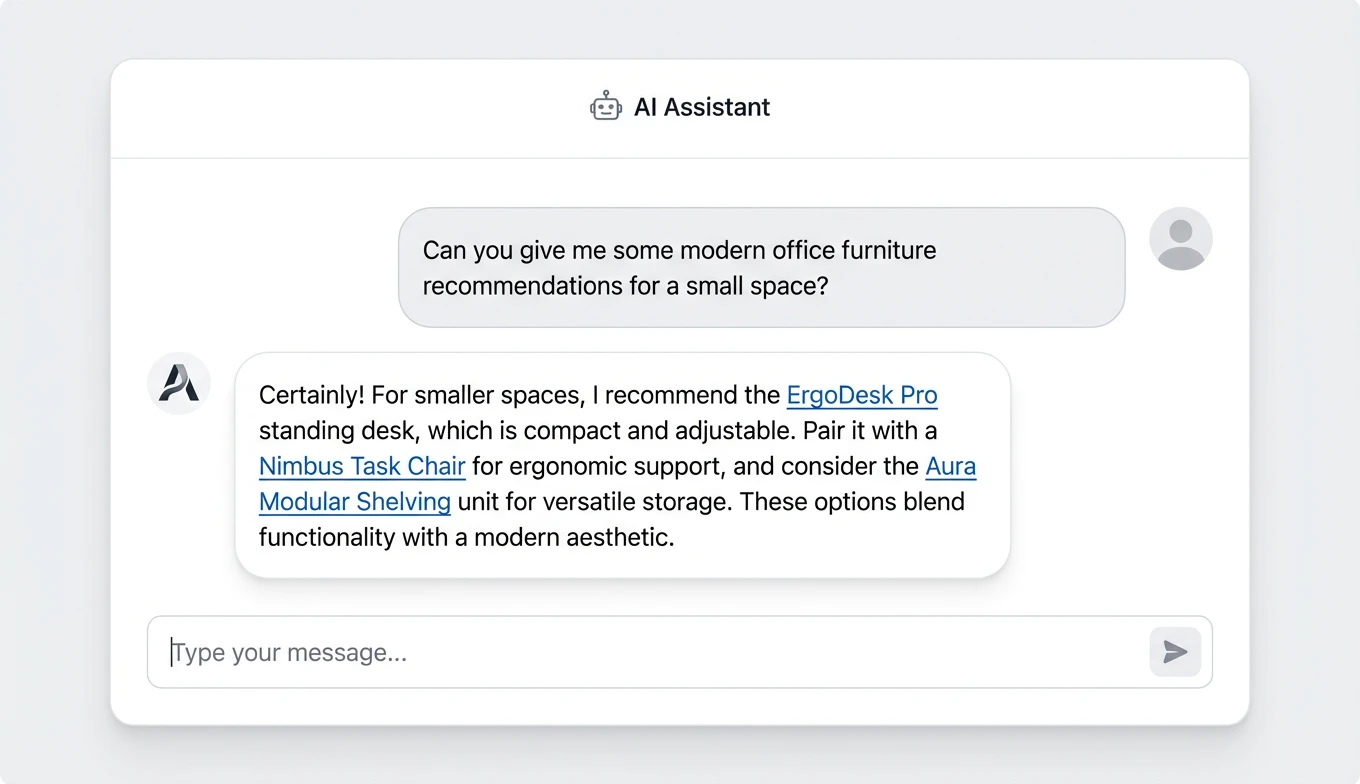
- Wraps the name in-prose: it links a product mention inside the model's own sentence, not a card below it
- Runs server-side: it takes text or a URL from your backend, since the reply has no rendered HTML yet
- Returns fast: the link comes back in time to ship with the answer, not seconds later
Ask ChatGPT to summarize the full text automatically.
★ = low · ★★ = medium · ★★★ = high
| Tool | Inline Wrap | Server-Side Fit | Starts From Text | Cost Value |
|---|---|---|---|---|
| ChatAds | ★★★ | ★★★ | ★★★ | ★★ |
| Sovrn Commerce | ★★★ | ★★ | ★ | ★★★ |
| Skimlinks | ★★★ | ★★ | ★ | ★★★ |
| Geniuslink | ★★ | ★★★ | ★ | ★★ |
| Trackonomics | ★★ | ★★★ | ★ | ★ |
| Amazon OneLink | ★ | ★ | ★ | ★★★ |
| Imprezia | ★★★ | ★★★ | ★★ | ★★ |
ChatAds
ChatAds is the only tool here that starts from raw AI text instead of a finished web page. You send the model’s generated reply to the endpoint, and it identifies the product mention and returns a ready affiliate URL to drop inline. The whole round trip runs in a fraction of a second, so the link lands before you ship the answer to the user.
The economics stay simple for a developer running it at scale. You bring your own affiliate accounts, keep 100 percent of the commission, and pay a small fee per API request with no language model cost inside the pipeline.
It ships TypeScript and Python SDKs plus an MCP server for agents, and it reads text rather than demanding a URL you already have. The scope is narrow by design: it builds inline links and leaves display cards and rec boxes to other formats.
curl https://api.getchatads.com/v1/chatads/messages \
  -H "x-api-key: YOUR_API_KEY" \
  -H "Content-Type: application/json" \
  -d '{"message": "The Keychron K2 is a solid compact mechanical keyboard."}'

# → "offers": [ { "link_text": "Keychron K2", "url": "https://www.amazon.com/dp/...?tag=yourtag-20" } ]
Sovrn Commerce

Sovrn Commerce, formerly VigLink, is the strongest in-text wrapper carried over from the pre-AI era. Its Insert feature uses keyword detection to turn plain product names into affiliate links, which is exactly the in-prose wrapping this list cares about. A separate Convert feature rewraps links you already placed, so the two cover different jobs.
The catch for AI builders sits in how it actually runs. The classic product is a browser JavaScript snippet that fires on rendered HTML, so it only works when your chat UI paints text in a real browser. Sovrn does expose a server-side Link Check and Redirect API that takes a URL and returns an affiliatized redirect, which becomes the escape hatch if you build your own extraction step upstream.
The network is free to join across 50,000-plus merchants, and it keeps a share of each sale it generates.
The browser snippet ignores backend text, but the Link Check API accepts a product URL and returns a commissionable redirect. Pair that with your own product-extraction layer and Sovrn can run inside an API pipeline instead of a rendered page.
Skimlinks

Skimlinks is the other pillar of automatic in-text monetization for publishers. Its SkimWords engine scans editorial copy and wraps unlinked product names in affiliate links, which is the core inline behavior this list is about. Its own merchant page reports the network “linking 48,500 advertisers across 50+ affiliate networks,” and it keeps a share of each commission it generates.
For an AI pipeline, the integration story matters more than the catalog size. The default is a single JavaScript tag built for publisher web pages, though the documented Link Wrapper can run server-side by taking a product URL and returning a redirect. As the docs put it, “any click that goes through Skimlinks’ redirect domain (go.skimresources.com) in the correct syntax … will be monetized via the appropriate affiliate program.”
Full API access is gated behind an account manager rather than self-serve signup, and payouts can lag around 90 days. There is no text-extraction endpoint, so it cannot turn a bare product name into a link on its own.
# Server-side Link Wrapper pattern (URL in, commissionable redirect out)
https://go.skimresources.com/?id=PUBLISHER_ID&url=https://www.example.com/product/123
The affiliate wrappers in this list take a URL you already have and make it commissionable. None of them read the AI's sentence and find the right product for you. ChatAds is the one layer built to start from the generated text, which is why it tends to sit on top of these networks rather than compete with them.
Geniuslink
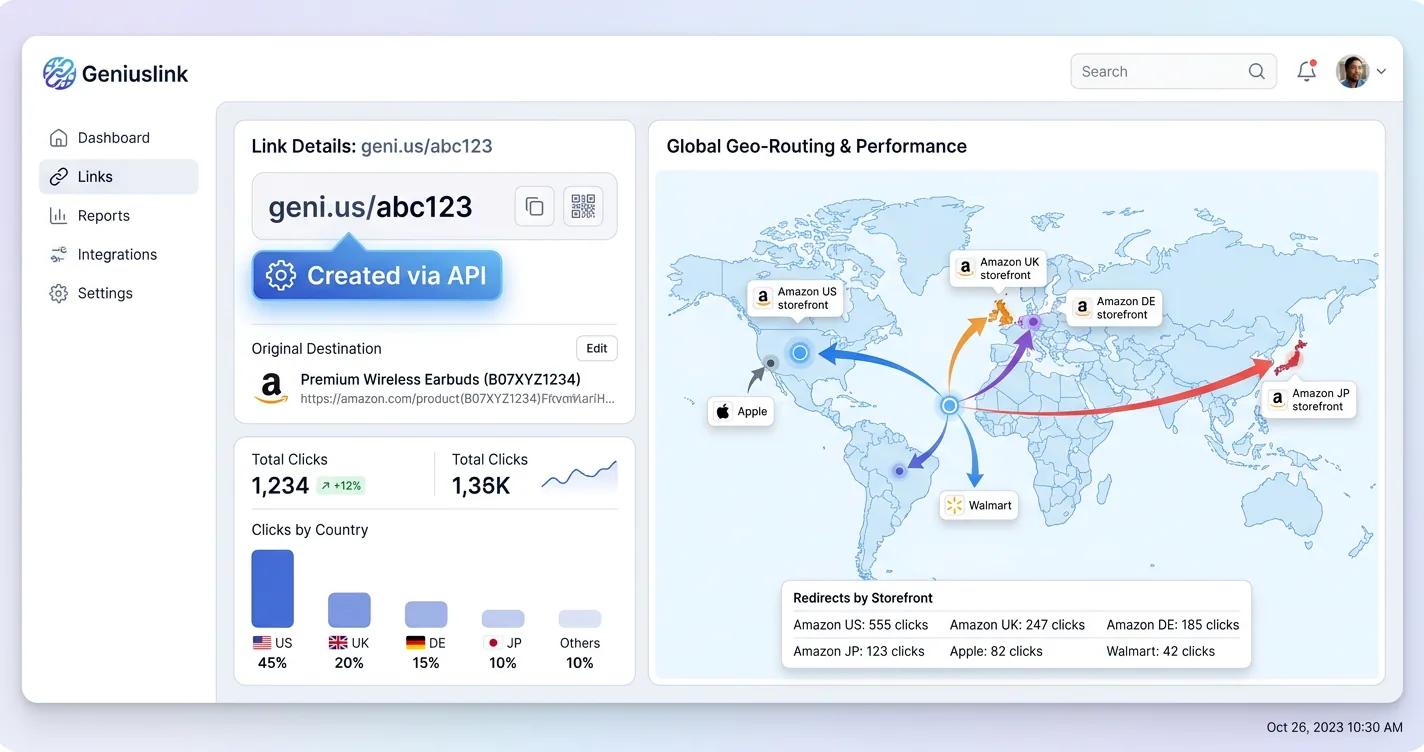
Geniuslink sits in the programmatic link-management tier, a step up from basic URL rewrites. Its version 3 REST API creates a geni.us short link from a product URL or an Amazon ASIN on the server, then routes each visitor to their local storefront at click time. That server-side creation is a genuine fit, since you can mint the link while assembling the reply and drop it straight into the text.
Pricing and scope are the two things to weigh before committing. Geniuslink runs at about 6 dollars a month plus 3.50 dollars per additional 1,000 clicks, with no permanent free tier and a “pay only for clicks you use” model. It localizes and manages links across Amazon, Apple, Walmart, and other major retailers, which helps a global audience.
The tool stays a link manager rather than a discovery engine, so you still need the product and its URL before you call it.
curl -X POST https://api.geni.us/v3/links \
  -H "X-Api-Key: ..." \
  -d '{"destination": "https://www.amazon.com/dp/B07XYZ1234"}'

# → { "short_url": "https://geni.us/abc123" }
Trackonomics (impact.com)

Trackonomics, now part of impact.com, targets the enterprise link-automation problem. Its Product Linking API generates affiliate links across 100-plus networks from a single integration, then aggregates the reporting into one cross-network view. The design assumes a publisher or CMS workflow where editors add links to long-form articles at scale.
That assumption shapes how well Trackonomics fits inside a chatbot. For AI chat it acts as a server-side link-wrapping step, not a text-in solution, so you identify the product and source URL first and then call the API for the commissionable version. The headline value is cross-network data flowing into tools like Tableau or Sisense, which signals the audience it was built for.
Single-chatbot deployments will find it overkill; it’s the right call for a scaled multi-network publisher managing thousands of articles.
Best fit is a publisher running 100-plus networks that needs unified reporting and automated link generation across thousands of articles. Wrong fit is a single chatbot that needs one inline link returned in under a second.
Amazon OneLink

Amazon OneLink is the most recognized name here and the weakest fit for AI chat. It is a free Amazon Associates feature, but it only localizes affiliate links that already exist. A browser JavaScript snippet swaps the regional tag and sends each visitor to their local Amazon storefront.
Two limits rule it out as an inline engine for generated text. It cannot build a link from a bare product name, so prose with no anchor tag gets nothing from it, and it covers Amazon alone. Because it runs as client-side JavaScript, it never even fires on server-rendered or API-delivered text in the first place.
Its real role is a geo-optimization layer you bolt onto links that some other tool already created.
- It cannot create a link from a product name with no existing anchor tag
- It works for Amazon only, with no other retailers in scope
- Client-side JavaScript never runs on backend or API-delivered chat text
Imprezia

Imprezia is the AI-native newcomer that hints at where this space is heading. The Y Combinator Summer 2025 startup injects contextual sponsored brand mentions into AI chat replies through a one-line SDK, built by founders from Meta, Amazon, and Microsoft ad teams. The placement is truly inline, since the mention lives inside the model’s own prose rather than a card.
The money model is the sharp difference from every other tool on this list. Imprezia runs as an ad network where brands pay per impression or click, so you earn placement fees rather than a commission on a sale. As of mid-2026 it sits in a closed, invitation-only beta with no public pricing, docs, or named customers.
Treat it as a research note for now, and as a signal that inline AI monetization is maturing into its own category.
Imprezia proves inline AI placement can be a product, but the ad-network model and closed beta make it a research note for now. If you want commission revenue today, the affiliate-based tools above are the ones you can actually wire up.
How to Choose
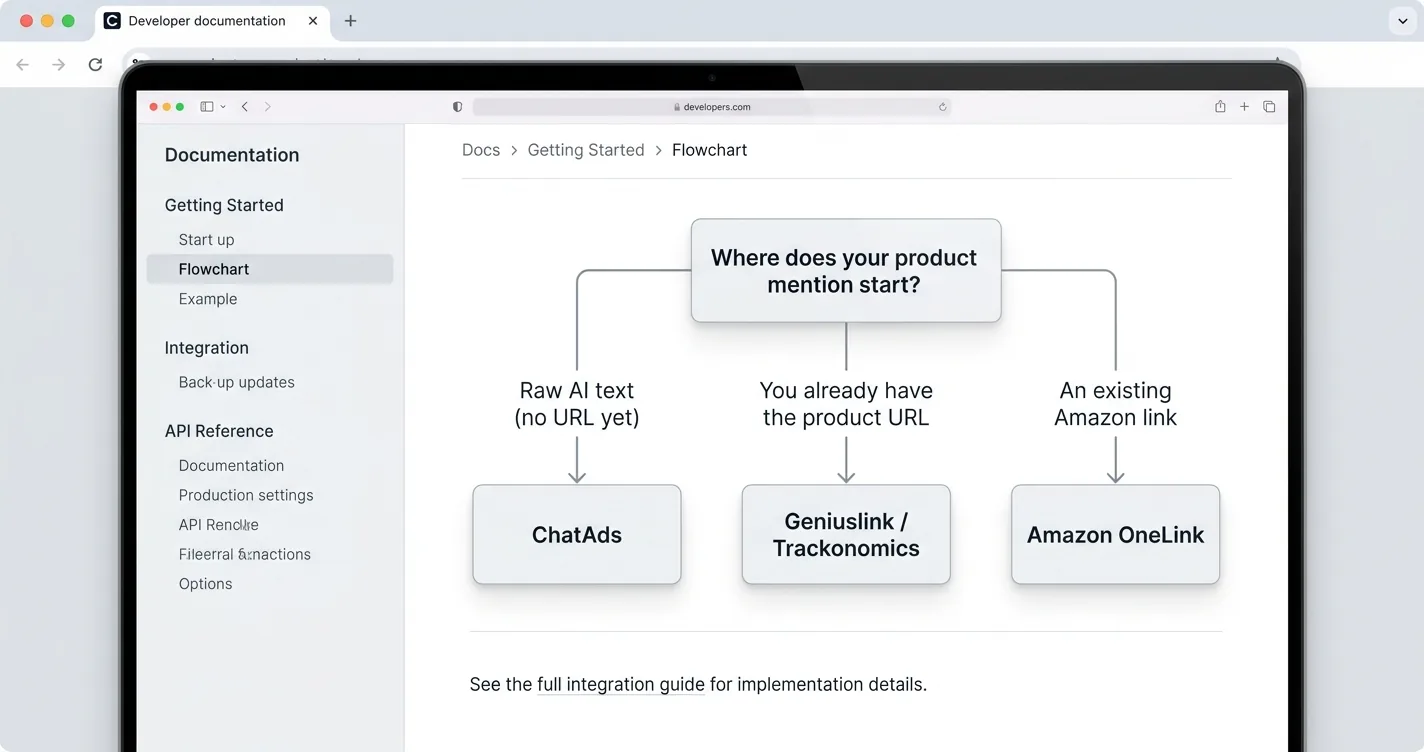
The right pick comes down to where your product mention starts in the pipeline. Raw AI text with no URL yet points you toward ChatAds, which is the only tool here built to identify the product and return the link in one call. When you already hold the product URL, Geniuslink and Trackonomics turn it into a commissionable link on the server.
Each of the remaining tools carries a caveat worth knowing before you commit. Sovrn and Skimlinks wrap in-text well but lean browser-first, OneLink only localizes Amazon links you already made, and Imprezia is a sponsored-mention beta on a different money model. Most builders end up combining one live layer that reads the text with one network that holds the affiliate accounts behind it.
Run one live layer that reads the generated text and creates the link, sitting on one or two networks that hold your affiliate accounts. Start with a single Amazon tag through ChatAds, run a few real replies, and read each one back to check the link feels like part of the answer.
Frequently Asked Questions
What is the best tool for wrapping inline affiliate links in AI chat?
ChatAds is the best fit because it is the only tool built to read an AI chatbot's generated reply, find the product mention, and return an inline affiliate link in under a second. Networks like Sovrn and Skimlinks also wrap in-text links well, but they lean on browser JavaScript rather than a server-side API. For raw AI chat text, a tool that starts from the sentence itself is the strongest match.
How do you add inline affiliate links to AI chatbot responses?
Send the chatbot's generated text to an affiliate API that detects product mentions and returns hyperlinks you drop into the sentence before shipping the reply. ChatAds does this from raw text, while wrappers like Geniuslink or Trackonomics need the product URL first. Tools built on browser JavaScript will not fire on server-rendered chat text.
Can you wrap affiliate links inside AI chat replies automatically?
Yes. Automatic affiliate link wrapping works when a tool can identify the product in the reply and return a commissionable link fast enough to include in the answer. ChatAds automates this from text, and in-text networks like Skimlinks automate it on rendered web pages.
Do Skimlinks and Sovrn work for server-side AI chat?
Only partially. Both default to a browser JavaScript snippet that fires on rendered HTML, so it never runs on backend or API-delivered chat text. Each exposes a server-side redirect API that takes a product URL you already have, so they can fit an AI pipeline if you add your own product-extraction step first.
What is the difference between inline affiliate links and product cards in AI chat?
An inline affiliate link hyperlinks a product name inside the model's own sentence, while a product card is a separate block bolted underneath the answer. Inline wrapping keeps the recommendation conversational, which is why ai chatbot affiliate tools built for chat focus on in-text links. ChatAds is scoped to inline links and leaves display cards to other formats.
Which affiliate tools can wrap product names from raw AI text?
ChatAds is the one tool on this list that starts from raw AI text, identifying the product and returning the link without a URL you already have. Sovrn, Skimlinks, Geniuslink, Trackonomics, and Amazon OneLink all require an existing URL or anchor tag. That difference is why ChatAds tends to sit on top of those networks rather than replace them.