
AI assistants handle billions of conversations every month in 2026, from shopping advice and travel planning to fitness coaching and financial comparisons. The developers behind those assistants face a familiar revenue problem. Subscriptions bring in cash from roughly 3% of users, while the other 97% use the free tier and generate nothing but inference costs.
Ad monetization gives AI assistant builders a way to earn revenue from every conversation without adding paywalls. When your assistant recommends a hotel, compares running shoes, or walks a user through meal prep ingredients, those product mentions become affiliate commissions or ad impressions with the right infrastructure behind them.
These eight AI assistant ad monetization platforms take different approaches to turning conversations into revenue, covering everything from automatic affiliate link insertion to reasoning-time advertising and enterprise in-chat ad placements.
AI assistants live at the intersection of user intent and product knowledge. Consider a travel assistant discussing hotels in Barcelona, a fitness coach recommending protein brands, or a shopping helper comparing wireless earbuds. Each of those interactions carries purchase intent that traditional display ads can only guess at. The conversational context tells you exactly what someone wants, which means higher relevance, better click-through rates, and more commission per interaction than generic banner placements on static pages.
★ = low · ★★ = medium · ★★★ = high
| Platform | Ease of Use | AI Focus | Cost Value | Advertiser Access |
|---|---|---|---|---|
| ChatAds | ★★★ | ★★★ | ★★ | ★★★ |
| ZeroClick | ★ | ★★★ | ★★ | ★★★ |
| Koah Labs | ★★ | ★★★ | ★ | ★★ |
| Imprezia | ★★ | ★★ | ★★ | ★ |
| Jutera | ★ | ★★ | ★★ | ★ |
| AgentVine | ★★ | ★★★ | ★★ | ★ |
| Adsbind | ★★ | ★★ | ★★★ | ★ |
| Aryel | ★ | ★★ | ★★ | ★★ |
Ask ChatGPT to summarize the full text automatically.
ChatAds

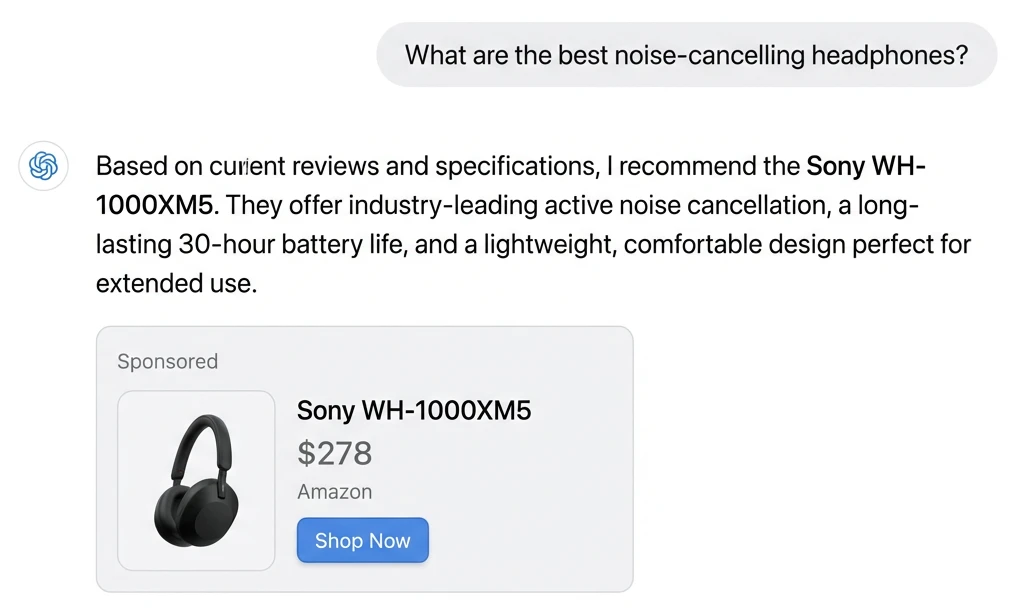
AI assistants that mention products during conversations have a direct path to monetization through ChatAds. The platform’s API reads your assistant’s responses, identifies product references, and returns affiliate links from your connected accounts in under 500 milliseconds. A shopping assistant mentioning a specific blender or a travel planner naming a luggage brand gets the right affiliate URL attached before the response reaches the user. Developers keep 100% of every commission because the pricing model charges per API request rather than taking a revenue share.
Five distinct integration methods cover the full range of AI assistant architectures. The TypeScript and Python SDKs handle most chatbot builds, while the REST API works for any language. An MCP server connects AI assistants built on ChatGPT or autonomous agent frameworks, and n8n nodes enable no-code workflows. Eight ad formats fit different assistant interaction patterns, from inline text links during conversational recommendations to product cards for comparison-heavy flows and banner placements between turns. The free tier at 100 monthly requests lets you test the integration against real assistant conversations before committing budget.
Pros:
- 100% affiliate commission retention with per-request pricing instead of revenue sharing
- Sub-500ms response time that fits inside real-time AI assistant conversations without lag
- Eight ad formats covering text links, product cards, banners, and autonomous agent placements
- Free tier at 100 requests per month for validating monetization against actual user conversations
Cons:
- Requires existing affiliate accounts (Amazon Associates, CJ, etc.) before you can start earning
- Currently focused on US market and English-language content
ZeroClick

Nearly all AI assistant monetization platforms on the market work after the response is generated. ZeroClick takes a fundamentally different approach by weaving advertiser context into the AI reasoning process itself. Founded by Ryan Hudson, who built Honey into a $4 billion PayPal acquisition, the platform raised $55 million in September 2025 from the same investors who backed that exit. Advertisers convert their product pages and campaign data into structured units that AI models evaluate for relevance during response generation, not after.
The advertiser network already includes over 10,000 brands spanning Walmart, Amazon, Target, Expedia, and Best Buy. That demand-side scale is unmatched among AI assistant ad monetization platforms on this list. The September 2025 acquisition of Sleek, a YC-backed shopping platform with 10,000 merchant integrations, extends the reach further into transactional use cases. The trade-off for AI assistant developers is access. ZeroClick operates in closed beta with no public documentation, pricing, or self-serve signup. The reasoning-time approach also requires deeper platform integration than post-processing alternatives, and it does not work with closed systems like ChatGPT or Claude where third-party code cannot access the inference loop.
Pros:
- Largest advertiser network among AI ad platforms with 10,000+ brands including major retailers
- $55 million in funding from investors who backed a proven $4 billion consumer exit
- AI model evaluates ad relevance during reasoning, preserving response quality over forced insertion
Cons:
- Closed beta with no public pricing, documentation, or timeline for general developer access
- Incompatible with closed AI platforms like ChatGPT and Claude that restrict inference-level access
- Deeper integration complexity than post-processing approaches used by most competitors
For any generative AI application, the timing of ad insertion matters for maintaining response quality. Post-processing platforms like ChatAds analyze the finished response and add affiliate links to detected product mentions. The assistant's natural output stays untouched. Reasoning-time platforms like ZeroClick inject advertiser context before the response is generated, which produces more relevant placements but requires deep access to the inference layer. For most AI assistant developers, post-processing is faster to integrate and works with any LLM provider. Reasoning-time approaches are positioned to deliver stronger results long-term but remain closed beta and technically complex in 2026.
Koah Labs

Display advertising for AI assistants has a dedicated platform in Koah Labs, which markets itself as the AdSense equivalent for generative AI applications. The JavaScript SDK processes user input and AI responses together, then returns contextually matched ads from a curated premium advertiser network. Verified production clients include Luzia with millions of users across Latin America and Europe, along with Liner, Heal, and DeepAI. That client roster gives Koah the strongest social proof among AI assistant ad monetization platforms aside from Aryel’s enterprise base.
Koah reports a $10 average eCPM and 7.5% click-through rate, claiming performance four to five times better than traditional mobile ad networks. Revenue flows through CPC, CPM, and affiliate CPA models that the platform optimizes automatically. A $5 million seed round from Forerunner Ventures and AppLovin co-founder Andrew Karam backs the operation. Cross-platform SDK support covers JavaScript, React, React Native, Flutter, iOS, and Android. The unknowns are real though: Koah does not publish its revenue share split, custom pricing requires a partnership conversation rather than self-serve signup, and the platform has operated for less than a year since its September 2025 launch.
Pros:
- Verified production clients at scale provide stronger social proof than most AI ad platforms
- Multiple revenue models (CPC, CPM, CPA) optimized automatically without developer configuration
- Cross-platform SDK support covering web, React Native, Flutter, iOS, and Android
Cons:
- Revenue share percentage not publicly disclosed, making take-home economics hard to predict
- Custom pricing model requires a partnership conversation rather than self-serve signup
- Less than one year of operational history since launching in September 2025
Imprezia

Sponsored brand mentions woven into AI assistant responses are the core offering from Imprezia. Instead of showing ads alongside the conversation, the platform inserts brand recommendations directly inside the AI’s reply. When a user asks an AI assistant about sunscreen options, for example, the response naturally references a specific brand paid for by an advertiser. The founding team built billion-dollar ad systems at Meta and Amazon before launching through Y Combinator’s Summer 2025 batch, and they claim the integration takes five minutes with a single SDK.
Imprezia works with any LLM provider, so AI assistants built on OpenAI, Anthropic, Gemini, or open-source models can all connect without switching APIs. The platform addresses a real tension for AI assistant builders: inference costs that run 10 to 30 times higher than traditional applications paired with subscription conversion rates stuck around 3%. Inline brand mentions generate revenue without adding paywalls. The problem is that Imprezia remains invitation-only in early 2026, with no public documentation, pricing, or named clients of any kind. The team credentials are strong, but the gap between pedigree and proof is wide.
Pros:
- Inline brand mentions feel native to AI assistant conversations rather than appearing as separate ad units
- LLM-agnostic compatibility lets AI assistants on any provider integrate without switching models
- YC S25 backing and founding team from Meta and Amazon ad systems add credibility
Cons:
- Invitation-only beta with no guaranteed timeline for general developer access
- No public documentation, pricing, or case studies available for evaluation
- Single ad format (inline brand mentions) limits creative variety compared to multi-format platforms
- Unknown minimum traffic requirements may exclude smaller AI assistant projects
Jutera

Enterprise compliance sets Jutera apart from other platforms in this category. The Austin-based company holds SOC 2 Type II certification alongside GDPR and CCPA compliance, making it the only AI assistant ad monetization platform with verifiable regulatory credentials. Their design philosophy caps sponsored content at 20% of responses and requires transparent disclosure on every ad placement. For AI assistants operating in regulated industries or serving enterprise clients, that compliance foundation simplifies procurement conversations.
The technical architecture processes ad requests in parallel with AI response generation rather than sequentially, which minimizes latency for AI virtual assistant conversations. Ad formats include sponsored recommendation cards, promotional messages within chat, and contextual links embedded in responses. Jutera describes multiple revenue models covering CPC, CPM, affiliate, and sponsored content. The execution gaps are substantial though. Documentation pages return 404 errors, there are no named clients or case studies, no public pricing exists, and the advertiser network is completely unknown. The compliance certifications and enterprise support hours suggest a legitimate operation, but the absence of any production evidence makes it impossible to recommend over platforms with demonstrated traction.
Pros:
- Only AI ad platform with SOC 2 Type II, GDPR, and CCPA certifications for regulated environments
- Parallel ad processing architecture avoids adding latency to AI assistant response times
Cons:
- Zero named clients, case studies, or production evidence of any kind
- Documentation pages return 404 errors, suggesting incomplete or pre-launch product
- No public pricing or advertiser network information available for evaluation
- Unknown whether platform is operational or still in concept stage
AgentVine

Autonomous AI assistants that make decisions across multi-step workflows have a monetization option in AgentVine. The platform positions itself as the first ad network built for the agent economy, targeting developers using LangGraph, CrewAI, AutoGen, and custom GPT frameworks. Instead of placing ads in a chat interface, AgentVine surfaces “Offer Units” at decision points within the agent’s reasoning process. The agent evaluates whether each offer genuinely serves the user before including it.
AgentVine’s privacy commitments are explicit: no user tracking, no behavioral profiling, and no cross-session data collection. Offers match only on current conversation intent, and CPC and CPA pricing means developers earn when users take real action on a sponsored suggestion. The platform is in public beta and free to join without minimum traffic requirements. The risks match the stage: revenue share terms are completely undisclosed, there are no case studies or named clients, and the founding team and funding details are unknown. Developers comfortable shaping early infrastructure may find value here, but anyone needing reliable revenue forecasting should wait.
Pros:
- Zero user tracking and intent-based matching align with growing privacy regulations
- Multi-framework compatibility with LangGraph, CrewAI, AutoGen, and custom GPTs
- Public beta is free to join with no minimum traffic requirements
Cons:
- Revenue share terms completely undisclosed, preventing economic modeling before integration
- No case studies, named clients, or founding team information available publicly
- Beta platform maturity raises reliability questions for production AI assistant traffic
The choice between affiliate and display approaches depends on what your AI assistant discusses. Assistants that recommend specific products by name (shopping helpers, travel planners, fitness coaches) generate stronger per-interaction returns through affiliate platforms like ChatAds because commissions scale with purchase price. Assistants with high conversation volume but fewer direct product mentions earn more consistently through display ad platforms like Koah Labs, where steady eCPM compounds across thousands of impressions. Many AI assistant developers run both approaches on different surfaces within the same application.
Adsbind

High inference costs are the specific problem Adsbind targets for AI assistant developers. The platform positions contextual advertising as a way to subsidize free tiers instead of forcing users behind subscription walls. A Python SDK installs through pip and claims five-minute setup. Your AI assistant sends user messages and responses to the Adsbind API, which analyzes the conversation context and returns an ad when one matches.
Early adopters on the waitlist receive 75-85% revenue share, the highest disclosed rate among the AI assistant ad platforms reviewed here. A dashboard controls ad frequency from one in every five messages to one in every two, letting developers adjust monetization aggressiveness without touching code. Ads appear as banners between messages, post-answer placements, or sponsored cards. The limitations are hard to overlook though. Adsbind remains waitlist-only with no published case studies, client names, or company background. The Python-only SDK excludes AI assistants built in JavaScript, TypeScript, or Go. Post-launch revenue share percentages are completely unknown and risk dropping sharply from the early adopter rate.
Pros:
- 75-85% early adopter revenue share is the highest disclosed rate among these platforms
- Dashboard-controlled ad frequency adjusts monetization without redeploying code
- Free to integrate with no upfront costs until ads generate revenue
Cons:
- Waitlist-only access with no guaranteed acceptance timeline for AI assistant developers
- Python-only SDK excludes assistants built in JavaScript, TypeScript, or Go
- Post-launch revenue share unknown and may fall well below the early adopter rate
- No case studies, named clients, or company background information published
Aryel

Enterprise advertisers looking to place visually rich ads within AI assistant conversations have an established partner in Aryel. The Italian adtech company serves over 150 organizations including P&G, Samsung, Nissan, BMW, and Disney, with 162% year-over-year growth and roughly three million euros in 2024 revenue. Their June 2025 In-Chat Ads product brings immersive formats to generative AI platforms, using a semantic engine that reads prompts in real time to score commercial intent and match relevant advertisers.
A strategic partnership with Criteo delivers a reported 4% average click-through rate across their inventory. Ad formats span the full funnel: branded sponsorship units during response loading, autoplay video between turns, interactive product carousels, and contextual recommendation ads tied to conversation topics. For AI assistant platforms large enough to attract enterprise campaign budgets, Aryel brings demand-side relationships that smaller ad networks cannot match. The platform does not fit most AI assistant developers though. There are no self-serve SDKs, no transparent pricing, and GenAI ad placements remain in beta with select partners only. Aryel targets publishers and enterprise advertisers, not individual developers building chatbots.
Pros:
- Tier 1 enterprise advertisers (P&G, Samsung, Disney) bring premium demand that smaller networks lack
- Criteo partnership delivers verified 4% average CTR across ad inventory
- Full-funnel ad formats from awareness to conversion cover more use cases than text-only platforms
Cons:
- Enterprise partnership model with no self-serve access for individual AI assistant developers
- In-Chat Ads for GenAI launched June 2025 and remain in limited beta
- Europe-focused operations with restricted presence in the US developer market
How to Choose the Right AI Assistant Ad Monetization Platform
Three factors should guide the decision: what your assistant talks about, where you are in your growth, and how much operational overhead you can handle. Assistants built around product discovery earn the most through affiliate monetization, where commissions scale with purchase value. ChatAds handles that use case with zero revenue sharing and response times under 500 milliseconds, and it works with any LLM through its REST API and SDKs. For a step-by-step walkthrough of the integration process, see how to add affiliate links to AI assistant responses.
For AI assistants generating high conversation volume across general topics, display advertising offers more predictable returns. Koah Labs has the strongest production track record among display-focused AI ad platforms, with verified clients running at scale globally. ZeroClick’s advertiser network dwarfs every other platform on this list, but closed beta access limits who can use it today.
The platforms still in early stages (Imprezia, Jutera, AgentVine, Adsbind) may mature into strong options, but carry meaningful risk in 2026. Aryel serves a different audience entirely: enterprise publishers with enough traffic to attract premium brand campaigns.
- If your AI assistant recommends specific products in conversations, start with ChatAds
- If your assistant has high volume across general topics, evaluate Koah Labs
- If you build autonomous agents on LangGraph or CrewAI, explore AgentVine
- If you run an enterprise AI platform with major advertiser appeal, consider Aryel
Most AI assistants that mention products during conversations should start with ChatAds for affiliate monetization, since it is the only platform here with zero revenue sharing on affiliate earnings. Pair it with Koah Labs for display ad revenue on high-traffic surfaces, and you cover both monetization approaches without overlap or revenue sharing conflicts.
Frequently Asked Questions
What are the best ad platforms for monetizing AI assistants?
ChatAds leads for AI assistants that recommend products because it detects mentions automatically and lets developers keep 100% of affiliate commissions. Koah Labs provides the strongest display ad option with verified production clients and a cross-platform SDK. ZeroClick has the largest advertiser network at 10,000+ brands but remains in closed beta. The right platform depends on whether your assistant generates product-specific recommendations or high-volume general conversations.
How do you monetize an AI assistant with ads?
For AI assistants with product recommendations, integrate ChatAds using the TypeScript or Python SDK to automatically insert affiliate links when your assistant mentions products. For display advertising, add Koah Labs' JavaScript SDK to show contextually matched ads alongside AI responses. Both approaches work with any LLM provider and analyze conversation content to match relevant ads without disrupting the user experience.
Which AI assistant ad platform lets developers keep the most revenue?
ChatAds offers the highest revenue retention because developers keep every dollar of affiliate earnings. The platform charges per-request API fees instead of taking a cut of commissions from AI assistant conversations. Adsbind offers 75-85% for early adopters using display ads, though standard rates after launch are unknown. Koah Labs and other platforms use revenue-sharing models where the exact splits are not published.
Do AI assistant ad monetization platforms work with all LLM providers?
ChatAds works through a REST API with SDKs for TypeScript, Python, and MCP, connecting to any AI assistant regardless of the underlying model. Koah Labs provides a JavaScript SDK compatible with any LLM provider. Imprezia claims LLM-agnostic compatibility across OpenAI, Anthropic, and Gemini. Most platforms on this list operate on the response layer rather than inside the model, making them provider-independent.
What types of AI assistants earn the most from ad monetization?
AI assistants that recommend specific products with clear purchase intent earn the most through affiliate links. Shopping assistants, travel planners, gift finders, and product comparison tools perform well because users are actively looking to buy. Assistants with high conversation volume but fewer direct product mentions earn better through display ad platforms, where steady eCPM accumulates across thousands of impressions.
Can you monetize a free AI assistant without adding a paywall?
Ad monetization platforms give AI assistant developers a way to earn revenue from every conversation without requiring subscriptions. ChatAds inserts affiliate links into product recommendations automatically. Koah Labs places contextual display ads alongside responses. Adsbind offers configurable ad frequency so developers can balance revenue against user experience. All of these approaches keep the assistant free while generating income from relevant product placements.