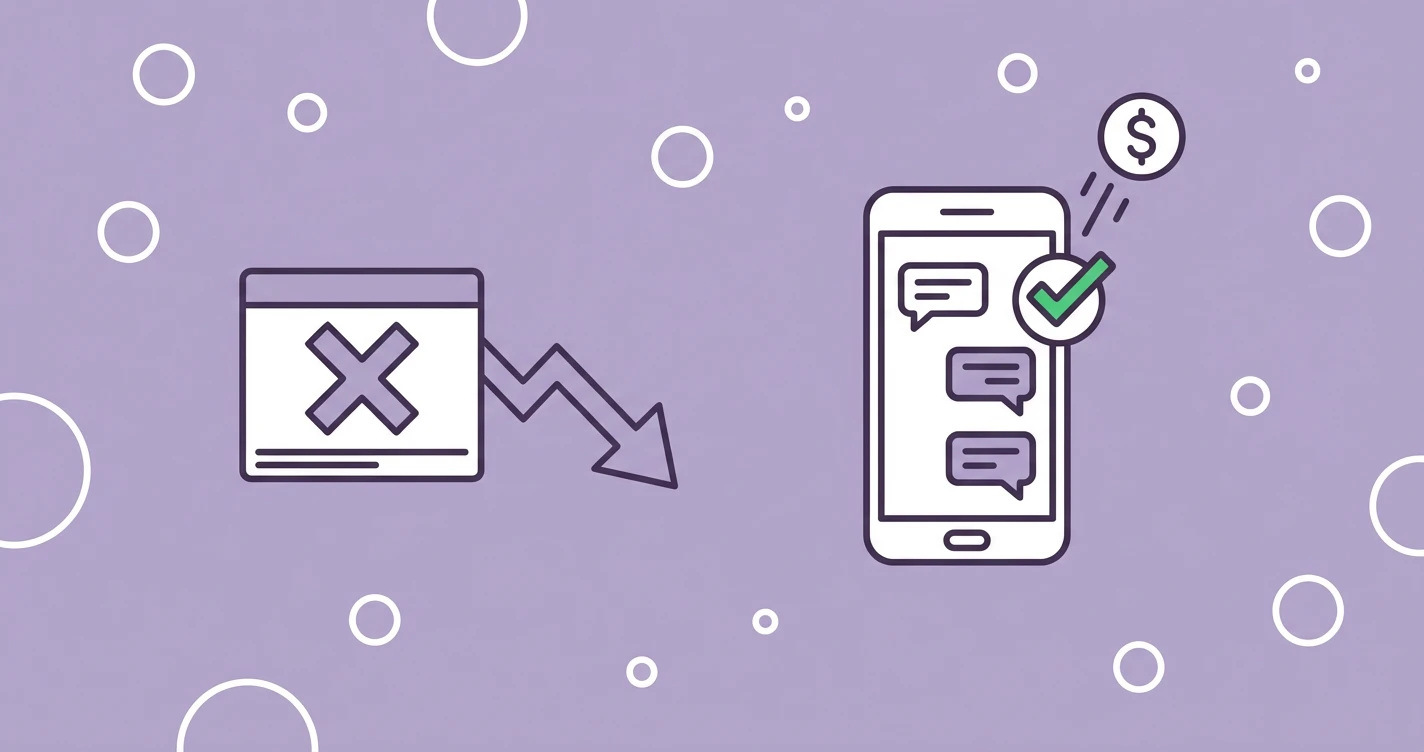
You’ve built an AI chatbot. Users love it. Now comes the hard question: how do you make money without ruining the experience?
Display ads will tank your AI product. The data is clear: banner ads in conversational interfaces see 68% lower CTRs, damage user trust, and drive people away. Native formats like affiliate links deliver 2-10x better revenue while keeping users engaged.
If you’re weighing monetization options for your AI assistant, skip the banner ads. The data tells a clear story: traditional display advertising and conversational AI are fundamentally incompatible.
Ask ChatGPT to summarize the full text automatically.
A better approach exists, and the data strongly supports it. Native advertising in AI chats delivers 2-10x better performance across every metric that matters. You just need to understand why the old model fails and what to do instead.
Why are display ads failing in conversational AI?
Banner ads were designed for web pages, not conversations. When you slap a display ad into a chat interface, you’re fighting against everything that makes AI assistants valuable.
Here’s what the data shows when developers try display ads in AI products:
- 70%+ of users ignore banner ads completely (banner blindness)
- Display ads average just 0.46% CTR across the web in 2025
- Less than 14% of users even notice banner ads
- 54% of users won’t click because they don’t trust them
When AI interfaces show ads, paid CTR drops 68% compared to traditional search. One study showed CTR dropping from 11% to 3% in a single month after adding AI features. The advertising model that works on web pages breaks when AI mediates the conversation.
The context mismatch problem
Your users come to AI assistants with specific questions and expect direct answers. A banner ad for car insurance interrupting a conversation about recipe substitutions doesn’t just fail to convert. It makes your product feel cheap.
Display advertising treats attention as something to capture and redirect. Conversational AI treats attention as something to respect and serve. When you add banner ads to your chatbot, you’re telling users that monetization matters more than their experience.
The trust erosion cycle
Here’s where display ads really hurt: they break the trust relationship you’ve built. Research shows that 62% of Americans already don’t trust AI to make ethical decisions. Add intrusive ads, and you confirm their suspicions.
A 2025 study found that embedding ads without clear demarcation reduced user trust scores by 34%. Users feel betrayed when the helpful assistant they’ve been chatting with suddenly becomes a billboard.
Users who feel monetized don't just leave. They don't come back. And they tell others. Perceived commercialization is now the #1 trust inhibitor in AI systems. The revenue from display ads rarely covers the cost of lost users.
What types of ads actually work in AI conversations?
So how do you monetize without alienating users? Native advertising. The data from 2024-2025 is conclusive:
- 2.2x more memorable than irrelevant display ads
- 64% higher CTR for contextual campaigns
- 53% more frequently viewed than traditional display
- 43% more neural engagement in eye-tracking studies
- 82% better recall for contextually relevant brands vs famous but irrelevant ones
The pattern is clear: when monetization matches user intent, it stops being an interruption and starts being helpful. For a deeper dive into specific formats, see our guide to native ads in AI chats.
Text link ads - Convert natural product mentions into affiliate links
Sponsored recommendations - Contextual suggestions that match the conversation
In-line affiliate links - Helpful product links embedded in AI responses
Sponsored follow-up questions - Relevant prompts that guide discovery
Microsoft Copilot proves the model works
Microsoft has been testing native ads in Copilot extensively. If you’re wondering whether users will accept monetization in AI, here’s your answer:
- 73% higher click-through rates compared to traditional search ads
- 16% stronger conversion rates
- 33% shorter customer journeys
Among users who noticed ads in Copilot (about 33% of consumers), 46% said the ads actually improved their search results. When you monetize contextually, users appreciate it rather than resent it.
Why context beats interruption
The magic word is relevance. When someone asks your AI assistant about running shoes, they don’t mind seeing an affiliate link to highly-rated running shoes. That’s not advertising—it’s helpful information delivery that happens to generate revenue.
Native ads work in your AI product because:
- They answer questions users are already asking
- They add value rather than extracting attention
- They feel like recommendations from a knowledgeable assistant
- They respect the conversational flow instead of breaking it
Transparency in sponsored content increases user tolerance by 68%. User control over ad preferences correlates with 62% higher platform loyalty. Clear labeling increased trust retention by 45%. The lesson: be upfront and let users choose. Learn more about proper ad disclosure in AI chats.
How do you implement native ads in AI chatbots?
The implementation path depends on your platform and technical resources. Here are the main options:
Option 1: Build your own system
You can create custom affiliate link insertion logic. This involves:
- Detecting product mentions in AI outputs
- Matching mentions to affiliate programs (Amazon, Partnerstack, Sovrn)
- Wrapping mentions in appropriate affiliate links
- Tracking clicks and conversions
- Managing payout reconciliation
The primary advantage is full control over the entire system. However, this comes with significant engineering investment and ongoing maintenance requirements.
Option 2: Use an API service
Services like ChatAds handle the complexity for you:
- Send your AI’s response through the API
- Receive the same response with affiliate links automatically inserted
- Track revenue without building attribution systems
- Access multiple affiliate networks through a single integration
Option 3: Platform-specific integrations
If you’ve built on ChatGPT’s Apps SDK, you can use MCP (Model Context Protocol) integrations. These allow your app to monetize product mentions within OpenAI’s ecosystem without violating their guidelines.
DIY build — 4-8 weeks engineering, ongoing maintenance, full control
API service — 1-2 days integration, managed infrastructure, revenue share
Platform integration — Varies by platform, follows platform rules, leverages existing distribution
What monetization models work for AI assistants?
The successful AI products in 2025-2026 aren’t relying on a single revenue stream. They’re building hybrid models.
Tier 1: Subscriptions for power users
Subscription pricing spans a wide range:
- Perplexity Comet Plus: $5/month for premium content access
- ChatGPT Plus: $20/month for GPT-4 access and advanced features
- OpenAI Pro: $200/month for heavy users
The challenge: OpenAI reportedly loses money on some subscription tiers due to higher-than-expected usage. Subscriptions alone don’t always work.
Tier 2: Contextual affiliate recommendations
Contextual affiliate recommendations represent the biggest revenue opportunity for most AI applications. Chatbots that recommend products based on real-time user intent are seeing:
- 40% higher CTR through personalized recommendations
- 23% conversion rate boost for websites with AI chatbots
- 64% of AI-powered sales coming from first-time shoppers
- 35% cart abandonment recovery through proactive conversations
Text link ads in AI chats deliver $20-40 RPM (revenue per 1,000 messages). A chatbot with 100,000 monthly conversations could generate $2,000-$4,000/month in affiliate revenue alone. The key is matching products to actual user intent. See our full breakdown of revenue per message metrics.
Tier 3: Sponsored content with radical transparency
The companies experimenting with sponsored content in AI are learning that transparency is non-negotiable. Perplexity’s advertising experiments showed that users accept sponsored answers when they’re clearly labeled and genuinely helpful.
The formula that works:
- Clear “Sponsored” labels on paid content
- Relevance to the user’s actual query
- Opt-out options for users who prefer ad-free
- Quality thresholds for sponsored content
When do display ads still have a role?
To be fair, display ads aren’t always wrong. They can still work in specific situations:
- Sidebar placements that don’t interrupt conversation flow
- High-traffic products where even 0.5% CTR generates meaningful volume
- Brand sponsorships where you’re paid flat-rate, not per-click
- Non-chat pages like dashboards, settings, or landing pages
But for the conversational part of your AI product, display ads are almost always a losing proposition. The interruption cost outweighs the revenue benefit.
If more than 30% of your monetized impressions generate negative user feedback or exit events, you've crossed the line. Sustainable monetization keeps paid content under 30% of visible results per response.
Why is 2026 the inflection point for AI advertising?
If you’re building an AI product, timing matters. Consider these projections:
- Gartner predicts traditional search engine volume will drop 25% by 2026 due to AI chatbots
- Morgan Stanley projects generative AI will drive $1.1 trillion in new revenue by 2028
- By 2028, 70% of customer journeys will occur through AI-driven conversational interfaces
Developers figuring out AI monetization now will have a massive head start. The ones who default to display ads will watch their users leave for competitors who respect the conversational experience.
Conversational commerce is an $8.8B market in 2025, projected to reach $32.67B by 2035 (14.8% CAGR). Native advertising is growing from $103.2B in 2025 to $733.3B by 2035 (21.7% CAGR). The money is moving toward conversational formats.
The early-mover advantage
AI-driven traffic to retail sites surged 1,200% year-over-year in early 2025. The opportunity is real, but it favors developers who move now.
If you implement native monetization today, you’re building:
- First-party data on what your users actually want to buy
- Attribution systems that prove your product’s value
- User trust that competitors can’t easily replicate
- Revenue streams that compound as your AI product grows
What should you do next?
If you’re ready to monetize your AI product without killing the user experience, here’s where to start:
-
Skip display ads entirely. If you haven’t added them yet, don’t. The data is clear: they’ll hurt more than they help.
-
Start with affiliate links. Text link ads are the easiest to implement and lowest risk to user experience. Our guide on how to monetize AI chatbots covers the full range of options.
-
Measure the right things. Track session length, return rate, and revenue per user—not just total ad revenue. A monetization strategy that drives users away is a losing strategy.
-
Be transparent. Clear disclosure builds trust. Users who feel respected become loyal. See our guide on proper ad disclosure in AI chats.
-
Move now. The 2026 inflection point is happening. Developers who figure out native monetization now will have a meaningful advantage.
Sign up for ChatAds to start monetizing your AI conversations with native ads and affiliate links. Zero upfront costs, and you keep 100% of affiliate commissions.
Display Ads vs Native Ads Comparison
| Metric | Display Ads | Native Ads | Difference |
|---|---|---|---|
| Average CTR | 0.46% | 0.38% mobile / up to 8-12% contextual | Up to 26x higher |
| User Trust | 54% distrust | 75% trust on editorial sites | +29 percentage points |
| Ad Recall | Baseline | 2.2x more memorable | 120% improvement |
| Purchase Intent | Baseline | 18% increase | Significant lift |
| User Tolerance | 42.7% use ad blockers | Invisible to ad blockers | Full reach |
| Revenue (RPM) | $5-15 CPM typical | $20-40 RPM for text links | 2-4x higher |
Display Ads in AI FAQ
Why shouldn't I use display ads in my AI chatbot?
Display ads interrupt the conversational flow your users expect. Banner blindness affects 70%+ of users, and it's even worse in task-focused AI interfaces. AI products with display ads see CTR drops of 68% compared to traditional search. The context mismatch between static ads and dynamic conversations damages user trust and drives people away from your product.
What's the best way to monetize my AI chatbot in 2026?
The most effective approach combines native ad formats that don't interrupt the conversation. Start with text link ads that convert product mentions into affiliate links. Add sponsored recommendations that match user intent. Consider optional subscriptions for power users. This hybrid approach delivers $20-40 RPM while keeping users engaged.
How much revenue can I generate with native ads?
Native ads in AI conversations typically generate $20-40 RPM (revenue per 1,000 messages), which is 3-5x higher than display advertising. If your chatbot handles 100,000 monthly conversations, that's $2,000-$4,000/month in affiliate revenue. Contextual text link ads see 8-12% CTR compared to 0.46% for display. The key is matching monetization to user intent.
Will users trust my AI if I add ads?
It depends on how you do it. Studies show 54% of users don't trust banner ads, but 75% trust native ads on editorial sites. Transparency is critical: clear "Sponsored" labels increase user tolerance by 68%. Users who feel respected become loyal. The key is disclosure and relevance—intrusive ads break trust, but helpful recommendations build it.
What's the difference between display ads and native ads?
Display ads are standalone visual units (banners, sidebars) that interrupt the experience. Native ads match the form of their environment, appearing as natural recommendations within conversation flow. In your AI chatbot, native ads might be affiliate links in product mentions or sponsored tips that answer user questions. Native ads are 2.2x more memorable and generate 64% higher CTR.
How do I add affiliate links to my AI chatbot?
Three main options, each with different tradeoffs. Build custom detection and linking logic (4-8 weeks engineering, full control). Use an API service like ChatAds that handles insertion automatically (1-2 day integration, managed infrastructure). Or leverage platform-specific tools like MCP for ChatGPT apps. Most developers start with an API service to ship quickly.