
OpenAI is testing ads in ChatGPT, and users aren’t happy about it. As of 2026, paid subscribers have seen product recommendations for brands like Target and Peloton appearing as cards below their AI responses. OpenAI initially called these “app suggestions” rather than ads, but the backlash was swift enough that they paused the feature.
ChatGPT ads are coming. Whether you can block them depends on how OpenAI implements them. Separate product cards are easy to block. Ads embedded directly in AI responses are much harder.
Ask ChatGPT to summarize the full text automatically.
What Do ChatGPT Ads Look Like?
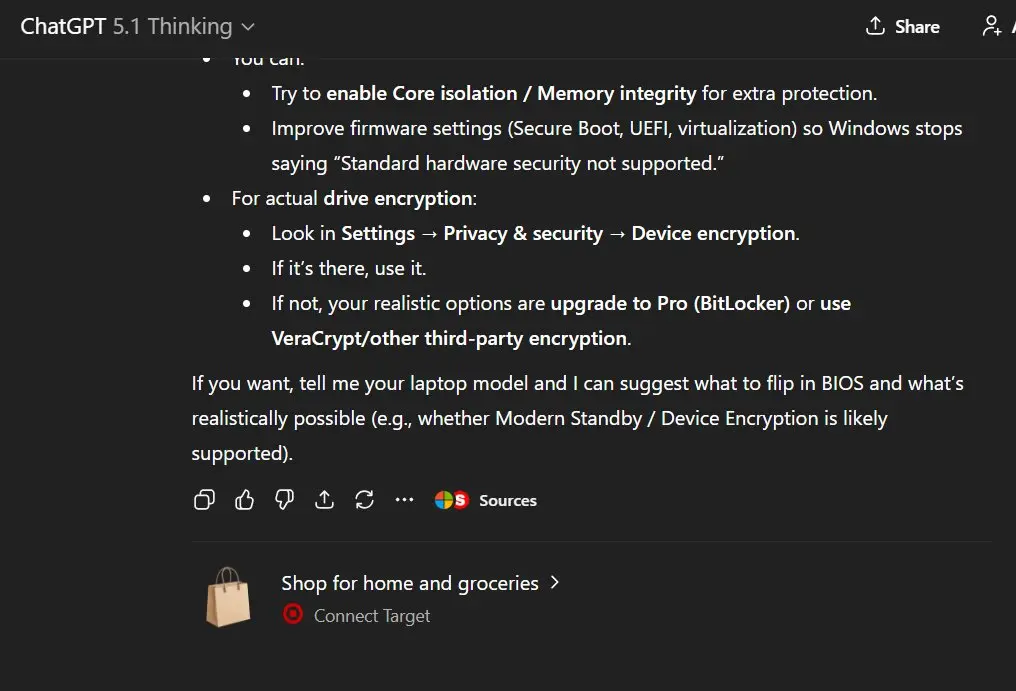
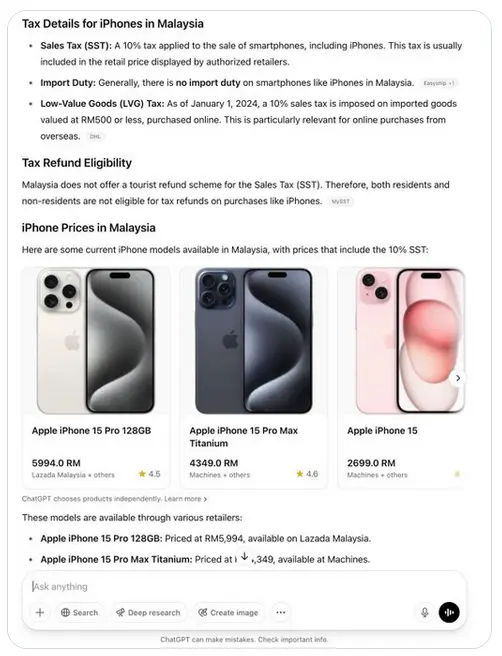
OpenAI’s ad format is still evolving, but early tests reveal a distinct card-based approach. The product recommendations appear as separate cards below the AI’s response, showing brand logos and prompts like “Shop for home and groceries. Connect Target.”

These aren’t inline text ads woven into the AI’s answers. They’re separate UI elements that show up after the response. That distinction matters for blocking, and it’s fundamentally different from native ads in AI chats where affiliate links appear within the conversation itself.
Android code analysis of ChatGPT version 1.2025.329 revealed strings like "ads feature" and "search ad" buried in the app. OpenAI is clearly building ad infrastructure even if they've paused public rollout.
Microsoft Copilot and Google’s AI search have already integrated sponsored content, and Perplexity has displayed product recommendations since 2024. OpenAI’s entry into advertising was only a matter of time given these precedents. The real question is not whether sponsored content will appear, but rather when OpenAI will resume rollout and how intrusive the final implementation will be.
Can You Actually Block ChatGPT Ads?
The answer is yes, but effectiveness depends entirely on how OpenAI chooses to implement sponsored content. AdGuard’s technical analysis breaks down the two scenarios:
- Separate product cards (current format): Relatively straightforward to block using existing filter techniques
- Ads embedded in AI responses: Would require advanced approaches like prompt reprocessing or AI-powered ad detection
AdGuard has already added filtering rules to their “Other Annoyances” filter for the product card format. They’ve documented their approach to blocking ChatGPT ads and confirmed the technology exists and works.
If OpenAI decides to embed sponsored content directly into ChatGPT's responses (think brand mentions that read like natural recommendations), conventional content filtering won't work. That would require fundamentally different blocking approaches that don't exist yet.
For now, the separate card format means several standard filtering tools are effective against OpenAI’s current approach.
1. AdGuard: Best for ChatGPT-Specific Blocking
AdGuard stands out because they’ve proactively added rules targeting ChatGPT product recommendations in their filter lists. They were among the first to address this emerging ad format, having already tackled similar implementations in Perplexity.
The free browser extension works across Chrome, Firefox, Safari, and Edge. It blocks ads, trackers, and annoyances without artificial limitations. The premium version ($2.49-5.49/month or $79.99 lifetime) extends protection to desktop apps, mobile devices, and system-wide blocking. You can download it from AdGuard’s official site.
| Feature | Details |
|---|---|
| Price | Free (browser) / $2.49-5.49/mo (premium) |
| Platforms | Chrome, Firefox, Safari, Edge, Windows, Mac, iOS, Android |
| ChatGPT blocking | Yes (via Other Annoyances filter) |
| Open source | Browser extension only |
Pros:
- Already blocking ChatGPT-style product recommendations
- Full-featured free browser extension
- Works across all major platforms with premium
Cons:
- Premium required for system-wide protection
- Can be resource-intensive compared to lighter options
- iOS version limited to Safari content blocking
2. uBlock Origin: Best Free Option for Firefox Users
uBlock Origin is widely regarded as the most effective free, open-source content blocker available, and it can block ChatGPT ads with the right configuration. It uses significantly less memory and CPU than alternatives while offering extensive customization through community-maintained filter lists.
There’s one major catch for Chrome users to consider. Google is phasing out support for uBlock Origin due to Manifest V3 restrictions, which limit the extension’s ability to intercept and modify web requests. The full-featured version is being deprecated on Chrome, so you’ll need to switch browsers or pick a different blocker if you rely on Google’s browser.
- Firefox (full support, no changes planned)
- Brave (committed to maintaining Manifest V2)
- Edge (still supporting as of late 2025)
For ChatGPT ad blocking, you’d need to add or enable filter lists that target similar content patterns. The community maintains lists for AI chatbot annoyances, though ChatGPT-specific rules may require manual configuration.
| Feature | Details |
|---|---|
| Price | 100% free, donation-supported |
| Platforms | Firefox, Brave, Edge (NOT Chrome) |
| ChatGPT blocking | Via custom filter lists |
| Open source | Yes, fully transparent code |
Pros:
- Completely free with no limitations
- Most efficient ad blocker (lowest resource usage)
- Highly customizable with community filter lists
Cons:
- Being phased out on Chrome (use Firefox or Brave instead)
- Requires some technical knowledge for advanced features
- No official mobile app
3. Ghostery: Best for Chrome Users
If you’re staying on Chrome and want to block ChatGPT ads, Ghostery is your best bet. It’s Manifest V3 compliant, meaning Google won’t disable it like they’re doing with uBlock Origin. Ghostery scored 99/100 on AdBlock Tester’s 2025 evaluation.
The interface is notably user-friendly. It shows you exactly which companies are trying to track you and blocks them with minimal configuration. The “Never-Consent” feature automatically declines cookie pop-ups, which is a nice bonus.
| Feature | Details |
|---|---|
| Price | 100% free (optional donations $1.99-11.99/mo) |
| Platforms | Chrome, Firefox, Edge, Safari, Brave, Opera |
| ChatGPT blocking | Via tracker and annoyance blocking |
| Open source | Yes |
Pros:
- Works on Chrome (Manifest V3 compliant)
- Best interface among ad blockers
- Never-Consent feature for cookie pop-ups
Cons:
- Some ads may slip through compared to uBlock Origin
- Limited platform availability (browser extensions only)
- Controversial history with past ownership issues
4. Brave Browser: Best All-in-One Solution
Brave takes a fundamentally different approach to content blocking than extension-based solutions. Instead of adding software to your existing browser, Brave builds blocking directly into the browser itself through its “Shields” feature, requiring zero configuration out of the box.
Brave scored 96/100 in AdBlock Tester’s 2025 browser blocking roundup. It blocks ads, trackers, and fingerprinting out of the box. For ChatGPT specifically, Brave’s approach means protection works automatically when you visit chat.openai.com.
Brave has committed to maintaining Manifest V2 support, so you can install uBlock Origin on top of Brave's built-in blocking for maximum coverage. Best of both worlds.
The trade-off is that you have to switch browsers entirely. If your workflow depends on Chrome-specific features or extensions, that’s a harder sell.
| Feature | Details |
|---|---|
| Price | 100% free |
| Platforms | Windows, Mac, Linux, iOS, Android |
| ChatGPT blocking | Built-in via Shields |
| Open source | Chromium-based, source available |
Pros:
- No extension needed, blocking built in
- Supports Manifest V2 (works with uBlock Origin)
- Faster page loads due to blocked content
Cons:
- Requires switching browsers entirely
- Some sites may break with aggressive blocking
- Less granular control than dedicated extensions
5. Pi-hole: Best for Network-Wide Blocking
For those comfortable with a more technical setup, Pi-hole represents the most comprehensive approach to network-wide blocking, though its effectiveness against ChatGPT ads is limited. It operates as a DNS sinkhole that intercepts advertising requests for every device on your home network, including phones, tablets, smart TVs, and gaming consoles.
The setup requires dedicated hardware (usually a Raspberry Pi costing $35-75) and some technical configuration. You’ll need to modify your router to use Pi-hole as its DNS server and be comfortable with basic command-line operations to get everything running.
Pi-hole blocks ads at the DNS level. If ChatGPT serves ads from the same domain as its main content (chat.openai.com), DNS blocking won't catch them. Pi-hole works best for ads served from separate ad domains.
For ChatGPT specifically, Pi-hole’s effectiveness depends on how OpenAI implements ads. If they use third-party ad servers or separate domains for product recommendations, Pi-hole will block them. If everything comes from openai.com, it won’t help.
| Feature | Details |
|---|---|
| Price | Free software (hardware cost $35-75) |
| Platforms | Network-wide (all devices) |
| ChatGPT blocking | Limited (depends on ad domain) |
| Open source | Yes |
Pros:
- Blocks ads on every device simultaneously
- Works on devices that don’t support extensions (smart TVs, IoT)
- Reduces network bandwidth usage
Cons:
- Cannot block same-domain ads
- Requires technical setup and hardware
- Single point of failure for network DNS
Which Ad Blocker Should You Choose?
★ = low · ★★ = medium · ★★★ = high
| Ad Blocker | ChatGPT Effectiveness | Ease of Setup | Cost |
|---|---|---|---|
| AdGuard | ★★★ | ★★★ | Free - $5.49/mo |
| uBlock Origin | ★★ | ★★ | Free |
| Ghostery | ★★ | ★★★ | Free |
| Brave Browser | ★★ | ★★★ | Free |
| Pi-hole | ★ | ★ | $35-75 hardware |
For most users: Start with AdGuard’s free browser extension. It already has ChatGPT-specific blocking rules and works across all major browsers.
For Firefox users: uBlock Origin remains the best option. It’s free, efficient, and highly customizable.
For Chrome users: Ghostery is your safest bet since Google is removing uBlock Origin support.
For privacy-focused users: Switch to Brave Browser for built-in protection without any extensions.
For tech-savvy users with multiple devices: Pi-hole provides network-wide coverage, but don’t rely on it alone for ChatGPT ads.
The ad blocking landscape for AI chatbots is still evolving. What works today may need adjustment as OpenAI and other AI companies refine their ad implementations. The safest approach is using a browser-based blocker like AdGuard or uBlock Origin that can be updated with new filter rules as the ad format changes.
For developers interested in the other side of the equation, understanding how to monetize AI chatbots through user-friendly advertising can provide perspective on why these ad formats are appearing in the first place.
Frequently Asked Questions
Can you block ads in ChatGPT in 2026?
Yes, you can block ChatGPT ads using browser extensions like AdGuard, uBlock Origin, or Ghostery. AdGuard has already added specific filtering rules for ChatGPT-style product recommendations. The effectiveness depends on how OpenAI implements ads, with separate product cards being easier to block than ads embedded in responses.
What is the best ad blocker for ChatGPT in 2026?
AdGuard is currently the best option because it has proactively added rules targeting AI chatbot product recommendations. For Firefox users, uBlock Origin offers the most customization. Chrome users should consider Ghostery since Google is phasing out support for uBlock Origin.
Does ChatGPT have ads now?
OpenAI tested product recommendations in ChatGPT as of 2026, showing cards for brands like Target and Peloton below AI responses. After user backlash, OpenAI paused the feature but is clearly building ad infrastructure for future rollout.
Will uBlock Origin work on Chrome for blocking ChatGPT ads?
No, Google is phasing out uBlock Origin on Chrome due to Manifest V3 restrictions. The full-featured version is being deprecated. Chrome users should switch to Ghostery (which is Manifest V3 compliant) or use Firefox or Brave browsers where uBlock Origin still works fully.
Can Pi-hole block ChatGPT ads?
Pi-hole has limited effectiveness for ChatGPT ads. It blocks ads at the DNS level, so if OpenAI serves ads from the same domain as ChatGPT (chat.openai.com), DNS blocking won't catch them. Pi-hole only works if ads come from separate third-party domains.
Are ChatGPT ads the same as affiliate links in AI responses?
No, they are different. ChatGPT's product recommendations appear as separate cards below responses, making them easier to block. Native affiliate links are embedded within the AI's text response itself. Blocking embedded links requires different, more advanced approaches that don't exist yet.