Amazon Associates has been the default starting point for affiliate marketers since 1996, and in 2026 it still covers hundreds of millions of products across nearly every purchase category. If your AI app recommends anything that can ship to a doorstep, Amazon is almost certainly the first network worth understanding.
The problem is that everything Amazon built for affiliates assumed a human browsing a website, where SiteStripe generates links from a toolbar and WordPress plugins auto-tag URLs. Review sites link products in static HTML that never changes. An AI chatbot generates responses dynamically, mentions products conversationally, and needs tracked links resolved in milliseconds with no browser session involved.
This guide covers the commission structure, program rules, API options, and practical integration paths for getting Amazon affiliate links into AI app responses in 2026.
- Amazon's top commission rate is 20% for Amazon Games, down to 0% for gift cards and alcohol
- The standard attribution window is 24 hours, significantly shorter than the 30-90 day windows common elsewhere
- PA-API 5.0 retires April 30, 2026. All new integrations should target the Creators API
- API access requires 10 qualifying sales in the trailing 30 days
- Bounties on service signups (Audible, Prime) can reach $25 per conversion
Ask ChatGPT to summarize the full text automatically.
What Is Amazon Affiliate Marketing?
Amazon Associates lets publishers earn commissions by sending traffic to Amazon through tracked links and collecting a percentage of any qualifying purchases made within the attribution window. The mechanic is straightforward: you get a tracking tag (like tag=yoursite-20), append it to Amazon product URLs, and Amazon pays you when referred visitors buy.
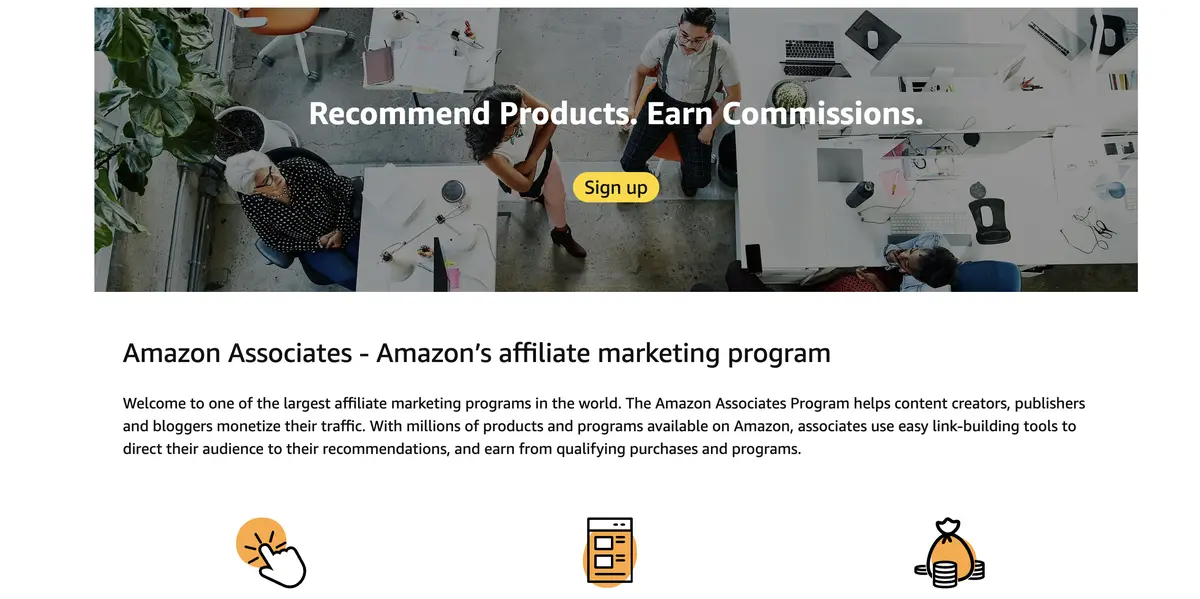
For over two decades, this worked exactly as designed for websites, newsletters, and browser extensions. Every tool in the affiliate ecosystem, from AAWP to ThirstyAffiliates to SiteStripe, was built for that use case.
AI applications represent a use case that the original affiliate program was never designed to handle. Chatbots mention products the same way a knowledgeable friend would, conversationally and unpredictably, without pre-formatted links baked in. The commerce opportunity is real, but the mechanics of capturing it are fundamentally different from anything Amazon’s affiliate toolchain assumes.
If you're building your first AI monetization integration, read our overview of how affiliate links work in AI chatbots before going deep on Amazon-specific details. The general pipeline applies across networks; Amazon just has its own rules on top.
Why Is Amazon Affiliate Marketing Harder for AI Apps?
Traditional affiliate toolchains were built around one assumption: a human author writes a page, inserts links manually or via a plugin, and that page sits on a server serving the same content to every visitor. Amazon’s SiteStripe toolbar generates a tracked link while you browse a product page. AAWP queries the Product Advertising API and renders comparison tables in WordPress. The whole ecosystem is static-first.
Modern AI applications break every one of those static-first assumptions at the same time. A chatbot generates each response dynamically based on user input, meaning product mentions are unpredictable until the moment they appear. There’s no browser session for SiteStripe-style tools, and the response needs to reach the user in milliseconds, so slow API calls are a real problem.
Three separate problems need to be solved in real time for this to work:
- Extract product mentions from the AI’s generated text before it reaches the user
- Match those mentions to the right Amazon ASIN (product identifier) and build a tracked URL
- Inject the affiliate link back into the response text without degrading latency
Each step in this pipeline has its own failure mode that can derail the whole process. NLP extraction misses vague references like “a decent blender,” ASIN matching returns wrong product variants, and slow API calls push response time past 500ms where users notice latency. For a technical walkthrough of how this pipeline works in practice, see our guide on how to add Amazon affiliate ads to your AI app.
Every Amazon affiliate integration in an AI app needs to solve extraction, resolution, and injection. Build or buy each piece, but all three have to work inside the latency budget of a live chat response.
How Do Amazon Affiliate Commission Rates Work?
Amazon uses a flat category-based commission structure, not a negotiated rate. Every affiliate earns the same percentage for the same product category, regardless of volume or account tenure. The category of the product at the time of purchase determines the rate, not the category of the page that referred the traffic. Amazon publishes the full rate schedule on Associates Central.
This matters for AI apps because your chatbot’s domain directly determines your revenue ceiling. A cooking assistant earns 4.5% on kitchen gear while a tech assistant earns 2.5% on laptops, and capturing the 10% luxury beauty rate requires actually driving purchases in that category. Categories most common in AI conversations, particularly electronics, home goods, and books, sit in the 2.5-4.5% range.
| Category | Rate |
|---|---|
| Amazon Games | 20% |
| Luxury Beauty, Luxury Stores Beauty, Amazon Explore | 10% |
| Amazon Haul | 7% |
| Digital Music, Physical Music, Handmade, Digital Videos | 5% |
| Physical Books, Kitchen, Automotive | 4.5% |
| Apparel, Fashion, Devices (Echo/Ring/Fire), Watches, Jewelry, Luggage, Shoes | 4% |
| Toys, Furniture, Home, Home Improvement, Lawn & Garden, Pets, Beauty, Sports, Baby | 3% |
| PC, PC Components, DVD & Blu-Ray | 2.5% |
| Televisions, Digital Video Games | 2% |
| Amazon Fresh, Physical Video Games, Grocery, Health & Personal Care | 1% |
| Gift Cards, Wireless Plans, Alcoholic Beverages | 0% |
| All Other Categories | 4% |
Fine Art carries a $200 commission cap regardless of sale price. The “All Other Categories” default of 4% applies to anything not explicitly listed, which catches many product types that don’t fit neatly into Amazon’s defined buckets.
What Are Amazon’s Bounty and Bonus Programs?
Beyond product commissions, Amazon pays flat fees for certain service sign-ups and trials, called bounties. These aren’t tied to purchase amounts, so they don’t suffer from Amazon’s 1-3% commission rates on commodity categories.
Bounties are particularly relevant for AI apps because the trigger is a signup action, not a product purchase. An AI reading assistant that recommends Audible during a book conversation can earn $10 for a free trial signup, which outperforms dozens of 4.5% book commissions from a $12.99 paperback.
| Program | Bounty |
|---|---|
| Audible Premium Plus Annual | $25 |
| Amazon Business Registration | $15 |
| Audible Monthly Memberships | $10 |
| Prime Video First Stream | $5 |
| Audible Free Trials | $5 |
| EBT Card Registration | $5 |
| Prime Signups (all variants) | $3 |
| Kindle Unlimited Free Trial | $3 |
| Amazon Music Unlimited | $3 |
The $25 Audible annual membership bounty is among the highest single-action payouts in the Amazon program. For AI apps in content-adjacent categories (books, podcasts, education, research), bounty optimization can meaningfully outperform product commission optimization.
If your assistant frequently discusses books, audiobooks, media, or productivity, build explicit Audible and Kindle Unlimited recommendation paths into your monetization layer. A single $25 Audible bounty equals roughly 55 book commissions at 4.5% on a $10 paperback. The math shifts heavily in favor of service recommendations for content-focused AI apps.
How Has Amazon Changed Commission Rates Over Time?
Amazon’s commission history shows a clear pattern of gradual compression in established categories. The 2017 overhaul replaced the tiered volume-based structure with today’s flat category rates, removing the incentive for high-volume affiliates. The April 2020 cuts were more aggressive, with furniture dropping from 8% to 3%, grocery from 5% to 1%, and health from 4.5% to 1%.
The April 2025 changes brought another round of reductions to home and outdoor categories. The offsetting change was the introduction of high rates in new segments like Amazon Games at 20% and Amazon Haul at 7%, both designed to bootstrap new Amazon products with affiliate traffic before organic demand builds.
The pattern is consistent: Amazon uses high rates to attract affiliate traffic into new programs, then cuts rates once the category is established. For AI developers building commission projections, this means today’s rates shouldn’t anchor multi-year models. Categories like home, grocery, and health have already seen their rates roughly halved over five years.
The most stable long-term bet is physical books and handmade goods, which have held steady, plus service bounties like Audible, where Amazon has structural incentive to maintain affiliate acquisition costs. Understanding the full rate landscape sits within the broader question of which affiliate networks work best for AI chatbots.
What Are the Cookie Duration and Attribution Rules?
Amazon’s 24-hour attribution window is the single biggest structural disadvantage of the program compared to alternatives. When a user clicks your affiliate link, Amazon tracks that session for 24 hours and any qualifying purchase in that window earns a commission. If the user adds an item to cart without buying, the window extends to 90 days for that specific cart item.
The complication for AI apps is that chatbot conversations are often research-oriented, not purchase-ready. A user asking about espresso machines might research for a week before converting, well outside the 24-hour window. Compare this to networks like ShareASale or Impact that routinely offer 30-90 day windows, where late-converting research sessions still earn commissions.
Amazon’s affiliate program uses last-click attribution, which has real consequences for AI apps. If a user clicks your affiliate link and then clicks a different affiliate’s link before purchasing, that second affiliate gets the commission. This means your conversion rate on referred traffic is lower than gross click volume suggests, particularly for high-consideration purchases where users comparison-shop across multiple sources.
- 24-hour window means high-consideration purchases (furniture, electronics) convert at low rates
- 90-day cart extension only helps for items explicitly added to cart after clicking your link
- Last-click attribution means any competitor link after yours erases your referral
- Lower-consideration purchases (books, accessories) align better with the 24-hour window
What API Options Does Amazon Provide?
Amazon offers two API paths for affiliates who want programmatic product data and link generation. The Product Advertising API 5.0 (PA-API) has been the standard for years, supporting keyword search, ASIN lookup, product variation data, and category browsing. It returns affiliate-tagged product URLs ready for use. The replacement Creators API offers functional parity with a different authentication model.
Both APIs carry a critical access requirement: you need 10 qualifying sales in the trailing 30 days to maintain API access. New accounts that haven’t yet generated sales can’t use the API, which creates a bootstrapping problem for developers who need product search to generate the links that would produce the sales.
The no-API option is to construct links directly using known ASINs, formatted as amazon.com/dp/{ASIN}?tag=yourtag. This bypasses the sales threshold entirely and has no rate limits, but it requires knowing the correct ASIN upfront with no ability to search or validate product data dynamically.
For AI apps handling open-ended product conversations, dynamic search via the API is usually necessary. The bootstrapping problem is real: either seed your account with organic sales through another channel, or start with a curated ASIN list for known product categories while building toward API access.
How Does the PA-API to Creators API Migration Work?
Amazon’s PA-API 5.0 retires on April 30, 2026, and migration is mandatory for any app currently using it.
The Creators API replaces PA-API’s AWS-style credential signing with OAuth 2.0, with credentials managed through Associates Central instead of the AWS console and field naming shifting from PascalCase to camelCase. Region-based credential scoping means your US credentials only work for the US program, not automatically for UK or DE.
Functional parity is maintained across the four core operations: search, ASIN lookup, variation data, and category browsing. The migration is primarily an authentication-layer change, not a data model change. Most applications can migrate by replacing the authentication mechanism and updating field name references without restructuring the business logic.
New developers building Amazon integrations should start on the Creators API directly. There’s no reason to learn PA-API at this point. For existing integrations, Amazon has provided a migration guide through Associates Central, and the clock is running.
If your affiliate link pipeline currently uses PA-API's AWS signature-based auth, start the Creators API migration now. Post-April 30, PA-API calls will return errors. Test your new integration in parallel before cutting over rather than migrating in place under deadline pressure.
What Are Amazon’s Rules for AI and Automated Applications?
Amazon’s operating agreement includes language that directly addresses AI use cases, and parts of it are genuinely ambiguous in 2026.
The March 2024 generative AI clause prohibits using Amazon Special Links “in connection with generative AI.” Amazon hasn’t clarified what that clause covers in practice, and hasn’t publicly enforced it against API-based integrations that insert affiliate links into AI-generated responses. But the language describes exactly that scenario. Developers building on Amazon Associates for AI apps are operating in a gray area that Amazon hasn’t resolved.
The November 2025 Agent Terms added a separate requirement: automated systems that interact with Amazon must self-identify in their user-agent strings. This applies to any programmatic access, including API calls from AI backends.
There are two provisions in the operating agreement that cut in the other direction. The operating agreement explicitly permits “online software applications” and “Alexa skills” as valid affiliate placements, which arguably covers chatbots and AI assistants. Amazon also hasn’t moved to shut down any known AI affiliate integrations despite the generative AI clause being in place for over two years.
The absolute prohibition with no ambiguity: using Amazon product data to train machine learning models is explicitly banned. Product names, prices, descriptions, and other data returned by the API cannot be used as training data.
The generative AI clause is the live risk. Amazon hasn't enforced it against API-based integrations, but it exists in the agreement. Developers who want conservative compliance should implement links as direct product recommendations rather than AI-generated text insertions, and ensure user-agent strings identify automated access per the November 2025 requirements.
What Program Rules Can Get Your Account Banned?
Beyond the AI-specific rules, Amazon Associates has program requirements that are easy to violate when building dynamic applications. These apply regardless of whether your app is AI-powered.
The mandatory disclosure statement (“As an Amazon Associate I earn from qualifying purchases”) must appear wherever affiliate links are shown. For static websites, this typically lives in the footer and sidebar. For AI chat interfaces, it needs to appear in the UI where affiliate links are displayed, which requires explicit engineering work. FTC rules compound this requirement by mandating per-response disclosure adjacent to recommendations, covered in more detail in our guide on how to disclose ads in AI chats.
Link cloaking, meaning masking the Amazon destination behind a redirect URL, violates program terms. If your integration routes through a shortened URL or custom domain before reaching Amazon, that likely counts as cloaking.
Product price data returned by the API has a 24-hour freshness requirement. Any displayed price must reflect current Amazon pricing or carry a disclosure that pricing may be out of date. Caching product data longer than 24 hours without a staleness disclaimer violates this rule.
A few additional rules that frequently trip up new affiliates:
- No incentivizing clicks (don’t offer rewards for clicking affiliate links)
- No self-purchasing through your own links
- No dual-commission stacking with seller-side networks like Levanta, where a seller pays you separately for the same traffic
For AI apps, the disclosure and price freshness requirements are the most operationally significant. Both are trivial to handle on a static website and require explicit architecture decisions in a dynamic chat environment.
How Do International Amazon Programs Affect AI Apps?
Amazon runs 19 separate country affiliate programs, and your US Associates tag earns nothing on purchases through Amazon.co.uk, Amazon.de, or any other regional storefront. A user in Germany who clicks a US affiliate link and lands on Amazon.com may convert, but if they navigate to their home storefront instead, you earn nothing.
Amazon’s OneLink feature can redirect international visitors to their local Amazon storefront, but it only works if you’re enrolled in each country’s affiliate program. Enrollment requires separate applications and separate tracking tags per country.
For AI apps serving a global user base, geographic reach is a natural advantage. Users on every continent can interact with a single deployment. But affiliate monetization has to match that reach, and the enrollment burden per country is real.
Third-party geo-routing services like Geniuslink handle the redirect and program switching automatically, but they add an intermediary layer with their own pricing and latency implications. The simpler path for most developers is to start with the US program, build to the API access threshold, and expand internationally once the core integration works.
- US only: Simplest setup, no coverage for non-US purchases
- Manual multi-program enrollment: Full coverage, high admin overhead, separate tags per country
- Amazon OneLink: Handles redirects, requires enrollment in each program
- Third-party geo-routing (Geniuslink): Simplifies routing, adds cost and latency layer
How Can AI Developers Actually Implement This?
Three paths exist for getting Amazon affiliate links into AI app responses, each with different tradeoffs on complexity, control, and time to first commission.
Option 1: Build on the Creators API directly. You own the full stack, handling NLP extraction, ASIN matching, link injection, and 24-hour data freshness management for cached product data. You also need to reach 10 qualifying sales to maintain API access, which creates the bootstrapping problem described above. This path gives maximum control and keeps all commissions with you, but it requires several weeks of infrastructure work minimum.
Option 2: Construct links without the API. Build a curated ASIN list for the product categories your app covers, then construct amazon.com/dp/{ASIN}?tag=yourtag URLs directly without querying the API, bypassing the sales threshold and rate limits entirely. The limitation is coverage, since you can only link products you’ve pre-mapped with no dynamic search capability. This works well for vertical-specific apps with a defined product catalog but poorly for general-purpose assistants.
# Direct ASIN link construction — no API access required
PRODUCT_MAP = {
    "kindle paperwhite": "B09TMN58KL",
    "echo dot":          "B09B8V1LZ3",
    "air fryer":         "B0936FGLQS",
}

def build_amazon_link(product_name, tag="yourtag-20"):
    asin = PRODUCT_MAP.get(product_name.lower())
    if asin:
        return f"https://www.amazon.com/dp/{asin}?tag={tag}"
    return None
Option 3: Use a third-party service. Tools like ChatAds abstract extraction, matching, multi-network complexity, and data freshness into a single API call that returns your AI response with affiliate links already inserted. No need to maintain your own NLP pipeline, manage per-network API credentials, or solve the bootstrapping problem independently. The tradeoff is adding a dependency and paying for the service, though you keep the affiliate commissions themselves.
For most AI developers, the decision point is whether Amazon-specific control matters enough to justify the infrastructure investment. Direct Creators API integration makes sense if Amazon is your primary monetization channel and you need full control over matching logic. A service layer makes sense if you want to monetize across multiple networks (Amazon, CJ, Impact) without building and maintaining separate integrations for each.
Whatever path you choose, the disclosure requirement and attribution window aren’t negotiable. Every response with an affiliate link needs the Associates disclosure statement, and your product categories need to match the 24-hour buying intent typical of AI conversations for the attribution window to work in your favor.
Amazon Associates remains the most product-rich affiliate program in existence, and most AI apps will want it in the monetization mix at some point. The commission rates, attribution rules, API requirements, and compliance landscape covered here give you a complete picture of what you’re working with in 2026. The generative AI clause in the operating agreement is the live compliance question the industry is watching; otherwise, the mechanics are well-defined.
For developers ready to move on implementation, the choice between building on the Creators API directly and using an integration layer like ChatAds comes down to how much of the pipeline you want to own. Either way, the tooling for monetizing AI chatbots has matured enough that none of this requires starting from scratch.
Frequently Asked Questions
Can AI apps use Amazon affiliate marketing?
Yes, though with some compliance caveats. Amazon's operating agreement includes a March 2024 generative AI clause that prohibits using Special Links "in connection with generative AI." Amazon hasn't enforced this against API-based integrations, and the agreement elsewhere explicitly permits "online software applications." Most developers building AI chatbot affiliate integrations use the Creators API (formerly PA-API) to generate tracked links dynamically. The mandatory Associates disclosure statement must appear in the chat UI wherever affiliate links are shown.
What are the Amazon affiliate commission rates for 2026?
Rates range from 0% (gift cards, alcohol, wireless plans) to 20% (Amazon Games). The most relevant categories for AI apps sit in the middle: physical books and kitchen goods at 4.5%, home goods and toys at 3%, electronics and PC components at 2-2.5%. Amazon Haul earns 7%. All other categories default to 4%. Amazon adjusts these rates periodically, with established consumer categories historically trending downward over time.
What is the Amazon affiliate cookie duration?
Amazon uses a 24-hour attribution window from the time a user clicks your affiliate link. Any qualifying purchase in that 24-hour session earns a commission. If the user adds an item to cart within that window, the attribution extends to 90 days for that specific cart item. This is shorter than most other affiliate networks, which typically offer 30-90 day windows. Last-click attribution applies, meaning a competitor link after yours can overwrite your referral before a purchase completes.
What is the Amazon Creators API and how does it differ from PA-API?
The Creators API is Amazon's replacement for the Product Advertising API 5.0 (PA-API), which retires April 30, 2026. The Creators API provides the same four core operations (keyword search, ASIN lookup, variation data, category browsing) but uses OAuth 2.0 authentication instead of AWS signature-based signing. Credentials are managed through Associates Central rather than the AWS console. Field naming shifts from PascalCase to camelCase. New developers should build on the Creators API directly; existing PA-API integrations must migrate before April 30.
How many sales do you need to access the Amazon affiliate API?
Both the PA-API and Creators API require 10 qualifying sales in the trailing 30 days to maintain access. This creates a bootstrapping problem for new integrations: you need the API to generate links efficiently, but you need sales to access the API. The workaround is to construct affiliate links directly using known ASINs in the format amazon.com/dp/{ASIN}?tag=yourtag while building toward the sales threshold through other channels.
Do Amazon affiliate links in AI apps need an FTC disclosure?
Yes, two disclosure requirements apply simultaneously. Amazon requires the Associates disclosure statement ("As an Amazon Associate I earn from qualifying purchases") wherever affiliate links appear, including in chat UIs. The FTC separately requires that affiliate disclosures in AI responses be "unavoidable" and adjacent to each recommendation, not just in a site footer or one-time signup consent. Both requirements need to be addressed in your implementation, either with per-response disclosure text or a persistent UI indicator combined with inline disclosure.
What Amazon affiliate bounties are available for AI apps recommending services?
Amazon pays flat bounties for service signups: $25 for Audible Premium Plus annual memberships, $15 for Amazon Business registrations, $10 for Audible monthly memberships, $5 for Audible free trials and Prime Video first streams, and $3 for Prime signups and Kindle Unlimited trials. These bounties aren't subject to the 24-hour attribution window in the same way product commissions are, since the trigger is a signup action. For AI apps in content, education, or productivity categories, bounty revenue can significantly outperform product commission revenue.